Biannual Roundup: Thanks for following posts to and fro

Haunting the Graveyard: Unearthing the Story of the Coker Settlement

Know it appears suspicious that a post about the author’s book that finally made it into print popped up as the most-read by you during the past year, but you actually were that kind.

Of course, the controversial redevelopment plans for Alamo Plaza still remain of grave concern for those who love San Antonio. Will the plaza be fenced in? Will the Texas General Land Office repurpose the buildings on the west side of the plaza as a new museum or bulldoze those important historic landmarks? So many design issues remain unresolved as we enter 2020.

The author always hope postcards sent back from other places help tease out the boulevardier in you, seducing you into traveling more and serving as helpful guides when you do.

The following list represents the posts you clicked most in 2019, with the number in parentheses representing rankings from six months ago.

  1. Postcard from the Coker Settlement: Following long gestation, book finally due to arrive, 2019
  2. Has Alamo Plaza fallen in the hands of ‘reverential’ caretakers? 2019 (2)
  3. How’s the GLO managing Alamo Plaza? Welcome to the faux Alamo. 2019 (3)

    Hey, GLO. No faux Alamo.
  4. Postcard from Castello di Rivoli, Turin, Italy: History with a horse hanging overhead, 2019, (5)
  5. The Madarasz murder mystery: Might Helen haunt Brackenridge Park? 2012 (7)
  6. The danger of playing hardball with our Library: Bookworms tend to vote, 2014
  7. Postcard from Oaxaca, Mexico: ‘I’ve a feeling we’re not in Kansas anymore.’ 2019
  8. Postcard from Mexico City: The Lord of Poison and potent relics, 2017
  9. Postcard from Sevilla, Spain: Foods steeped in tradition, 2019 (11)

    Boquerones, fried anchovies, at El Rinconcillo in Sevilla, Spain
  10. Postcard from Sevilla, Spain: The most celebrated mother in Spain, 2019
  11. Postcard from Malaga, Spain: Street Art, Part I, 2019
  12. Postcard from San Antonio Botanical Garden: Walking across Texas without leaving home, 2019
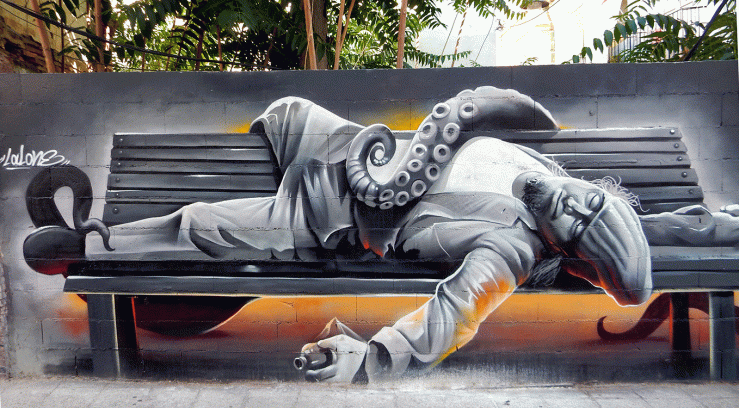
From the streets of Malaga, Spain, pulpo y vino

Thanks for dropping by. Would love to see comments anytime.

Postcard from Naples, Italy: Frisky gods frolicked in the buff

Artemis of Ephesus, Goddess of Fertility, 2nd Century

In the mid-1700s, Charles III of Bourbon (1716-1788), King of Naples, began exploring the towns buried by Vesuvius and combined some of those finds with works of art he moved from palaces in Rome and Parma he inherited from his mother, Elisabeth Farnese (1692-1766), Queen of Spain. His son, Ferdinando IV (1751-1825), moved the treasures into a building that originally was a 16th-century riding school and later the university. Today the structure serves as the National Archaeology Museum or Museo Archeologico Nazionale di Napoli (MANN).

The mosaics from Pompeii were my favorite part of the museum, but, unfortunately the galleries containing the largest mosaics were closed temporarily for renovation. No photos appear here of the outside of MANN because it was completely covered by scaffolding, possibly removed by now.

While ancient Romans favored wearings togas, tunics, stolas and pallas, many of their gods tended to frolic shamelessly in a bacchanalian existence, cavorting and coupling in fashions far from puritanical.

This is evident throughout the impressive museum, but even more so in the Gabinetto Secreto, or Secret Cabinet. In this gallery clearly marked with a warning as to its mature content, one finds the more pornographic-seeming artifacts from Pompeii and erotic objects of the Borgia Collection. The only one of the above images shot in the Secret Cabinet is that of the enormously endowed god Priapus, kind of an X-rated scarecrow threatening evil-doers with rape.

Postcard from Herculaneum, Italy: Hot volcanic ash buried town for centuries

View of Mount Vesuvius from Vomero neighborhood in Naples

Although a gorgeous backdrop on the Sea of Naples, Mount Vesuvius is not sleeping. The only active volcano on the mainland of Europe erupted as recently as 1944, showering ash and rocks upon the Allied forces establishing an airbase nearby.

But the volcano is most known for its spectacular explosion in the year 79, an event reputed to have killed as many as 16,000 citizens of the Roman Empire.

From “Visiting Pompeii” on World Archaeology:

At peak intensity, the eruptive column reached a height of 30km (about 18 miles) or more as the mountain ejected 150,000 tons of material per second…. The air-fall of ash, pumice and occasional rock fragments, accumulating at about 15cm an hour, eventually covered Pompeii to a depth of almost 3m (close to 10 feet)….

The mountain had not finished its work, however, and only now, in the final six hours or so of the eruption, did it became truly lethal….

“A fearful black cloud,” Pliny reports, “was rent by forked and quivering bursts of flame, and parted to reveal great tongues of fire, like flashes of lightning magnified in size. …Soon afterwards the cloud sank to earth and covered the sea ….”

It took perhaps five or six minutes to reach Pompeii from the lip of the crater: a dense, rolling, ground-hugging mass of gas, ash and rock (the pyroclastic flow), preceded a few seconds in front by a scorching blast like that from a flamethrower…. At its hottest, where temperatures reached anything from 400 ° to 800 ° C, the ‘black cloud’ carbonized wooden timbers, doors and shutters, and killed those it struck instantly, as brains boiled and skulls exploded in the flash. Others, where the heat was less, were asphyxiated as they breathed in hot gas and incandescent ash….

In the 24 hours plus that the eruption had lasted, it is estimated that Vesuvius had unleashed thermal energy 100,000 times greater than that of the atomic explosion at Hiroshima.

Strangely, the destruction of Pompeii and other towns around the base of the volcano preserved the ruins for thousands of year.  Ancient cities frozen in time.

I was fortunate to have visited Pompeii in college, but much has been uncovered, restored and opened to public since then.

The flaw is that the 163-acre archaeological park is no secret. The number of tourists swarming through the treasured ruins is creeping toward 4-million annually. Photographs such as the lead one for an October story in the New York Times, “Can a Restored Pompeii Be Saved from ‘Clambering’ Tourists?,” scared us away. Paige McClanahan writes that nearly 450,000 people overwhelmed Pompeii in the month of July.

In contrast, only about 300,000 tourists visit Herculaneum a year. So instead, we opted for the much smaller town, a little closer to Naples, not as spectacular but not over-crowded.

The first official explorations at Herculaneum were begun in 1738, yet only a small portion of the once-wealthy port town has been excavated. While the archaeological zone is modest in size compared to Pompeii, the affluence of its residents is evidenced by abundant use of marble throughout.

For centuries, it was believed that almost the entire population of the town had been evacuated by sea before the worst of the eruption. But in the 1980s, digs uncovered skeletal remains of hundreds, huddled together under the arcades of the then-seaside boat houses, buried under ash while waiting ships that failed to save them.

We left them unmolested, as the hoards of tourists in Pompeii left us unmolested to explore Herculaneum at our own pace in peace.