

Film as dream, film as music. No art passes our conscience in the way film does, and goes directly to our feelings, deep down into the dark rooms of our souls.
Director Ingmar Bergman (1918-2007)
It is hard to imagine a more dramatic setting for The National Museum of Cinema (Museo Nazionale del Cinema Torino) than its home in Turin. Surrounded by banks and banks of flickering screens on multiple levels of ramps encircling the main “temple,” all eyes immediately are drawn upward to the amazing dome seemingly hovering above. Jimmy Stewart never could have rescued Kim Novak from the observation deck atop the dome if he were required to board the vertiginous elevator soaring upward to reach her (Vertigo, 1958).
I demand that a film express either the joy of making cinema or the agony of making cinema. I am not at all interested in anything in between; I am not interested in all those films that do not pulse.
Director Francois Truffaut (1932-1984)
The year Vertigo was released in theaters was the year the Museum of Cinema opened in a wing of the Royal Palace in Turin. However, in the 1980s the exhibition space was declared no longer up to code, and it was closed to the public.
The camera’s a ballpoint pen, an imbecile; it’s not worth anything if you don’t have anything to say.
Director Roberto Rossellini (1906-1977)
Rewind briefly to the birth of a spectacular Turin landmark: the Mole Antonellian. During the period when Turin briefly was capital of the new Italian state (1860-1864), the Jewish community wanted a new synagogue worthy of capital status. They hired architect Alessandro Antonelli (1798-1888) to complete the project for them on a set budget. But Antonelli’s dreams continued to soar higher and higher, resulting in continuing alterations in the plans. He added more than 150 feet to the original planned height of the dome, and the projected costs far surpassed the original agreed upon amount. Antonelli’s unhappy clients pulled the plug, halting construction upward in 1869.
Going to the cinema is like returning to the womb; you sit there, still and meditative in the darkness, waiting for life to appear on the screen.
Director Federico Fellini (1920-1993)
The city of Turin traded another piece of property for construction of a more budget-conscious synagogue and then undertook completion of the 550-foot-tall building it dedicated to King Victor Emanuele II (1820-1878). From ground level to the statue and star on the top of the dome, the Mole Antonellian was the tallest brick building in Europe upon its completion in 1889. From 1908-1938, Turin used the Mole as its Museo Nazionale del Risorgimento Italiano, tracing the history of Italy’s unification as a republic. After a 1953 storm destroyed those extra 150 feet or so on which Antonelli had insisted, the city reinforced the rebuilt section with metal.


I depend on style more than plot. It is how you do it, and not your content that makes you an artist. A story is simply a motif, just as a painter might paint a bowl of fruit just to give him something to be painting.
Director, Alfred Hitchcock (1899-1980)
As part of the centenary celebrations of Italian unification in 1961, a panoramic lift was added inside the Mole Antonelliana. The glass elevator suspended in the dome will take those who don’t mind feeling as though hanging from the hands of the clock in Metropolis up to an observation deck offering views of the city from the perch 280 feet above the street below.
Mole Antonelliana became home to the National Museum of Cinema in 2000 and is an amazing location to fritter away a drizzly day.
Even if I set out to make a film about a fillet of sole, it would be about me.
Director Federico Fellini (1920-1993)
And then there is the allure of the dream job for any cinephile – night watchman in the museum. And, of course, there is film of that. Davide Farrario’s After Midnight (Dopo Mezzanotte) released in 2004. Click here to watch the trailer and find Stephen Holden’s review of it in the New York Times here.
Fortunately, somewhere between chance and mystery lies imagination, the only thing that protects our freedom, despite the fact that people keep trying to reduce it or kill it off altogether.
Director Luis Bunuel (1900-1983)


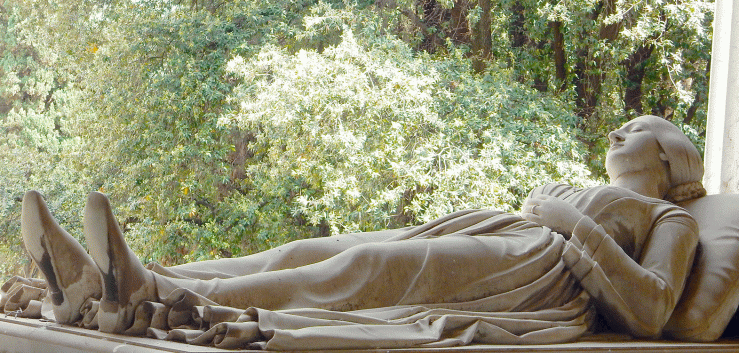 Monumental Cemetery of Staglieno, Genoa, Italy


 Postcards from Barton Springs