
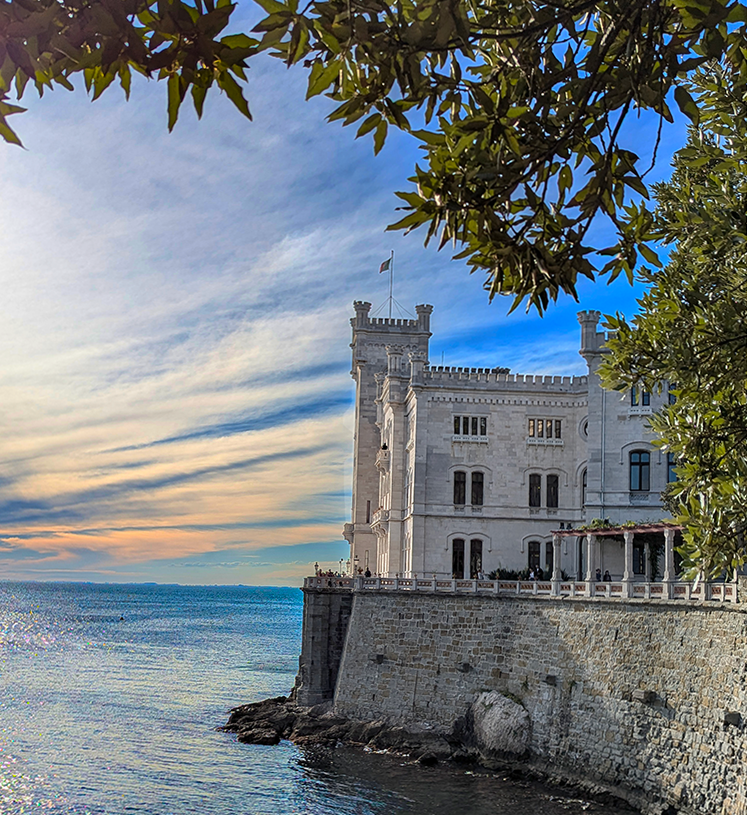
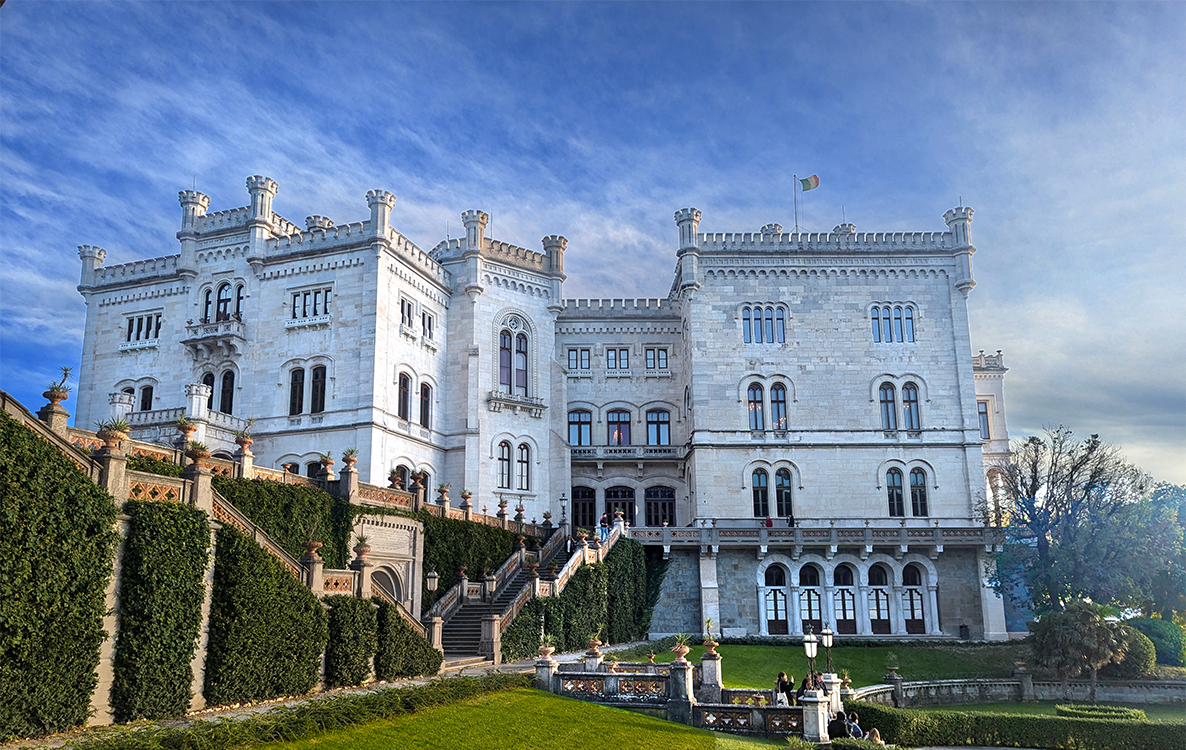
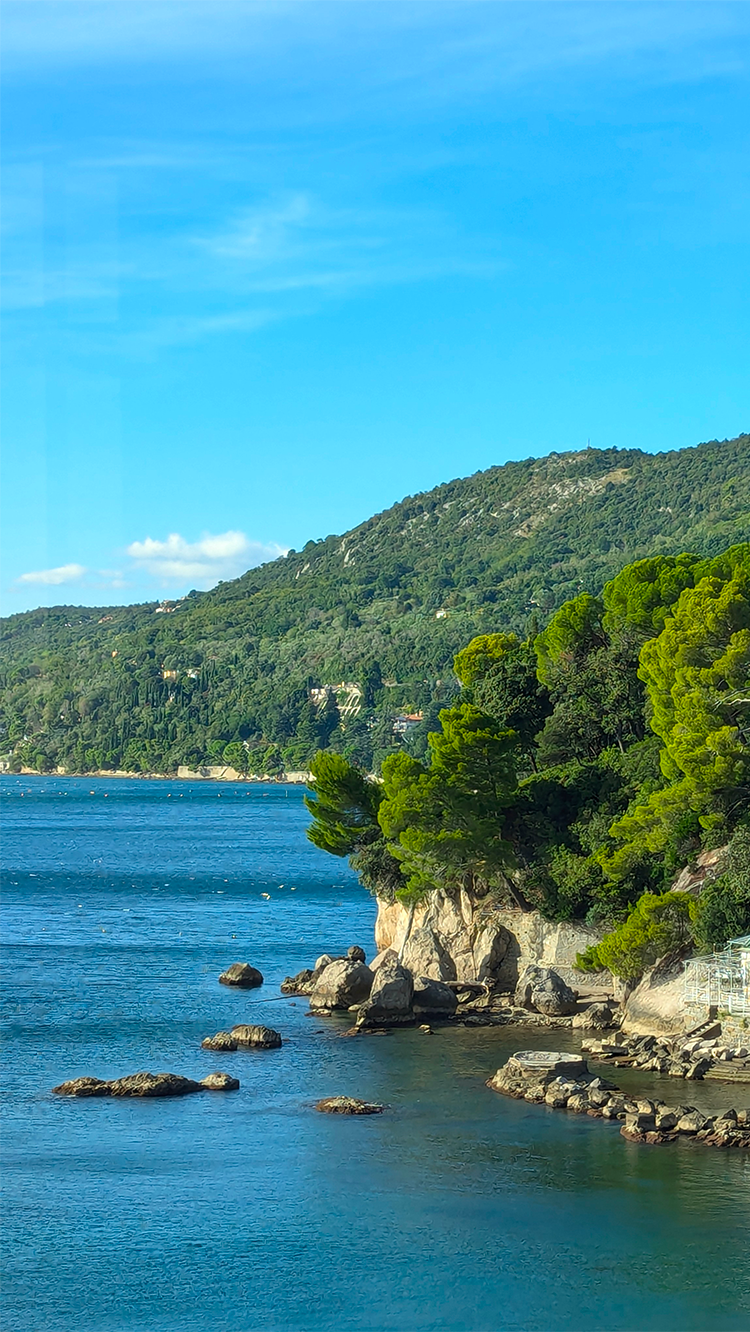
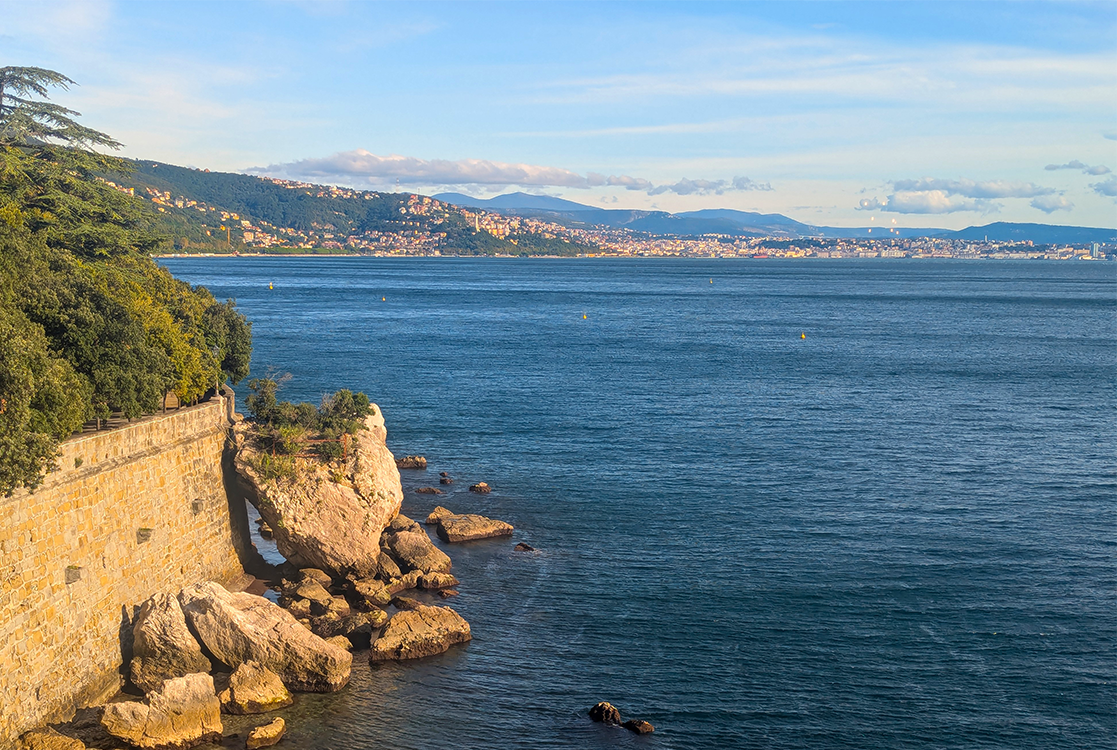
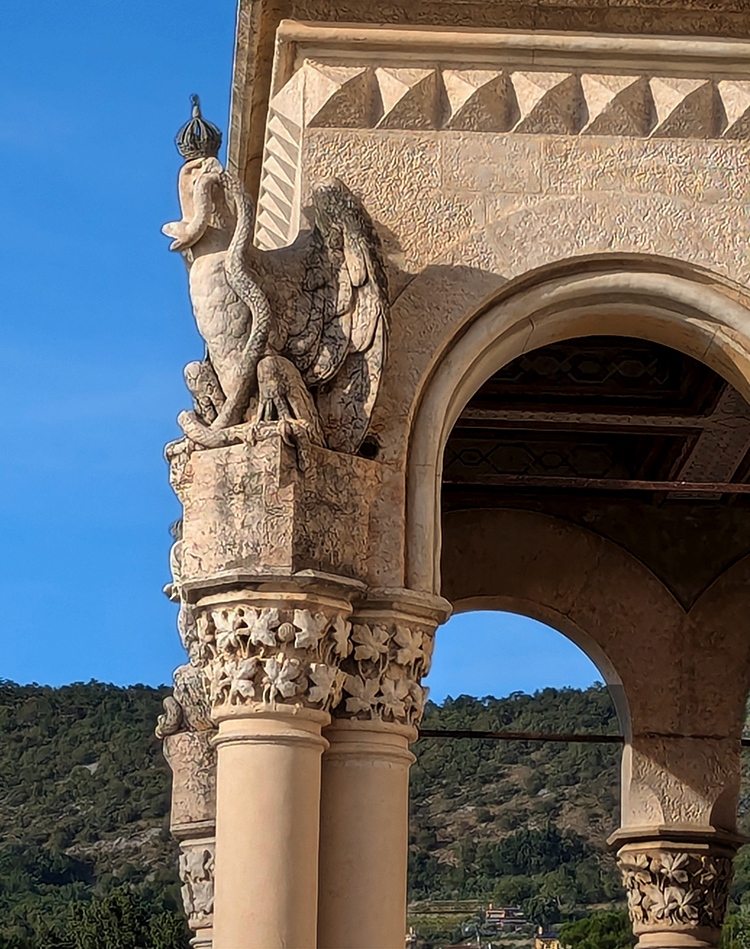
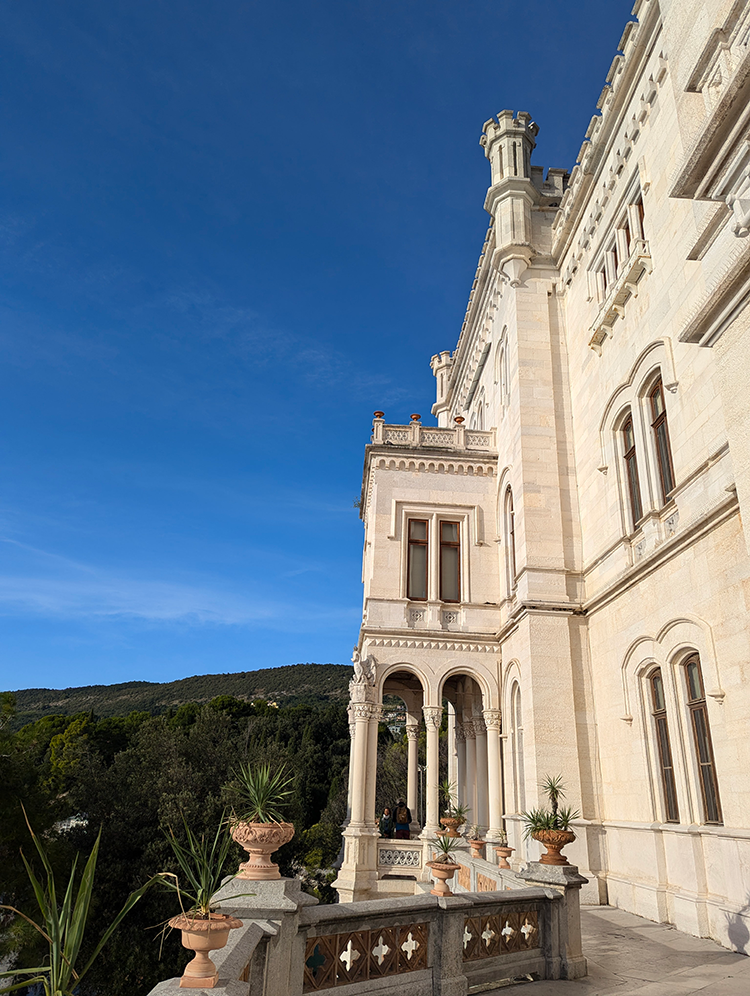
Above: Miramare, a palace erected by Princess Charlotte of Belgium and Archduke Ferdinand Maximilian of Austria
At age 22, Archduke Ferdinand Maximilian (1832-1867) was named Commander-in-Chief of the Austrian Navy. Sailing in 1855 in the Gulf of Trieste, then ruled by the Kingdom of Austria, the young archduke spotted a promontory jutting out into the water. Barren, rocky, yet a gorgeous waterfront view on three sides. He decided to acquire the land for his home.
Construction of the house, which he named Miramare, was already underway at the time of his 1857 marriage to Princess Charlotte of Belgium (1840-1927). Also in 1857, his older brother, Emperor Franz Joseph I of Austria (1830-1916), appointed Maximilian Viceroy of Lombardy-Venetia.
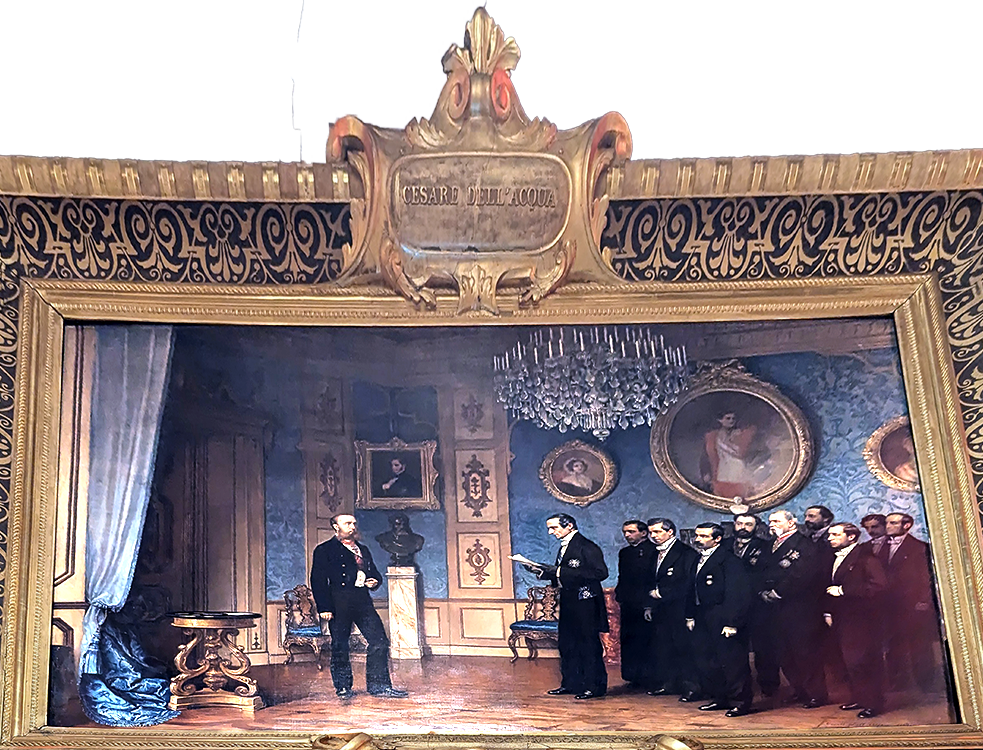
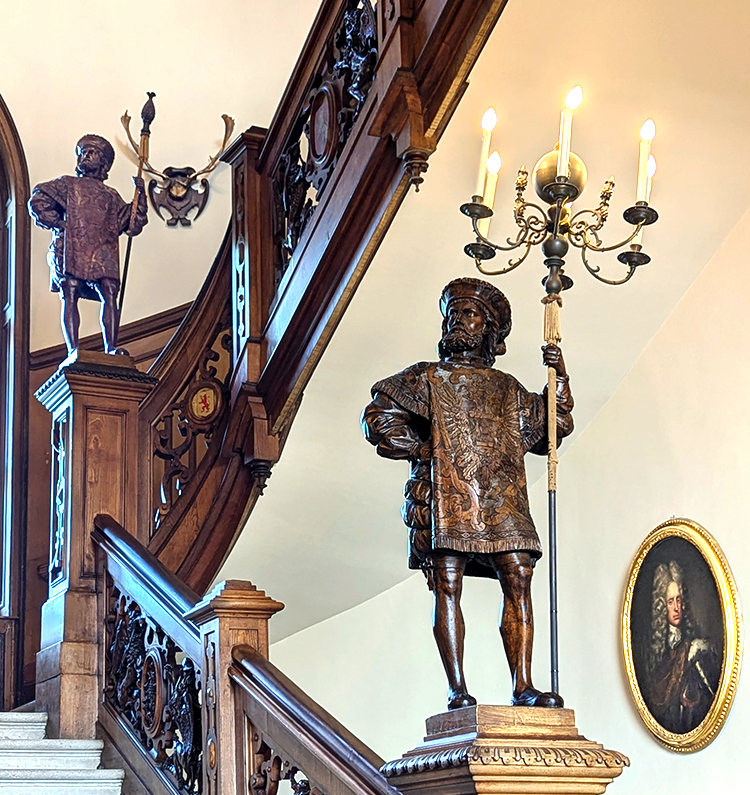
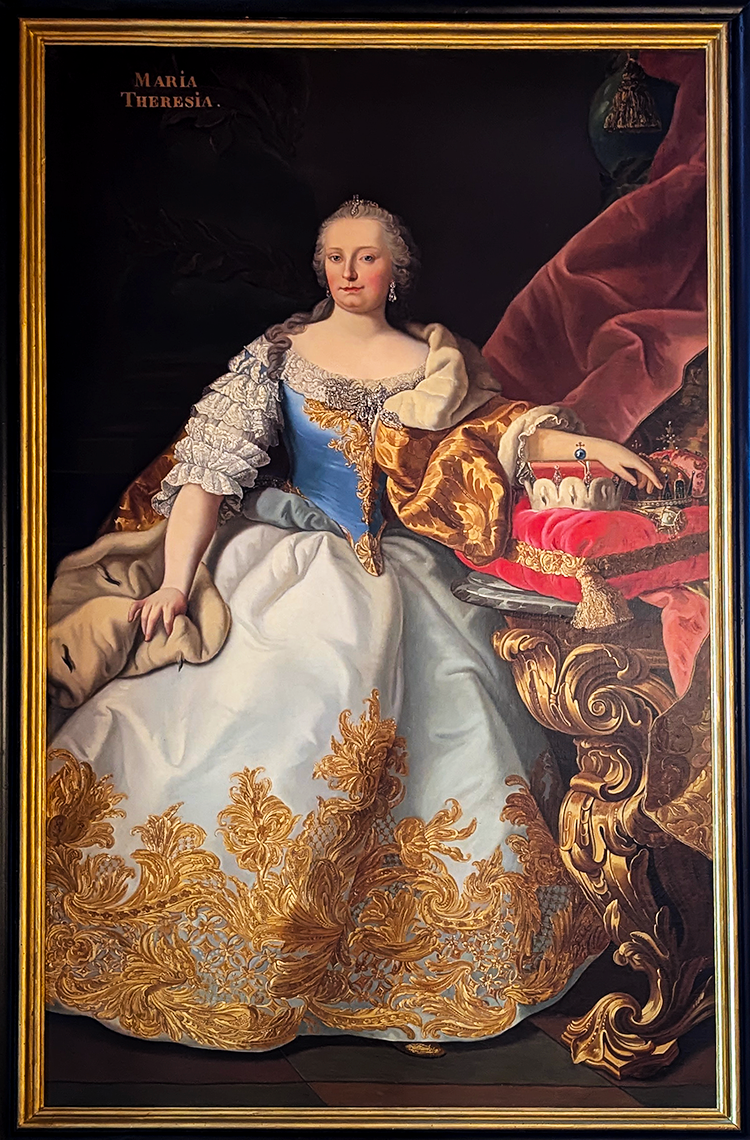
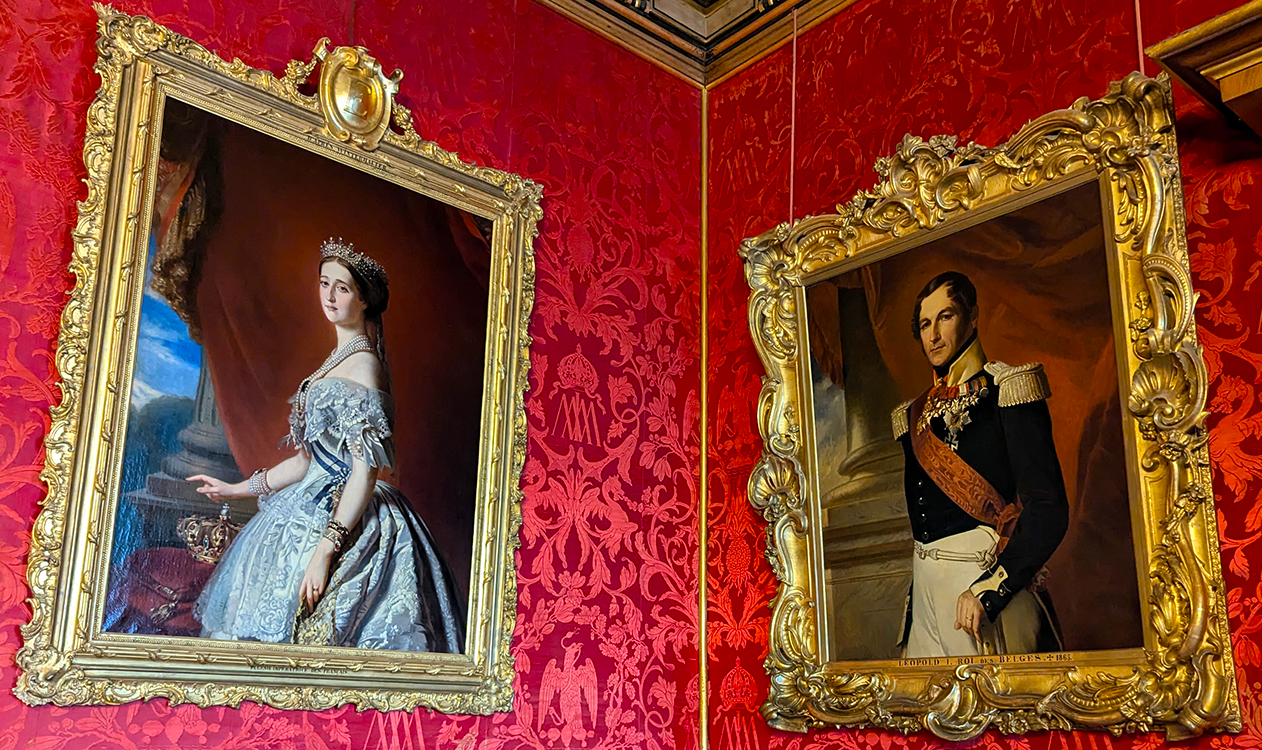
The couple moved into the Royal Palace of Milan while continuing work on Miramare. Charlotte’s royal dowry contributed to the money-pit project, including bringing in tons of dirt and topsoil for extensive gardens. Surrounded by all the requisite family portraits, the couple moved into their completed dream home in 1860.
Alas, sometimes crown envy sets in, particularly amongst siblings. And, as the saying goes, all the gold for a crown. However, the purchase price proved higher than gold; Maximilian would pay with his life.
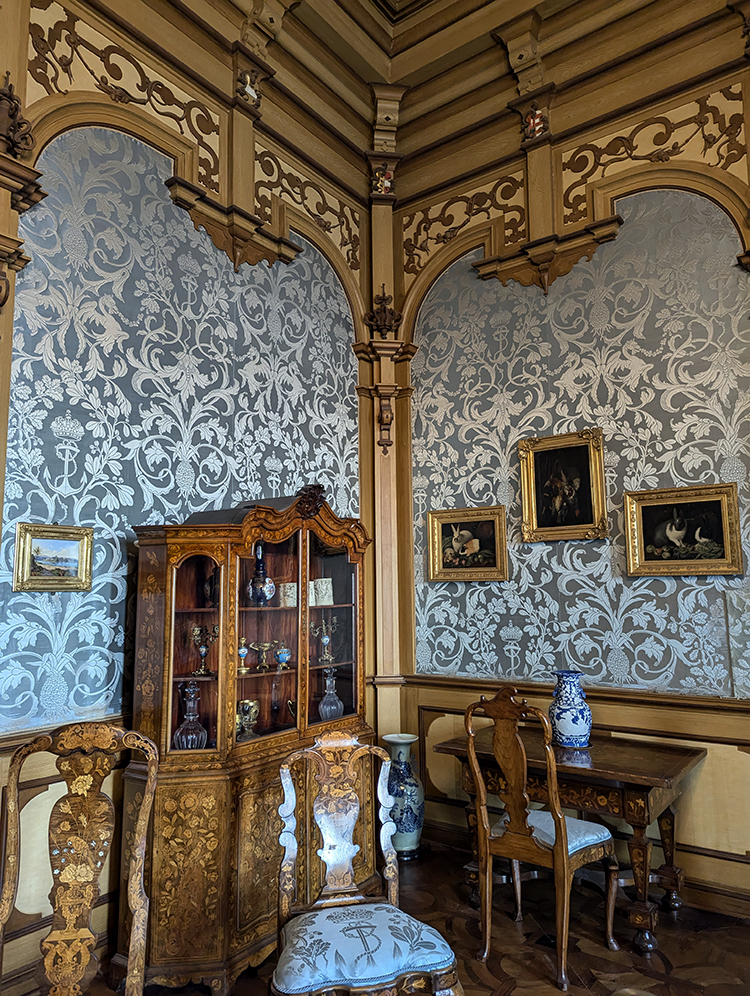
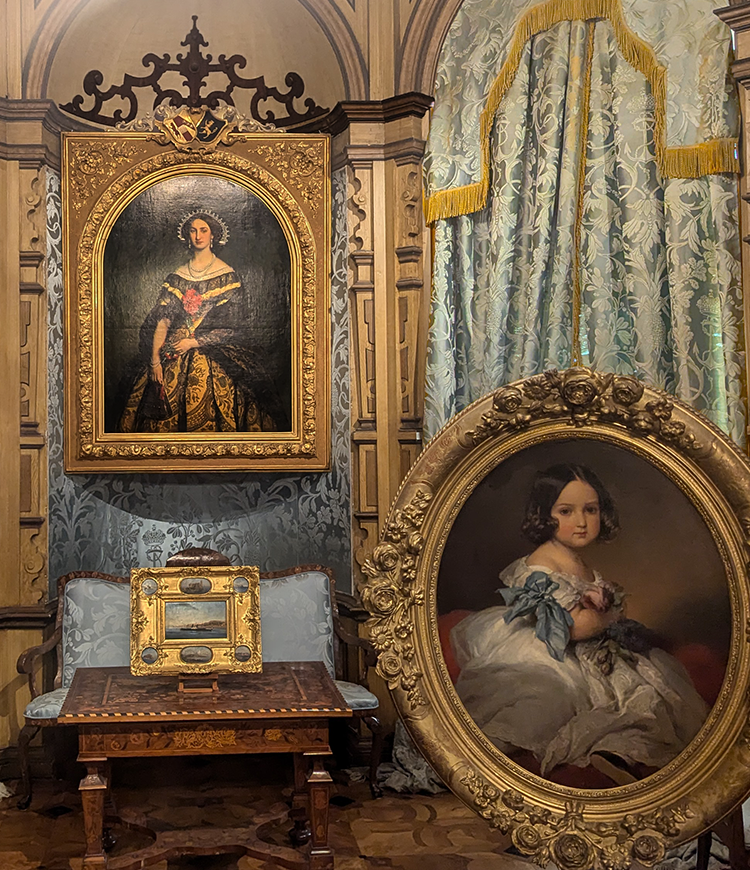

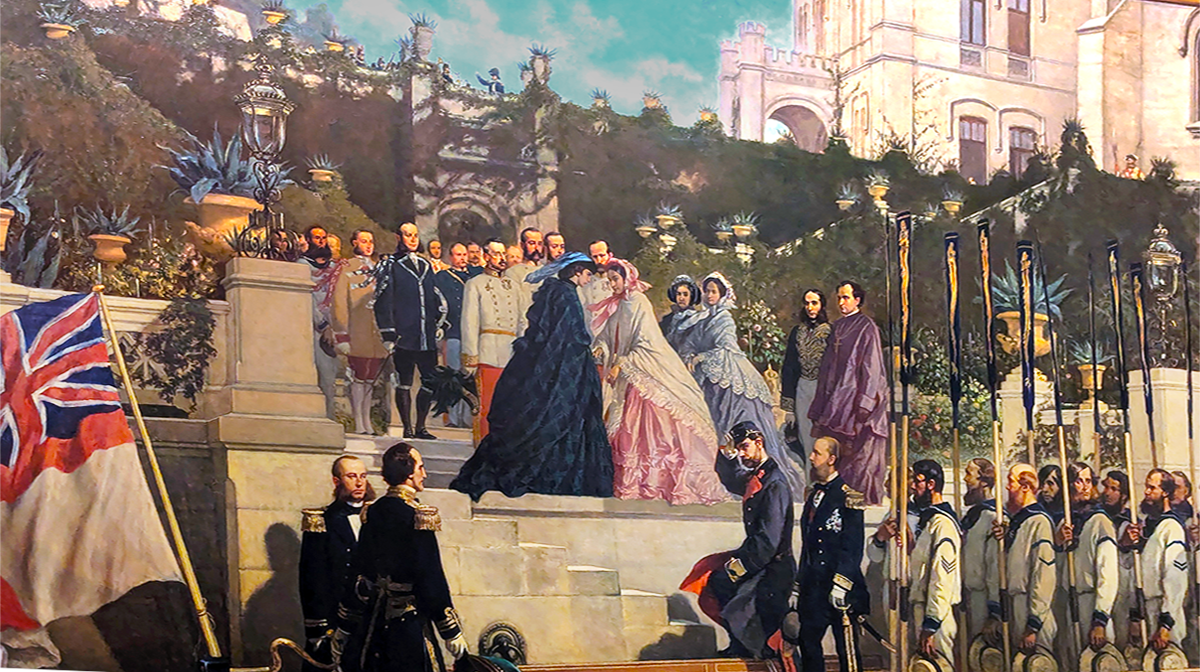
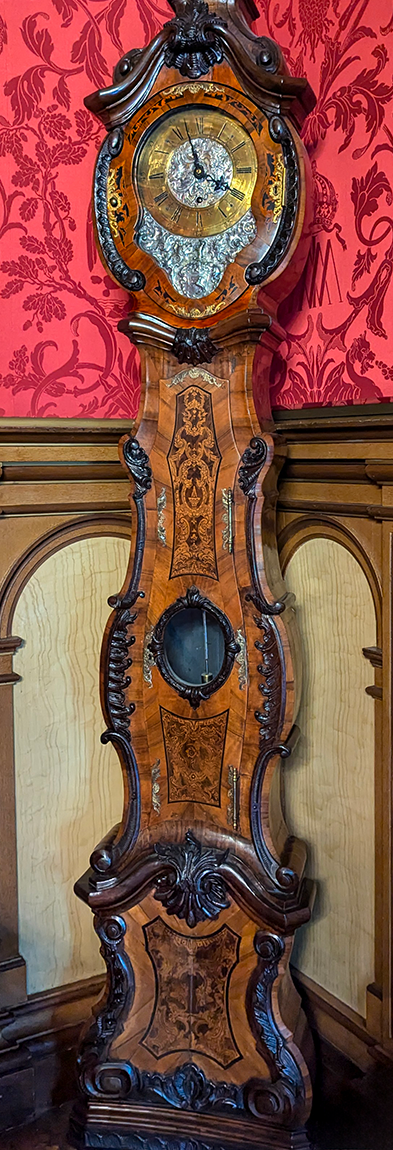
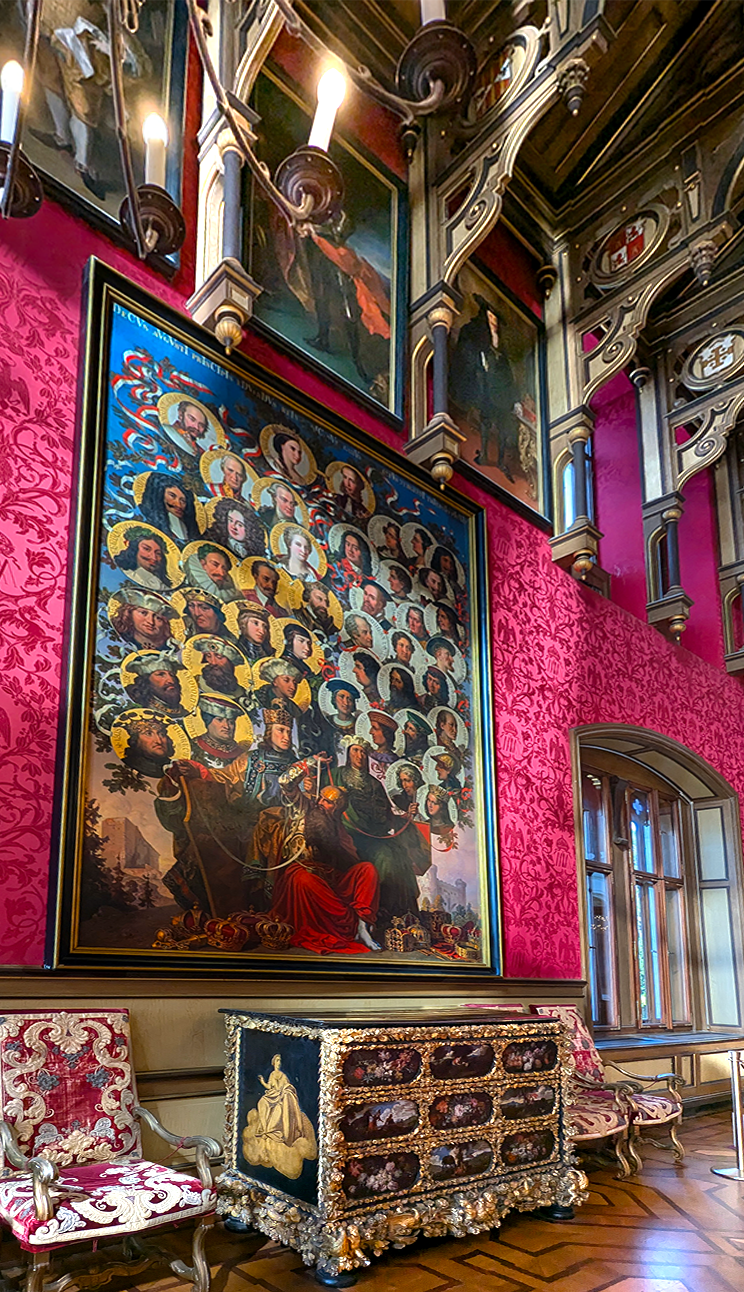
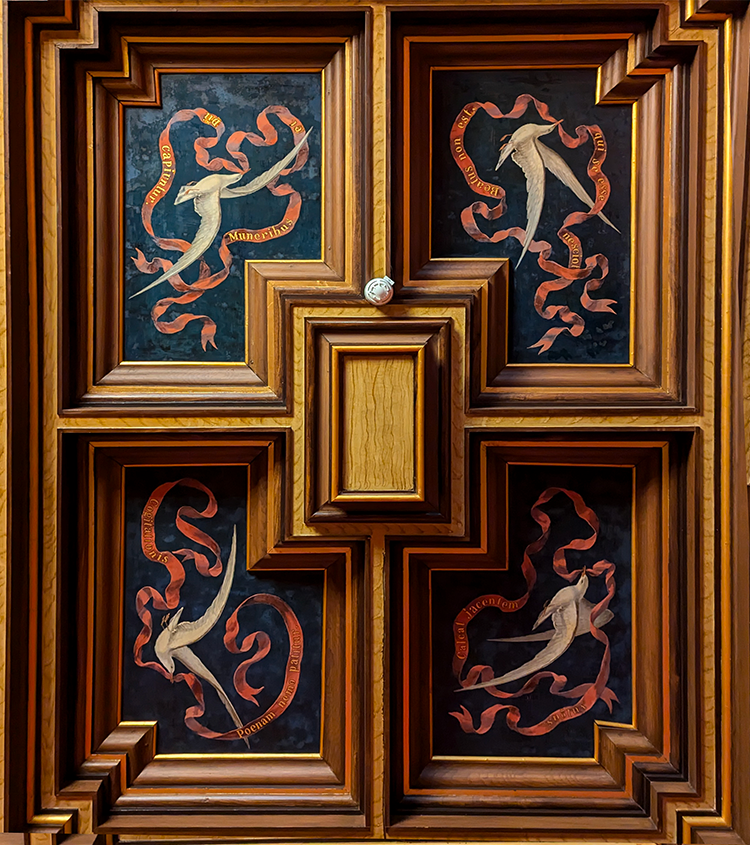
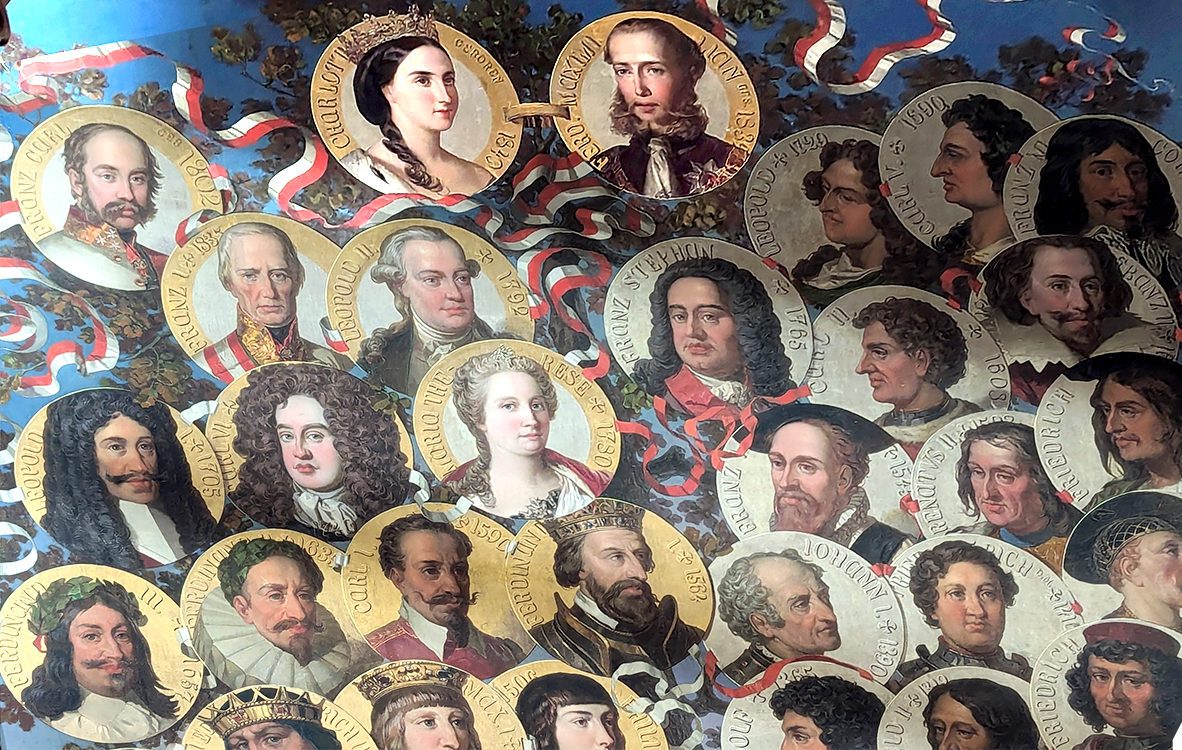
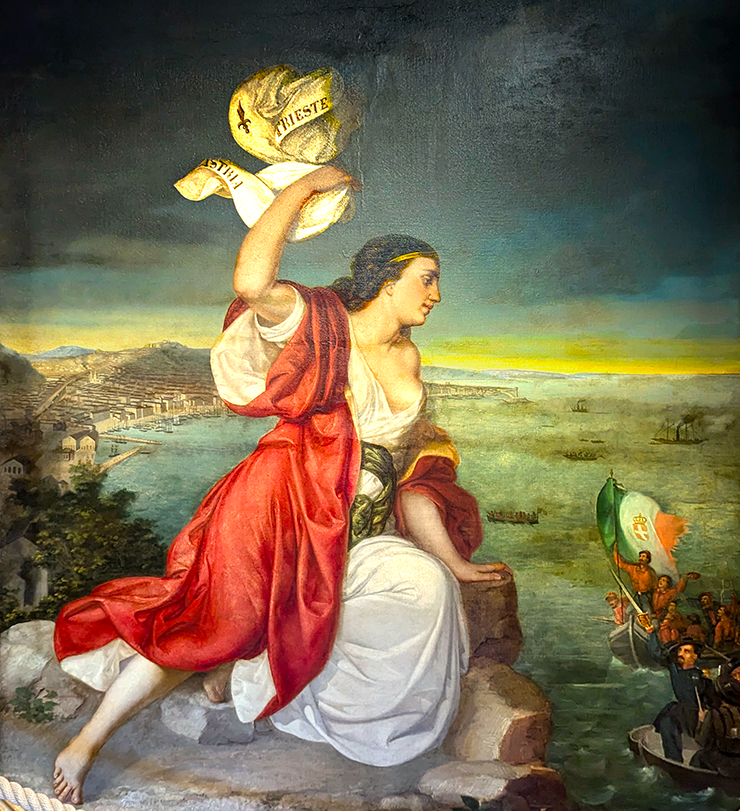
International intrigue interrupted life in their idyllic new palace. I’m simplifying facts here, so don’t expect to pass a history exam based on this version.
On the other side of the Atlantic Ocean, the liberal-minded Benito Juarez (1806-1872), having overthrown the Mexican dictator Antonio Lopez de Santa Ana (1794-1876) of remember-the-Alamo fame, was elected president of Mexico in 1858. Conservative royalists and Catholics in Mexico disliked the direction the country was heading. So, they went emperor-shopping in Europe. As the least controversial candidate, Maximilian rose to the top of their list.
With the existing colonies or dependencies of any European power we have not interfered and shall not interfere. But with the Governments who have declared their independence and maintain it, and whose independence we have, on great consideration and on just principles, acknowledged, we could not view any interposition for the purpose of oppressing them, or controlling in any other manner their destiny, by any European power in any other light than as the manifestation of an unfriendly disposition toward the United States….”
The Monroe Doctrine, 1823
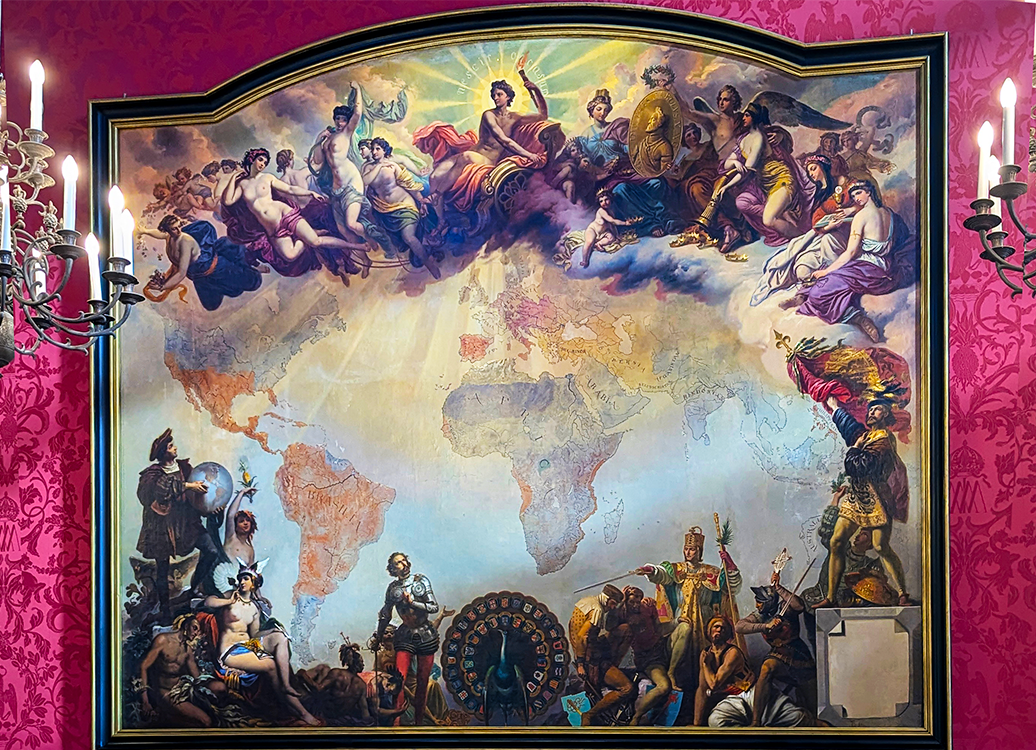
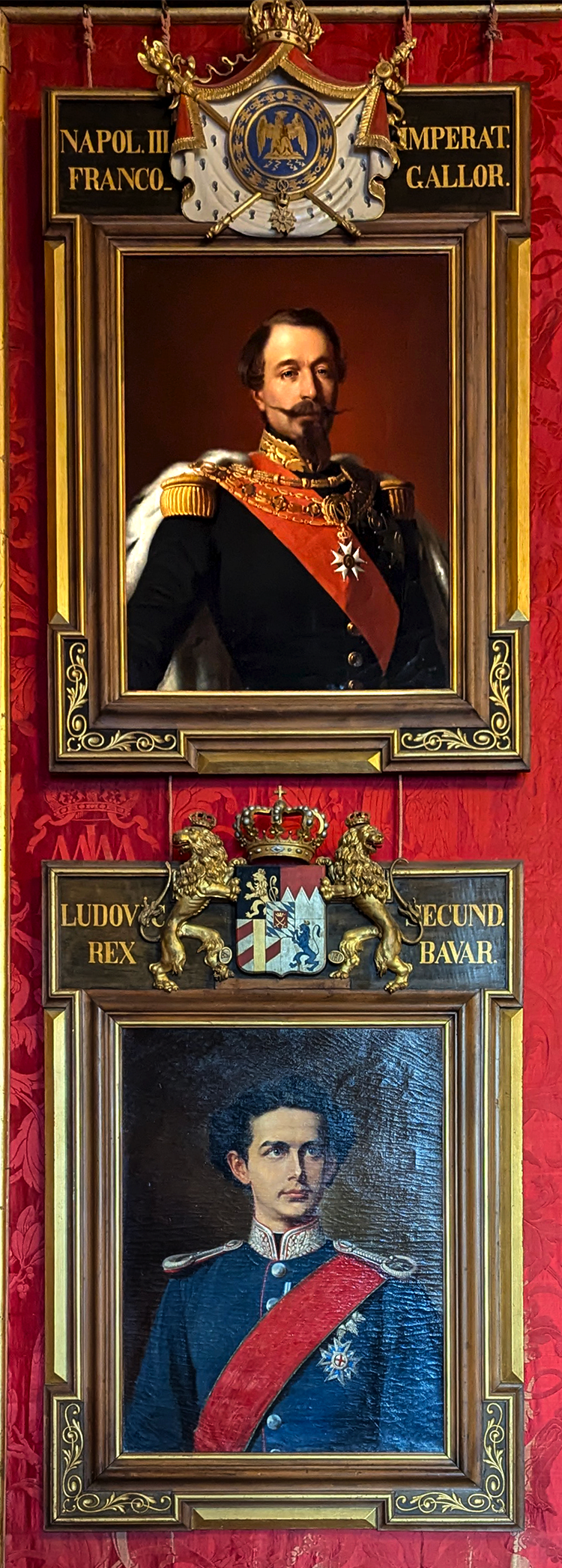
With the United States bogged down in its own Civil War, Napolean III of France (1808-1873) determined that President Lincoln could not enforce its Monroe Doctrine. Claiming Mexican debt as its excuse, the French proclaimed the imperial crown of Mexico for Maximilian. So, Maximiliano and Carlota (as they became known) set sail from Miramare for Mexico.
The new Emperor and Empress were not as universally welcomed as they expected. Juarez still considered himself president, a claim backed by recognition from Mexico’s northern neighbor. And conservatives soon found themselves lukewarm about their chosen emperor.
Who knew? Maximilian turned out to have a liberal bent in a difficult-to-govern land. He refused to return property Mexico had seized from the Catholic church, alienating Pope Pius IX (1791-1878); invited liberals to join his government; defended the rights of laborers, even indigenous ones; promoted free schools; and espoused equality before the law.
So, liberal Mexicans viewed Emperor Maximiliano as representing invasion by yet another foreign land, while conservatives viewed him as a weak monarch. Napoleon III soon tired of expending funds to defend the Emperor he installed and began withdrawal of troops. Maximiliano only had assembled limited support and control over the Mexican military.
The Emperor refused to flee but sent Empress Carlota sailing back to Europe to plea for support. Pope Pius and other European leaders no longer expressed willingness to try to control the revolutionary forces at work in Mexico.
Maximiliano was captured and executed by a firing squad in 1867. Carlota is said to have suffered a nervous breakdown and was secluded in Belgium until her death in the 1920s.
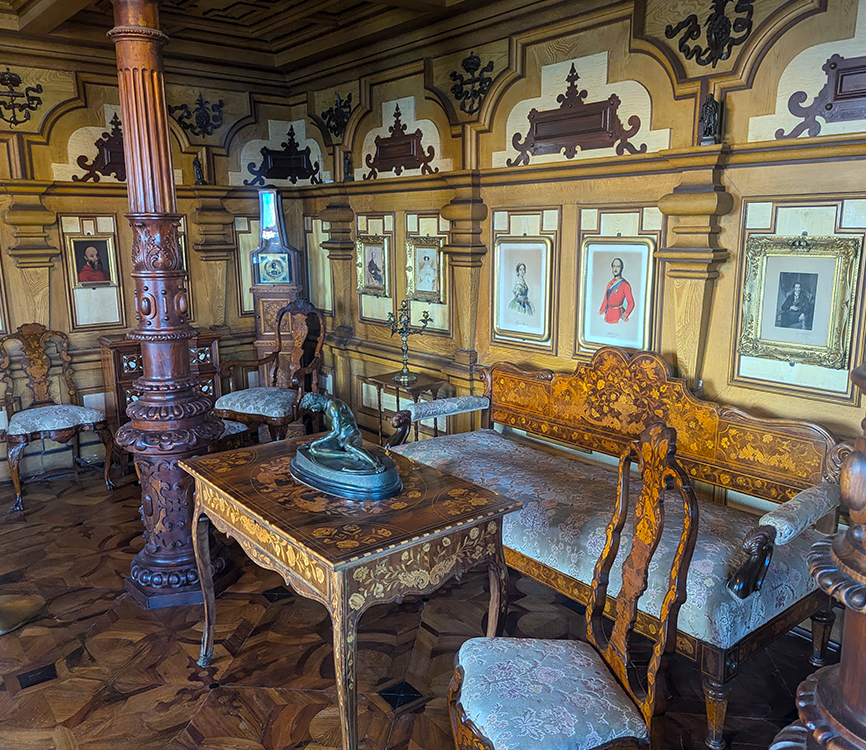
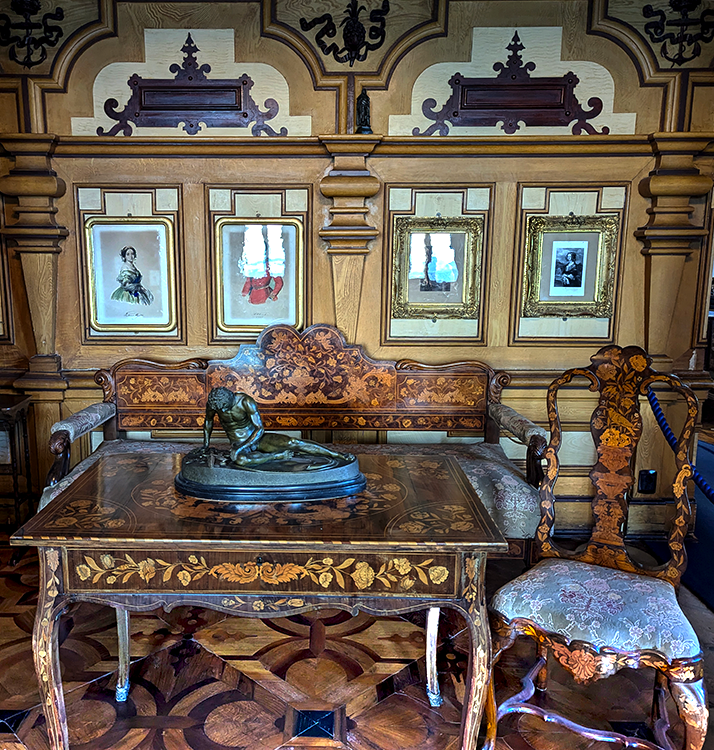
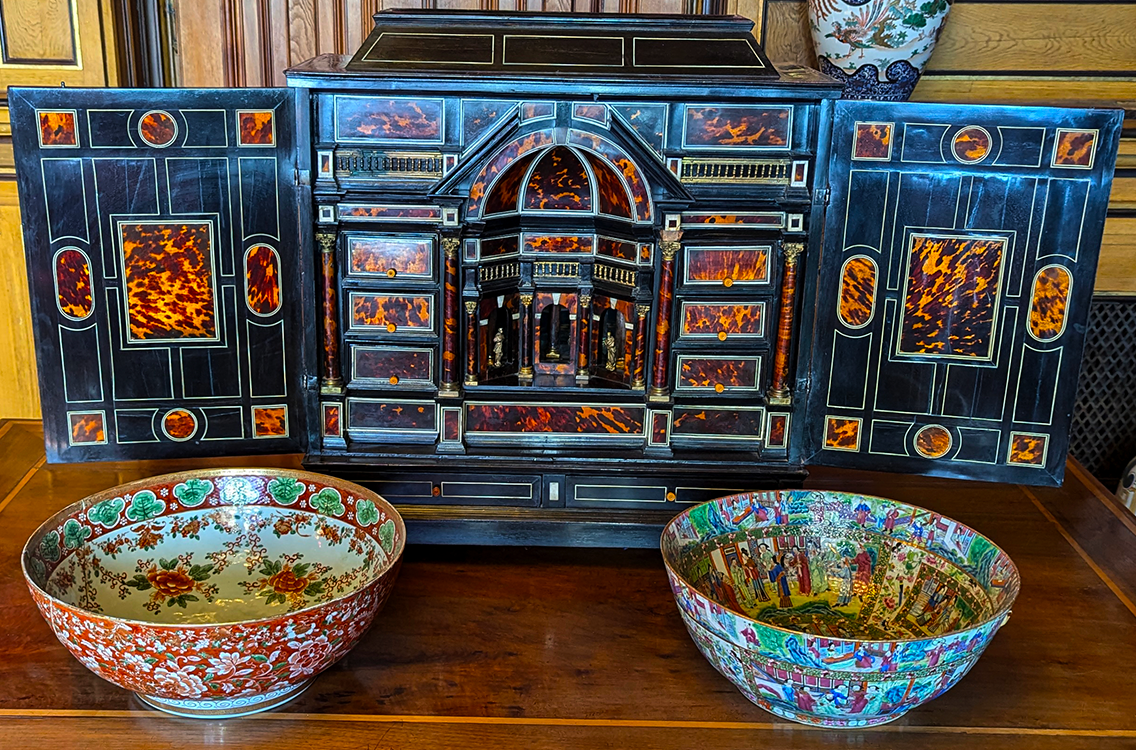
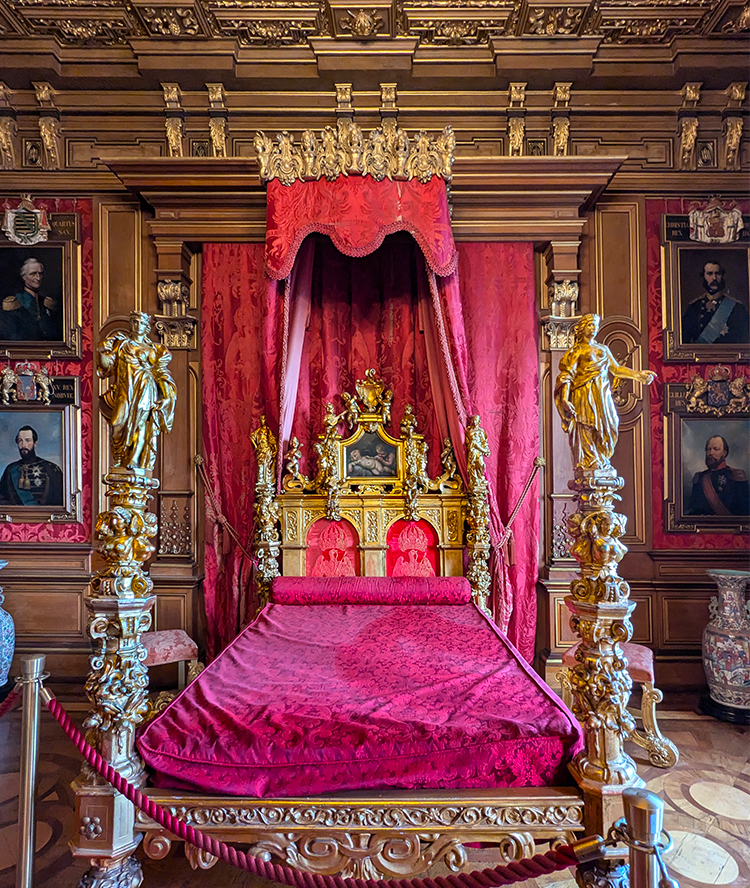
The couple never slept once together in the handsome bed on view, a gift to them from Pope Pius IX. While there are many remnants from their lives displayed in Miramare, art deco furniture pictured above was added by other royals in the 1930s.
 Postcards from Barton Springs