


Above: One of Colectivo Subterraneos’ “Nobodies” on exhibit at the Chrysler Museum of Art through May 11.
Oaxaca has emerged as a global hub for contemporary printmaking, fueled by the medium’s rich history in Mexico and the city’s vibrant artistic heritage. Internationally renowned Oaxacan artists, most notably Rufino Tamayo and Francisco Toledo, invested heavily in developing their native city’s cultural infrastructure. Building on this foundation, numerous printmaking workshops now thrive in Oaxaca, fostering an environment of experimentation and collaboration.”
Curator’s notes, “Oaxaca Central: Contemporary Mexican Printmaking”
Unless you are new to my blog, you know I wander streets far and wide prowling for street art. I’ve been pursuing Colectivo Subterraneos‘ “Nobodies” around corners in Oaxaca, Mexico, during numerous visits over the past few years.
When I went back to the land where I grew up, Virginia Beach, to visit my sister and her husband in early March, I was surprised to encounter a fresh crop of migrating “Nadies” peopling gallery walls in Norfolk’s Chrysler Museum of Art as part of “Oaxaca Central: Contemporary Mexican Printmaking.”
In the series ‘The Nobodies,’ figures from Mexican history and contemporary culture exist within a single visual space. Ancient Mesoamerican warriors appear to stand and move alongside modern rural peasants and urban citizens. By destabilizing the chronological boundaries between them, Subterraneos highlights the timeless nature of the systems that have oppressed and anonymized them – rendering them ‘nobodies.'”
Curator’s notes, “Oaxaca Central: Contemporary Mexican Printmaking”


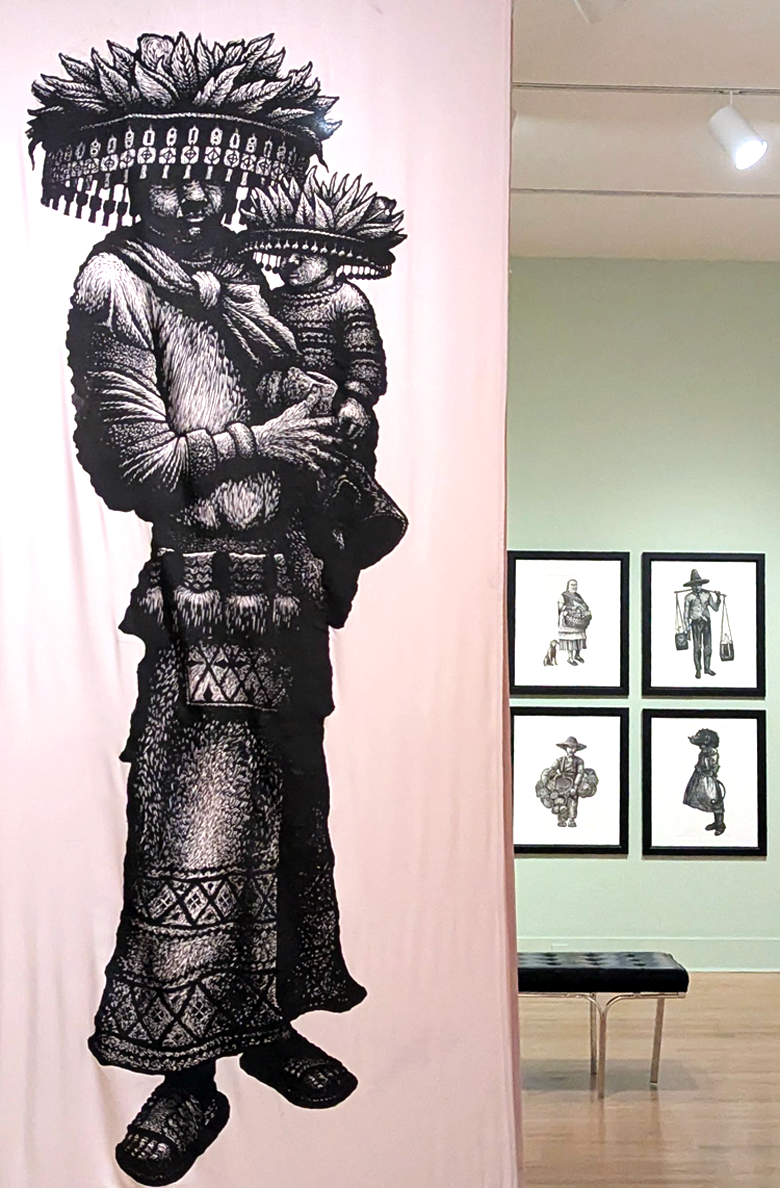


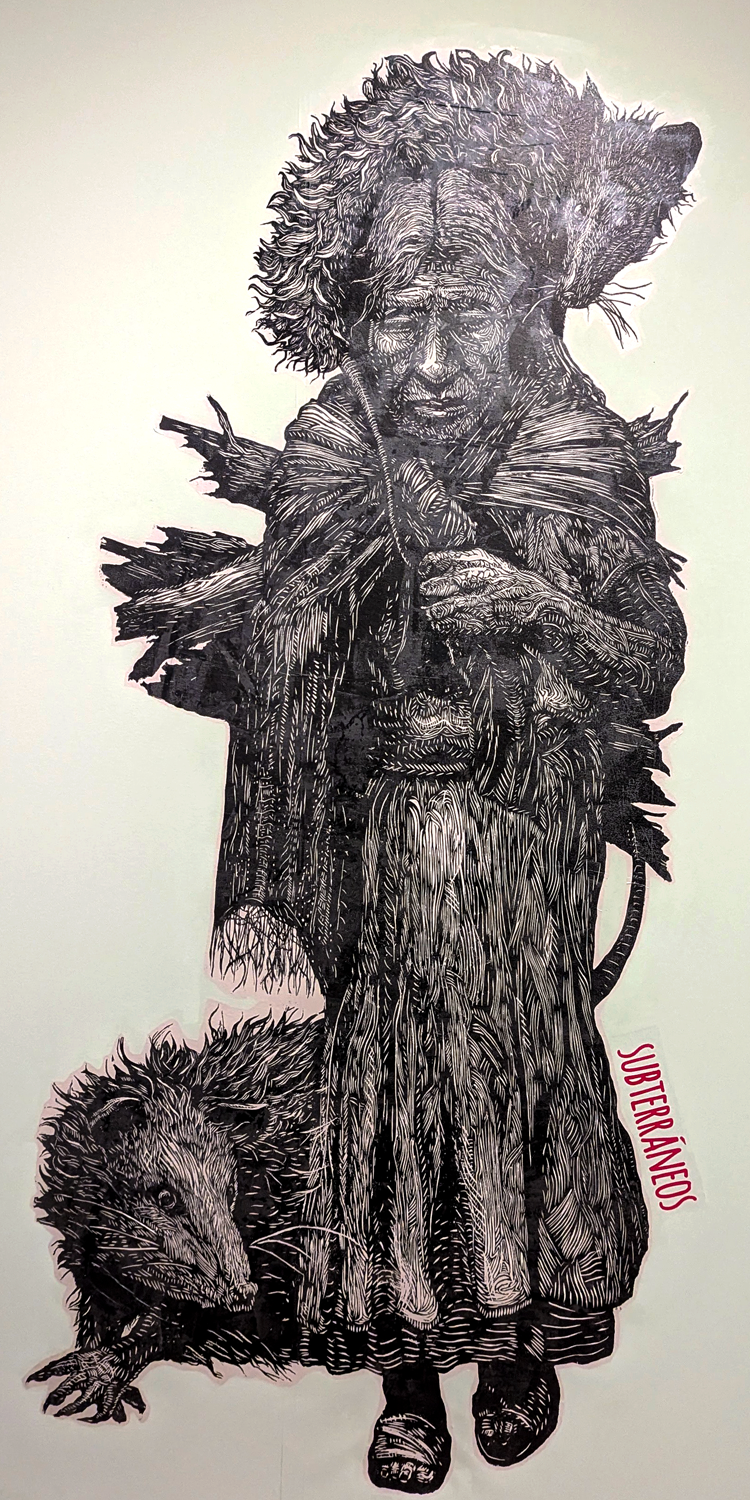
Above: Colectivo Subterraneos “Nobodies”
Produccion Grafica Zanate helps artists blend traditional techniques like etching, woodcut, and lithography with innovative new approaches, producing works that explore a diverse range of subjects. This technical mastery and thematic diversity are showcased in the prints produced for Zanate’s 10th Anniversary Portfolio.”
Curator’s notes, “Oaxaca Central: Contemporary Mexican Printmaking”
The exhibition at the Chrysler also focuses on the work of other collectives active in Oaxaca as well as individual artists perpetuating printmaking skills in new directions.

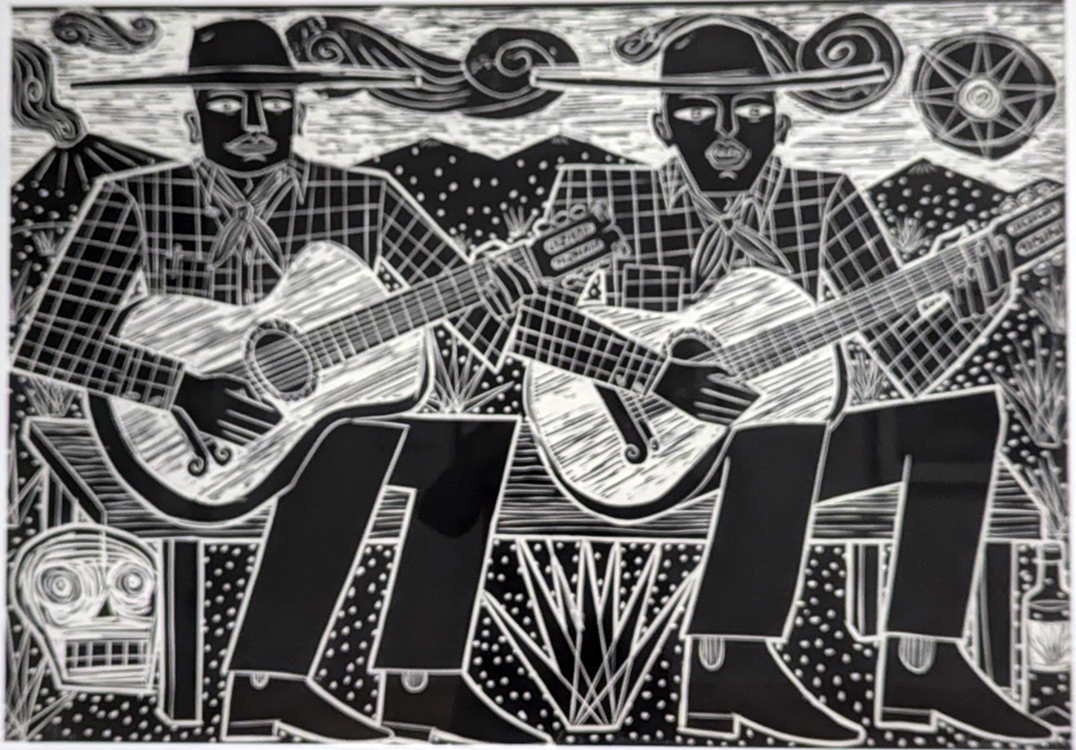
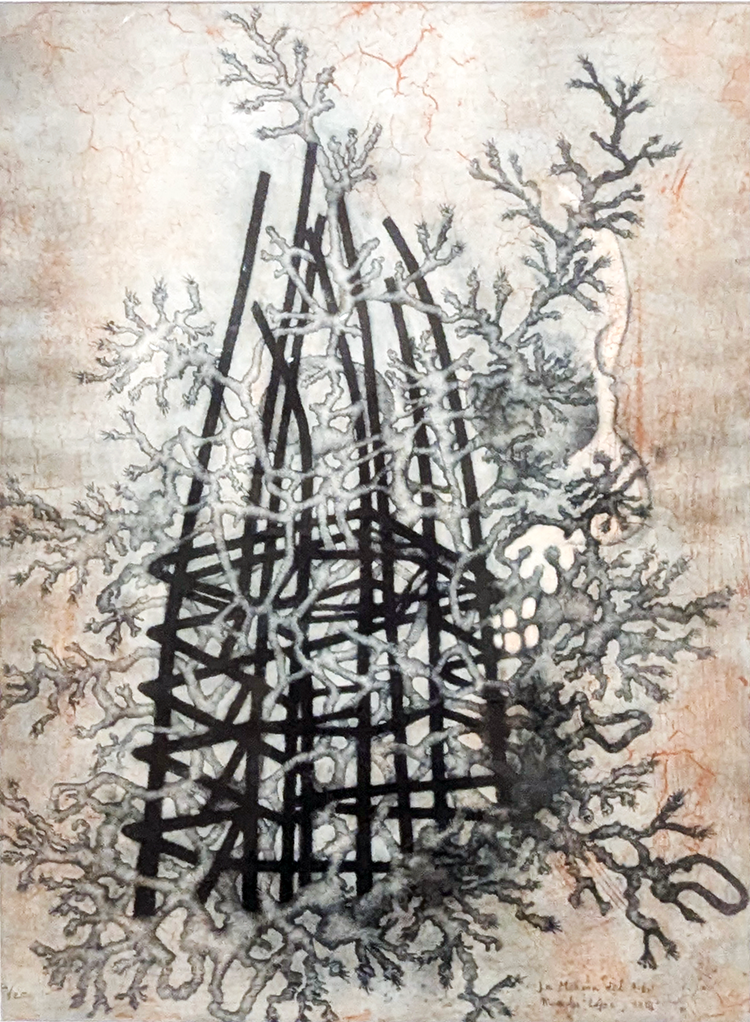
Above left: Untitled, Marco Velasco (1989-), etching and aquatint, 2018. Second from left: Untitled, JC Eber (1989-), etching and aquatint, 2019. Third from left: “The Guitar Players,” Joel Rendon (1967-), linocut, 2018. Far right: “The Memory of a Tree,” Mercedes Lopez (1983-), etching and aquatint, 2018. All four from Colectivo Zanate’s 10th Anniversary Portfolio.
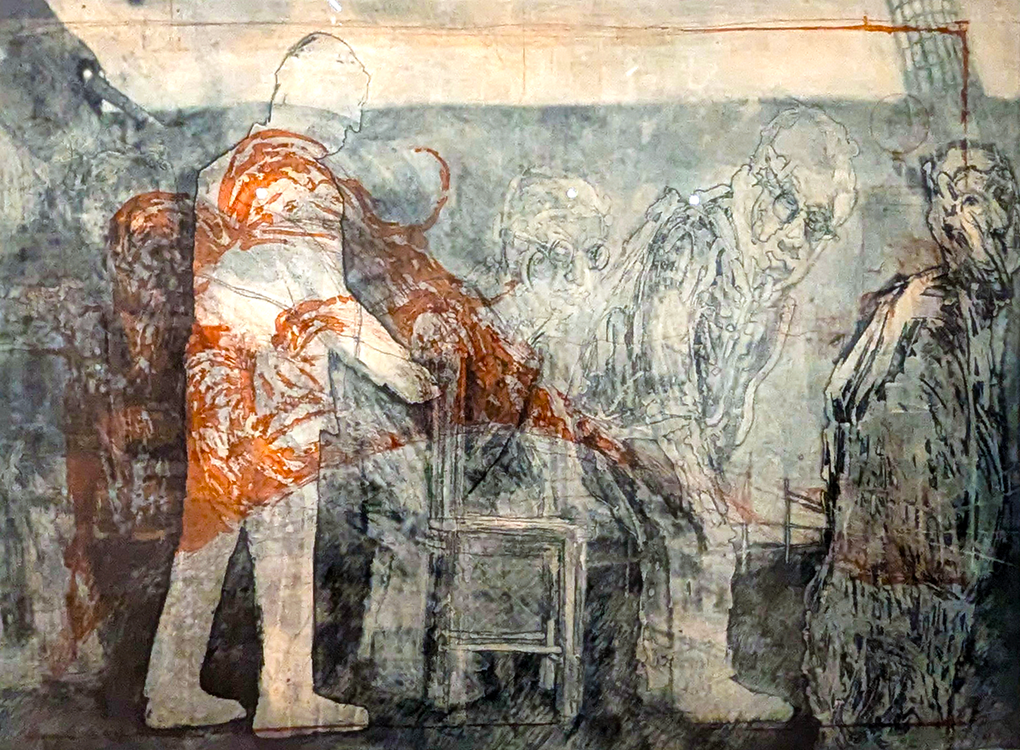
In this series…, Jeronimo Lopez Ramirez, better known as Dr. Lakra (1972-), subverts the formal composition of devotional paintings…. Lakra replaces traditional iconography with imagery drawn from classical mythology, world religions, tattoo aesthetics, and pop culture.”
Curator’s notes, “Oaxaca Central: Contemporary Mexican Printmaking”


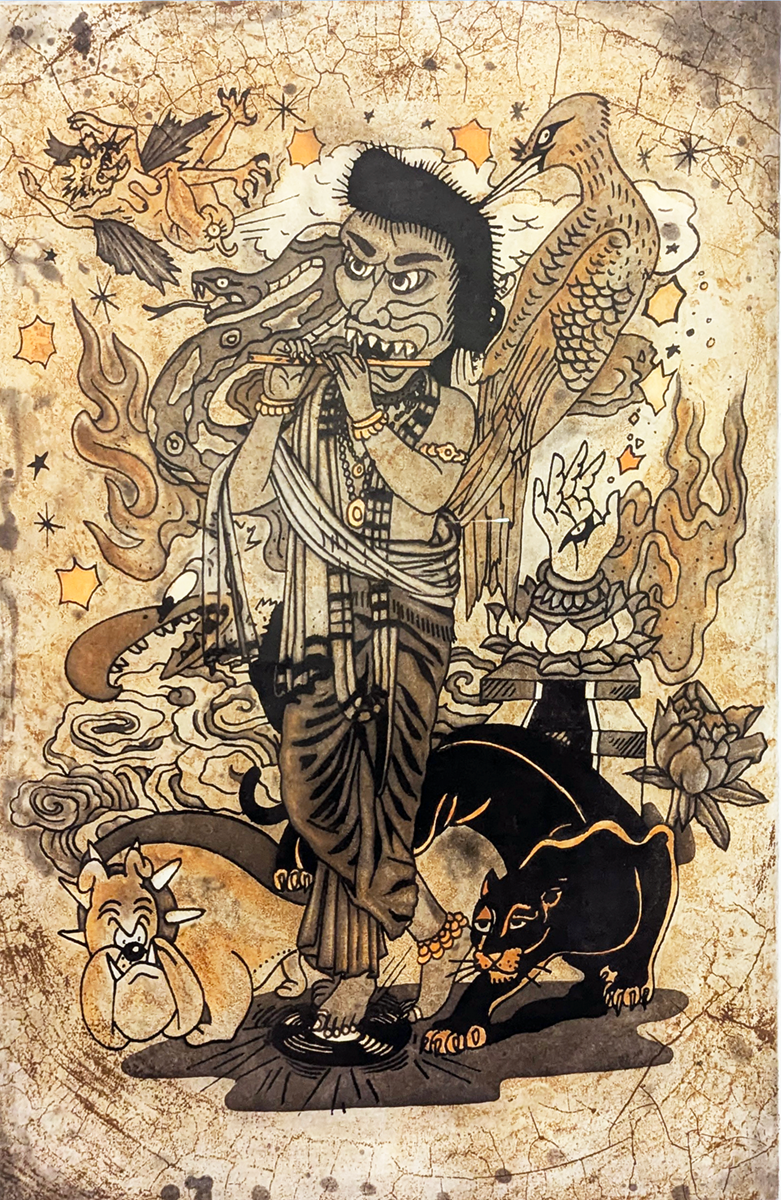


Above: Untitled portfolio, Dr. Lakra, etching, aquatint and direct acid, 2022.
For photos from a 2015 exhibition of Dr. Lakra’s works we encountered in Oaxaca, visit “Tattooed Museum Walls.”
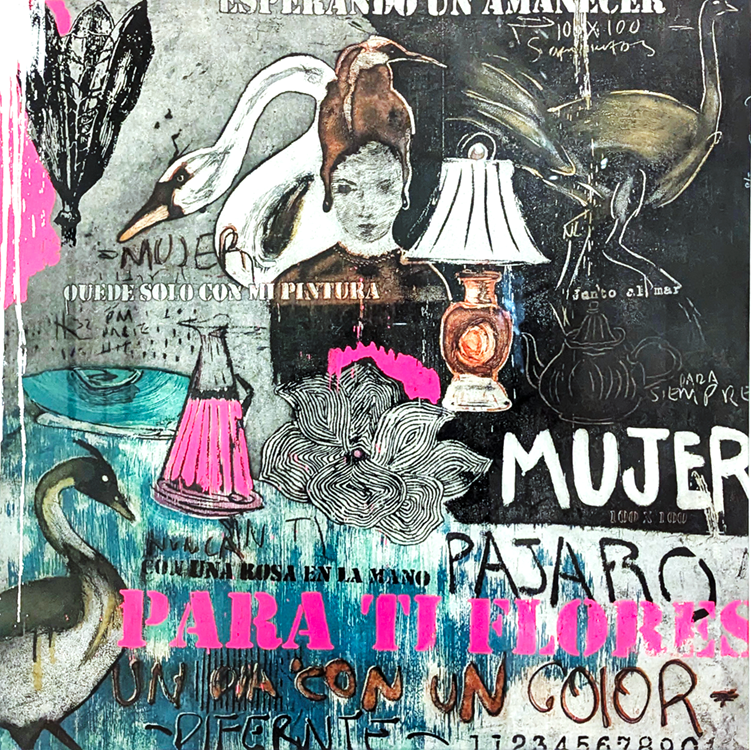
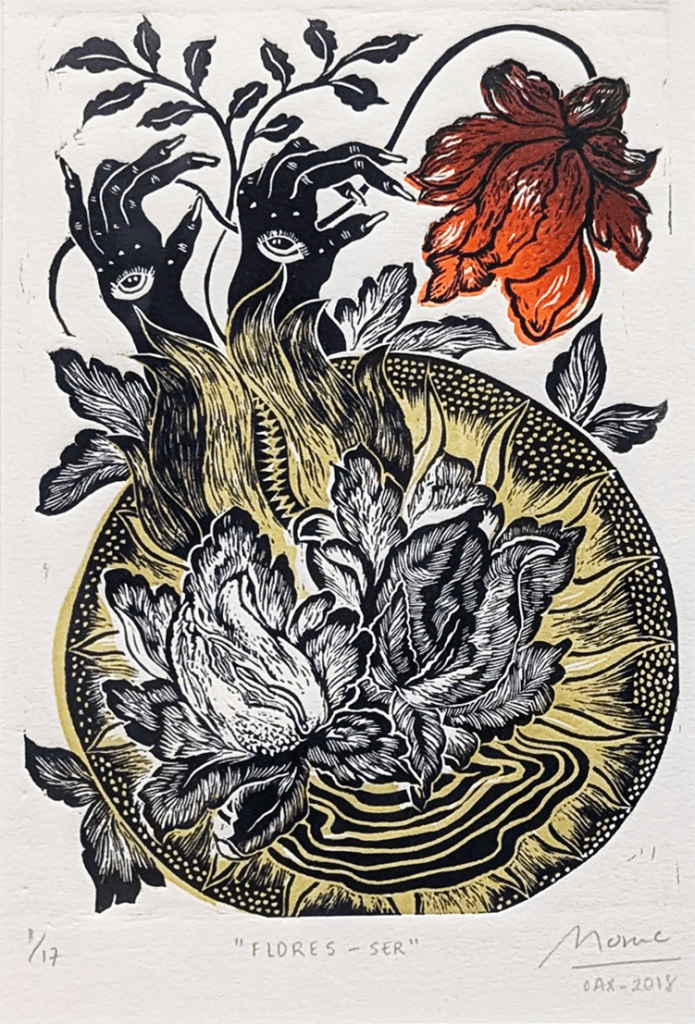

Above left: “Para Ti Flores,” Amador Montes (1975-), etching, aquatint and silkscreen, 2024. Middle: “Flores Ser,” Gabriela Morac (1986), linocut and woodcut in three colors, 2020. Far right: “Frase una Vez,” Julieta Cano, linocut print.
La Piztola was formed as a collective in 2006, at a time when a political revolt was brewing in the city of Oaxaca, Mexico. This uprising gave rise to a movement of social graphics in the city, with locals and foreigners contributing street art. We handle our interventions as urban graphics to create a visual dialogue with society….”
Website of La Piztola
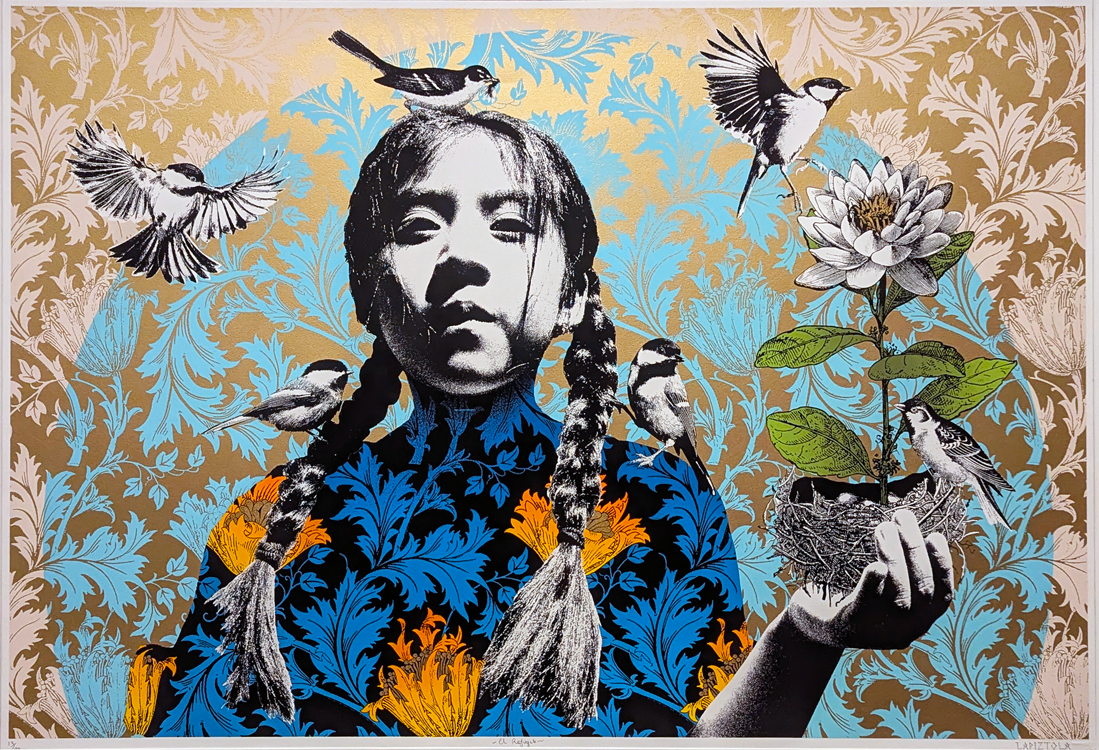

Above left: “The Refuge,” La Piztola, silkscreen on cotton paper, 2021. Right: “Mutual Help,” La Piztola, silkscreen on cotton paper, 2022.
Trailblazing artist and activist Joyce J. Scott has elevated the creative potential of beadwork as a relevant contemporary art form. Scott uses off-loom, hand-threaded glass beads to create striking figurative sculptures, wall hangings, and jewelry informed by her African American ancestry, the craft traditions of her family, and traditional Native American techniques, such as the peyote stitch.”
Curator’s notes for “Joyce J. Scott: Messages”
The beadwork of Joyce Scott (1948-) on display in another temporary exhibition, “Messages,” is stunning, colorful, intricate and witty. Entering the gallery fronted by ‘Mz. Teapot’ (2022), a cigarette dangling from her ruby-colored lips, one can’t help but smile (both front and back images shown below).
Scott’s political “Rechristening” from 2022 features a MAGA-hatted man wearing a white christening gown in a champagne-glass-shaped baptismal font. Names of several of President Trump’s first-term enablers run up the stem, Senator McConnell evidenced in the photo below. A noose coils off the end of Pence’s name on the base.


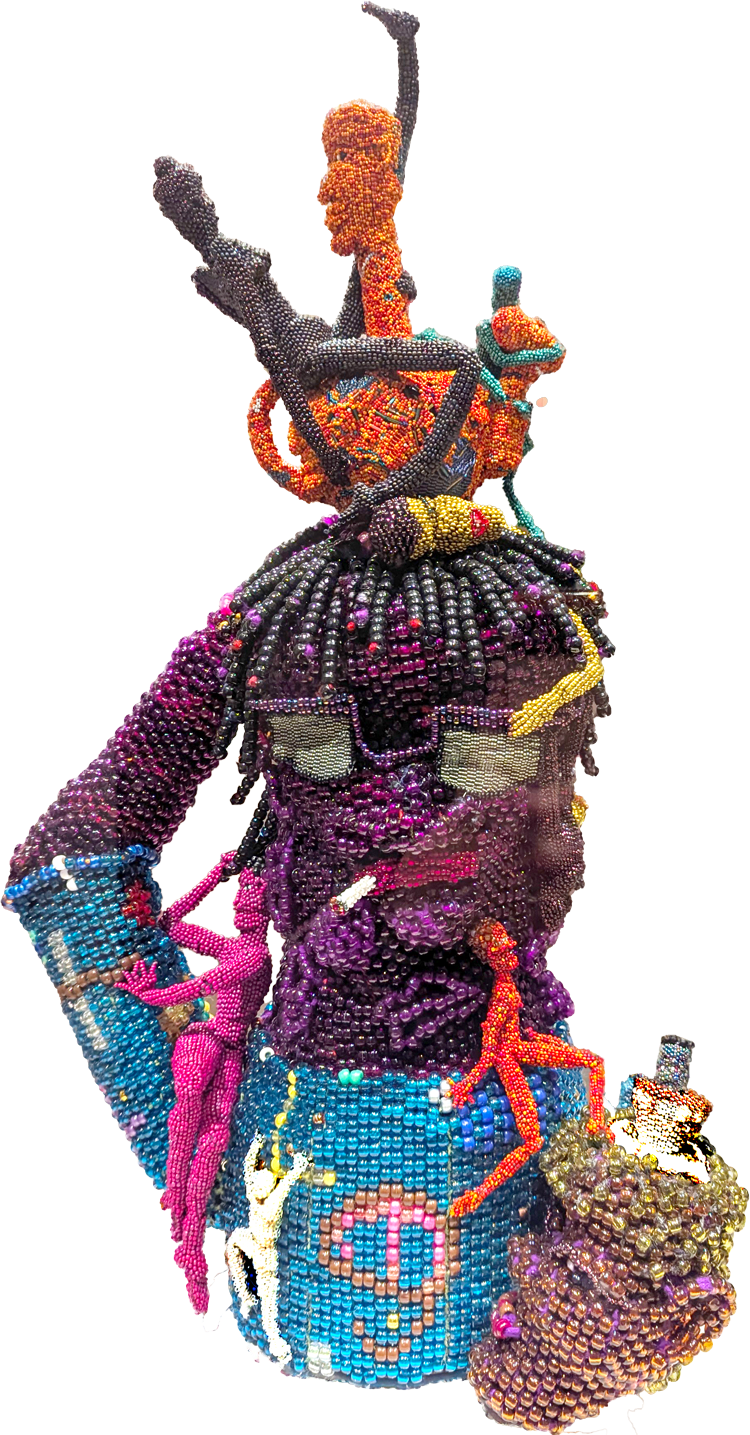

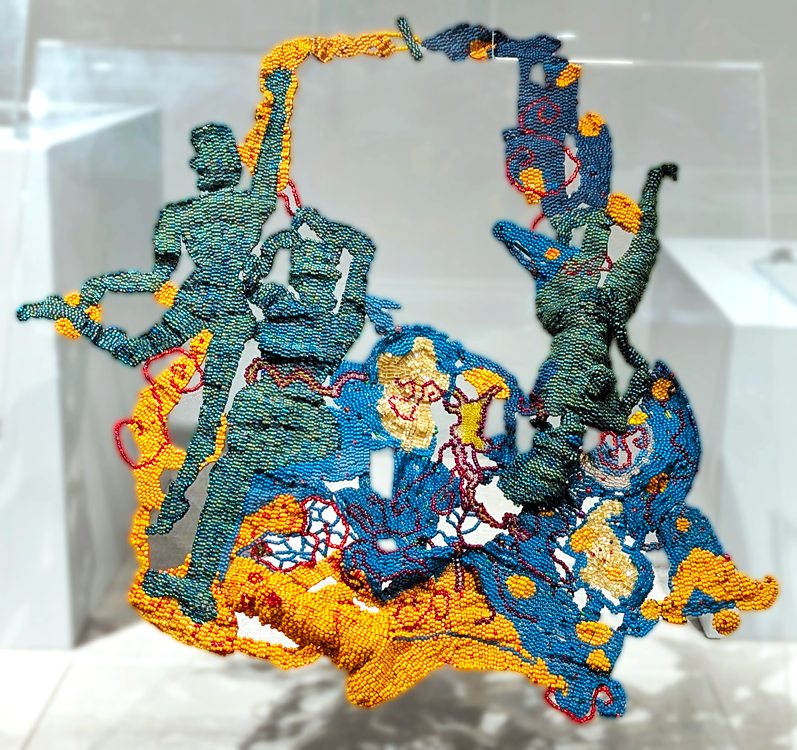
Above: Beadwork by Joyce Scott: glass beads, plastic beads, wire, armature, thread embroidery, loom and peyote stitch.
While this museum was founded in 1933, its history made a radical turn when Walter P. Chrysler, Jr., (1909-1988) began to gift his collection of more than 10,000 works of art to Norfolk in 1971. Norfolk had an edge on other potentional locations; his second wife, Jean Outland was from there.
We really did not have enough time to delve back into more of the Chrysler’s 50 galleries. Below are a few random examples distracting us on our way out.
The unusual cropping of this scene, with the figures just entering our view, suggests the fragmented and lonely character of this anonymous urban world, a frequent theme in Edward Hopper’s work.”
Curator’s notes about Edward Hopper’s”New York Pavements,” below on left


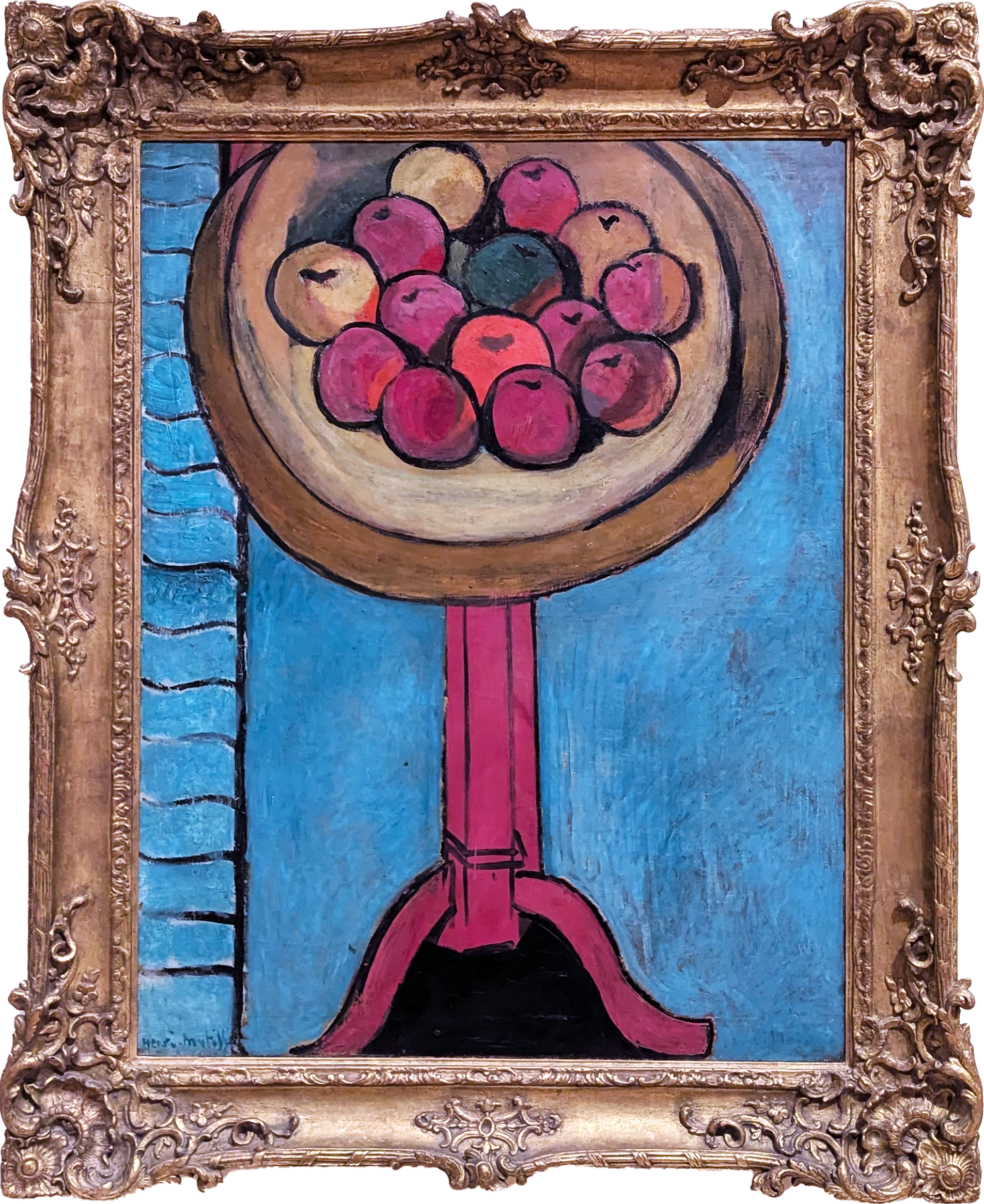
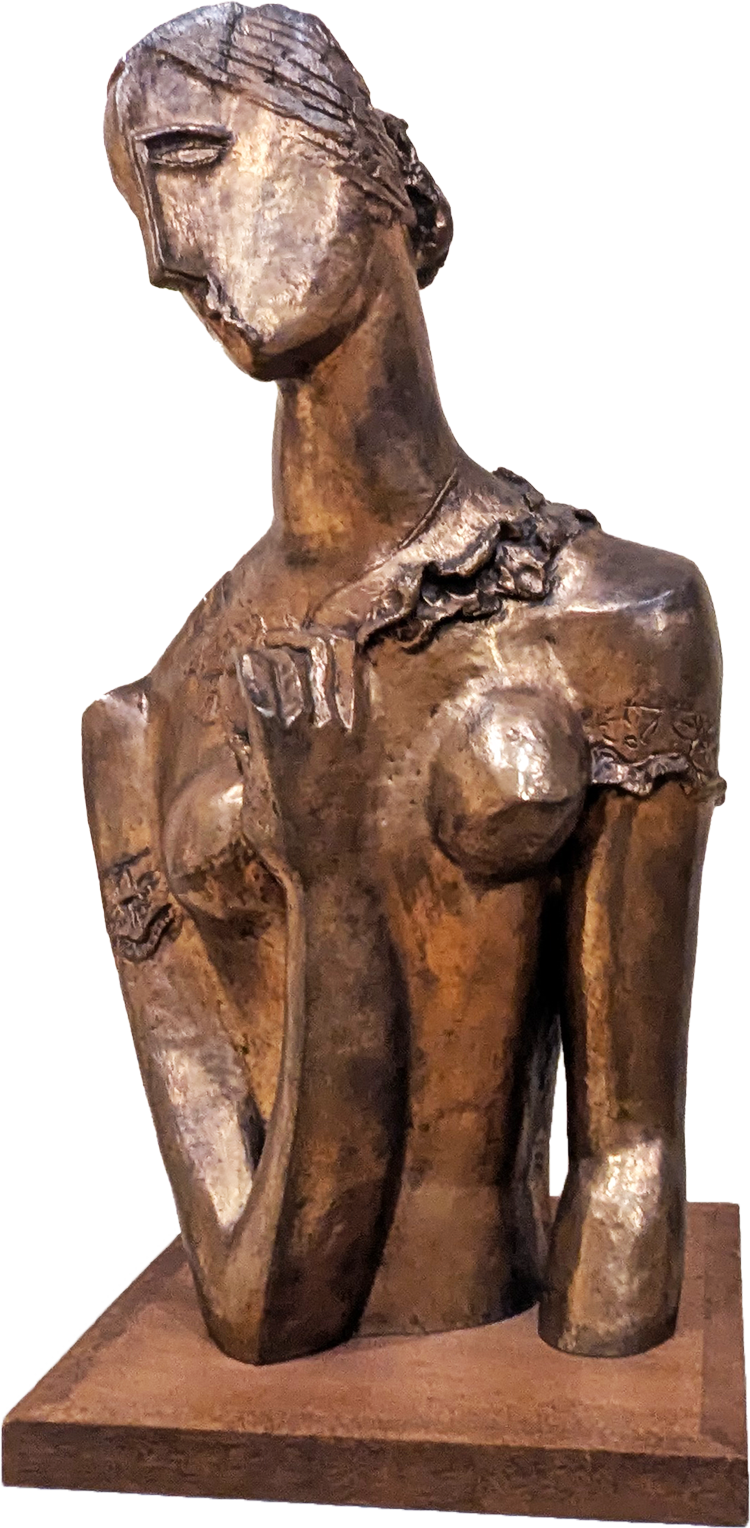
Above left: “New York Pavements,” Edward Hopper (1882-1967), oil on canvas, 1924. Second from left: “Portrait of Black Man with African Shield,” Jacques Gommers (1915-2000), oil on canvas, 1936. Third from left: “Bowl of Apples on a Table,” Henri Matisse (1869-1954), oil on canvas, 1916. Far right: “Bust of Carol Janeway,” Ossip Zadkine (1890-1967), gilded bronze, 1943.
Ending with a painting that, in my mind, feels connected to the plight of ordinary people in much the same way as the contemporary Oaxacan prints above. A wide painting by artist Thomas Hart Benton (1889-1975) is suspended high on the wall. Benton befriended Mexican artist Diego Rivera (1886-1957) in Paris prior to World War I, and this work reflects the influence of the Mexican muralist.

Above: “The Arts of Life in America: Unemployment, Radical Protest, Speed,” Thomas Hart Benton (1889-1975), tempera on board, 1932. One of eight long ceiling panels originally decorating the library of the Whitney Museum of American Art, New York, before its 1954 move to a new building.
Capturing the speed referenced in Benton’s title, the short looping video offers a quick glimpse of a potential use for a cool, new, free-for-now app for iOS, Panoscano, developed by Chris Stangland. Unfortunately, I‘m unable to access it with my Android phone. But grab your iPhone and get carried away creating shareable images from panoramic or normal photos.
And, by the way, the Chrysler Museum of Art has a surprising connection to street art: Admission is free, an ever-increasing rarity among museums. Plus, there is an abundance of free parking. Amazing.
 Postcards from Barton Springs
Glad to see you today.
LikeLiked by 1 person
Kathy – We spent about as much time yesterday backing-and-forthing on I-35 as we did in San Antonio. The threat of I-35 at rush hour doesn’t make lingering very appealing; although the drive was mercifully reasonable for us, a rarity. Such a short distance creates a big gulf. But good to say hello at least and determine we’re still kicking.
LikeLike
Gordon’s address is on Barton Springs Rd. as well. It was great to see you and have a little catch-up. XXOO
LikeLiked by 1 person
Anne – Surprised we haven’t spotted him zipping by on the trails amongst the sea of ‘bodies passing us…. Hoping for a longer visit next time.
LikeLike