
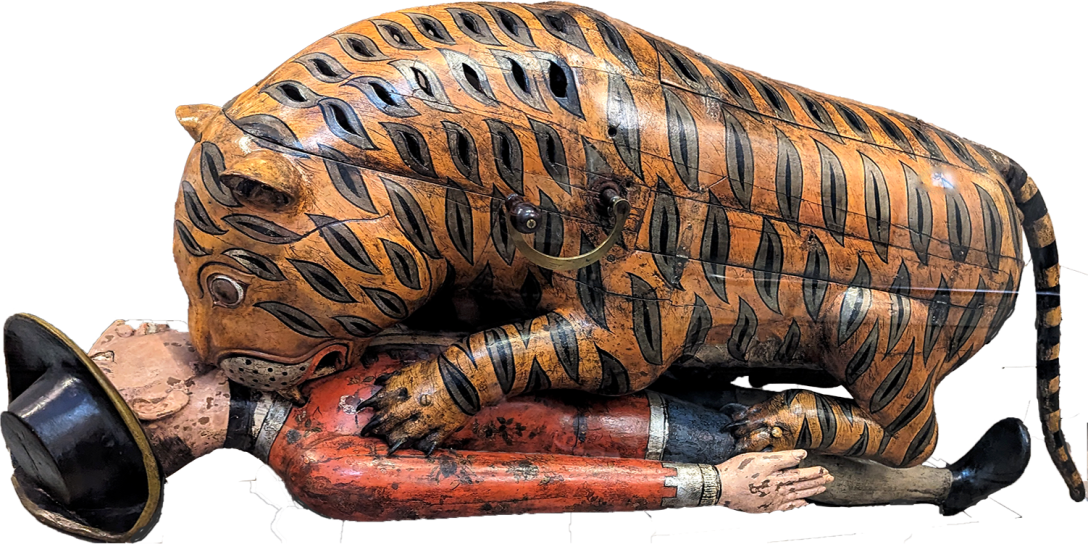
Above: “Tippoo’s Tiger,” Tipu Sultan’s automaton seized from Seringapatam, Mysore, South India, by the East India Company in 1799, eventually ending up displayed in the Victoria & Albert Museum.
It’s a giant mechanical tiger… and I just was so enchanted by it. Because I’d seen British propaganda – you know, cartoons and ethnographic representations of Indians – but I’d never seen Indian art depicting the colonizer or the English…. I think Tipu Sultan, who commissioned it… was so contemptuous of the British and so determined to drive them out of India…. This was a gift to his sons, who had been taken hostage by the British.”
Tania James, author of the novel Loot, interviewed in 2023 by Ari Shapiro for All Things Considered on NPR
By chance, I had recently read Tania James’ Loot when we visited Victoria & Albert Museum last year. Spying the 18th-century automaton tiger one grasps how it sent the author’s imagination flying back into history to investigate the tiger’s origins. The soldier-mauling tiger serves as a mighty symbol of conquered nations’ contempt for their colonizers.
While the exhibit is motionless today, this video demonstrates how its mechanical wonders could strike awe when seen in action in the 1790s.
The entire V&A Museum overflows, its immense collection igniting curiosity to roam the far corners of the globe. The original base appears fairly simple for Queen Victoria (1819-1901) to accumulate. She reigned over the British Empire for 63 years. At one point, as many as four-million people inhabiting about one-third of the world’s land mass fell under her rule. Yet most of the collections did not originate from the queen.



In 1857, Queen Victoria dedicated the first South Kensington Museum on this site, with an emphasis on applied art and science. Making the museum accessible to all was an early goal; gas lighting was added the following year, expanding evening hours to accommodate the working class.


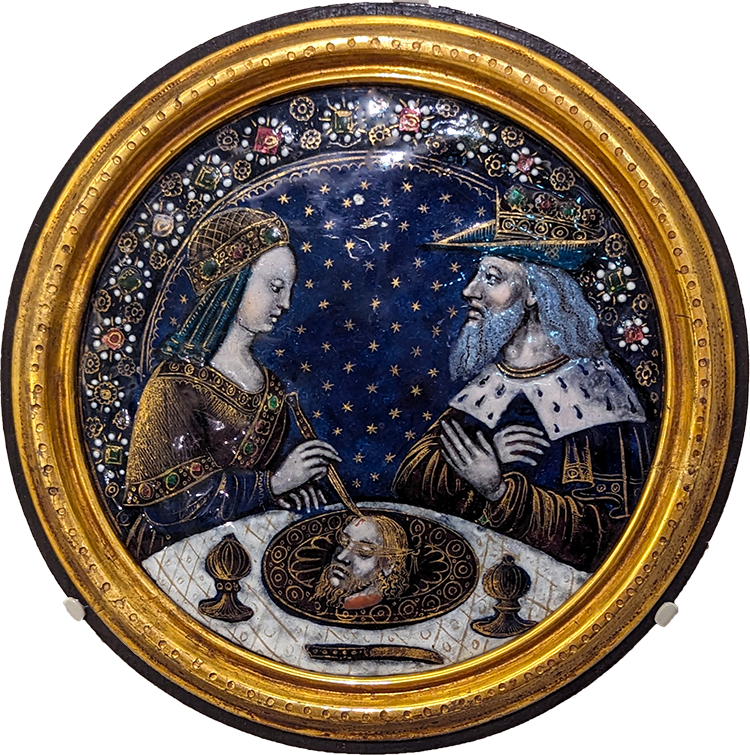
Above: “Altarpiece of Saint George,” 1420-25, Valencia, Spain. Beheaded for his beliefs in 303, Saint George is heralded for miraculously appearing to King James I of Aragon in 1237 to lead him to victory over the Muslim ruler of the region.
Science eventually was separated into nearby quarters, as the decorative arts collection continued to grow. Queen Victoria presided over ceremonies for a major museum expansion in 1899.
I trust that it will remain for ages a monument of discerning liberality and a source of refinement and progress.”
Queen Victoria, 1899
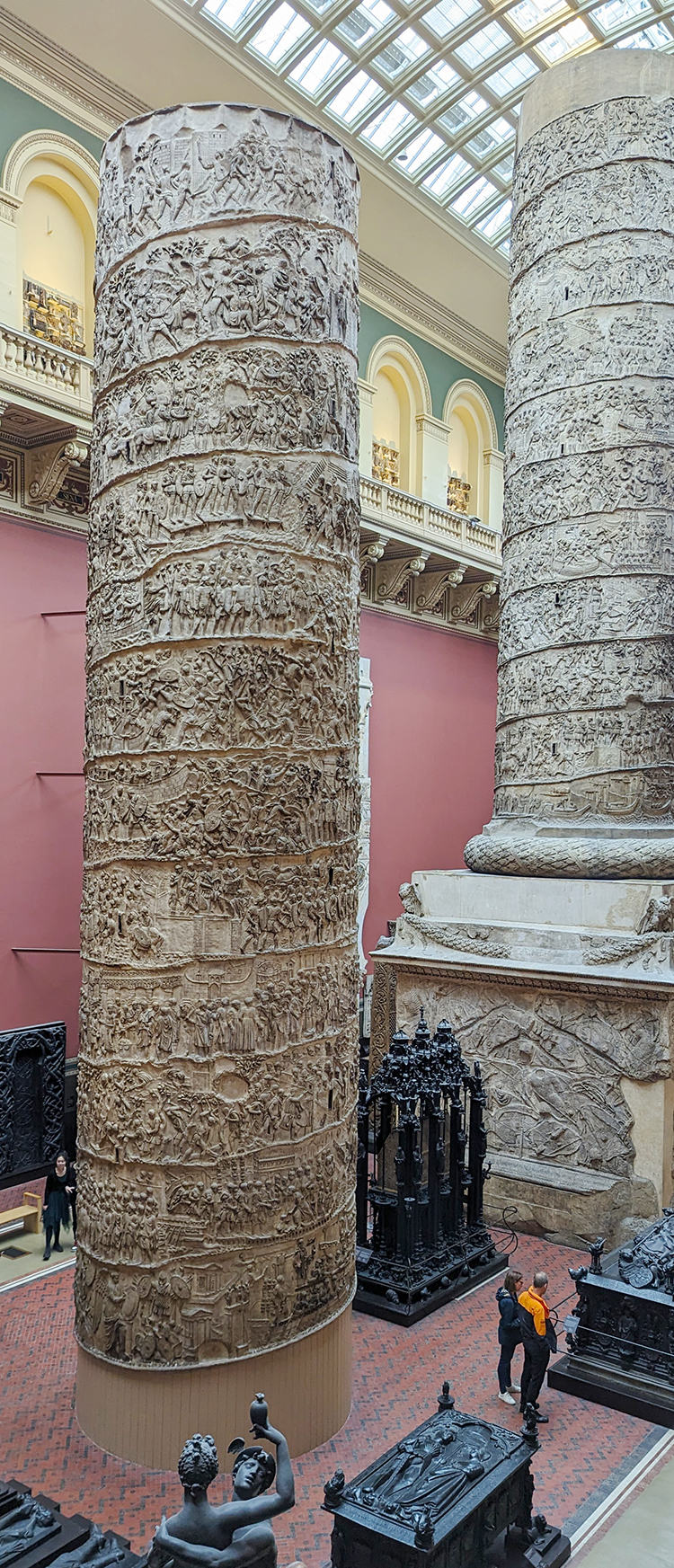


Above: Plaster casts of major artworks, including to-scale copies of Hadrian’s Columns and Michelangelo’s “David,” enriched the public’s exposure to art the British Empire could not acquire, even in Victorian times.
For Londoners without the means of traveling abroad, these casts provided a fascinating glimpse into the marvels of European sculpture. One of the earliest major casts of Italian figure sculpture – Michelangelo’s David – sets the tone for the scale and breadth of the objects to be found in the courts. David, which was constructed by the Florentine cast-maker Clemente Papi in the 1850s, is more than five metres tall and was created from hundreds of pieces of a plaster mould taken directly from the original.
Acquired by chance, it was sent to Queen Victoria by Leopold II, Grand Duke of Tuscany, supposedly in an attempt to placate the British following his refusal to allow the National Gallery to export from Florence a painting by Domenico Ghirlandaio. The Queen, shocked by the nudity of the cast, requested that a suitably proportioned fig leaf be made… and hung on the cast using a pair of hooks when dignitaries visited. Today the plaster fig leaf is a popular exhibit on its own.”
“History of the Cast Courts,” Website of V&A Museum
Wonder how many fig leaves Queen Victoria commissioned during her long reign, historically regarded as a prudish one. She cautioned:
Beware of artists, they mix with all classes of society and are therefore most dangerous.”
More later.
 Postcards from Barton Springs
This was a most interesting post for me, Gayle. Loved the tile mural and Tipu the Tiger!
LikeLiked by 1 person
Thanks so much, Susan. Would so love to see Tipu unenclosed and in action.
LikeLike