

Above: A portion of Fontana Pretoria, nicknamed Fontana della Vergogna
Officially it’s called Fontana Pretoria, so-named because of its location in the plaza fronting the palazzo that houses City Hall. But its nickname is Fontana della Vergogna, or Fountain of Shame. But shame on whom?
Well, obviously this fountain would be branded as more than shameful, downright pornographic, by some in Florida where a school principal recently was forced to resign after a teacher held up an image of Michelangelo’s “David” as part of a Renaissance art lesson for sixth graders. But art of the Italian Renaissance, even religious art, is not known to be puritanical in nature.
Amongst the theories, spouted off by guides to the huddled groups they shepherd, is that the name first was muttered by offended neighboring nuns, who would slip out onto the plaza under the cover of darkness and apply modest garb to the most exposed statues. Some guides magnify the vigilante efforts undertaken by the Dominican sisters to include amputation of numerous limbs and offensive protrusions. The sisters naturally were upset after they were coerced into giving up a large portion of their property to accommodate the grandiose plaza for the government.
Then again, some credit the maiming and nose-smashing to marauding citizens of Messina, an ancient rival of Palermo. But, hey, these figures are old, 16th-century old, and they arrived on the island in far-from-pristine condition.
As it is unlikely hoards of Sicilians would be offended by classical nudes, another reason given is citizens felt that Palermo officials authorizing the project should themselves feel shame. Shame for demolishing perfectly good buildings to create an open space meant solely to aggrandize their own importance. Shame for draining city coffers for extravagant public art instead of needed city services. Shame for importing Florentine-style work uncharacteristic of Palermo. Sort of a “buy local” movement.


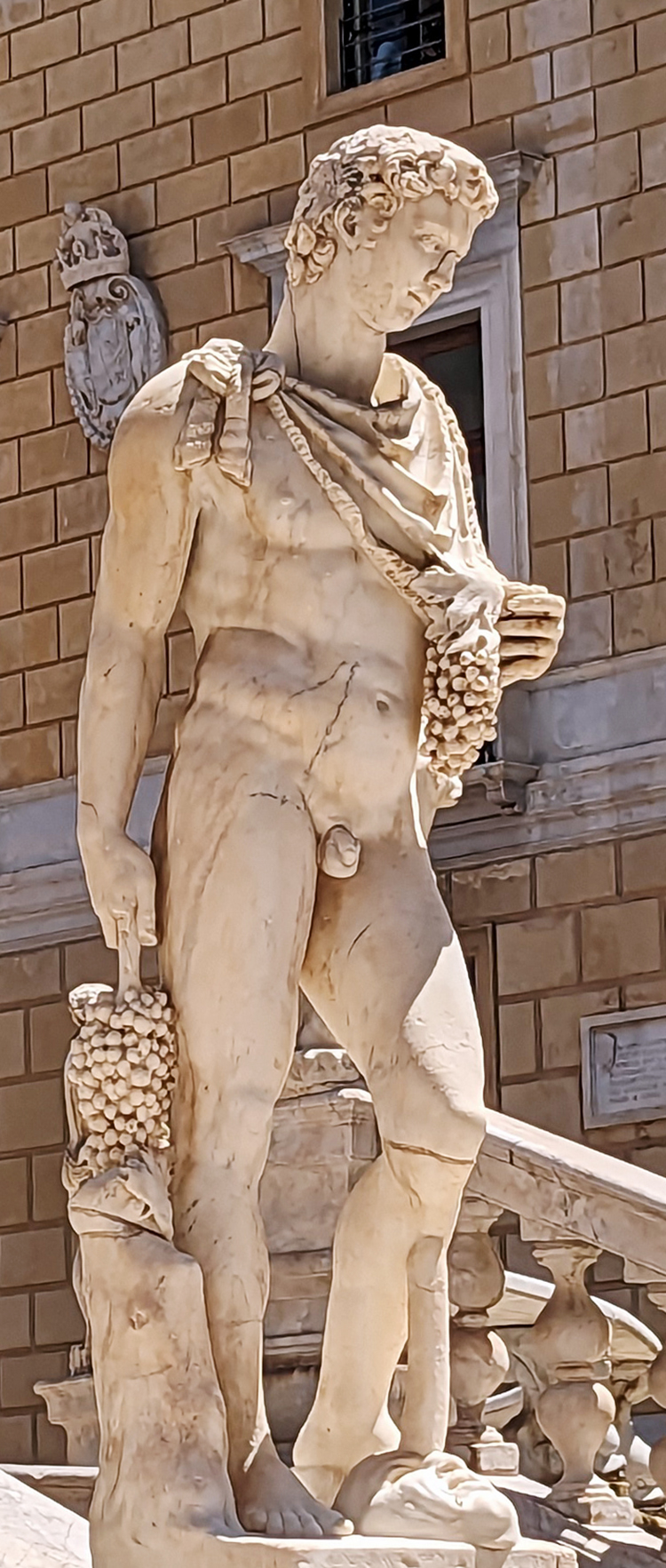
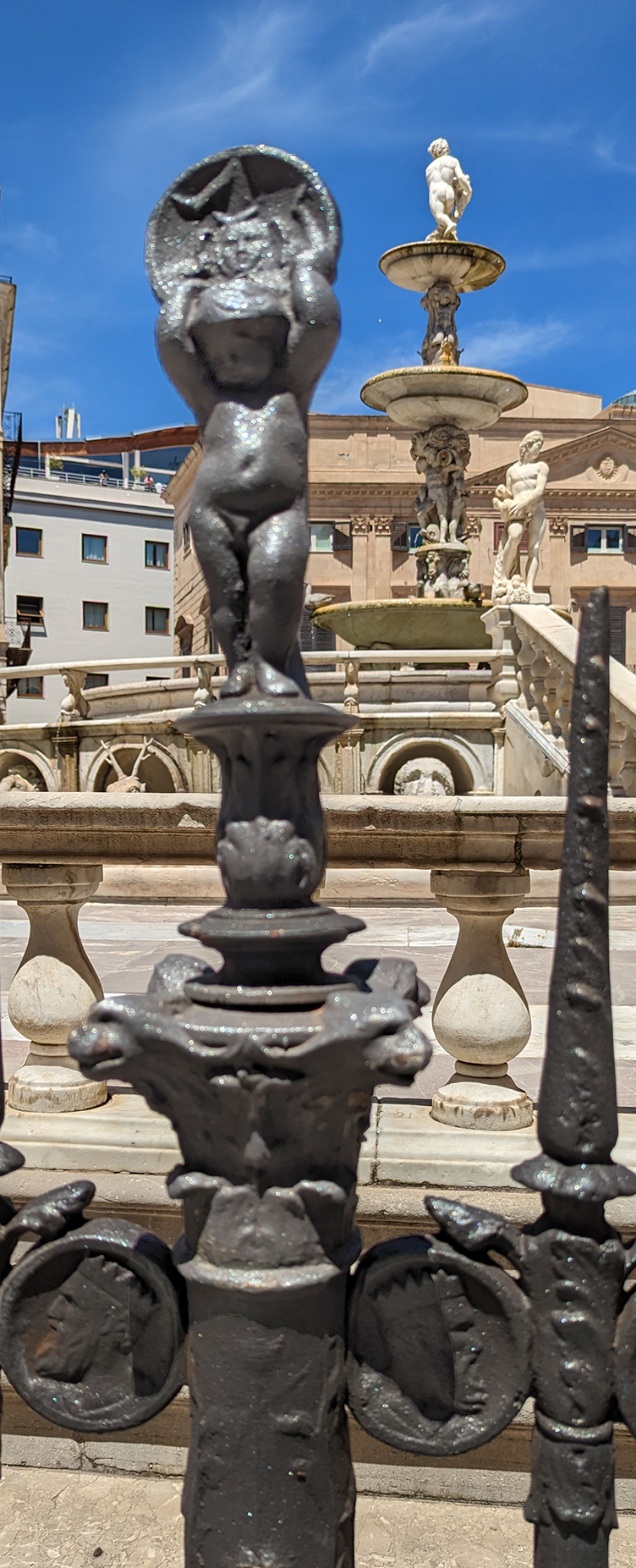


The assemblage was commissioned by the Spanish viceroy of Naples, Pedro Alvarez de Toledo y Zuniga (1484-1553), to grace the gardens of his villa outside of Florence. A 90-column arbor elegantly framed the fountain’s 48 statues. The Florentine sculptor, Francesco Camilliani (1530-1586), was putting the finishing touches on the work when his patron died.
With an estate in debt and and unable to support his lavish lifestyle, the viceroy’s son, Luigi Alvarez de Toledo, placed the spectacular fountain on the market. Officials in Palermo regarded it as the ideal ornamentation for an enormous new piazza.
The massive sculpture was cut apart for shipment by sea to Palermo. When the 674 pieces were delivered, the son of Francesco, Camillo Camilliani (?-1603), was commissioned to reassemble the three-dimensional puzzle. Camilliani enlisted the aid of Michelangelo Naccherino (1550-1622), who had helped his father with the project in Florence.
What the pair soon discovered is several statues never had made it on board. Several others were damaged beyond repair. Obviously, the fountain could not be rebuilt in exactly the same configuration. Somehow, they pieced things together in a new formation, slightly more oval than round.
According to The World of Sicily, an additional challenge faced was to make the Florentine statues and themes relevant to Palermo. This required the insight and creativity of a local – Sicily’s most famous poet, Antonio Veneziano (1543-1593). Symbols of four rivers of meaning to Florentines were transformed to represent four rivers near Palermo. With some figures from Greek mythology missing, repositioning their relationship might have necessitated some new versions of their stories.
I have read that the figure crowning the fountain represents Genio di Palermo, a pre-Roman deity of sorts believed to assist with the saintly protection of the city. As Genio is perched up high on the top basin of the fountain, it’s easy to miss identifying him by his traditional pose with a large snake in the process of devouring his chest.
The symbolic message conveyed by this is well beyond this blogger’s paygrade. Did words penned by Veneziano refer to Genio’s plight? Probably not, but women have been associated with serpents since Eve rose up out of the garden.
Although you try so hard to sever this my life,
Doing your very best to slaughter me,
Instead the greater challenge that you pose
Manages to instill in me greater resolve.
If you succeed in tearing me apart
Believe me, love, believe what I am saying,
That in each little piece of me, you’ll find
Your lovely mien reflected in my faith.
Antonio Veneziano
 Postcards from Barton Springs