

Above: Central detail of the main Gothic altarpiece, dating from the early 1500s, in Santa Iglesia Catedral Basilica Metropolitana de Oviedo
He who goes to Santiago and not to the Savior visits the servant and forgets the Lord.”
Back in the year 40, the apostle James was preaching in Zaragoza when the Virgin Mary miraculously floated down on a cloud to assist him with his efforts to convert pagans living under Roman rule to Christianity. Soon after establishing a chapel in her honor, James traveled all the way back to Jerusalem. His preaching incurred the ire of the King of Judea, Herod Agrippa (11 BC-44 AD), who had him beheaded in the year 44. Avenged as, according to Acts Chapter 12, Verse 23, King Herod Agrippa met his maker within the same year:
“…an angel of the Lord struck him, because he did not give glory to God. And he was eaten by worms and died.”
The head of Santiago, as James is known in Spain, is said to be entombed below the altar of the Armenian Apostolic Cathedral of Saint James, the church built on the site where he was martyred in Jerusalem. But what became of the rest of his body? As Santiago is the country’s patron saint, let’s go with the miraculous version. A band of angels arrived on a cloud to retrieve it, placed it in a simple boat and guided it to shore in northern Spain.
The angels then buried Saint James in a forest. There, he rested unmolested for almost eight centuries until a shower of stars guided a hermit to the grave. King Alfonso II of Asturias (760-842) journeyed from Oviedo to the site and ordered a chapel be built in the field of stars, Compostela. Santiago de Compostela soon became the major European destination for Christian peregrinos, pilgrims.
In the mind of King Alfonso the Chaste, the capital of Asturias, then Oviedo, was the point of origin for the pilgrimage route, Camino Primitivo. The seat of the archdiocese was a new church surrounded by his court.
This all leads back to the saying adopted during his reign appearing at the top of this post, pilgrims needed to stop to pay tribute at what became the Cathedral of the Holy Savior, San Salvador. And the king supplied prized religious relics to entice them to Oviedo.

The main star is an ark of major relics purportedly rescued by Christians fleeing Jerusalem in advance of a Persian invasion in 614. The treasured artifacts were transported through Egypt and across the rest of north Africa before their final landing spot in Spain. Chief among the contents of the agate casket, encased in gold embedded with precious stones, is said to be the Holy Shroud. Not the full-body one of Turin but a linen one placed over Jesus’ head after his death.
The bejeweled Cross of the Angels, so named because the workmanship was considered so fine only angels could have crafted it, was donated by King Alfonso II in 808. The cross is the symbol of the Cathedral and the city of Oviedo itself. Priceless.
But in August 1977, a different category of pilgrims passed through the doors of the Cathedral – three delinquents wandering the streets of Oviedo seeking easy targets to rob. When the priest locked the doors that night, the thieves remained hidden inside. Undetected.

According to Guillermo Guiter in La Voz Asturias, one of them, Jose Dominguez Saavedra:
“…had already stolen from churches when he was young, he knows that there is some easy money from alms and perhaps some objects of more value normally little guarded….
And… bingo. They come across relics…. They decide that they can’t take everything as it is and literally smash the Cross of the Angels, which weighs about three kilos and is reduced to pieces practically the size of a peseta…. They also dismantle the Victoria Cross and the Agate Box from their wooden frames; they pile up the gold and stones.”
According to Guiter, Dominguez brazenly returned to the scene of the crime that very night while television cameras filmed the archbishop lamenting the robbery. That curiosity did not result in his capture though.

Border guards stopped Dominguez as he attempted to cross into Portugal less than two weeks following the theft. After showing his actual identification card, he panicked, dropped the bag and fled. As police now knew his identity, Dominguez was not on the lam long before being captured.
Has a film been made about this blundered heist yet?
Hard to envision the immensity of talent possessed by the goldsmiths charged with reassembling the venerated crosses from the recovered Humpty-Dumpty-like fragments. Perhaps angels once again assisted.
Alfonso II also secured the relics of the body of Saint Eulalia, Julia in English, one of many Christians martyred during the reign of Roman Emperor Diocletian (242-312). Disobeying her parents request to keep her faith secret, 13-year-old Eulalia snuck out of her house in the middle of the night in the year 303 to travel into Merida. She strode into the tribunal to confront the judge and magistrates.
According to Thieleman van Braght’s 1660 book, Martyrs Mirror of the Defenseless Christians, the teen admonished “ye wretched men” for denying the true God to worship: “Isis, Apollo, and Venus are vain idols.” She challenged them to put her to death with other Christians. Of course, her confrontational attitude enraged the judges.
Still, they offered Eulalia a chance to deny her faith, but her response was to knock over the statuettes of Roman gods on the altar in the chamber. Van Braght wrote two executioners stepped forward and:

“…tore her tender limbs, and with cutting hooks or claws cut open her sides to the very ribs. Eulalia, counting and recounting the gashes on her body, said, ‘Behold, Lord Jesus Christ! …they are signs of Thy victory!…’
This she spoke with an undaunted and happy countenance, evincing not the least sign of distress, though the blood flowed like a fountain from her body. After she had been pierced through to her ribs with pincers, they applied burning lamps and torches to the wounds in her sides, and to her abdomen. Finally the hair of her head was ignited by flames, and taking it in her mouth, she was suffocated by it.“
One impressive version of her martyrdom claims a dove flew out of her mouth during her torture, frightening all present.
In the 17th century, an ornate chapel added inside the church was dedicated to Saint Eulalia, newly proclaimed patron saint of Oviedo. A nickel-plated casket displayed underneath the baldachin contains all that remains of Eulalia.
Walking around the exterior of the Cathedral of the Holy Savior reveals alterations and enlargements through the centuries, from square Romanesque tower on one side to the Gothic spire atop it. Much of the interior architectural alterations are Gothic in style. The main apse and chapels feature stunning gilded altarpieces covered in panels inspired by the New Testament or the lives of saints.
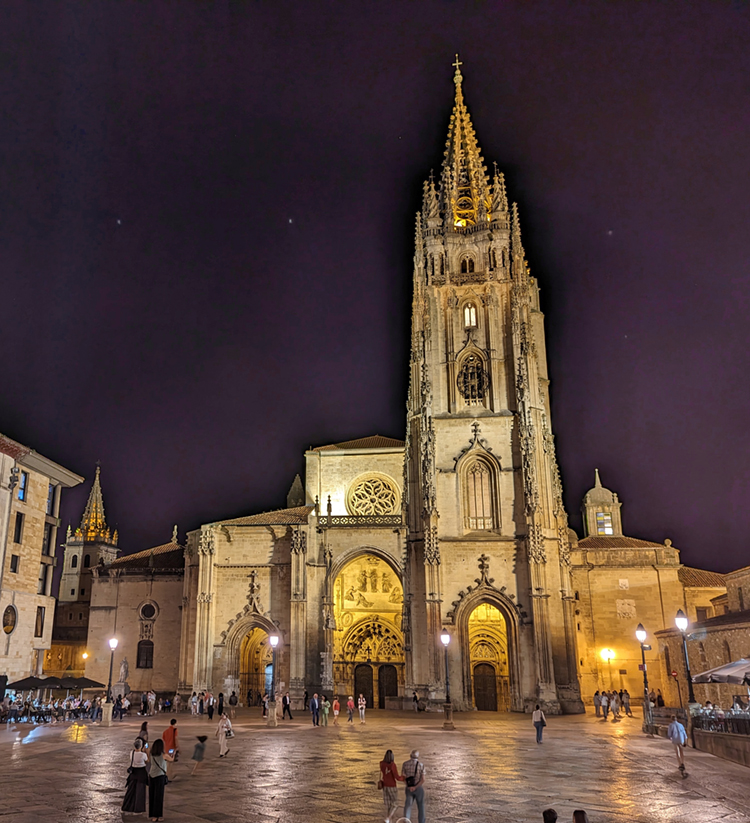


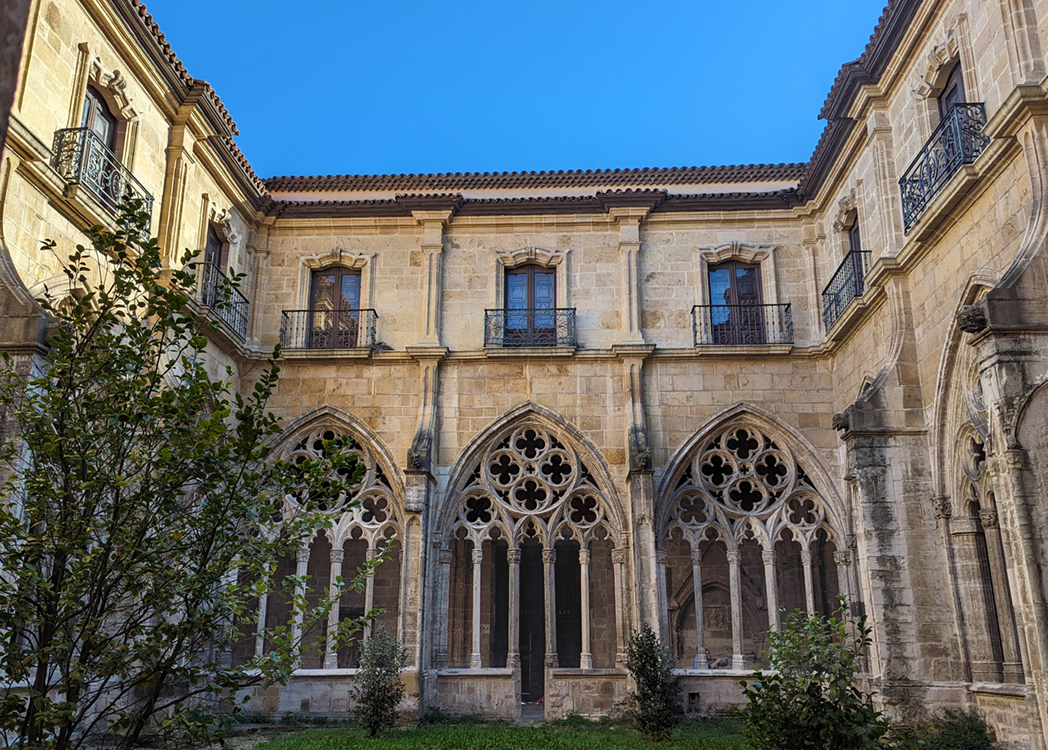


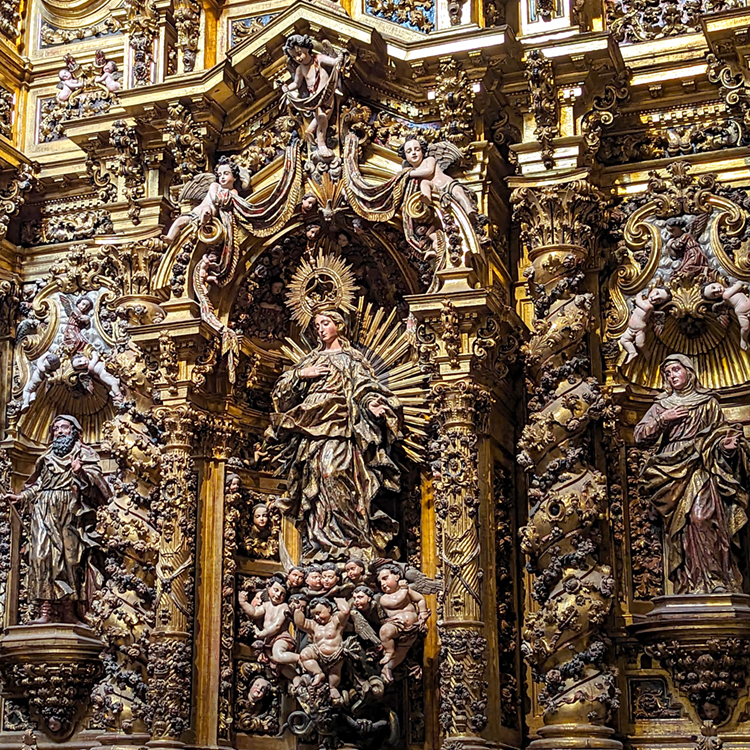


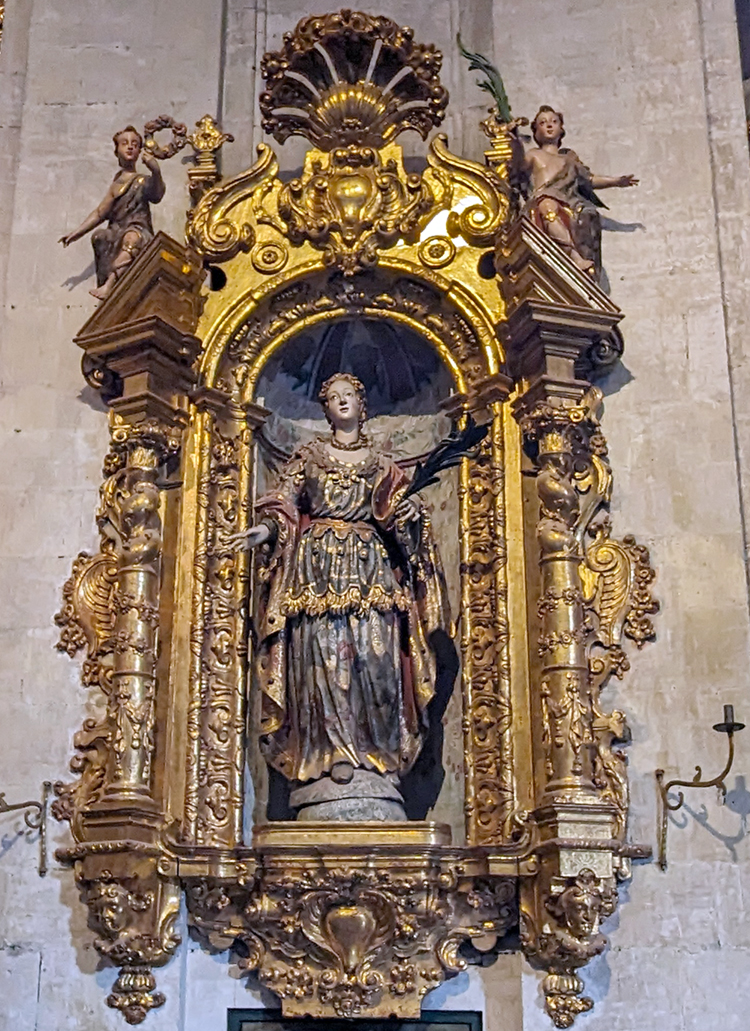
Above: Santa Iglesia Catedral Basilica Metropolitana de Oviedo
The altar dedicated to Saint Bartholomew made me realize that, while I might be able to name Saint Nicholas’ reindeer, I would flunk recalling all twelve apostles. The horrific version of Bartholomew’s martyrdom portrayed in the panel below is that he was skinned alive and then beheaded in an area of Armenia that is now in Turkey. In a gruesome nod to the removal of pounds of his flesh, among the saint’s many patronages are tanners, bookbinders, glovemakers and butchers. At least post-death, Bartholomew appears to have gained revenge upon a gagging demon chained underfoot.


Above: The flaying of San Bartolome
And that marks the end of this long-winded post. Well, except my inquiring mind wants to know…

Does Saint Mary Magdalene or Aquaman wear it best? Cast your vote below.

I tried, but I can’t resist pointing out the similarities of the gilded formal gown worn by Saint Mary Magdalene on the left and the gleaming scales hugging Aquaman while he battles to defend the lost kingdom of Atlantis.
First though, let’s set the record straight. The exaggerated rumors that Mary Magdalene was a tainted woman arose from a case of mistaken identity by Pope Gregory I in the year 591. It took almost 1,400 years to officially erase that stain, with Pope Paul VI proclaiming she was no sinful woman in 1969. Still, gossip persists.
Not to bias your opinion, but Aquaman’s skin-tight wetsuit leaves absolutely nothing to the imagination. Some might label that trashy. But Mary Magdalene’s graceful gown does nothing of the sort. It modestly drapes from the bodice to its full-length hemline. Are you in favor of some comic-book superhero or the saint?
Does the poor, wrongly maligned Saint Mary Magdalene wear this look the best? Please exercise your right to vote anonymously. Click on thumbs up for yes. Of course, it’s completely up to you to decide.
 Postcards from Barton Springs