

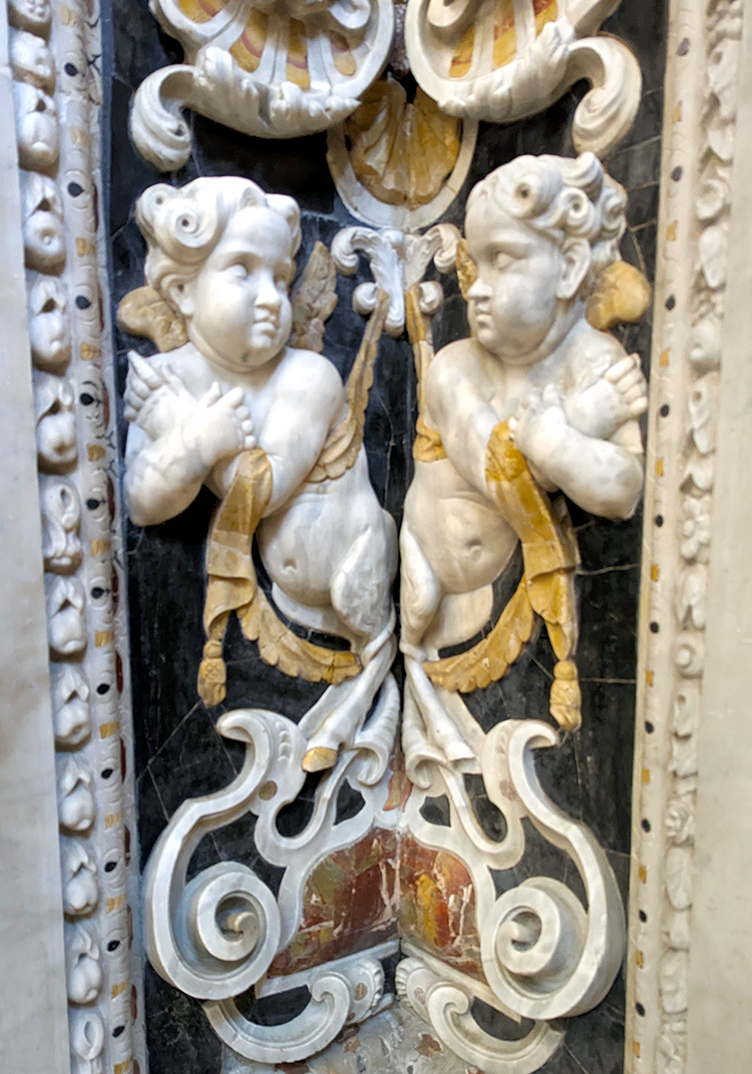
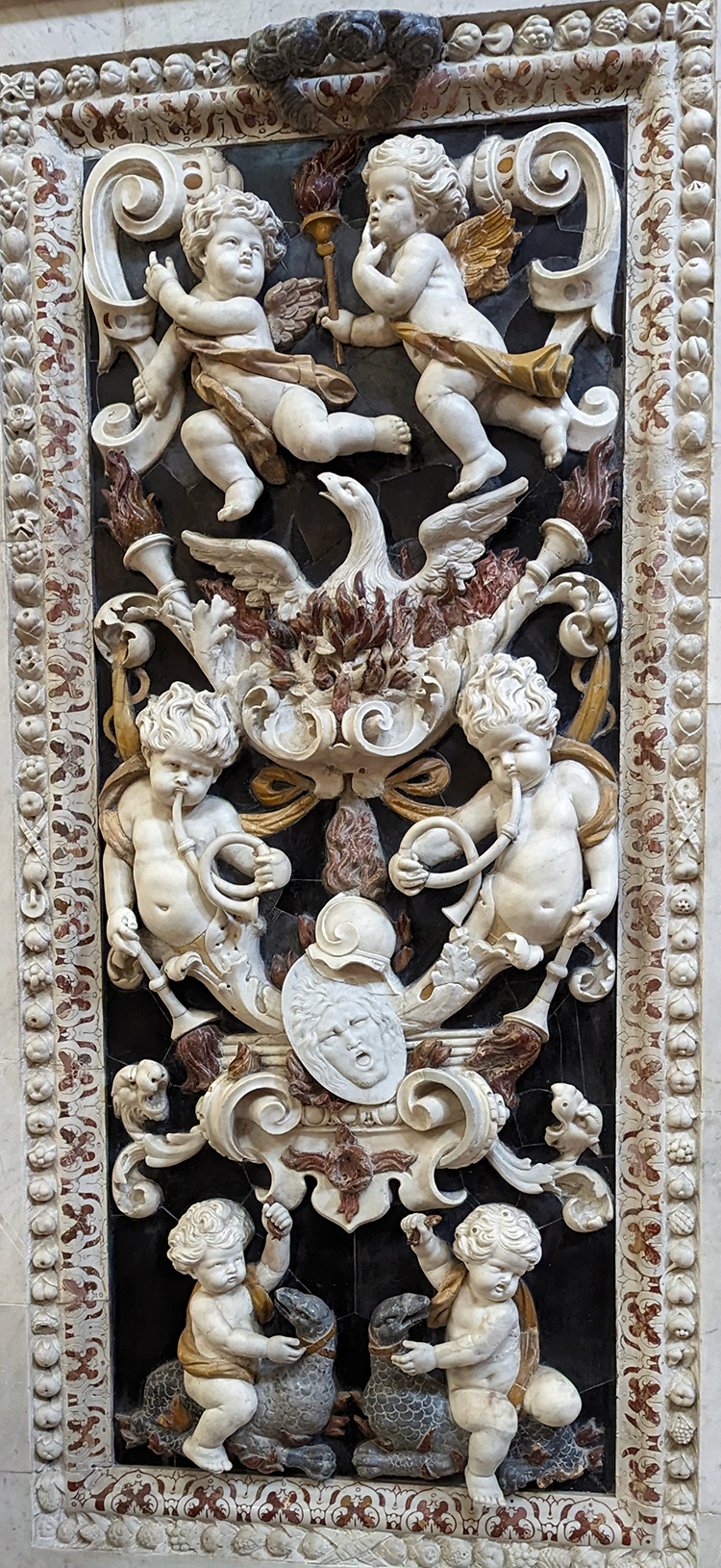
Above: Putti sculpted of marble in Chiesa del Gesu
Known as soldiers of God, Jesuits travel throughout the world to educate and evangelize the masses. They take a vow of poverty when they enter the order, which makes the extravagant beauty found in their churches particularly surprising.
The website of Chiesa del Gesu explains their evangelization efforts through art with words of Saint John of Damascus (676-749):
If a pagan comes and says, “Show me your faith!” take him to church and show him the decoration with which it is adorned and explain to him the series of sacred pictures.
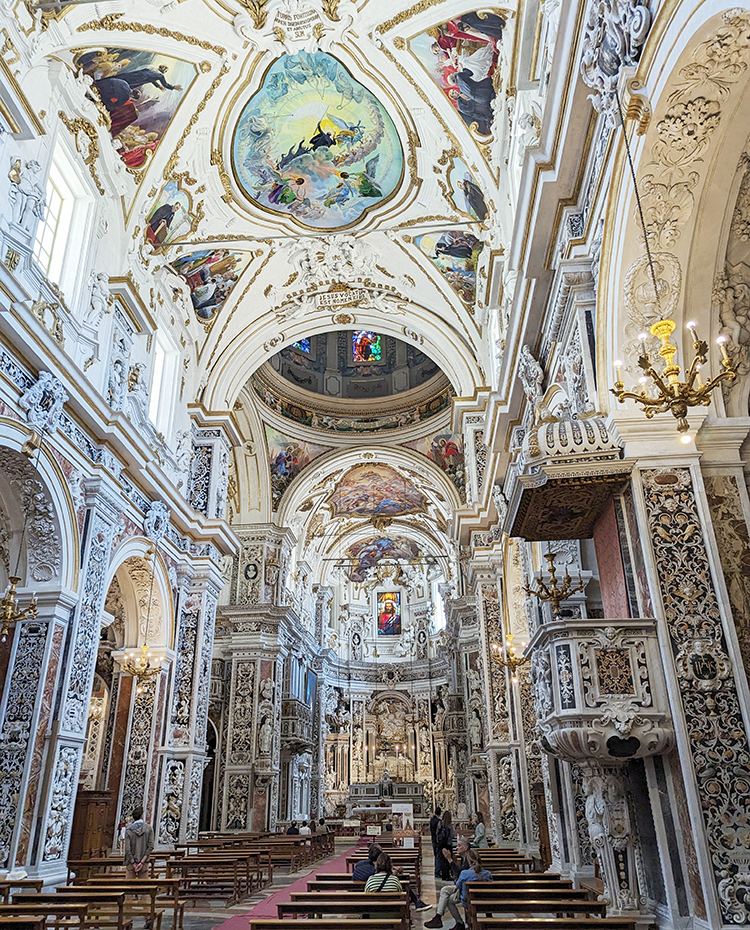
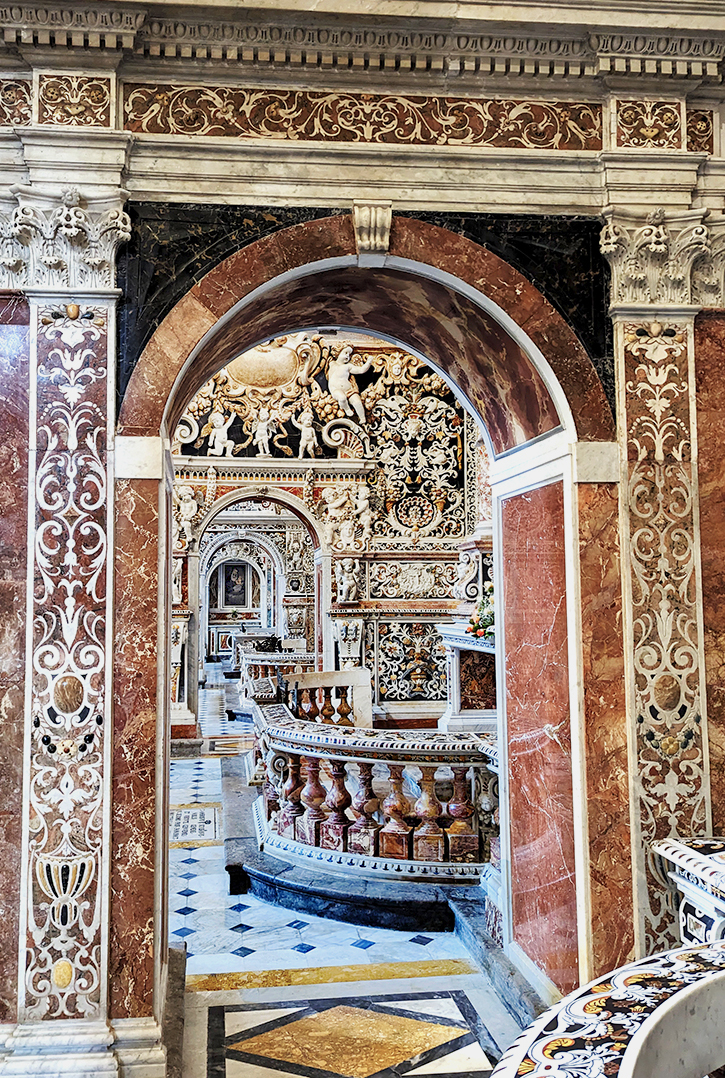
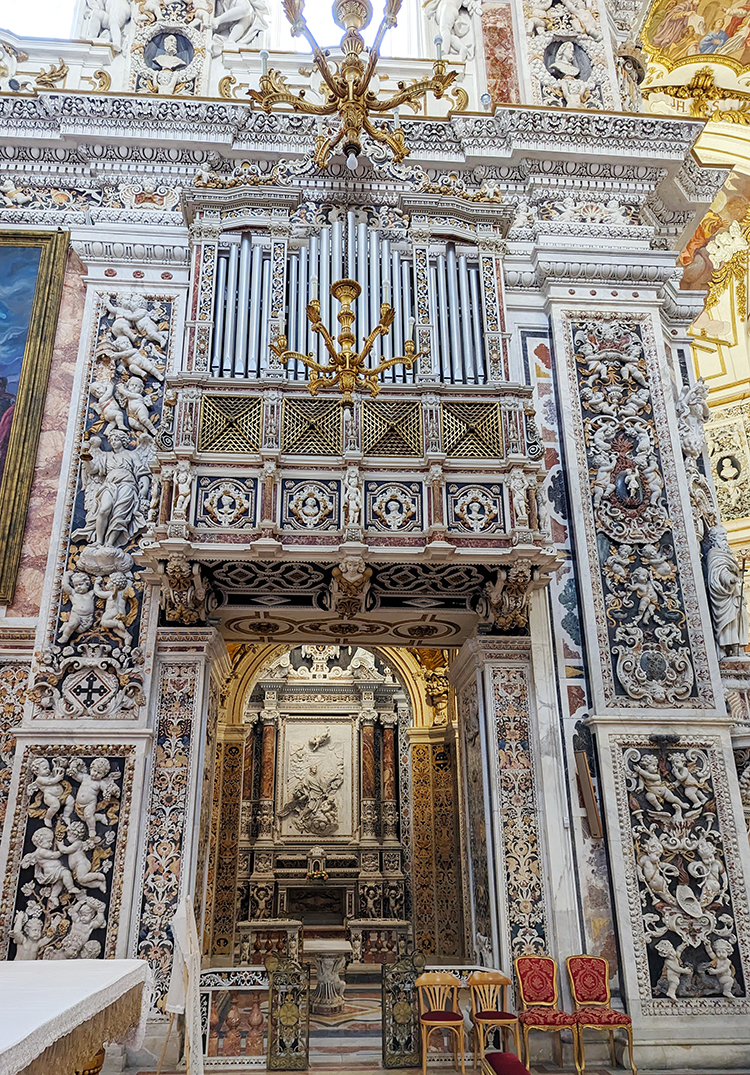
Chiesa del Gesu is a prime example of this – simple on the outside but with such flamboyant Baroque flourishes and decoration that it’s amazing they did not go broke. Construction of the church was begun in the late 16th century, and it was enlarged and further embellished in the 17th.
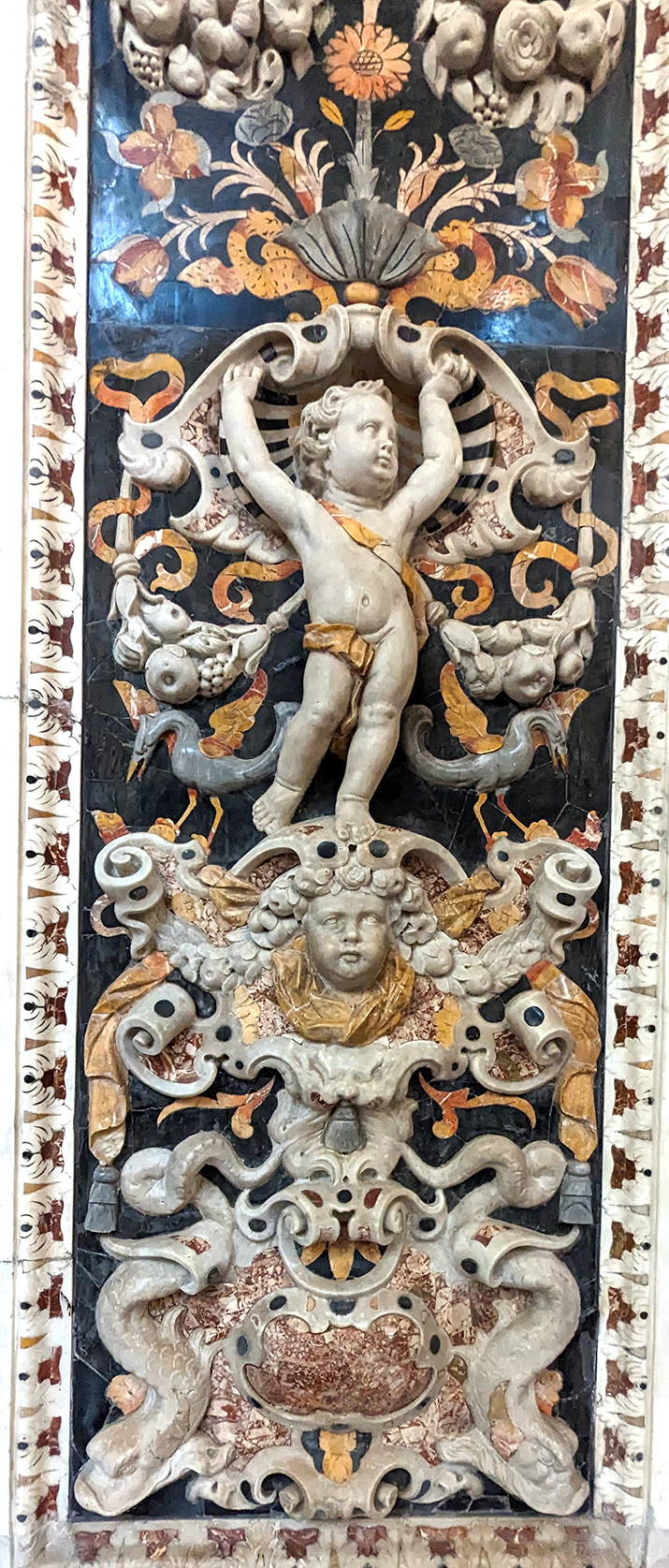
While from a distance all of the marble sculptures and colorful inlaid work covering the walls look repetitive, closer examination reveals that the army of putti are not just flitting aimlessly around. Each individual putto contributes to stories presenting teaching opportunities the Jesuits could employ to enlighten visitors about the mysteries of the Church.









Only a century after the completion of the dome, the Kingdom of the Two Sicilies expelled the Jesuits. King Charles III of Spain (Charles V of Sicily) (1716-1788) feared the Jesuits were inciting citizens to revolt against his royal authority. Following the Napoleonic Wars, Pope Pius VII (1742-1843) restored the right of the order to return to Catholic countries in Europe in 1815.
Unfortunately, Palermo’s importance as a port city servicing the Axis Powers made it a prime target for repeated bombing attacks by the Allied forces. While their intensions were mainly to strike the port and harbor, much of the center of the city was impacted. After Palermo was captured by the Allies on July 22, 1943, Italian and German forces commenced bombing the city. In 1943, the continuous bombardment collapsed the dome of the Jesuit church. The dome was rebuilt and the church restored, finally reopening in 2009.

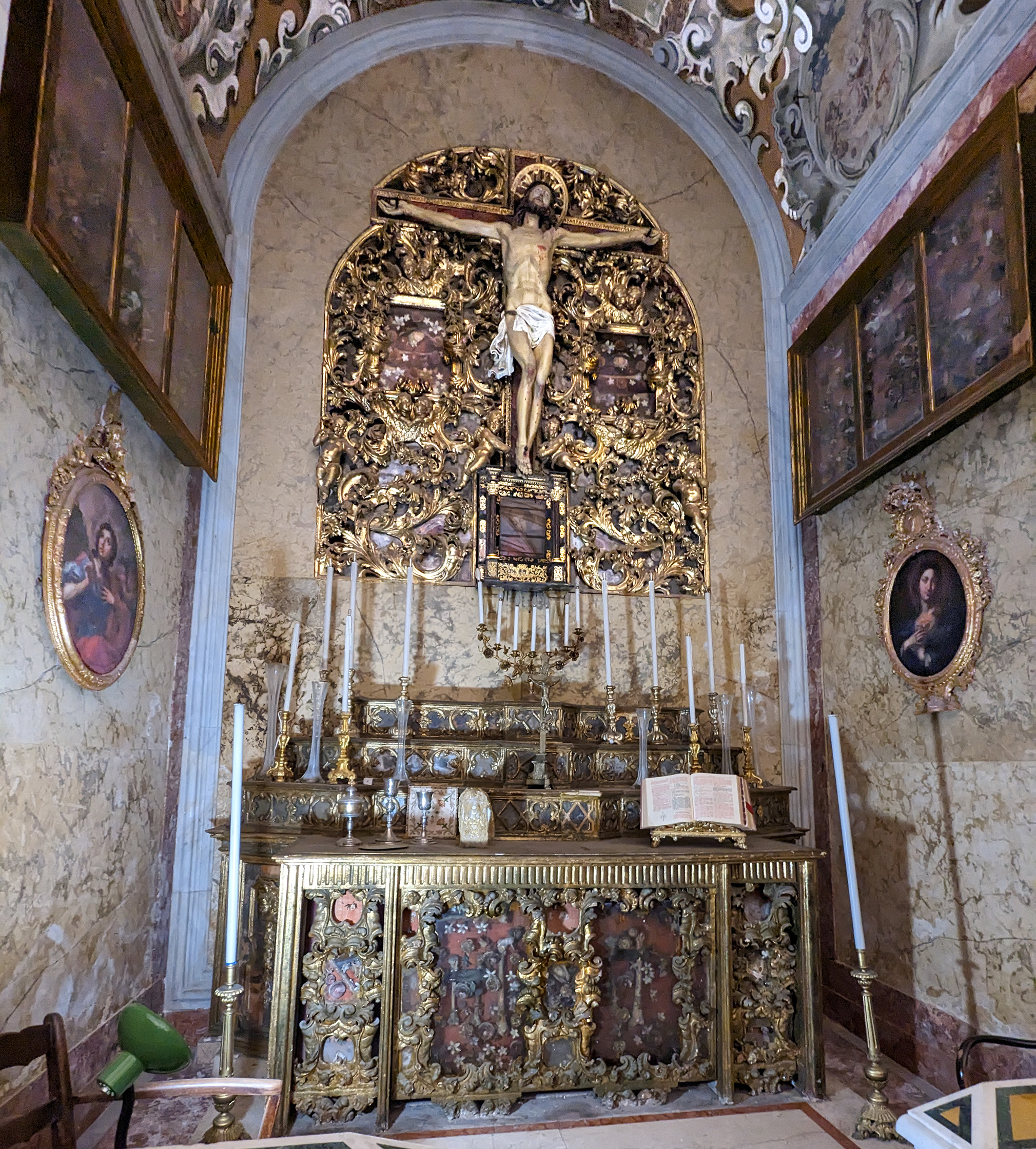
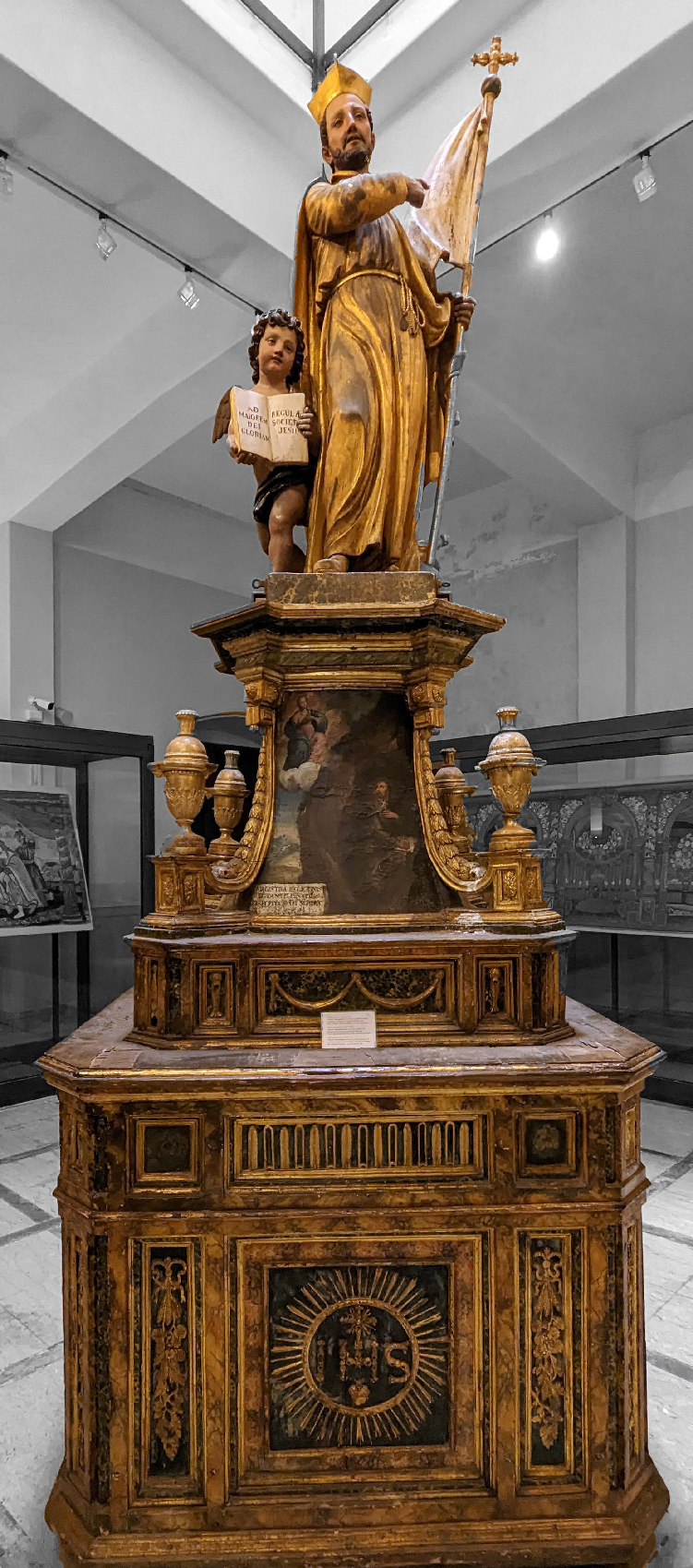
Only one of us (not I) descended into the crypt below the church, which does not appear an exciting one to view when amidst all the splendor above. But that is not to say that there is a lack of saint’s bones to be found in reliquaries throughout the church and the adjacent museum housed in Casa Professa, the former quarters for the resident Jesuits.
One that calls attention to itself is labeled as a relic of San Francesco Saverio (1506-1552), Saint Francis Xavier in English, a Spaniard who was one of the original seven Jesuits to take a vow of poverty. He traveled extensively in his missionary role, primarily in Asia, and is said to have left a string of miracles in his wake. The patron saint of missionaries was canonized less than a century after his death on the island of Shangchuan, China, an outpost of Portugal at the time.
Aside from his forearms, most of his incorruptible remains lie intact in an ornate glass and silver casket in a basilica in Goa, India. My online sleuthing is a little confused by this, but I believe this is the forearm the saint used to bless the faithful. It was severed in 1614 and displayed in the Chiesa del Gesu in Rome. While I know that arm traveled to Canada in 2018, perhaps it is visiting Palermo now?


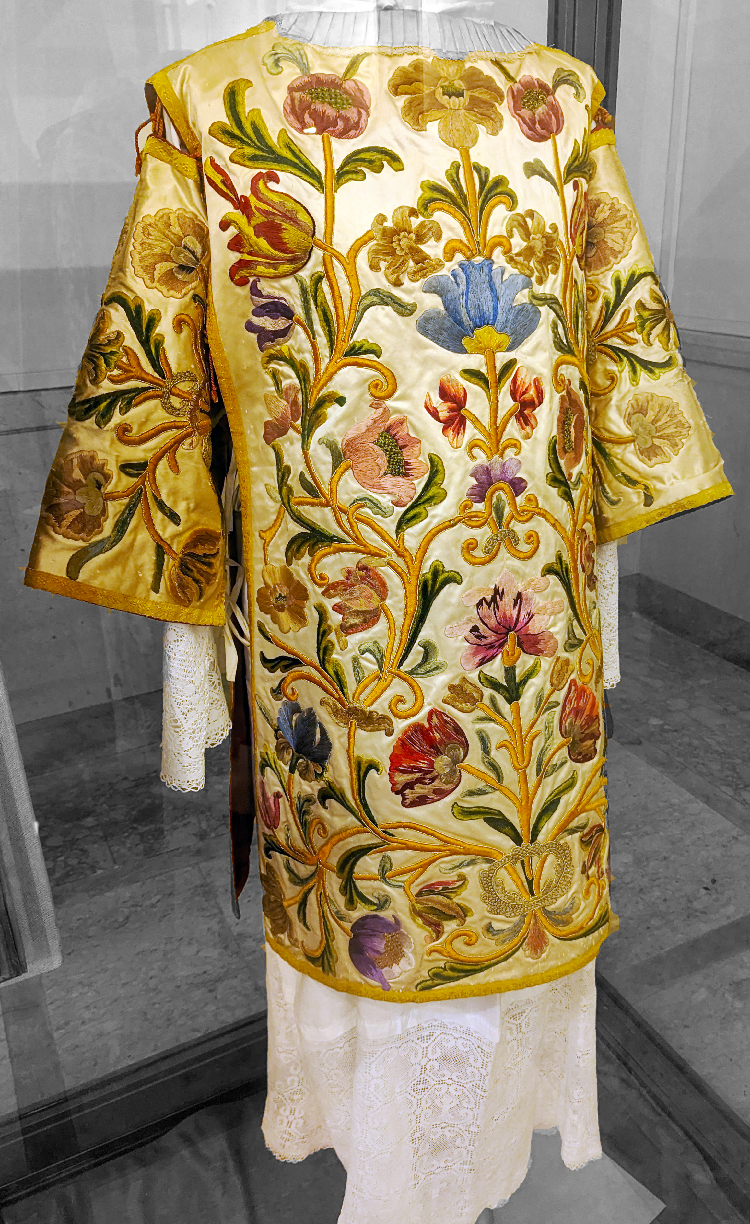
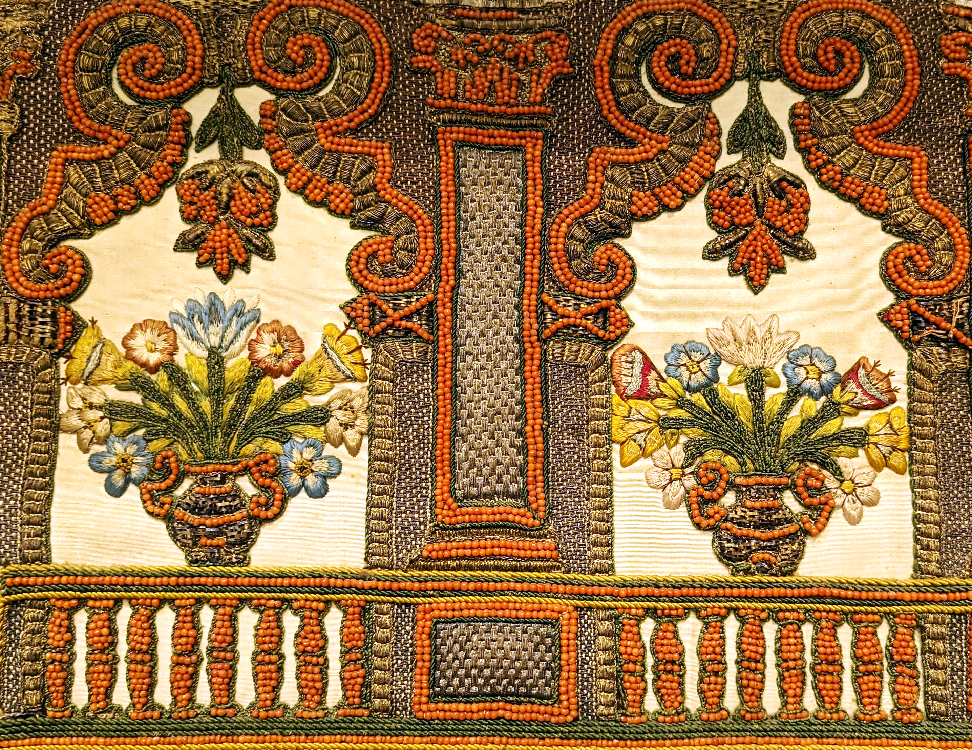
Flowers and wildlife, as tenderly rendered as the illustrations in a Beatrix Potter book, are captured in a majolica tile mural in Casa Professa. Several of the photos below are close-ups of parts of a long piece of jute covered with designs primarily rendered in metallic thread and coral beading.


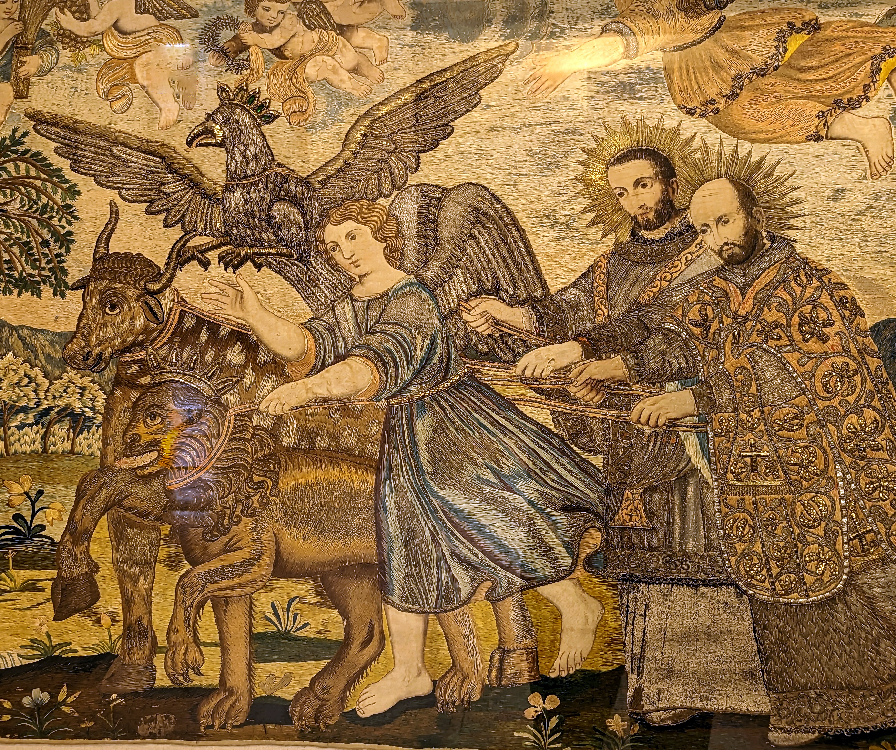

A reproduction of a painting by Giuseppe Bagnasco (1807-1882) hangs in virtually every school and institution founded by Jesuits, but Casa Professa is home to the original depicting forty Jesuit missionaries who were martyred on the high seas off of Santa Cruz de La Palma, Canary Islands.
Setting sail in 1570 from Lisbon, the proselytizing missionaries were headed for Brazil. Their ship was waylaid by vessels under the command of pirate Jacques de Sores, who already had earned the moniker “The Exterminating Angel” following his 1553 looting and burning of Havana. No quarter was offered the Jesuits, the pirate unimpressed by their doctrines and their missionary zeal in spreading them. The priests were slaughtered, dismembered and thrown into the sea, turning the surrounding water red with their blood.
As the popularity of Jesuits in Rome ebbs and flows with the tide of Vatican politics, the forty were not beatified until almost three centuries later.
The website of Chiesa del Gesu further explains the important role artistic beautification of a church continues to play today:
In Europe and in a good part of the Western world, religiosity experiences a strange paradox: the more society is called “secularized,” the more interest in the great religious monuments that history has scattered in our geography grows. Visits to the great monasteries, cathedrals and churches of the great Christian tradition continue to increase, and religious tourism is one of the few sectors that does not suffer from the crisis. The less you go “to church,” the more you go “to churches.”
While the artistic beauty and mystifying displays of relics definitely serve as potent magnets pulling this tourist through the doors of church after church, they have not yet managed to entice me to attend Mass. But I do appreciate the art and the history contained within, so I hope time allows me to cross the threshold of many more.
 Postcards from Barton Springs
Extraordinary. It does se
LikeLike
Eric – I’m not sure how you are sending your comments, only a word or two actually gets entered. Would love to hear your thoughts and feedback though. Thanks.
LikeLike