

Above: Santa Lucia holy card superimposed over silver milagros displayed in Cattedrale della Nativita di Maria Santissima
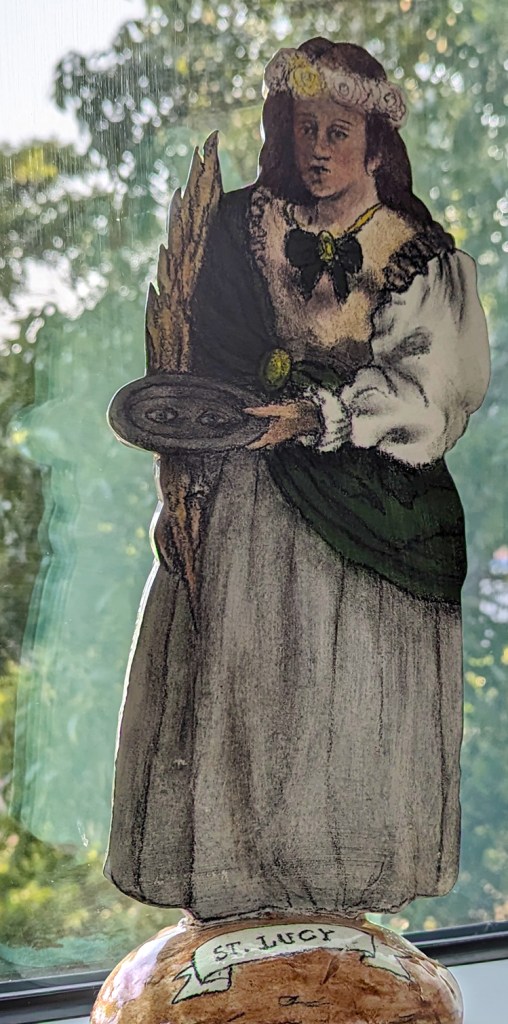
She stands guard on the windowsill by my desk as I write. As the patron of eyesight and authors, Saint Lucy (283-384) has long been a favorite of mine. Both near-sighted and far-sighted, I’ve worn glasses since the second grade. And certainly my writing needs all the help it can get.
Having lost sight in my right eye a year ago, it seemed serendipitous that one of the spots the Mister planned on staying, Siracusa, turned out to be her hometown. A church dedicated to the saint, Chiesa di Santa Lucia alla Badia, was a block away from our rental – a proximity presenting an opportunity to soak up some of Santa Lucia’s goodwill to protect the left.
Her father, a wealthy Roman nobleman, left her mother Eutychia a widow when Lucia was five. At the time, Christianity was outlawed by the Roman rulers, so the two practiced their beliefs in secret. Lucia’s faith was fervent, leading her to pledge in her prayers to consecrate herself to serve God, remain celibate and distribute her dowry to the poor.
Eutychia, though, had promised her daughter’s hand to a suitor. When her betrothed heard Lucia was sharing the dowry he dreamed of having with the poor, he betrayed her by telling the Roman authorities about her Christian beliefs.
The Roman authorities sentenced Lucia to be forced into prostitution in a local brothel. But divine intervention rendered the Virgin as immovable as a boulder, despite the soldiers’ repeated efforts to budge her to carry out the sentence. Thwarted, they gouged out her eyes and set her ablaze. But Lucy proved impervious to the flames so they resorted to ending her life by thrusting a sword through her throat. Upon retrieving her body, family and friends found her eyes restored.
Under the patronage of Queen Isabella of Spain (1451-1504), a church and female Benedictine monastery were built on the site of the house of prostitution where Lucia was sentenced to live. The catastrophic earthquake of 1693 destroyed this church, but it was rebuilt with its façade changed to address the Piazza Duomo. Above the Baroque portal of Chiesa di Santa Lucia della Badia, a sword symbolizes her martyrdom and a crown her virginity.
I thought I should head there almost as soon as we arrived. Alas, the church has been deconsecrated, a feeling sensed immediately. Despite the ceiling fresco and the large painting above the altar depicting moments in the saint’s life, I felt disappointed.
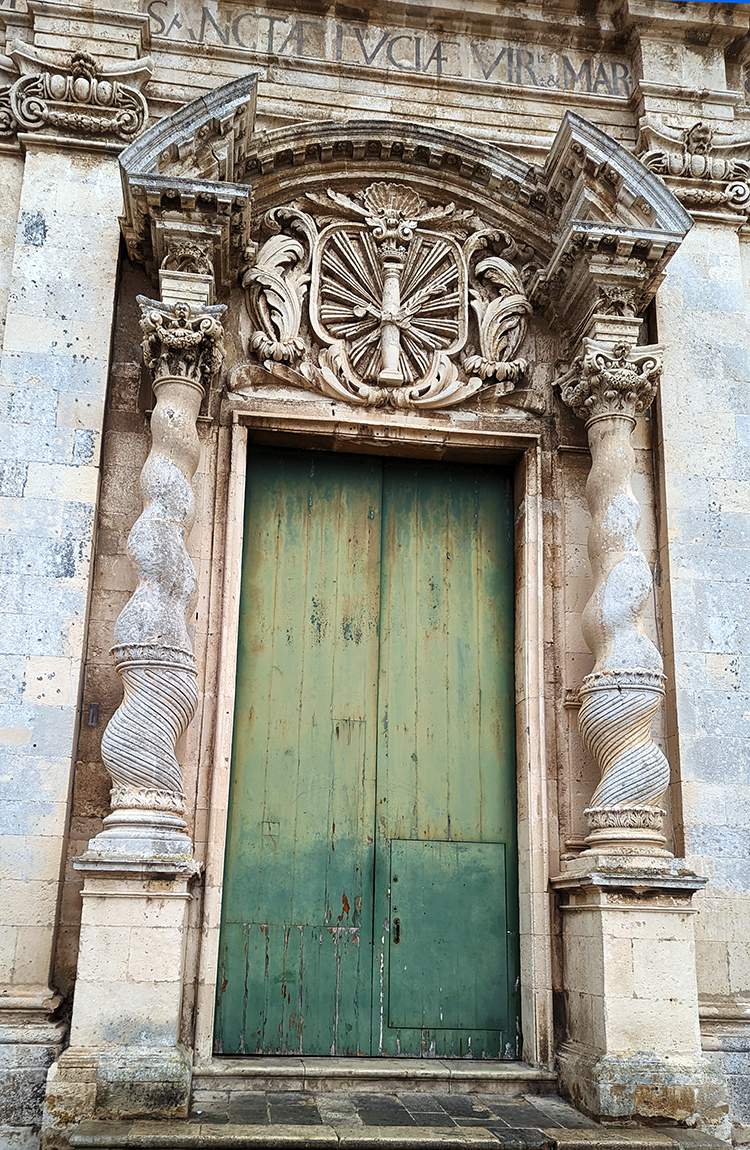
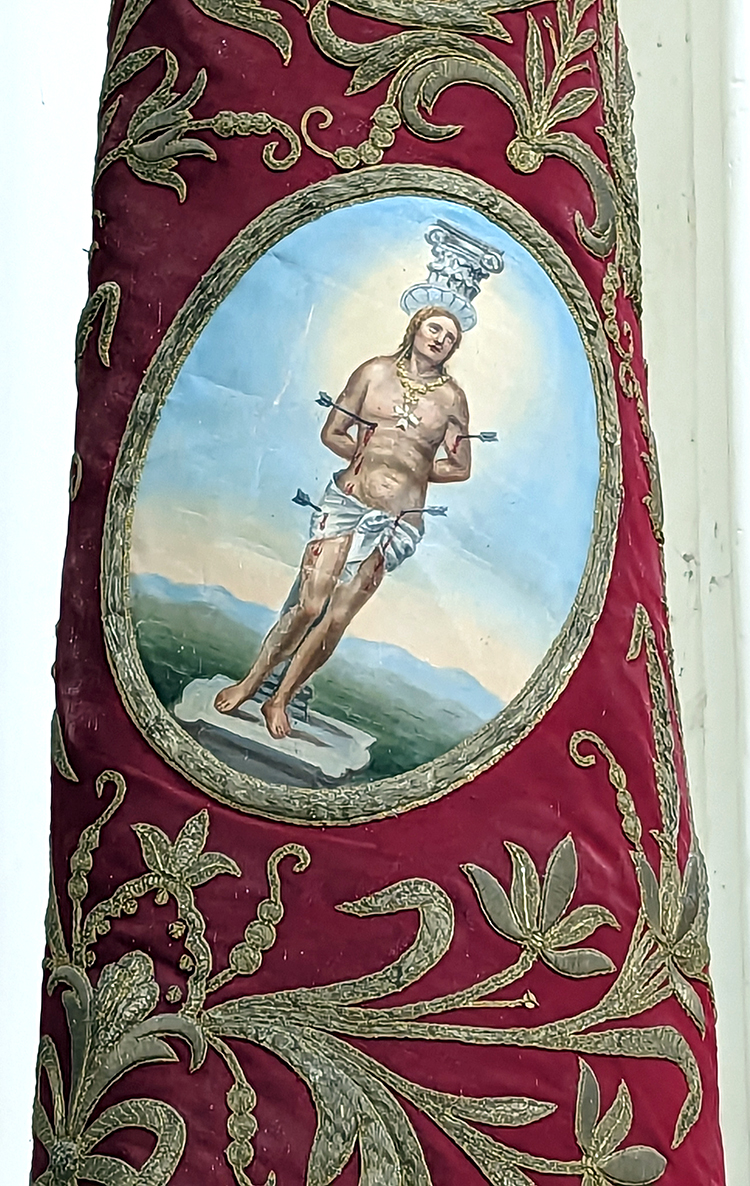
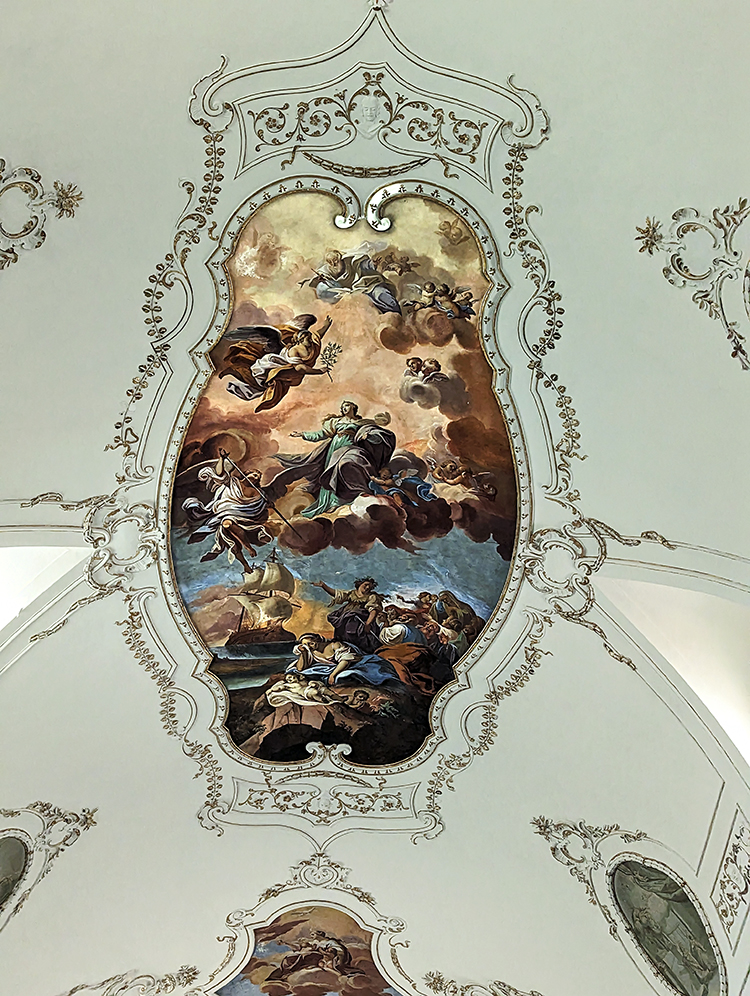
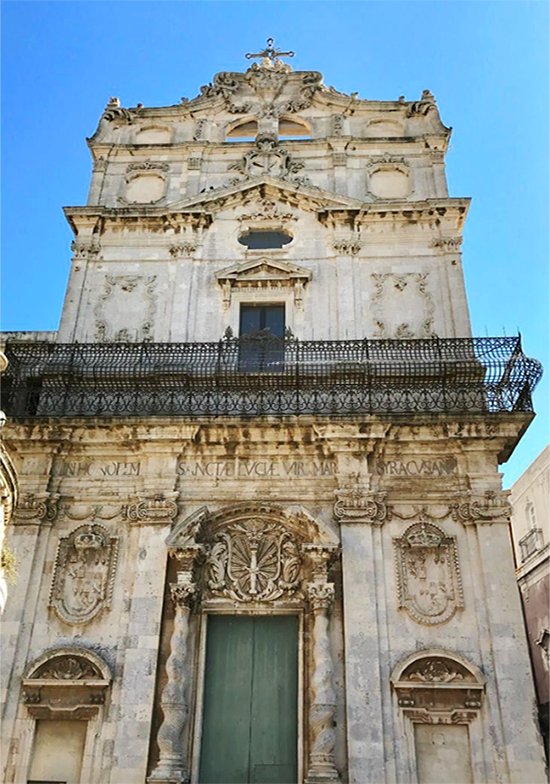
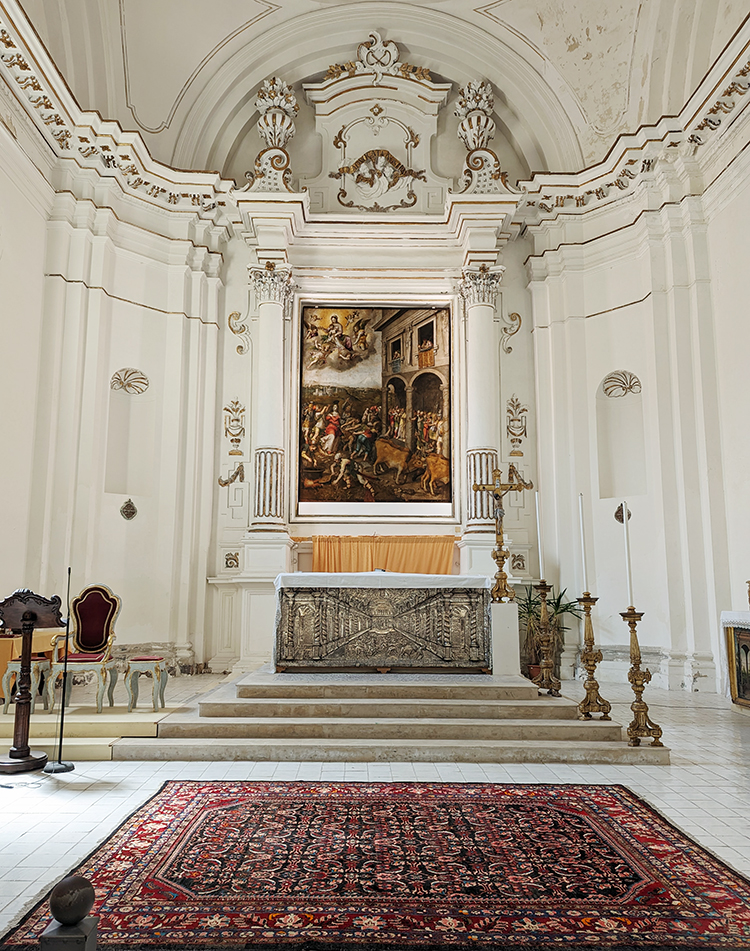
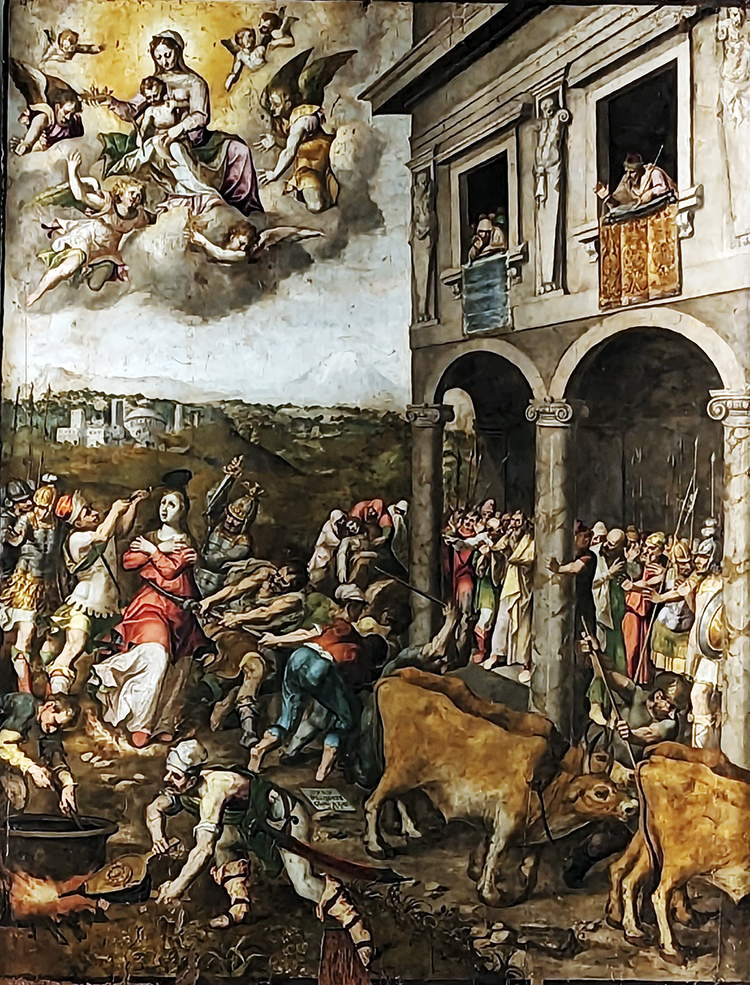
Above: The deconsecrated Chiesa di Santa Lucia alla Badia
But looking for Lucy did not stop there. We made a pilgrimage on foot to the mainland to the basilica marking the spot of her martyrdom. Built in 1100 by Normans, the original design was modified numerous times, in addition to alterations caused by the earthquake referenced above.
The basilica contains a major painting by Carvaggio (1571-1610) – “The Burial of Santa Lucia.” Frequently in legal troubles, Carvaggio painted the altarpiece while temporarily seeking refuge in Sicily to avoid a death sentence imposed on him on the mainland. We would have loved to see “The Burial” but found an actual funeral service at the time of our visit.
Although, there was the sepulcher bearing her name next door. The remains of Lucia were kept in Siracusa for four centuries until the Duke of Spoleto confiscated her remains for a church in Abruzzo. As different factions competed for the popular saint’s relics, she moved around a lot. Siracusa held out hope for their return and, in the 17th century, erected an octagonal temple atop existing catacombs to house her remains. But the majority of Lucy was never returned to Siracusa.
The sepulcher does house a life-size statue of Santa Lucia reclining. Sweat miraculously oozed from the sculpture, according to legend, to express Lucy’s sorrow for the residents of her city during the 1735 Spanish siege of the city a century later.
Although her skull was separated from her body as a gift for King Louis XII of France in 1513, most of Santa Lucia’s relics eventually made their way to Venice. She rested in the church of San Geremia on the Grand Canal for a century, but, in 1981, two men stormed into the church, shattered her glass urn and stole the bones before the priest could stop them. Several weeks later police recovered them on her feast day December 13, so they were returned to the Venetian church. That would seem a logical time to transfer them to the waiting tomb in Siracusa, but, alas, no.
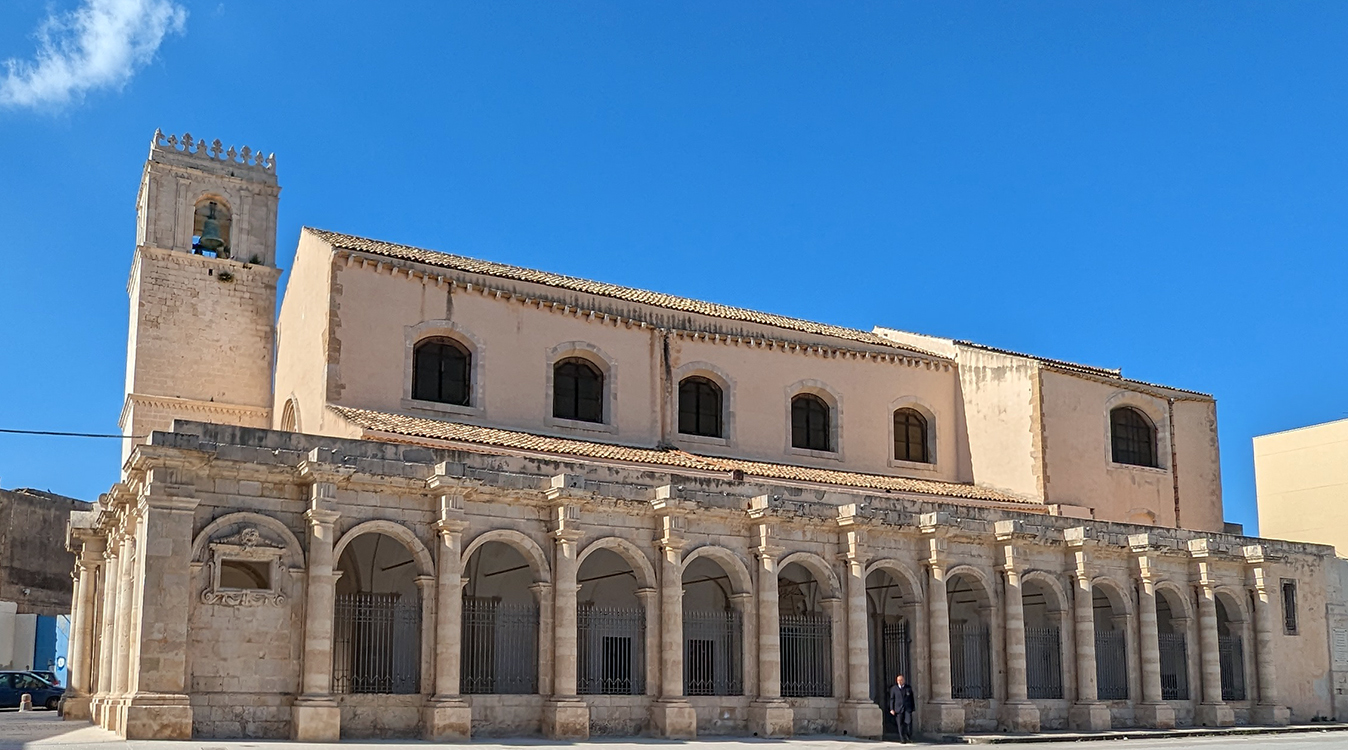
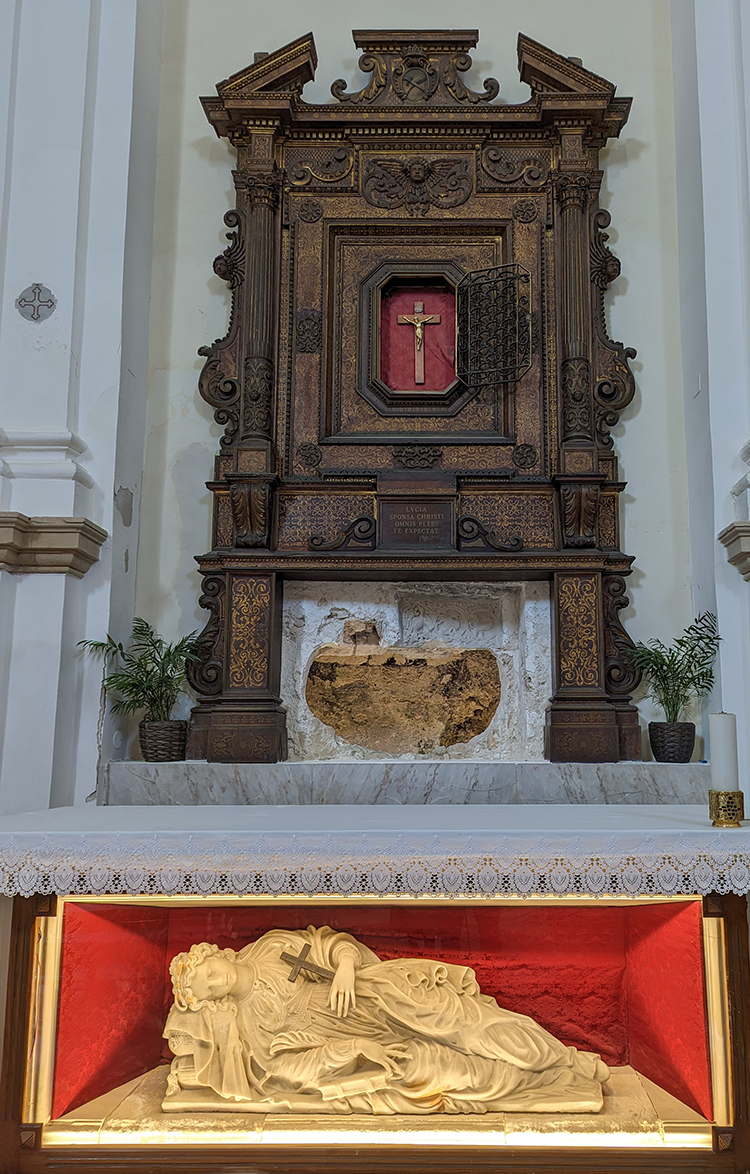
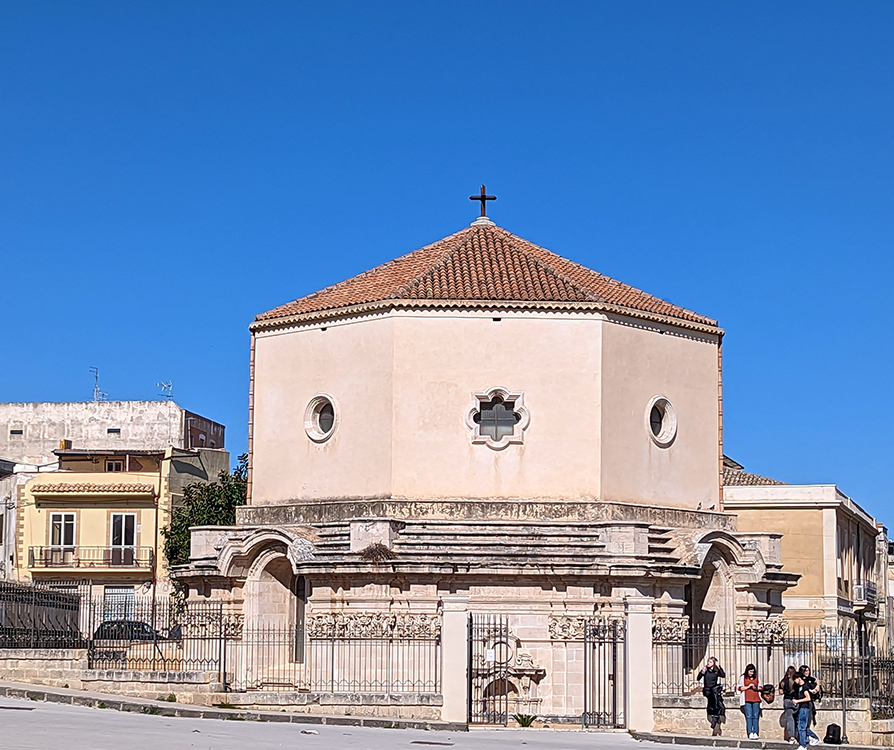
Above: Basilica Santuario Santa Lucia al Sepolcro
Trying to find a time when there weren’t school field trips filing into the church, we had waited a while to visit the Cathedral. Much to my surprise, that seems more like Lucy’s home. A chapel by the front door is dedicated to her.
Beautiful milagros of gold and precious gems are displayed in glass cases; a silver urn enshrines part of the humerus of her left arm; and there is even a dress she wore. I don’t know how these made their way to Siracusa. Maybe someone tapped her ruby red slippers together three times to send them all home.
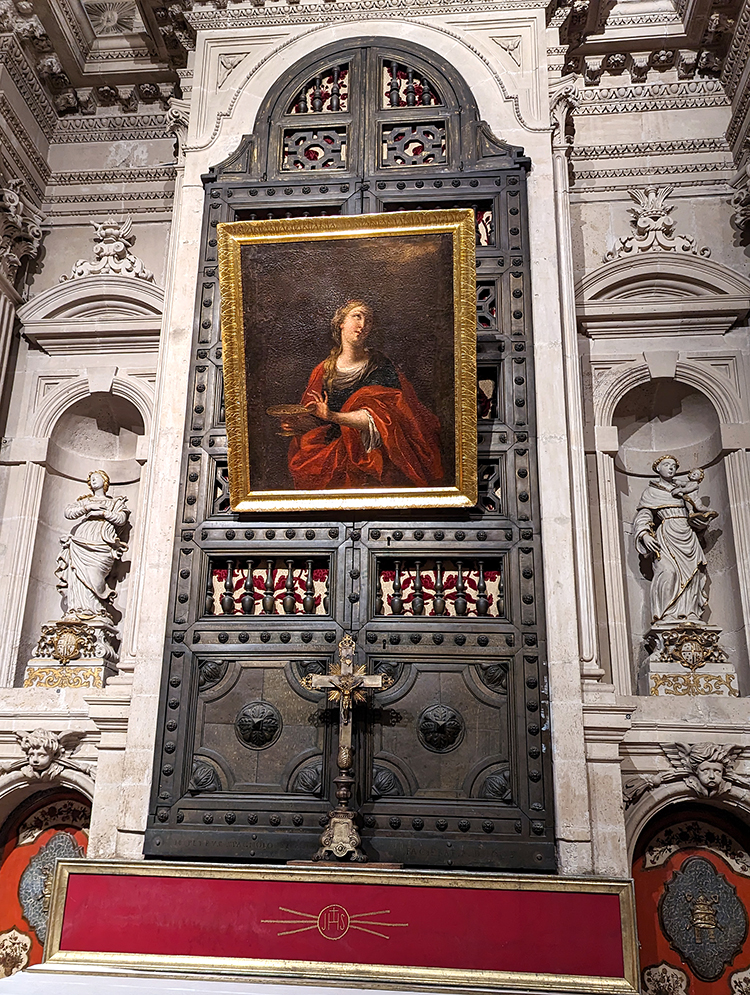

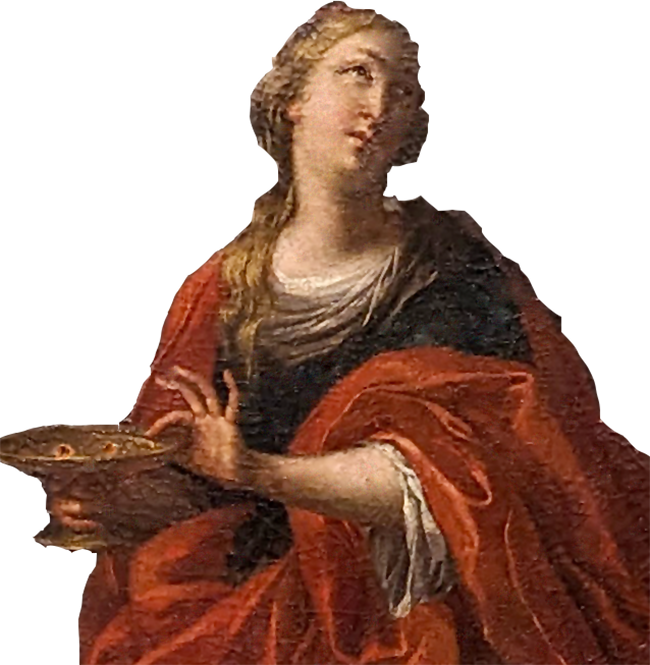
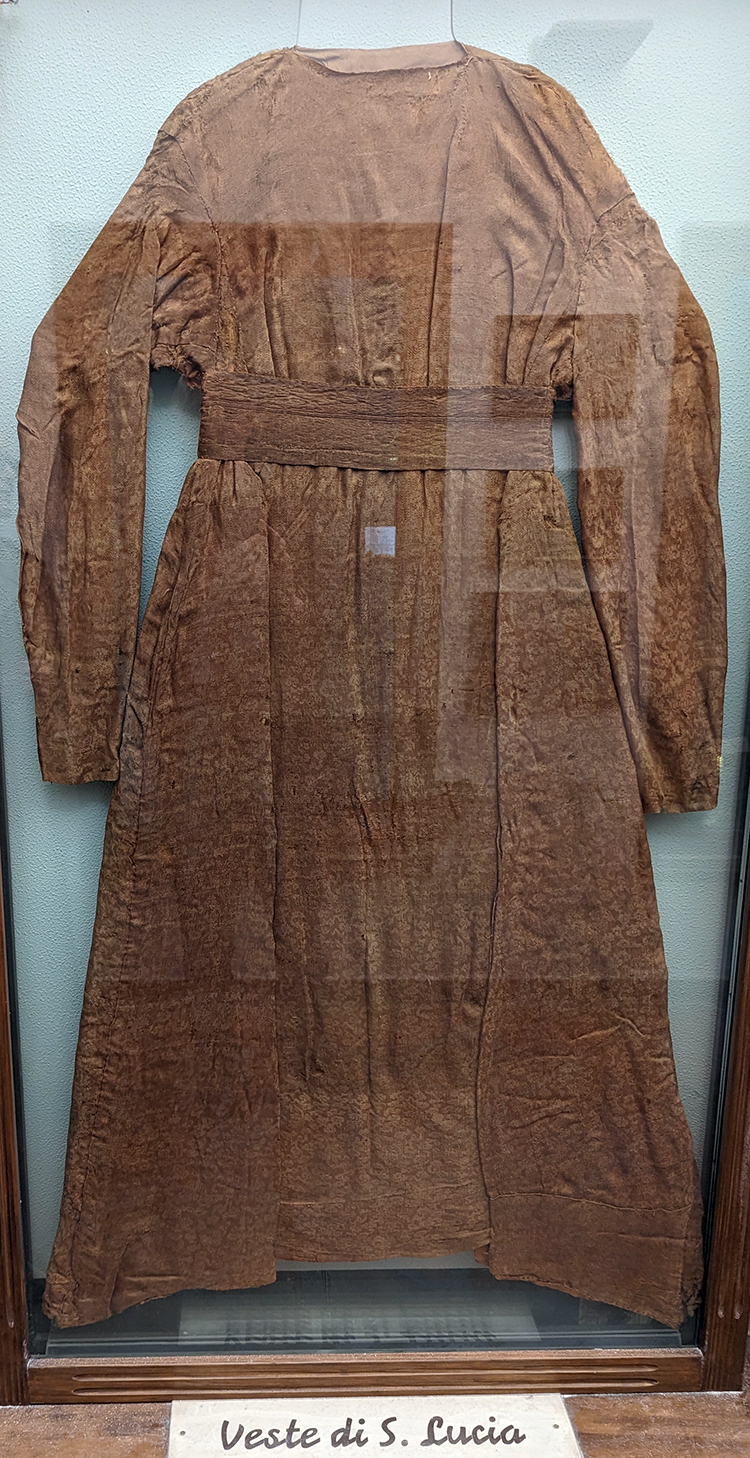


Above: Cattedrale della Nativita di Maria Santissima
Somewhere in the vaults of the Cathedral or inside Santa Lucia of the Sepulcher there is large silver statue of the saint that contains three fragments of her ribs in her chest. This emerges and is paraded through the city of her feast day in December. The statue also is carried aloft on the first Sunday of May to celebrate Santa Lucia’s intercession to alleviate the city’s famine in 1646. As people gathered in the Cathedral praying to her for help, two ships bearing grain suddenly appeared in the harbor. A quail, symbolizing the Holy Ghost, swooped through the church to proclaim the miracle attributed to Santa Lucia.
The famed tenor Enrico Carruso (1873-1921) was among the many artists to record “Santa Lucia,” but I’m opting instead to choose the Elvis version. I would love for someone to share with me the plot line that led him to sing this in the film “Viva Las Vegas,” but here it is.
Hopefully, with all these efforts I made in pilgrimage, Santa Lucia mercifully will protect my left eye for the duration.
 Postcards from Barton Springs