As 2016 begins, you, once again, have given me an excuse to write about whatever strikes me. Your favorite posts on this blog during the past six months are as random as the thought process of the writer pecking at the keyboard.
Thousands of eggshells from February’s Cowboy Breakfast are recycled annually by volunteers from the San Antonio Conservation Society who stuff them full of colored confetti, transforming them into cascarones to crack over the head of revelers at A Night in Old San Antonio. During NIOSA alone, 200,000 cascarones are cracked. Can’t imagine what the overall total is for the entire 11-day run of Fiesta San Antonio, April 16 through 26.
Although San Antonians continue to exuberantly embrace the more than 100 events packing the calendar, few pause to remember the origins of Fiesta. The festival was founded as a salute to the Texian victory at the Battle of San Jacinto on April 21, 1836.
Perhaps a reporter, though, writing a century ago in the San Antonio Light best summarized what the annual event means for natives: it transports San Antonians “from the prosaic, work-a-day world to a wonderful fairyland” – a ten-day escape from reality.
King Antonio I, 1915, San Antonio Light
The year 1915 was the first year the king assumed the name of King Antonio. Following his ceremonious arrival aboard a whistle-blowing Southern Pacific train, Dr. T.T. Jackson’s chariot drawn by six milk-white horses transported him to Alamo Plaza to kick off Fiesta San Jacinto.
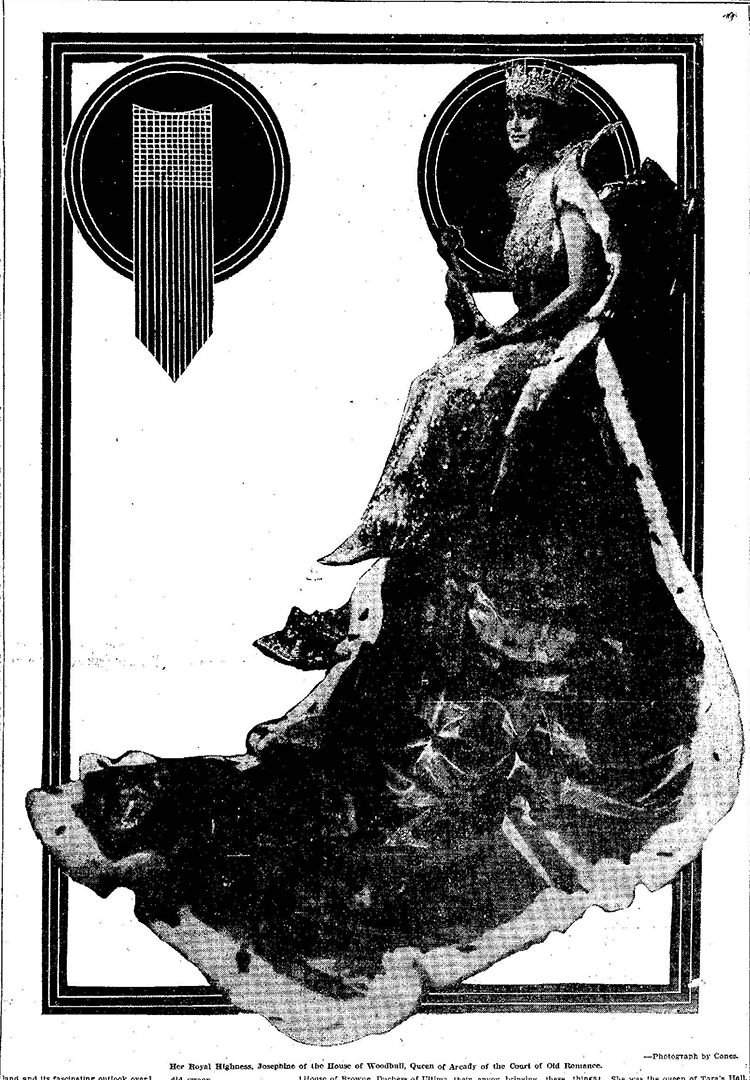
Queen of Arcady, 1915, San Antonio Light
Later in the week, Josephine Woodhull was crowned as “Her Majesty, the Queen of Arcady” at the Majestic Theater. She wielded her scepter over the “Court of Old Romance.” Edged in ermine, her peacock blue velvet train was embroidered heavily with gems, shimmering as a peacock’s feathers.
Numerous parades filled the week, including the “Pageant of Caliph,” a burlesque night parade staged by the Fiesta Association. The first float in 1915 bore the “Duchess of Frijoles,” satirizing the high society coronation of the prior evening. Politicians, local to international, received “a goodly share of ‘guying,’” including a “Floating Vote” float with politicians portrayed aboard as “pulling the strings.”
A century ago, the Battle of Flowers Parade represented the high point of the week, with floats and carriages laden with thousands of fresh flowers. During the mock battle circling Alamo Plaza, even visiting Governor “Pa” Ferguson was pelted with flowers.
Somehow, the flower-pelting tradition was allowed to continue, despite its tumultuous first year. The following is pulled from a post from several years ago. Sarah Reveley transcribed the description of the 1891 melee from an April 25, 1891, edition of the San Antonio Daily Light:
…The procession contained over 100 carriages and other vehicles, all gaily decorated and many containing decorations of real artistic merit. Mr. Madarasz’s carriage, decked in pure white lilies and variegated grasses, with honeysuckle was plain, pretty and neat. Col. H. B. Andrews’ pony phaeton, with four Shetlands drawing it, was exquisite, and J. J. Stevens’ children in a four-in-hand Shetland surrey, representing a yacht, was also very pretty….
On arriving at the plaza the police divided the procession into two lines, each half going in opposite directions and passing around the park were brought, face to face with each other. The crowd on foot pressed the carriages closely and the fight began and waged furiously for nearly an hour. The occupants of the carriages had all the ammunition while those on foot had none. They began picking the fallen roses from the pavement, and even tore off the trimmings of the carriages, and soon had the best of the fight. Heavy bunches of laurel thrown soon had their effect, and many ladies lost their temper and used their carriage whips indiscriminately on the crowd. One lady struck Mr. Doc Fitzgerald, a passive spectator, a severe blow on the face with her whip, but did not see fit to apologize for her mistake. Mr. H. P. Drought made an ugly cut with his whip into the crowd…. One young angel with white wings appealed to the crowd for protection from the missiles saying, “I wish you men would make them quit….”
The police were powerless to keep the people off the park beds, and prevent them from tearing off the flowers. One outright fight occurred. Mr. Phil Shook, one of the horseback party, lost his temper, and cutting a man in the face with his riding whip, was assaulted, and a fist fight on the pavement resulted. Both combatants were arrested by the police. Mr. Charley Baker used his umbrella for defense. While the crowd was very dense on the plaza, waiting for the procession to come along, Mr. Cristoph Pfeuffer’s splendid team and carriage took fright on South Alamo street, at an electric car. The carriage was decorated and contained several ladies, a child and the driver. Dashing into Alamo street, past and into the crowd of people and vehicles, it overturned a buggy and horse at the corner, and its driver jumped out and was dragged under the carriage by the lines. The lady on the front seat caught one of the lines and held it, but the horses made straight for the crowd of women and children in the park and struck a very deep mass of them, it being impossible for them to move out of the way. The ladies were thrown out and their clothing was badly torn. One little boy was knocked senseless, another was bruised, and one little girl had her apron torn off. Other children were trampled by the frightened people. The plunging horses were secured and the carriage was taken to a side street….
Some irrepressible small boys arranged a dog fight in the midst of an interested crowd of spectators, during the battle, and a regular stampede ensued. Some of the combatants whose supply of ammunition had exhausted, resorted to buggy robes and quirts for aggressive warfare, and umbrellas and parasols for the defensive….
The battle was a success, but if it is given next year, more police will be needed, carriages must not be allowed on the plaza at all, and the participants must not lose their temper.
In June of 1920 I received the degree of Bachelor of Arts with Honors in Mathematics and Economics, a title which, coupled to the name of Lucius Mirabeau Lamar the Third, was of such resounding grandiloquence as to bring from the assembled students faculty and families (who else would be there in the boiling muggy Texas sun?) a burst of applause embracing, I knew well enough, a component of irony. It did sound good, as some of the movie false fronts look good, but there was mostly air behind it.
From Shards by Lucius M. Lamar, 1968
And this before Lucius M. Lamar, III, (1898-1978) added a law degree.
It is not surprising someone so willing to self-mock would choose a conscientiously pretentious name for the protagonist in a pride-before-the-fall, the-grass-is-always-greener, be-careful-what-you-wish-for fable, So Doth a Little Polly, woven for his five-year-old-niece and seven-year-old nephew.
Jesus Francisco de Assisi Sensontle.
This tale of a San Antonio mockingbird did not bow to monosyllabic rhyming words first-graders could read. No, it was a vocabulary-stretching story rippling with multiple layers of bicultural meaning and accompanying music ranging from “Hinky Dinky Parlez Vous” to Handel.
Sensontle, or Don Sensontle as he preferred to be called, wintered on Alamo Plaza, convinced he reigned over all other feathered creatures. He believed his singing so awe-inspiriting he was “astonished at his own virtuosity” (Notes in the margin recommend the accompaniment of a toy flute here.).
One day a sparrow, Cecil, asked if Sensontle had read the recent news from Austin in the paper:
“A gentleman never reads,” replied Sensontle with dignity, being innocent of that clerical accomplishment.
“Perhaps not,” went on Cecil, ignoring the implication….
The news Cecil the sparrow was trumpeting was that the mockingbird had been proclaimed the State Bird of Texas.
Pompous pride over this tribute soon led to a downturn in Sensontle’s popularity among the birds of the plaza (pompous chords followed by a fast march).
Frustrated, Sensontle flew to a home on Zarzamora Street to visit his caged cousin, Maria Ysabel Dolores Soledad Sensontle, “a handsome and engaging young fellow, whose somewhat effeminate name had been bestowed by his captors under a misapprehension as to his sex.”
Yearning for an easy life, Sensontle negotiated to change places with his cousin for a year.
youtube video posted by zxtkain
A year later Maria returns and perches on the branch of a fig tree near his former cage. Sensontle desperately pleads:
“Kindly release me.”
“Come,” said Maria, “your morals have improved at the expense of your manners. You should ask no labor of me until I have got my wind.”
“I ask nothing save the fulfillment of your promise, which is a sacred duty you should perform at once, tired or not. Be quick, let me out!”
The end of the story is missing, scattered somewhere amongst the shards left in the wake of closing the Mister’s parents’ household. Lost. Along with copies of other “children’s” works produced by Lucius, including “Hardboiled Harry.”
We are hoping the Mister’s great-uncle passed the stories down orally to his own children and are mailing “So Doth a Little Polly” to his daughter tomorrow.
Please. Let us know if Sensontle lived to fly freely lording over the Alamo once again….




 Postcards from Barton Springs