Postcard from the Coker Settlement: Following long gestation, book finally due to arrive

haunting the graveyard

cover designed by Andréa Caillouet; cover photo courtesy of Virginia Heimer Ohlenbusch

Birthing a book can be a long process, but to say the gestation period for Haunting the Graveyard: Unearthing the Story of the Coker Settlement has proved elephantine is no exaggeration. A female elephant’s pregnancy only lasts two years. This birth has taken much longer.

But labor has been induced, and the hefty 400-page baby will be delivered at 5 p.m. for a signing/reading celebration at The Twig Book Shop at the Pearl on Tuesday, September 10.

A lady’s handbag was my first introduction to the Coker Settlement more than a decade ago. As I sat on the carpet of a conference room on the 30th floor of a downtown office building surrounded by stacks of ephemera-filled boxes, the purse was the first thing to catch my eye. So I opened it. The pocketbook belonged to Minnie Tomerlin Voelcker (1904-2000).

last farm standing on buttermilk hillMy nosiness was at the invitation of attorney Banks Smith, a trustee of the Max and Minnie Tomerlin Voelcker Fund. I continued digging through those boxes for some time, uncovering the couple’s relationships with the dairy farmers clustered around them. That led to the 2010 birth of Haunting the Graveyard’s older sibling – Last Farm Standing on Buttermilk Hill: Voelcker Roots Run Deep in Hardberger Park.

Many of those who lived around the Coker Settlement, including Minnie and Max, remained neighbors after their deaths. They were buried in intimate groupings under the spreading live oaks of the Coker Cemetery. The trustees of the Coker Cemetery Association approached me to write a prequel/sequel of sorts to Last Farm to chronicle the lives of more of these early residents.

I revisited the cemetery. Inconspicuously tucked away north of Loop 410 and in the shadow of Wurzbach Parkway, it appeared so peaceful. The Coker Cemetery contains the graves of more than 600 people, but I assumed I already was well acquainted with them from my work on the first book. So my answer was yes.

I failed to heed the obvious warning signs – several Texas Ranger and Texas Historical markers indicating this turf is fertile with tales. At first their “voices” were mere whispered tidbits here and there. As I poked through mountains of information and interviewed their descendants, more and more of the occupants of those graves seemed to be shouting at me to include them. I heeded the call of as many as possible while trying to remain sane.
So in the near future, expect an invitation to make their acquaintance.* You will encounter some heart-breaking tragedies, a bit of mayhem and even an unsolved murder as their lives unfold in Haunting the Graveyard. Whether focused on the good or skeletons that popped out of the closet, the stories are shared with love for the entire community of farmers I have come to know over the past decade.
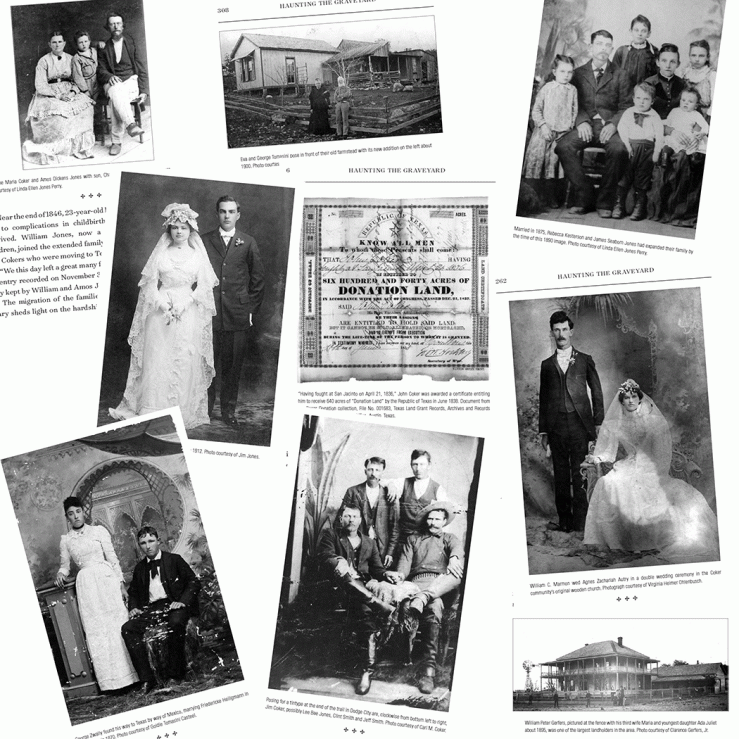
haunting the graveyard photos
lila banks cockrell, phil hardberger, scott j. baird*In addition to availability at The Twig Book Shop at the signing, pre-publication orders are being accepted now at Material Media Press.

August 4, 2019, Update: An interactive companion index of people inhabiting the pages of this book helps readers understand how they relate to the family patriarch, Joseph Coker (1799-1881). The list can be accessed now for those who want to know if any information about their particular relatives can be found inside. To check the list, click here: http://cokercemetery.com/pdfs/coker_settlement_index.pdf.

Here is a shorter glimpse of surnames mentioned:

Biannual Roundup: Kind of like beating a dead horse

taxidermy horse nonvecento maurizio cattelan castello di rivoli

All one needs to do to drive up readership in San Antonio is mention the Alamo. The top three posts attracting attention to this blog during the past 12 months were all Alamobsessive.

Unfortunately, the main concern drawing you in, the fencing in of Alamo Plaza, is a horse already out of the barn. The city agreed to turn over San Antonio’s management to the State of Texas and allow them to corral it.

The next two were complaints about the Texas GLO’s non-reverential management of their new acquisition with its addition of a shiny red faux Alamo. Even those images have failed to spur any action; powers that be must be wearing blinders.

Welcome to the faux red Alamo plopped down in the middle of Alamo Plaza.

Sometimes it feels as though sharing concerns for Alamo Plaza is like beating a dead horse, but you apparently are interested in dead horses as well because fifth on the list of most-read posts this year was a postcard “to” San Antonio from Italy featuring an embalmed horse hung by artist Maurizio Cattelan in the Museo d’Arte Contemporanea in Rivoli.

Without further horsing around, the following list represents the posts you clicked most, with the numbers in parentheses representing rankings from six months ago:

  1. Alamo CEO applying armtwisting pressure to secure gated plaza, 2018 (1)
  2. Has Alamo Plaza fallen in the hands of ‘reverential’ caretakers, 2019
  3. How’s the GLO managing Alamo Plaza? Welcome to the faux Alamo, 2019
  4. King William Home Tour: Historic houses whisper stories of early residents, 2018 (4)
  5. Postcard from Castello di Rivoli, Turin, Italy: History with a horse hanging overhead (2019)
  6. Please put this song on Tony’s pony, and make it ride away, 2010 (6)
  7. The Madarasz murder mystery: Might Helen haunt Brackenridge Park?, 2012 (5)
  8. Street art entices venturing under the overpass, 2018 (7)

    detail of Marilyn Lanfear’s buttonwork, “Uncle Clarence’s Three Wives”
  9. Marilyn Lanfear buttons up a collection of family stories, 2018 (8)
  10. Postcard from Oaxaca, Mexico: ‘I’ve a feeling we’re not in Kansas anymore.’ 2019
  11. Postcard from Sevilla, Spain: Foods steeped in tradition, 2019
  12. Postcard from Genoa, Italy: Hey, don’t knock peanuts, 2018 (12)
street art in Oaxaca, Mexico

Thanks for putting up with my horse feathers, and please feel free to comment anytime.

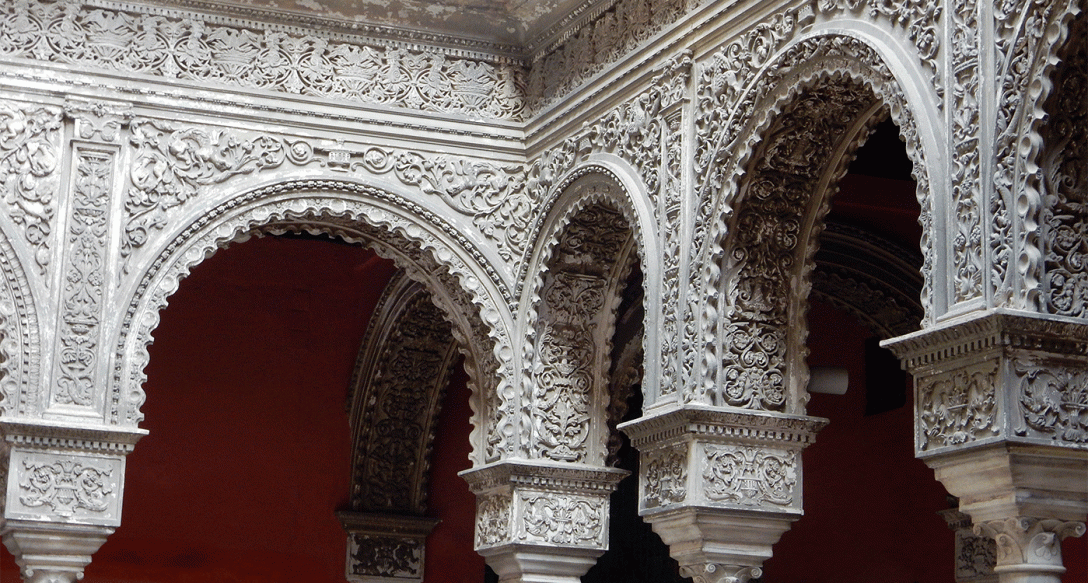
Postcard from Sevilla, Spain: A trio of Mudejar-Renaissance palaces

Elderly and disabled priests needed a suitable place to live out their lives, so the Brotherhood of Silence undertook construction of an elegant residence to accommodate them in 1675 – Hospital de los Venerables Sacerdotes, or the Hospital of Venerable Priests. No expense appears spared during the Baroque palace, with altars and murals by some of Spain’s most famous artists. The project was completed under the direction of architect Leonardo de Figueroa (1650-1730), who designed San Luis de los Franceses. The former residence of aging priests was restored by the Focus Foundation in the late 1980s and now serves as the foundation’s headquarters and as an elegant exhibition space for the impressive artwork of the collection of its Velazquez Centre as well as contemporary acquisitions.

Among the numerous private palaces open to the public by its owners is Casa de Salinas. The 16th-century Mudejar-Renaissance style palace was purchased and restored by the Salinas family in the 20th-century. As in Casa Lebrija, Roman mosaic flooring found its way from an ancient site into a private home.

Another palace with origins in the 15th century is the Casa de las Duenas. In 1496, the house was sold to a member of the de Ribera family, and its rich combination of mudejar and Renaissance architectural details resembles the family’s Casa de Pilatos. Later, a Ribera descendant married a Duke of Alba, transferring the palace to the House of Alba.

The architectural interest of the house is perhaps overshadowed by the flamboyance of one of its owners, the 18th Duchess of Alba, who died in 2014 at the age of 88. The long-named María del Rosario Cayetana Paloma Alfonsa Victoria Eugenia Fernanda Teresa Francisca de Paula Lourdes Antonia Josefa Fausta Rita Castor Dorotea Santa Esperanza Fitz-James Stuart y de Silva Falco y Gurtubay also was multi-titled. According to Cayetana’s obituary in The Telegraph:

According to the Guinness Book of Records, she had more titles than any other person on the planet, being a duchess seven times over, a countess 22 times and a marquesa 24 times. Yet the Duchess always insisted she was not rich: “I have a lot of artworks, but I can’t eat them, can I?” she once said. Apart from thousands of paintings by Goya, Velazquez, Titian and others lining the walls of her numerous palaces, her collection included a first edition of Don Quixote, Columbus’s first map of America and the last will and testament of Ferdinand the Catholic, the father of Catherine of Aragon.

Her first wedding in 1947 to a son of the Duke of Sotomayor was held in the Cathedral of Seville, according to The Telegraph, the opulent ceremony:

…cost an estimated £2 million in today’s terms and was described at the time as “the most expensive wedding in the world.” The ceremony was so grand that there was concern it would overshadow the nuptials of Britain’s future Queen, held a month later in austerity Britain. The bride wore a white satin gown (view here) modelled on the dress worn by Napoleon III’s bride Empress Eugenie (1826-1920).

The couple had six children, with only one rumored to be fathered not by her husband but by a flamenco dancer. After her husband’s death in 1972, she next wed a former Jesuit priest 11 years younger than she. Outliving him as well, she shocked society, and her children, by marrying a civil servant 24 years younger in 2011. By then, much plastic surgery had transformed her former natural beauty into an almost cartoonish mask. The obituary includes photos of her with her final husband.

Most of her vast fortune, running into the billions, was divided amongst her children. One of her sons opened the first floor of the family residence to the public in 2016.