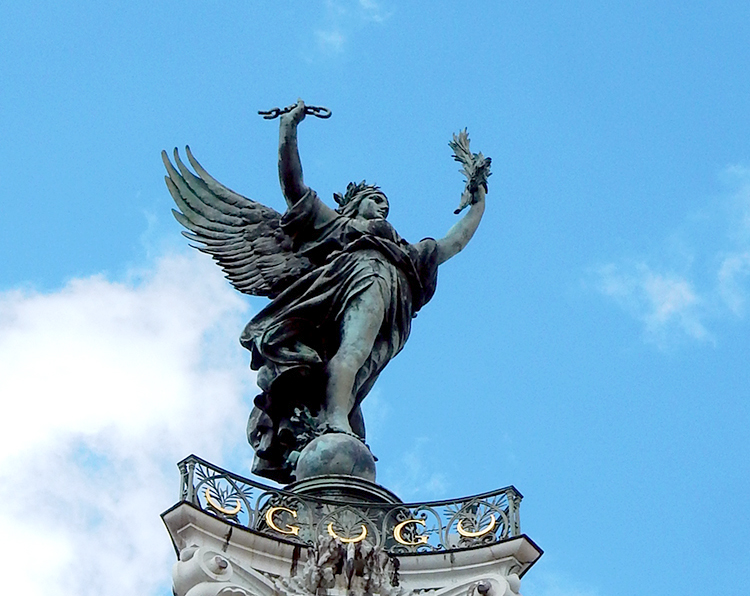
Postcard from Bordeaux, France: Lady Liberty breaks free of shackles on both sides of Atlantic

While the use of the guillotine symbolizes a reign of terror during the early days of the French Revolution, its usage was adapted in the late 1700s as a more humane way to carry out public executions. It was regarded as both efficient and fast, sparing the sentenced unnecessary pain. It is said that before it was sanctioned as the official executioner’s tool, King Louis XVI (1754-1793) suggested improving the design to utilize an angled straight blade instead of the original curved one. He himself, along with his queen, Marie Antoinette (1755-1793), benefitted from the enhanced efficiency when they were beheaded.

The tool became a hallmark of the political maneuverings carried out by one of the leaders of the revolution, Maximilien Robespierre (1758-1794). Robespierre definitely established himself as a kind of “if-you’re-not-with-me-you’re-against-me” kind of guy, placing those who found themselves in that category labeled as enemies of France. He was also adept at rallying the masses, the sans-culottes tradesmen in Paris, to protest against these enemies.

Continue reading “Postcard from Bordeaux, France: Lady Liberty breaks free of shackles on both sides of Atlantic”

Please leave my friend Phil out of the ongoing Battle over the Alamo

There we were, sitting beside each other. Phil and I. I’m talking about Phil Collins. But I just call him Phil now. Because I sat beside him for about one minute. As you can tell this is leading to one of celebrities’ worst curses: people who don’t know them writing about them.

2013 post on this blog following that year’s San Antonio Conservation Society Publication Awards

Okay. I admit it. Phil and I scarcely could be called friends. But someone needs to rise to his defense.

In Forget the Alamo, authors Bryan Burrough, Chris Tomlinson and Jason Stanford lay bare major flaws of men many Texans have elevated to heroic heights for their roles at the Alamo. They also illuminate less-than-noble reasons Texians were revolting against Mexico, including the preservation of slavery. This has so angered some of Texas’ leaders that their rhetoric against the book has helped it skyrocket up the bestseller list.

Continue reading “Please leave my friend Phil out of the ongoing Battle over the Alamo”

Most precious part of Zilker Botanical Garden reflects the spirit of one man

The drawing-rooms of one of the most magnificent private residences in Austin are a blaze of lights. Carriages line the streets in front, and from gate to doorway is spread a velvet carpet, on which the delicate feet of the guests may tread. The occasion is the entrance into society of one of the fairest buds in the City of the Violet Crown.

“Tictoca,” William Sydney Porter (O. Henry), The Rolling Stone, October 27, 1894

Clara Driscoll Sevier, who loved flowers to the point of promoting a rose garden next to the Alamo as more desirable than saving its historic convent walls, found Austin lacking a garden club for women. To remedy this, she invited a group of ladies to Laguna Gloria, her home that is now The Contemporary Austin, to establish one in 1924. O. Henry’s reference to the violet-crowned hills of Austin inspired the name for the new group, the Violet Crown Garden Club.

Annual flower shows were the primary focus of the club until 1946 when members set aside modest seed money of $50 to initiate efforts to seek space in the city’s Zilker Park for a botanical garden. The Violet Crown Garden Club recruited six other garden clubs to join its quest and their persistence finally resulted in the 1964 completion of the Austin Area Garden Center building in what became the Zilker Botanical Garden.

Continue reading “Most precious part of Zilker Botanical Garden reflects the spirit of one man”