Biannual round-up of what postcards you read most

cathedral6Every six months it’s good for me to check back to see what type of post you have been reading during the past 12 months. As usual, you are all over the map, leaving me free to continue selecting topics arbitrarily.

It makes sense that blog-readers love libraries; the most read post expressed concerns affecting funding of the San Antonio Public Library. The mystery surrounding the murder of Helen Madarasz in Brackenridge Park rose to second in popularity, and there are those who pine to hear the San Antonio Song. A few new posts pushed aside several long-time favorites, and, for some reason, you dug deep in the archives to resurrect a couple that had not been read for quite a while.

The number in parentheses represents the rankings from six months ago:

  1. The danger of playing hardball with our Library: Bookworms tend to vote, 2014
  2. The Madarasz Murder Mystery: Might Helen Haunt Brackenridge Park?, 2012 (7)
  3. Please put this song on Tony’s pony and make it ride away, 2010 (5)
  4. The Tragic Rule of Maximilian and Carlota in Mexico, 2014 (10)
  5. Remembering everyday people: Our rural heritage merits attention, 2014
  6. Picturing the City’s Past Just Got Easier, 2014
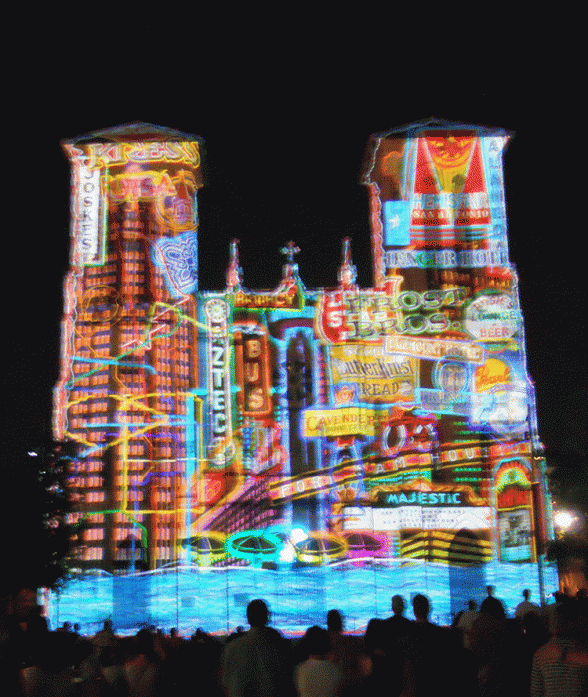
  7. Seeing San Fernando Cathedral in a new light…, 2014
  8. Postcard from San Miguel de Allende: Sun rises again at La Aurora, 2014 (9)
  9. “Nuit of the Living Dead” (8), 2010
  10. How would you feel about the Alamo with a crewcut?, 2011
  11. That Crabby Old Colonel Cribby Condemned the River to Years of Lowlife, 2013
  12. Postcards from San Miguel de Allende: Redirecting Graffiti Artists, Part Four, 2014

Thanks for dropping by every once in a while and for giving me permission to keep rambling on about whatever I’m currently pondering.

And best wishes throughout the coming year.

Quinze’s “Wind” to blow on the Mission Reach of the San Antonio River

A month in the searing desert sun building a huge wooden structure.

A mere four days to enjoy it. Then setting it ablaze.

“It is not that easy to burn your own installation down,” said artist Arne Quinze during a June 2013 lecture sponsored by the San Antonio River Foundation at the San Antonio Museum of Art. “I still have goosebumps from it.” While an estimated 50,000 people witnessed the conflagration at the 2006 Burning Man Festival in Nevada, “The day after, nothing was left over.”

The Belgian artist’s first public art took the form of graffiti, but his work evolved into large-scale three-dimensional structures, often installed in urban settings, including Nice, Shanghai, Rio de Janeiro, Brussels, Rouen and Beirut. Quinze views cities as “open-air museums,” with art teaching “you to look at the world in a different way.”

Many of his installations are temporal, although not as fleeting as the one in Nevada. His installations sometimes spark controversy, but, by the time they are removed, there are public protests. “When we take it down, the space is more empty than before,” he said. “It makes them realize the importance of art in their lives.”

wind
example of a “pillar” of wind

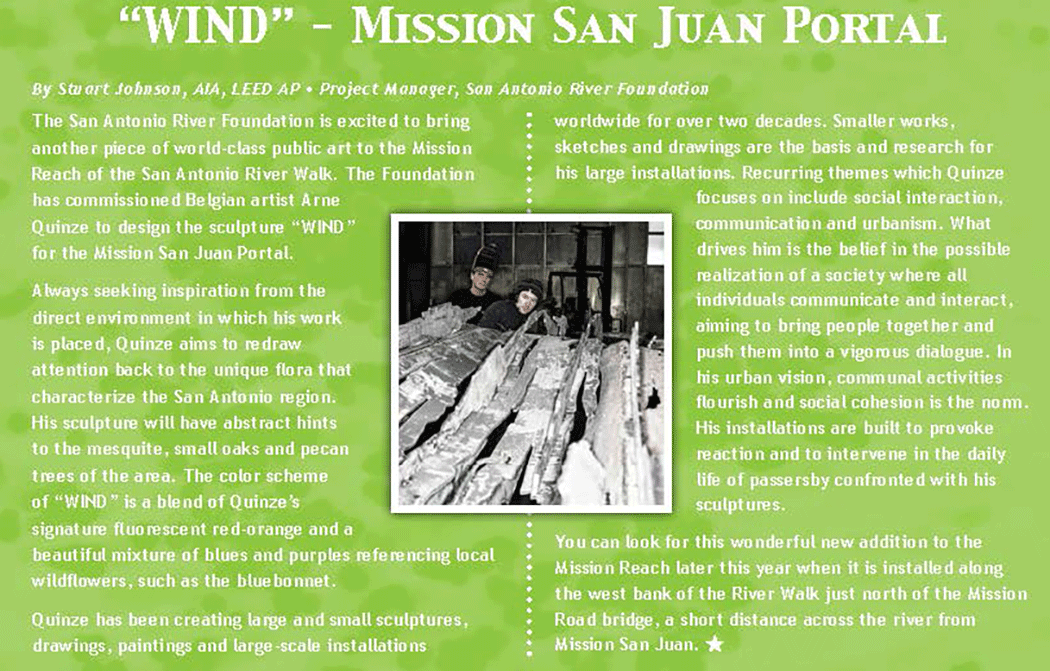
The artist is drawn to strong hues of red and orange because they are “full of contradictions – a fire burns or warms; blood means life or death.” His series of “Wind” sculptures seem to follow that predilection. On his website, he describes the elements he installs in the landscape as representing “the frozen movement of wind going through a grass field, a sculpture waving like leaves in the sun.”

berg's-mill
Berg’s Mill
san-juan-today-2
Mission San Juan Capistrano

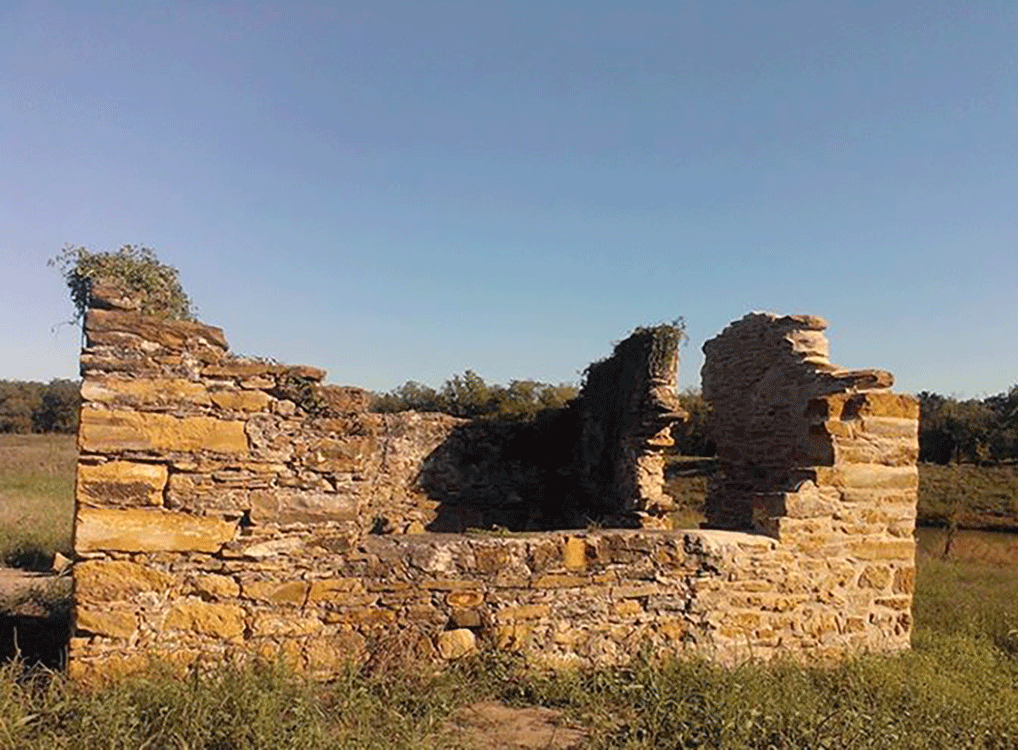
Perhaps that is what makes “Wind” most fitting for the rural river setting chosen by the River Foundation for his installation. His monumental blades of wind will serve as a gateway transitioning and leading people up from the river to the area where the ruins of the historic Berg’s Mill community are perched on the left and Mission San Juan Capistrano lies ahead on the right.

“Wind,” according to Quinze’s website, is designed to: “evoke emotion, spark conversation and make people stop in their tracks. They will be attracted to explore this surreal experience of the shadow and sunlight shining through the fixed pillars….”

To contribute to public art projects along the Mission Reach and the development of Confluence Park, visit the website of the San Antonio River Foundation.

Looking forward to being stopped in my tracks in 2015.

April 20, 2015, Update: Noticed that Arne has more site-specific renderings for his “Wind” installation posted online now.

And this is from the April 2015 River Reach, published by the San Antonio River Authority:

arne-at-san-juan

October 20, 2015, Update:

Artist Lecture: Arne Quinze will talk about “Wind” installation, his first permanent public art piece in the United States, at Blue Star at 6:30 p.m. on Thursday, October 22.

Sculpture Unveiling: Mission San Juan Portal will be unveiled at 10 a.m. on Wednesday, October 28.

Postcard from Portugal: Lessons for San Antonio?

Whenever you travel, you always come across things you’d love to see at home. These are listed randomly, not ranked. Click on the photos to see larger images or the highlighted links if you would like to see additional related photos.

  1. tables under giant rubber trees at Esplanada Cafe
    sandwiches served under giant rubber trees at Esplanada Cafe

    Huge multi-grain sandwiches oozing with melted cheese served under towering rubber trees in a park. This was the easiest of things to adapt from Portugal. Panini(tost)-maker purchased. How did I live without one? It grills veggie burgers, Greek cheese, eggplant, zucchini, naan bread, pineapple, French toast. Anything and everything.

  2. DSCN0748Robert H. H. Hugman designed the River Walk  in San Antonio with varying designs of sidewalks underfoot, but Portugal takes such artistry a giant step farther, and the results are striking. Every step you take should be memorable. Maybe we need a non-slick surface, though. But, it all goes back to something we haven’t quite embraced in Texas. Park the car. A city should be walked to be appreciated.
  3. DSCN0692Statues should be statuesque, or not at all. Poor Henry B. by the Convention Center, wherever he ends up relocated, is rendered too petite. He seems less than life-size. Statues should be awe-inspiring (The exception: Keep oyster-shelly Gompers small and hidden under overgrown trees.).
  4. DSCN1349DSCN1350Festival beer booths do not have to be hideous. Lisbon utilizes these little self-contained booths with several different designs for their special events. Some have homey images, such as a cat in a window or a friendly dog at the door.
  5. DSCN1163Tiles. We have the tradition here. Wonderful tiles from Ethel Harris’ San Jose Pottery. Or those colorful tiles Marion Koogler McNay installed on the risers of her patio stairs. Susan Toomey Frost donated a San Jose tile mural for the Museum Reach of the river to add to the original ones along the downtown river bend, and there are the incredible ones at Alamo Stadium. But we need more. They are such an enduring form of art.
  6. DSCN1200Promotional banners and advertising for festivals do not all have to be identical. Maintaining integrity of logos is one thing, but succumbing to boring repetition renders the message meaningless. Love the way Lisbon engages several artists each year to interpret their marketing materials for its month-long festival in honor of Saint Anthony.
  7. Sardines are a good thing. When they are fresh. Grilled street-side. Just before we left for Portugal, Central Market had a few laid out for the media preview of their Ciao Italia. Then we left, and dove into the land where they were in abundance. We’d like them here, please.
  8. DSCN1214DSCN1216Love our San Antonio Book Festival. But how in the world does Lisbon keep Feira Livro up and running for two weeks? Self-contained booths that can be locked up securely each night help. The sheer number of booths and books made me feel downright illiterate, particularly since the books were in Portuguese.
  9. DSCN0582Inner-city parks are filled with activities on a rotating basis. Farmers’ markets. Regional gourmet food festivals with vendors and tastings. Mini-book fairs. A once-a-month antique fair that would be great some place like Travis Park.
  10. DSCN1316The San Antonio Missions are crying out for intimate, customized tuk-tuk tours crisscrossing the Mission Reach of the San Antonio River. The tuk tuks of Lisbon had different designs on the outside. My favorite one, not pictured, was covered with a skin of images of some of Portugal’s distinctive blue tiles.
  11. DSCN1229We now have food trucks, but what about little portable craft beer carts, perfect for sampling new beers on tap in park-like settings. This cart was parked outside the botanical garden. We also encountered wine trucks for sampling Portuguese wine, complete with bar stools for sipping at the wine truck counter. Oh how I would love it if Texas wines were as inexpensive as Portuguese.
  12. DSCN1160Portugal seems to have more than its fair share of parts of saints enshrined in reliquaries. I always thought American Catholics were too squeamish to even want to know how far one saint could be spread, but I was wrong. We just don’t have many saints and parts to fight over. Archbishop Fulton Sheen has not even been beatified yet, and New York and Peoria are fighting over his body and whether he should be exhumed for obtaining some first-class relics to disseminate. I wonder if Portugal would share some modest little second-class relic of Saint Anthony with this city bearing his name….
  13. DSCN1248And about Saint Anthony. He is ever-present everywhere in Portugal. This city named after him needs to pay more attention to him, particularly on his feast day in June. He is a really useful saint.
  14. And, finally, although this blogger might prove the exception….DSCN1257

Note Added: The featured photo strangely popped up on my facebook page immediately after I posted this. Thanks to Mark Twain for providing it.