


Above: “The Pinch of Snuff (Rabbi),” Marc Chagall (1887-1985), mid-1920s
This painting, in which a rabbi sells his soul to Satan for a pinch of tobacco, was acquired by the Mannheim Kunsthalle in 1928. In 1933, Mannheim became the scene of an intense campaign of purge and defamation of modern art orchestrated by the Nazis…. the painting was dragged through the streets of the city with the message: ‘You who pay taxes should know where your money is being spent.'”
“‘Degenerate’ Art: Modern Art on Trial under the Nazis,” Curator Notes, Musee Picasso Paris, 2025
One evening at the end of May, we were fortunate to slip into a last remaining timeslot for viewing “‘Degenerate’ Art: Modern Art on Trial under the Nazis” at Musee Picasso Paris. It was packed with procrastinators, rendering the air-conditioning incapable of keeping the day’s lingering heat at bay. Yet, we all found ourselves crowding close to the artwork in an attempt to devour every word of the informative curator notes.
Most of the featured art had been included in a major exhibition of 600 works mounted by the Nazi regime in Munich in 1937. The purpose of this was not to shine light on exemplary art; instead, it was designed to condemn entartete kunst, or degenerate art, and the evil artists who spawned it.
It represented a full-frontal attack on modern art in vogue – expressionist, fauve, abstract, surrealist, cubist, dada, African and Oceanic-influenced art – banned art confiscated from museums and private collectors. The art was deemed un-German by the regime, a regime demanding art project an idealized image of the German race. Only a handful of the pieces were by Jewish artists. The makers of all modernist art, no matter religion or nationality, were labeled as idiots, criminals, Bolsheviks, mentally ill – all terms that would soon be employed as reasons to send Jews to concentration camps.
It is not the mission of art to wallow in filth for filth’s sake, to paint the human being only in a state of putrefaction… or to present deformed idiots as representatives of manly strength.”
Adolf Hitler (1889-1945)
Pablo Picasso’s pastel below did not measure up to his German ideals:
This drawing was one of the ‘degenerate’ works selected by the architect Paul Schultze-Naumburg to illustrate his book Art and Race, where it was set alongside a medical photograph of a man suffering from ‘acromegaly of the hands and lower face.’ This pastel, part of art dealer Paul Rosenberg’s collection, was among the works looted in 1940 when the Nazis invaded Paris….”
“Degenerate Art,” Curator Notes


Above left: “Seated Nude Wiping her Foot,” 1921. Right: “Skull,” 1943. Both by Pablo Picasso (1991-1973).
But why did Hitler launch his war against modern art as soon as he was in charge of the country in 1933? Was it a vendetta? Hitler didn’t set out with a goal to be fuehrer; he wanted to be a painter. But he was regarded as a mediocre painter. His application for admission to the Vienna Academy of Fine Arts was rejected – twice. His commercial success was represented by a handful of sales of his ho-hum, unoriginal landscapes and architectural landmarks to tourists.
From 1933 to 1945, more than 1,400 artists were fired from academic institutions, banned from exhibiting or forced into exile, if not condemned to concentration camps. During one period of only a few months, more than 20,000 artworks were removed from the collections of German museums. “Progressive” museum directors were sacked. Thousands of ‘degenerate’ artworks were seized, sold or destroyed.
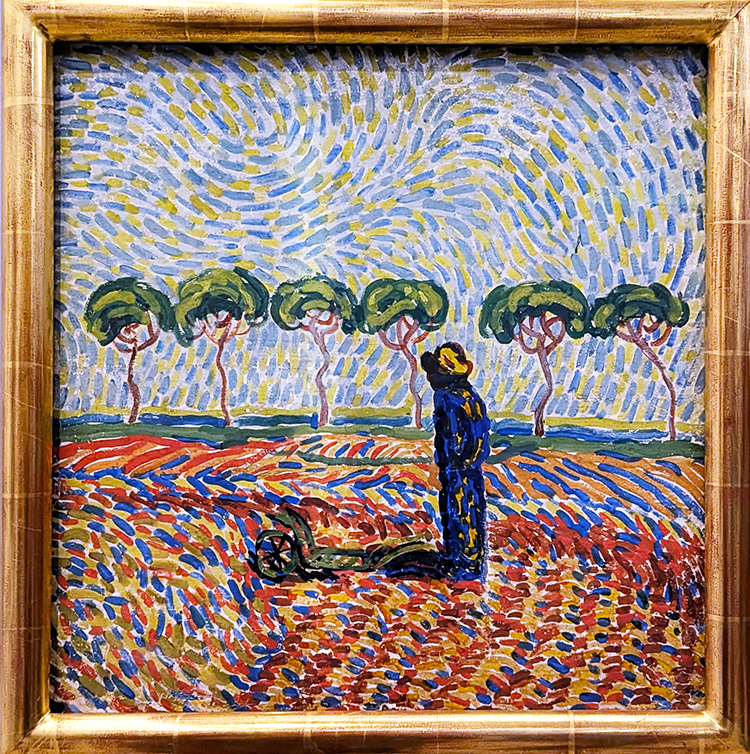

Above left: “Blue Man in a Yellow Landscape,” Wilhelm Morgner (1891-1917). Right: “Still Life with Wooden Statuette,” Emil Nolde (1867-1956), 1911.
Viewed as “cultural Bolshevism,” 700 works by artist Erich Heckel were confiscated from German museums by Nazi authorities in 1937. By the end of the war, his woodblock prints and plates had been destroyed. His version of the three graces below was spared by an art dealer who was retained by the Nazis to sell it outside of the country. The dealer’s daughter later donated it to a Berlin museum.
These anti-modernist commentators saw Vincent van Gogh as the embodiment of the ‘mad’ artists. In consequence, five of his paintings, three of which are now lost, were removed from German museums in 1937. This was not the case with ‘L’Arlesienne’ …, which was in the private collection of Marie-Anne von Goldschmidt-Rothschild…. (She) fled from Germany in 1938…, while her properties in Berlin were forcibly sold…. She did manage to salvage some of her collection, though, and donated this painting by Van Gogh to the French state on August 25, 1944, the day Paris was liberated.”
“Degenerate Art,” Curator Notes
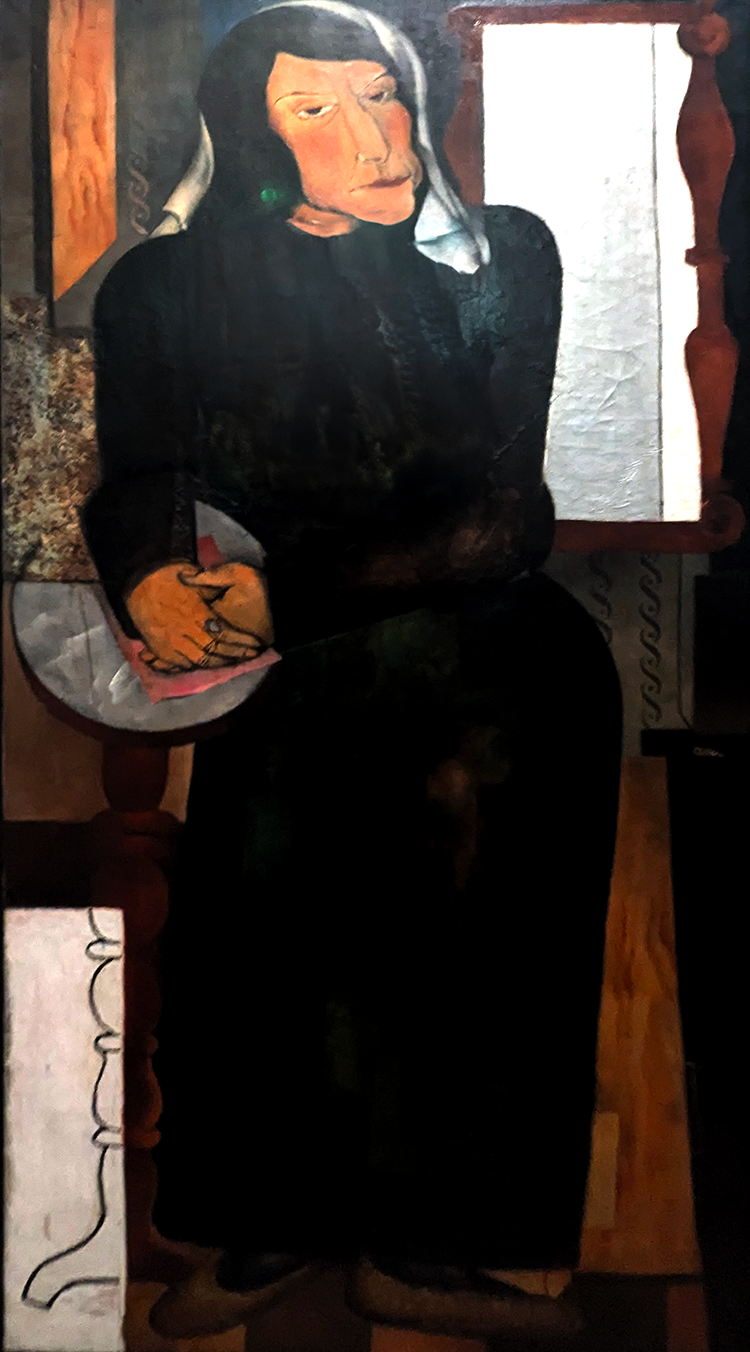


Above left: “Portrait of Else Lasker-Schuler,” Jankel Adler (1895-1949), 1924. Middle: “Three Women,” Erich Heckel (1883-1970), 1921. Right: “L’Arlesienne,” Vincent van Gogh (1853-1890).
With Joseph Goebbels at its helm, the Commission for the Disposal of Degenerate Art Works began selling some of the confiscated art unfit for Germany to other countries. One auction of more than 125 pieces featured works by Van Gogh, Matisse, Gauguin and Picasso.
This landscape by Kandinsky entered the collections of the Weimar Schlossmuseum in 1923. In 1937, it was confiscated by the Nazis, along with over 260 other works by Kandinsky…. In 1939, Swiss art dealers… bought it for 200 Swiss francs, and in February of the same year it was bought at auction in Bern by American collector Solomon R. Guggenheim, who had just opened a museum of abstract painting in New York.”
“Degenerate Art,” Curator Notes
In 2023, Sotheby’s London sold a Kandinsky landscape from 1910 for $41.9 million.
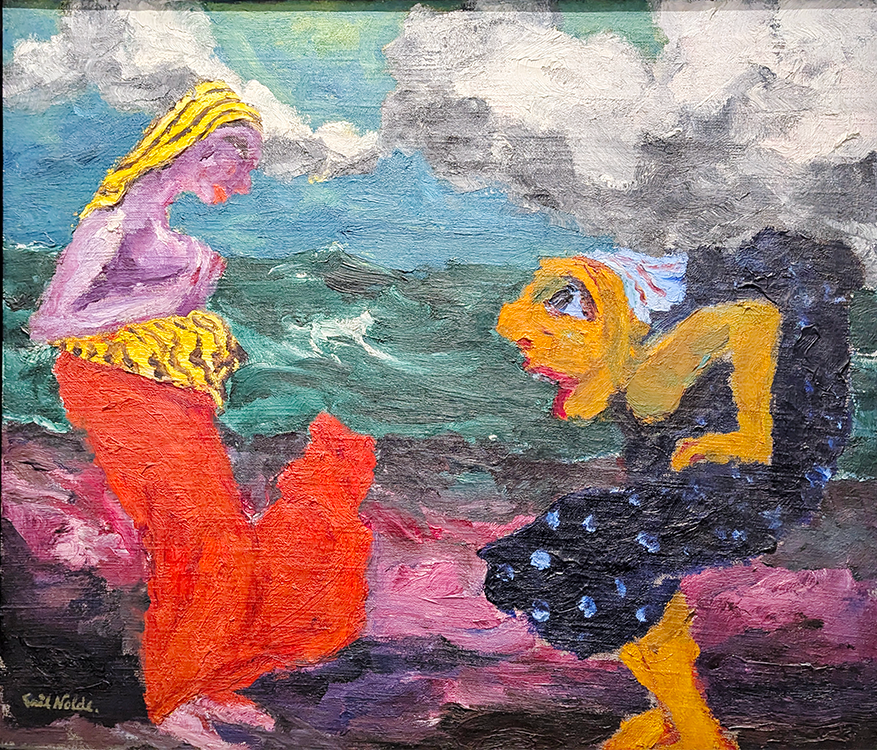
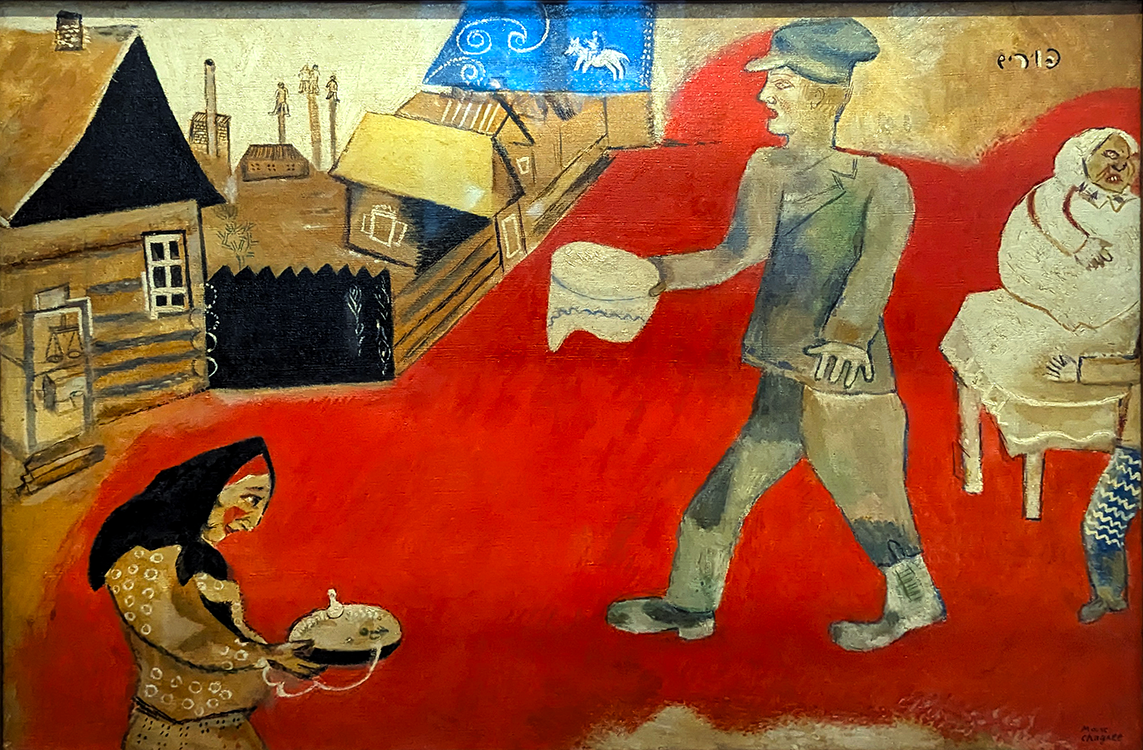
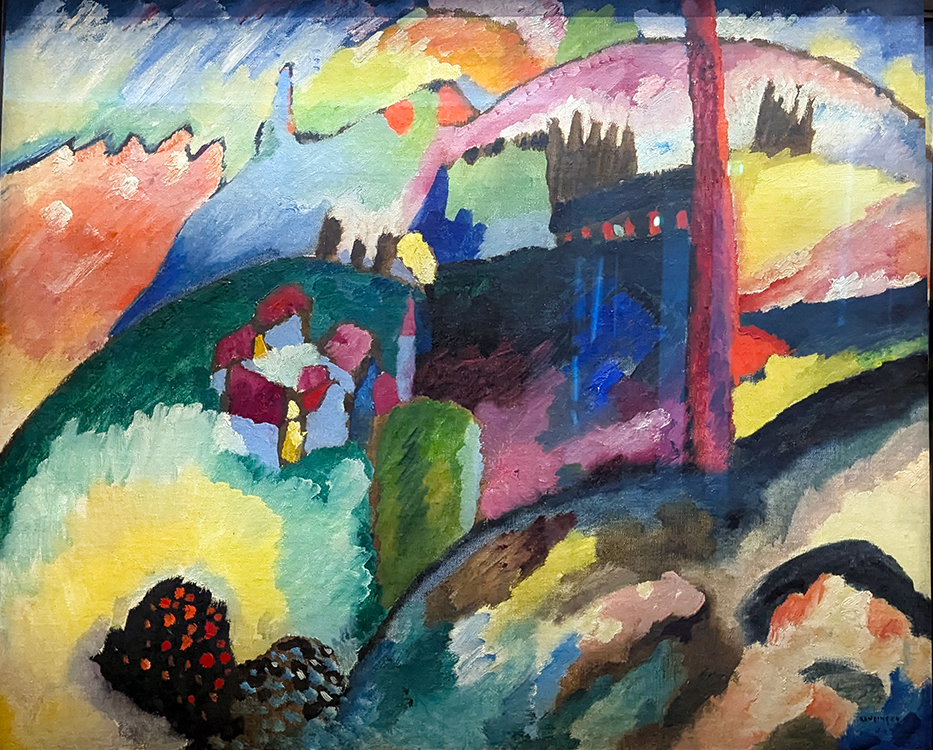
Above left: “Encounter on the Beach,” Emil Nolde, 1909. Top right: “Pourim,” Marc Chagall, 1917. Bottom right: “Landscape with Factory Chimney,” Vassily Kandinsky (1866-1944), 1910.
My bust of Nietzsche is valued at 400 English pounds. The interesting thing is that I gave this sculpture to Dresden City Museum in 1919, but now because it’s ‘degenerate’ it’s being flogged abroad for a top price. Ultimately I’m glad about it, because these things aren’t safe from destruction here anymore.”
Otto Dix, letter, January 1939
The sale of thousands of paintings was placed in the hands of four international dealers selected by Goebbels’ commission. This fundraising arrangement was not immune from pilfering by those chosen. One of these was Hildebrand Gurlitt (1895-1956):
He assembled an extensive personal collection including many stolen and confiscated works, part of which was seized in 1945 and restored to legitimate owners. However, Gurlitt held onto a large number of works, which he said had been destroyed by bombing. In 2010, during a routine customs check on the Zurich-Munich train, his son Cornelius (1932-2014) aroused suspicion…. which led the Bavarian authorities to discover the collection of some 1,600 works that he had inherited….”
“Degenerate Art,” Curator Notes

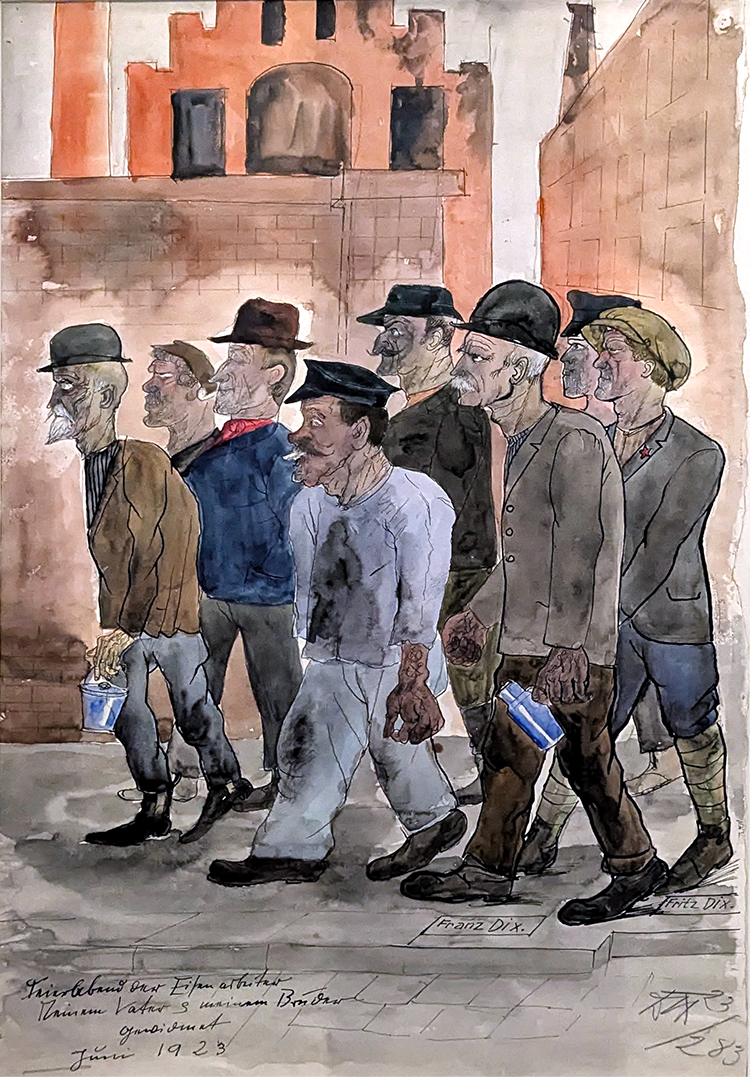
Above left: “Evening,” Georg Grosz (1893-1959). Right: “The End of the Day for Metal Workers,” Otto Dix (1891-1969), 1923.
I pulled several related images from a current exhibition at Musee d’Art Moderne de Paris – “Gabriele Munter: Painting to the Point.” Munter (1877-1962) was one of the founders of Munich’s Blaue Reiter, or Blue Rider, circle of expressionist artists. Her career often has been overshadowed by males of the group, including Paul Klee and Kandinsky, her at-the-time lover.
As the Nazi regime tightened its control over art, Munter moved south of Munich to the hamlet of Murnau. Hiding her paintings and those she owned by other members of the group in the basement, she assumed a low profile while continuing to paint in the expressionist style. Thick outlines and blocks of color characterize her work during that decade.
The painting on the right is of her close friend, Hanna Stirnemann (1899-1996), who became the first woman museum director in Germany in 1930 at the age of 30. Stirnemann stridently showcased the avant-garde, including a solo exhibition of Munter’s. The young museum director’s tastes clashed with those of the Nazi regime. After a forced cancellation of a scheduled exhibition and rumors asserting she had a Jewish great-grandfather, Stirnemann joined the ranks of museum directors pressured into relinquishing their posts.


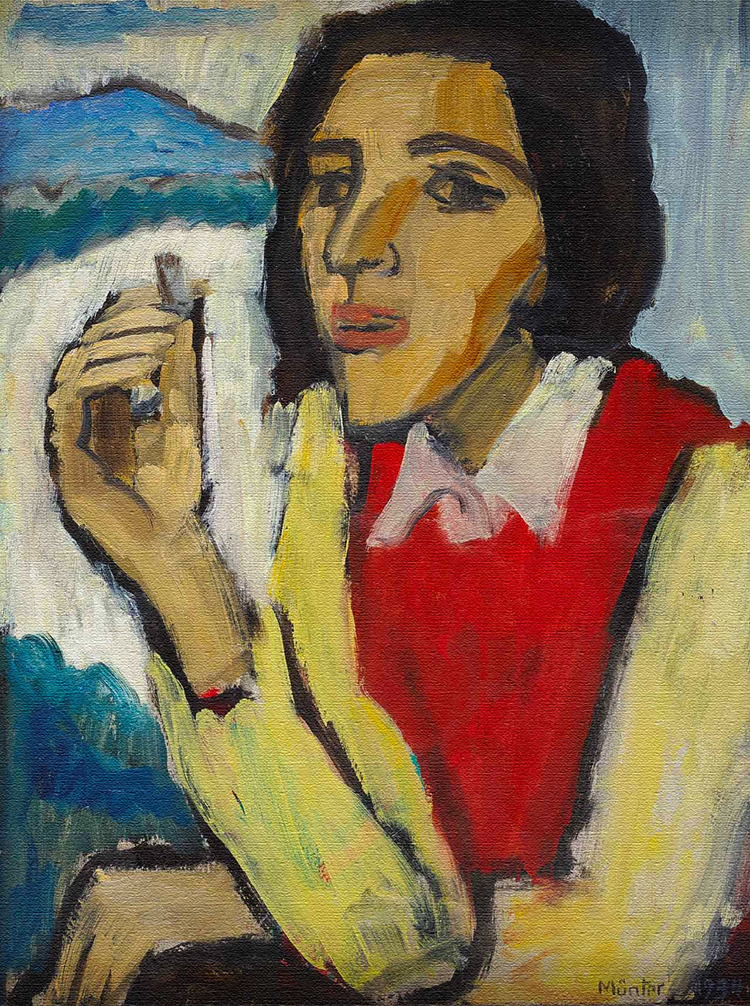
Above left: “Main Street of Murnau with Carriage,” 1933. Middle: “Petit-Dejeuner des Oiseaux,” 1934. Right: “Dr. Hanna Stirnemann,” 1934. All by Gabriele Munter (1877-1962).
Works of art which cannot be understood in themselves but need some pretentious instruction book to justify their existence will never again find their way to the German people.”
Adolf Hitler
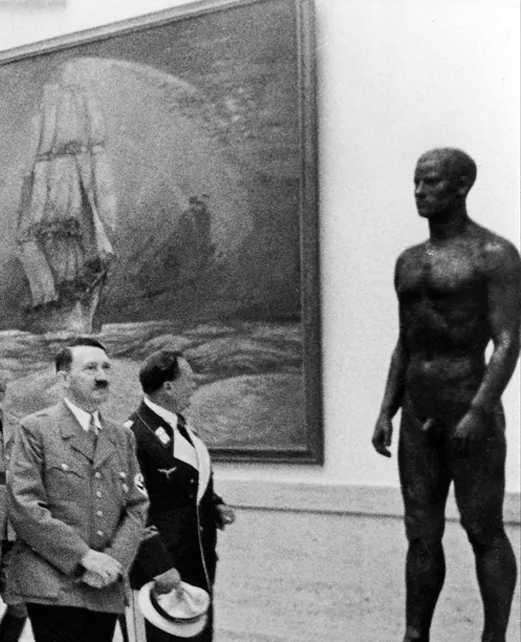
Art that won Hitler’s stamp of approval was displayed simultaneously with the degenerate show at a different location in Munich – the first annual Great German Art Exhibition. Among the chosen works were still lifes, landscapes and even some mythological scenes. There were paintings and sculptures of workers, heroes, nudes – all portraying pure Aryan characteristics. The names of most of the featured artists are forgotten.
Which of the two exhibitions was more successful in terms of attendance? Naturally, the verboten, or forbidden, destined for banishment or destruction. The ‘degenerate” art attracted an average of six times more visitors per day than the art judged “great” by Hitler.
We now stand in an exhibition that contains only a fraction of what was bought with the hard-earned savings of the German people and exhibited as art by a large number of museums all over Germany. All around us you see the monstrous offspring of insanity, impudence, ineptitude, and sheer degeneracy. What this exhibition offers inspires horror and disgust in us all.”
Adolf Ziegler (1892-1959), President of the Reich Chamber of Fine Arts and organizer of the 1937 “Degenerate Art” exhibition in Munich
Above: 1937 Video of the Nazis’ “Degenerate Art” exhibition in Munich, Germany.
German art of the next decade will be heroic; it will be like steel; it will be romantic, non-sentimental, factual; it will be national with great pathos, and at once obligatory and binding, or it will be nothing.”
Paul Joseph Goebbels (1897-1945), German Reich Minister for Propaganda and Public Enlightenment, 1933 to 1945
Fast-forward to 2025.
The National Garden will be built to reflect the awesome splendor of our country’s timeless exceptionalism…. Across this Nation, belief in the greatness and goodness of America has come under attack in recent months and years by a dangerous anti-American extremism that seeks to dismantle our country’s history, institutions, and very identity…. The National Garden is America’s answer to this reckless attempt to erase our heroes, values, and entire way of life. On its grounds, the devastation and discord of the moment will be overcome with abiding love of country and lasting patriotism.”
“Building the National Garden of American Heroes,” Executive Order 13978 signed by President Donald J. Trump, January 18, 2021
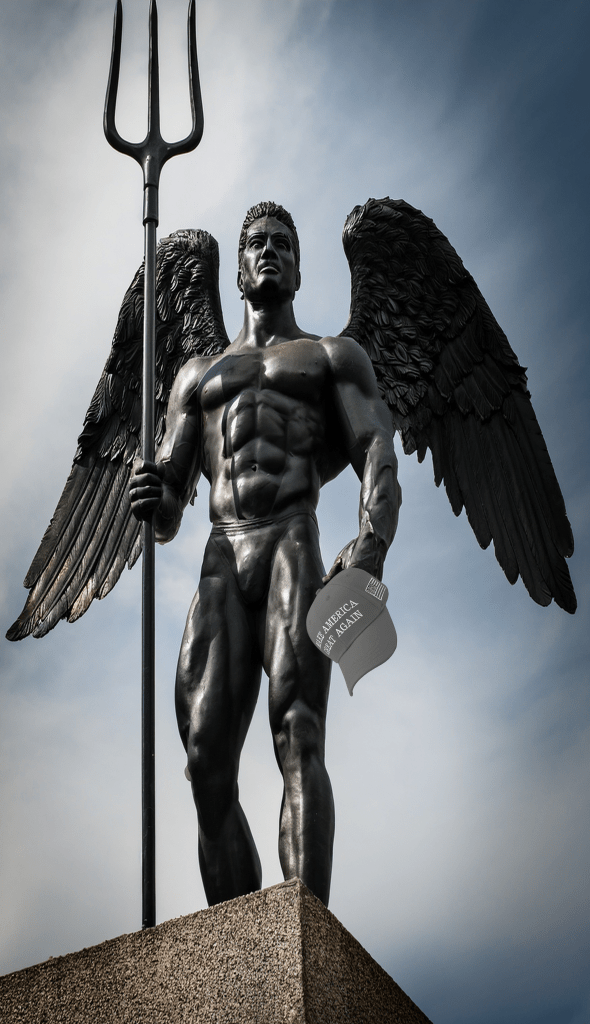
As per the Executive Orders, all statues must be lifelike or realistic representations of the persons they depict, not abstract or modernist representations. The statues should be in the classical style….”
National Endowment of the Arts request for proposals from artists for the National Garden of American Heroes
“We’re going to produce some of the most beautiful works of art.”
President Donald J. Trump, February 2025
 Postcards from Barton Springs
Here is something that shows some admirable depth. Were you an Art History major at any time? Your research is impressive.
>
LikeLiked by 1 person
Thanks Roland. My major was International Relations. I had enough credits for an art history major, aside for a requisite studio course. I didn’t take it because my college didn’t award double majors. Plus, the art interest is personal, not professional. Hope you like my potential submission for Trump’s Garden of Heroes. Holding a pitchfork to represent Middle American values; sprouting angel wings to represent his appeal to evangelicals; and holding a MAGA cap. Maybe it should be gilded?
LikeLike
Well done, Gayle.
LikeLiked by 1 person