
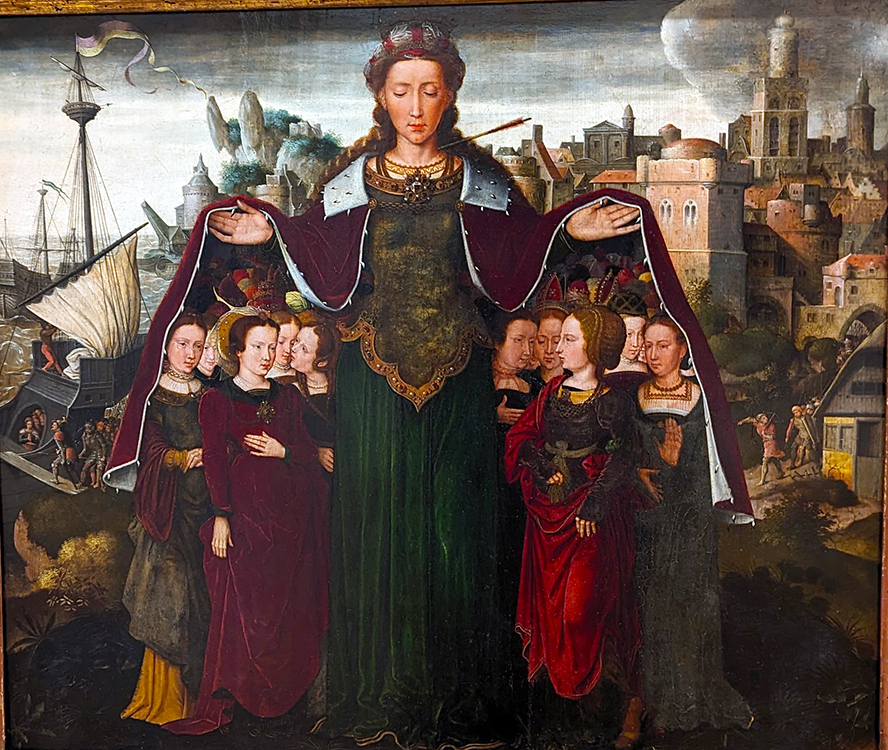
Above: “Saint Ursula and the 11,000 Virgins,” Pieter Claeissens, 1560
Pieter Claeissens’s painting hanging in Museo de Bellas Artes de Asturias attracted my attention because of my unfamiliarity with Saint Ursula. According to legend, 11,000 handmaidens of Princess Ursula set sail with her from southern England on a journey to marry the pagan to whom her father had betrothed her. The ship was blown off course, so Ursula and her entourage decided on an extended pilgrimage to Italy first. Huns had taken over Cologne by the time they finally arrived there, and, for some reason, the Huns failed to appreciate having all those virgins in their midst and slaughtered them.
Eleven-thousand virgins sounds like a lot to have been able to round up in the south of England in the fourth century, and Pope Paul VI must have felt the same way. He revoked her sainthood in 1969. Which makes me feel sorry for all the centuries of cloistered nuns who served in the Ursuline order. Kind of like growing up with belief that Saint Patrick would bestow good blessings upon you only to discover he was never even canonized at all.
Sorry to digress so far before showing you more art from the museum’s collection, but the saintly tales I did not grow up knowing always fascinate me. It’s a side of Catholicism the nuns of Star of the Sea rarely shared with us.
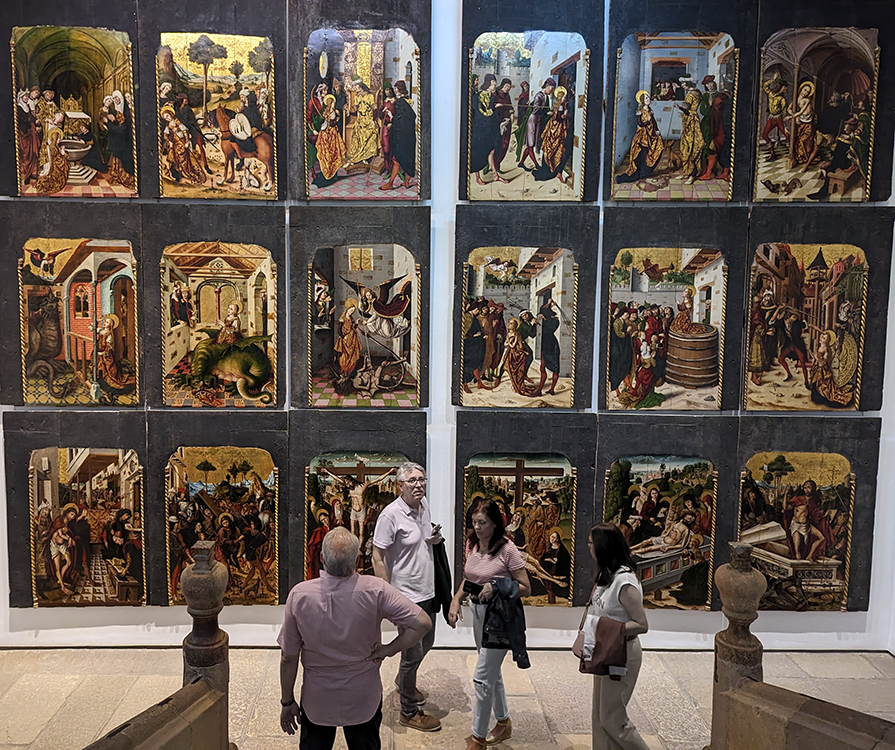

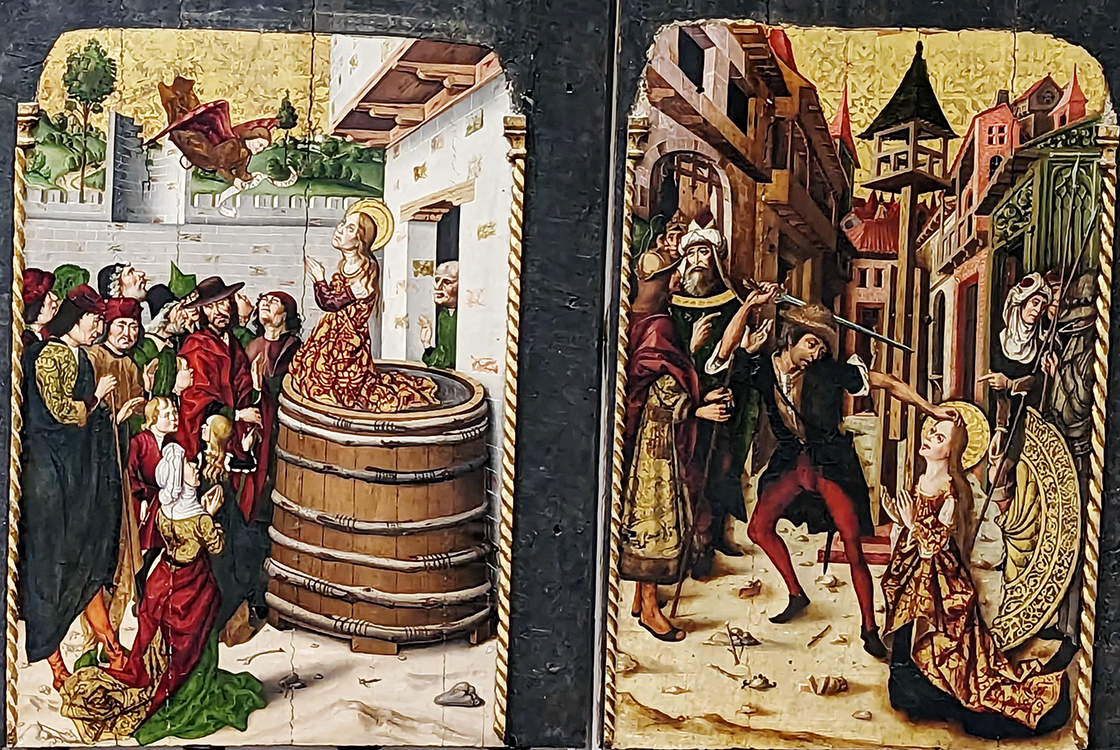
Above: “Retablo de Santa Marina,” Master Paliquinos, 1500
Take the altar depicting the end-of-life experience of Saint Marina of the Holy Waters dominating one of the stairwells in the museum. A Roman soldier spied the young virgin and wanted her for his own. His attention spurned, he reported Marina as a member of the outlawed Christian sect – a certain death sentence when not denied. A spring of water shot up from the ground where her head fell after being severed.
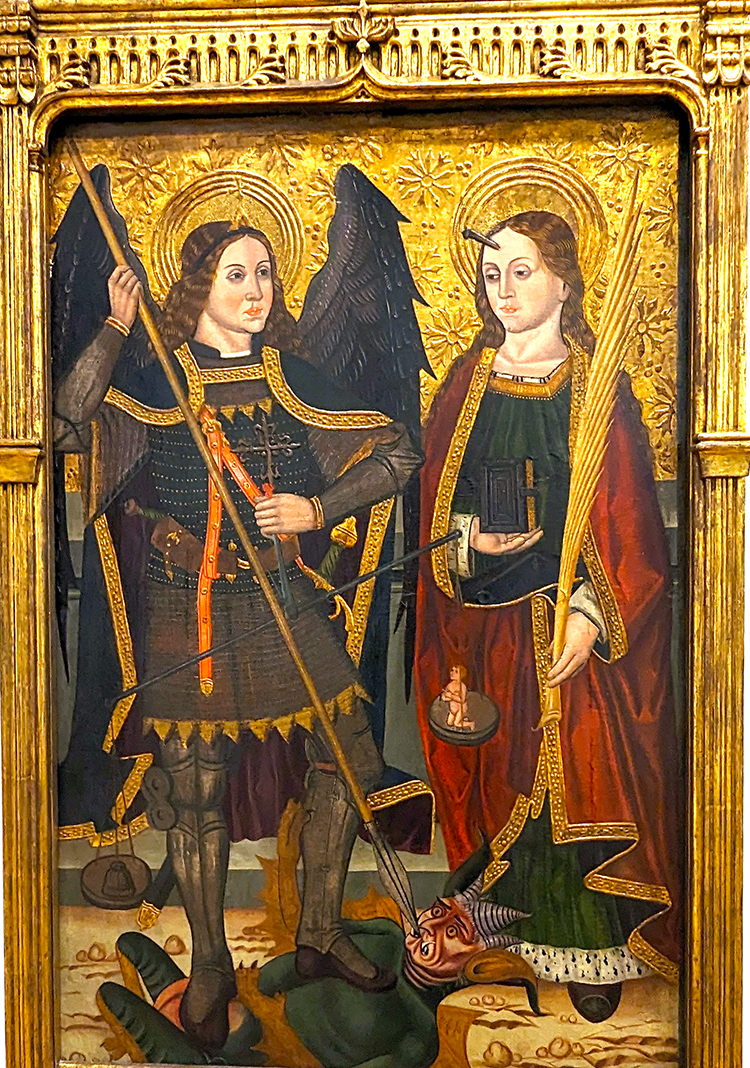


Above: “San Miguel y Santa Engracia,” Juan de la Abadia el Viejo, 1490
Santa Engracia was yet another sacrificed virgin, a story we encountered in Zaragoza more than a year ago as one of the city’s “countless martyrs.” What draws my attention to this painting is the artist’s imaginative portrayal of the claw-footed jester-type devil being speared by San Miguel.

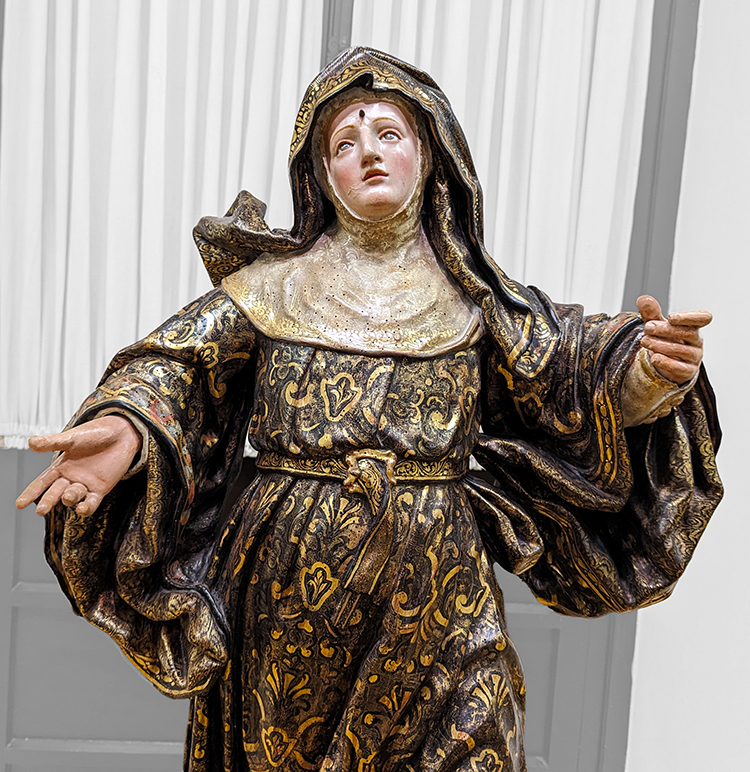
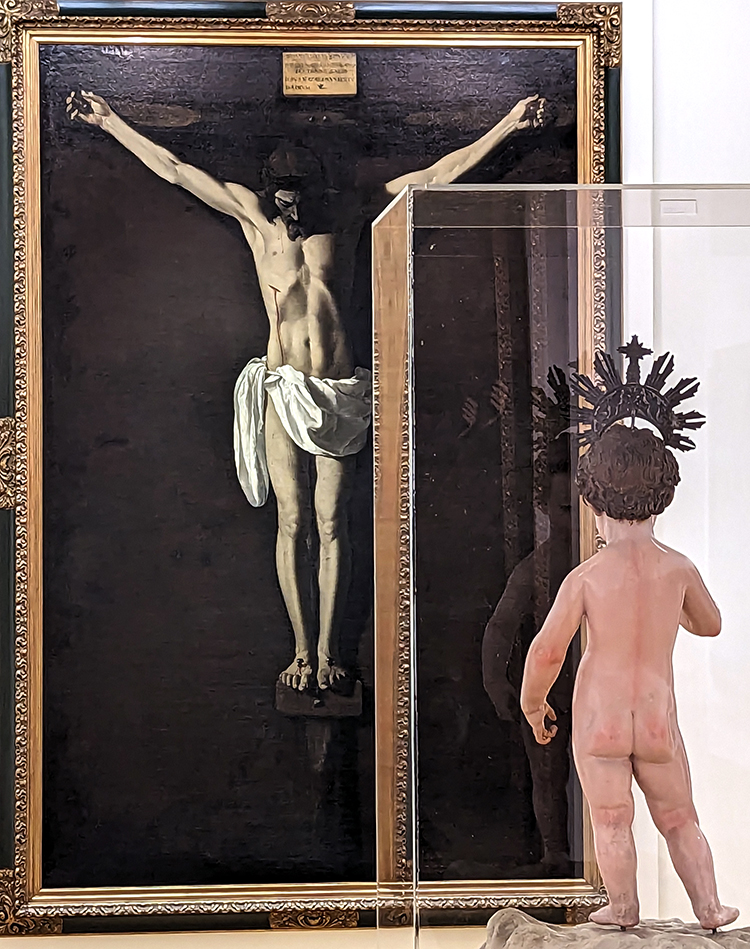

Above left: “Cristo Muerto en la Cruz,” Francisco de Zurbaran, 1636. Above right: “San Bernardo de Claraval,” Jose de Ribera, 1634.
Zurbaran (1598-1664) is regarded as “the Spanish Carvaggio,” and Ribera (1591-1652) has had a one-man show of his work at El Prado in Madrid. I love the gallery’s positioning of El Nino as though he is contemplating his destiny. And the wonderful wrinkles on San Bernardo’s hand (I am of an age where I regard a wrinkled hand as exhibiting wisdom.).

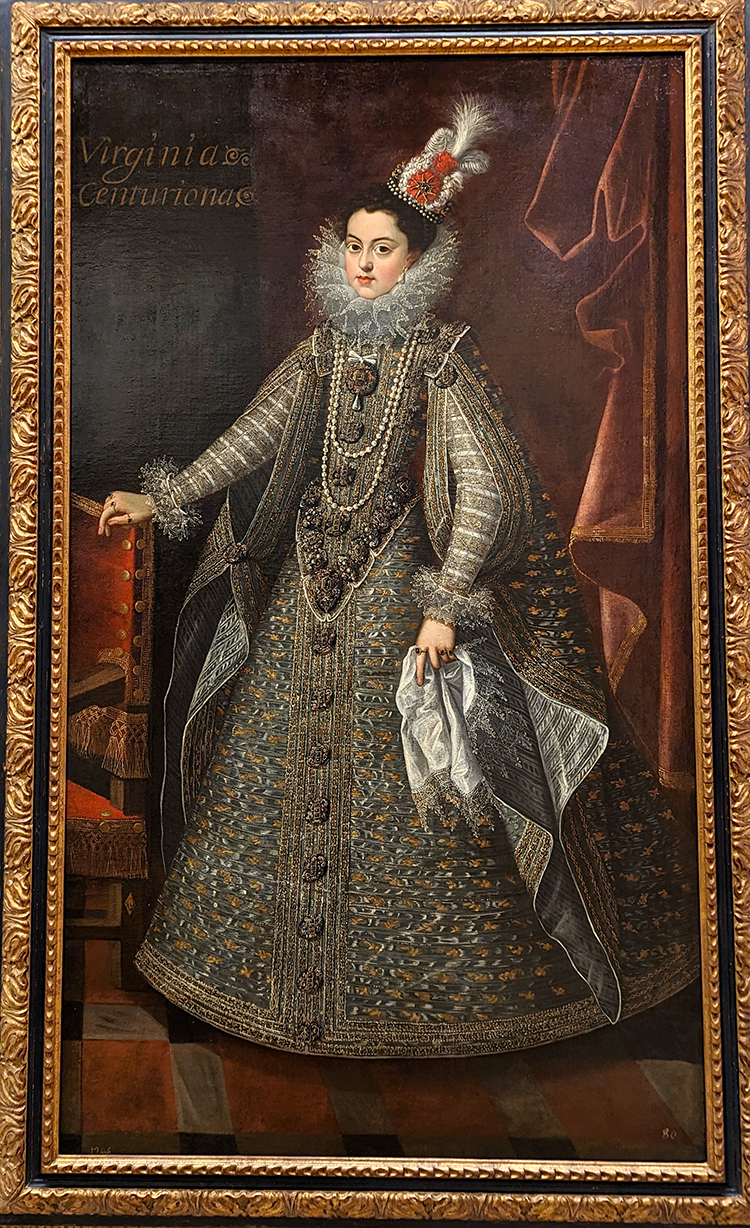
Above: “La Princesa Isabel de Borbon, Futura Reina de Espana,” Bartolome Gonzalez, 1616
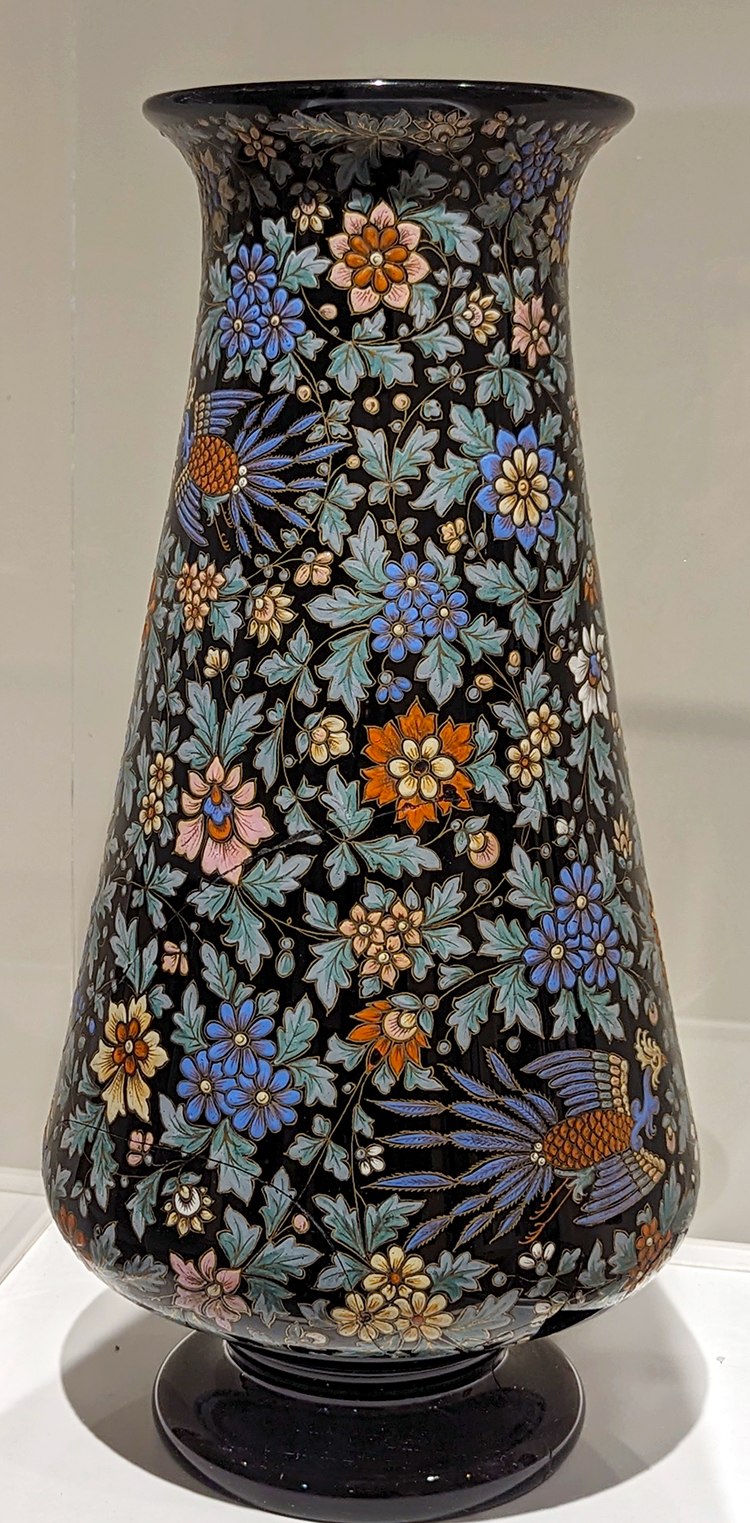


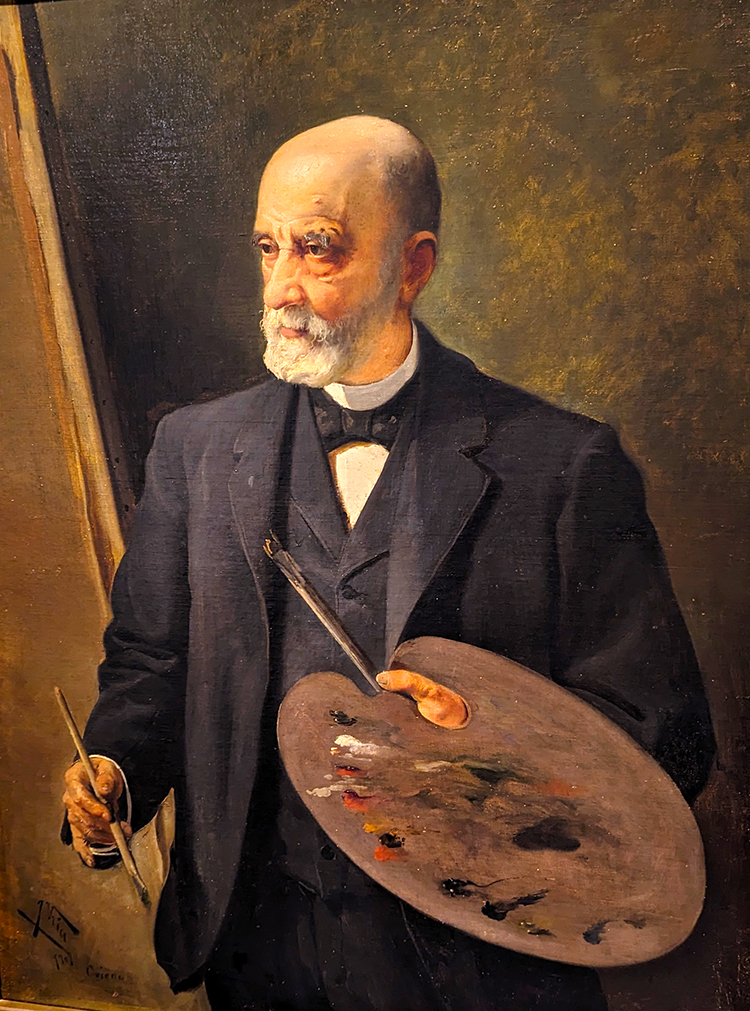
Above: Majolica pottery. “La Monjardin,” Sebastian Miranda, 1925. “Carmina Hija del Artista,” Luis Menendez Pidal, 1926. “Ramon Romea y Ezquerra,” Jose Uria y Uria, 1901.
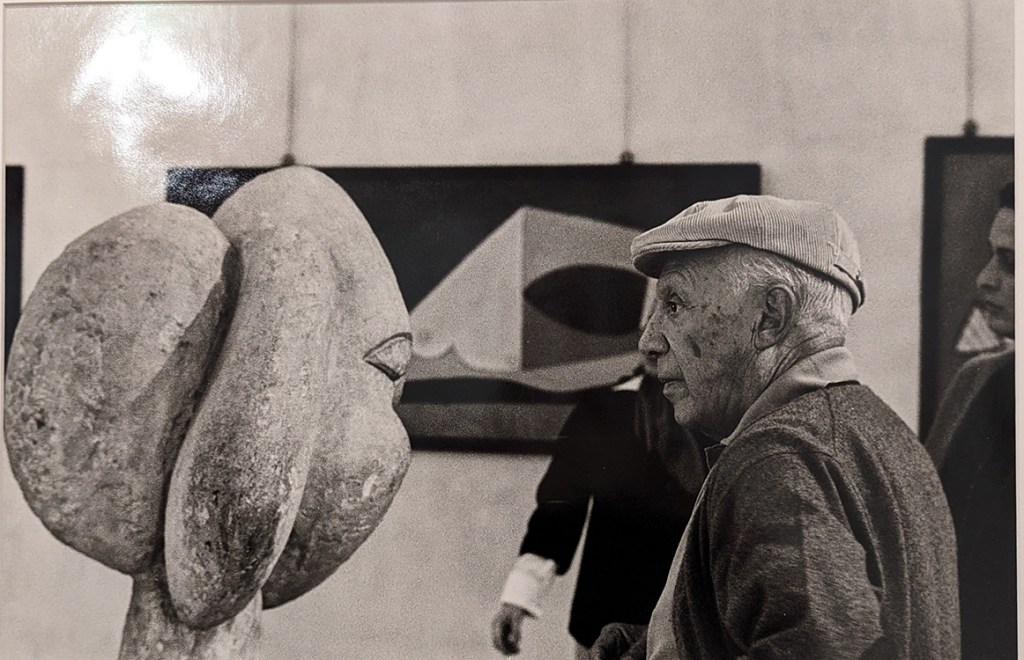
Above: Picasso reflecting upon his 1931 sculpture, “Cabeza de Mujer con Mono,” Antonio Cores, 1966.
 Postcards from Barton Springs
Not being a catholic, i found this post very entertaining! I hope the Order of the Star of the Sea will endure. It sounds very exotic. As usual, excellent photos.
LikeLiked by 1 person
Ric – Star of the Sea actually was the name of the little parish I went to in Virginia Beach, Virginia, USA, as a child. I didn’t attend the Catholic school so was sentenced to Catechism classes every Saturday. The nuns who had been teaching school all week were grouchier even than we were by this arrangement. But American Catholicism is quite boring compared to Europe. We missed out on most of the entertaining saintly tales involving mystical miracles.
LikeLike
In Australia the catholic tradition is fighting Irish, and far from boring. It has had an enormous influence. Even in my parents’ day, one of the greatest social chasms was between the protestants and catholics.
My father used to boast that he had been expelled from Sunday school for putting a firehouse through the window! So i managed to escape Sunday school altogether.
Cheers
Ric
LikeLiked by 1 person
In Australia the catholic tradition is fighting Irish, and far from boring. It has had an enormous influence. Even in my parents’ day, one of the greatest social chasms was between the protestants and catholics.
My father used to boast that he had been expelled from Sunday school for putting a firehose through the window! So i managed to escape Sunday school altogether.
Cheers
Ric
LikeLike
Firehose! Predictive text should be excommunicated.
LikeLike