Diving down rabbit holes: Fledgling 19-teens’ silent film industry proved distracting

Above: “Boy Playwright Shows Talent,” San Antonio Express, July 6, 1913, UNT Libraries, The Portal to Texas History

Seeking the feel of an era when trying to write historic fiction requires time-consuming research, but distracting detours are so seductive and somewhat justified as snippets gleaned slip into the pages you type.

Take Oliver Perry Wilson Bailey (1897-1978), tagged with an ambitious-sounding name. The 1910 Census, when he was but a lad of 12, recorded him as a professional rabbit-raiser living on South Alamo Street, now part of Hemisfair, in San Antonio. By 1913, he was an accomplished screen writer. Yes, the son of a reporter of the San Antonio Express already had sold screenplays to three different companies.

Continue reading “Diving down rabbit holes: Fledgling 19-teens’ silent film industry proved distracting”
Texans sure like reading about Texas

Above: 2021 brought new ghost lore for Brackenridge Park.

In the end of the year push to publish An Ostrich-Plumed Hat, and Yes She Shot Him Dead, I almost forgot the all-important round-up of your favorite posts from 2021. Most readers appear to favor stories about their hometowns, whether it is San Antonio (still Alamobsessive as ever) or Austin. Or maybe this represents a two-year confinement blip, where you are looking for comfort close to home and aren’t fully prepared to play boulevardier yet.

Continue reading “Texans sure like reading about Texas”

A sweet San Antonio mystery: Where did the Candy King’s recipe go?

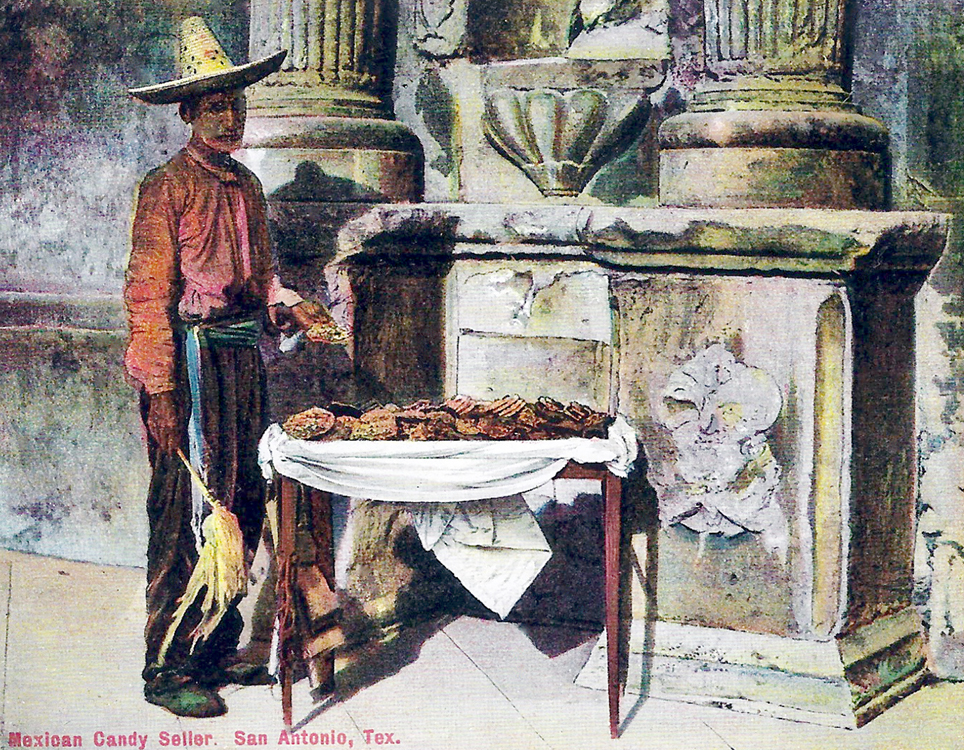
Flip side of above postcard: “The Mexican Candy seller is a typical sight on the streets of San Antonio. Dressed in his native garb and selling a kind of pecan candy peculiar to Mexico which he alone seems to have the secret of making more toothsome than anyone else.”

Pecan pralines that melt in your mouth. The perfect finishing taste after overdosing your Mexican food with spoonful after spoonful of addictive salsa and jalapenos.

In 1910, there was one praline vendor who dominated the market in San Antonio, Tomas Contreras (1847-1912). I “met” him when I was researching my recent book, An Ostrich-Plumed Hat, and Yes, She Shot Him Dead. I stumbled across a full-page obituary for the Candy King in one of the local newspapers.

Tomas was born in Guanajuato and arrived in San Antonio with his mother Juanita in 1877. In the kitchen of their rented house on Matamoros Street, Juanita made what everybody claimed was the best pecan candy. She would dispatch Tomas to sell it downtown. He would take his basket and head to Alamo Plaza near the Menger Hotel. The Menger soon invited him to sell inside the lobby, positioned next to their popular blind harpist.

Continue reading “A sweet San Antonio mystery: Where did the Candy King’s recipe go?”