A place to seek miracles

Above, Chapel of the Miracles, photo by Michael Cappelli, 1984

This is, in the words of the Abbe Dubuis, ‘a place of frequent emotions.’

Julia Nott Waugh, The Silver Cradle, 1955
Close-up of El Senor de Los Milagros from Michael Cappelli’s 1984 photo

El Senor de los Milagros, or The Lord of the Miracles, is suspended majestically above an altar in a small privately-owned chapel on the near west side of town. La Capilla de los Milagros stands somewhat in isolation on what was Ruiz Street, now Haven for Hope Way, severed from downtown by IH-10.

The age and origin of this crucifix are part of its mystery. In 1907, Charles Barnes wrote in the San Antonio Express that it was brought to San Antonio by Spanish friars as early as 1716 and placed in San Fernando Cathedral. In a 1928 edition of the Dallas Morning News, Vivian Richardson claimed its origins were local, that “it was revealed to a Mexican that he should make a crucifix for San Fernando Mission.”

Continue reading “A place to seek miracles”
A pair of Marys’ distinctive impressions of city landmarks

bonner keating concepcion

Above, Mission Concepcion de la Purisma by Mary Bonner (left) and by Mary Aubrey Keating (right)

‘I had always dabbled a little in artistic things in a sort of boarding school fashion, but I had certainly never taken anything I had done very seriously.’

Mary Bonner (1887-1935) in a 1926 interview by Penelope Border in the San Antonio Express

Mary Bonner, well known etcher, in conjunction with her sister, Emma Jane, has a studio on Agarita Street. There, period furniture, rare objets d’art, first editions, and, of course best of all, etchings my be had. ‘Mary’ has won many medals and decorations from the French Government for her etchings. The Bonner place… is set in an ancient walled garden, hemmed in by giant cypress trees. In the garden there are many paths. One leads to Mary’s studio, another to an underground part of the Shop, known as the Caverns…. Beyond this, is the room for the gigantic etching press where the artist spends most of her time.

Mary Aubrey Keating (1894-1953) described her fellow artist in Keating’s 1935 guide, San Antonio: Interesting Places in San Antonio and Where to Find Them.
Continue reading “A pair of Marys’ distinctive impressions of city landmarks”

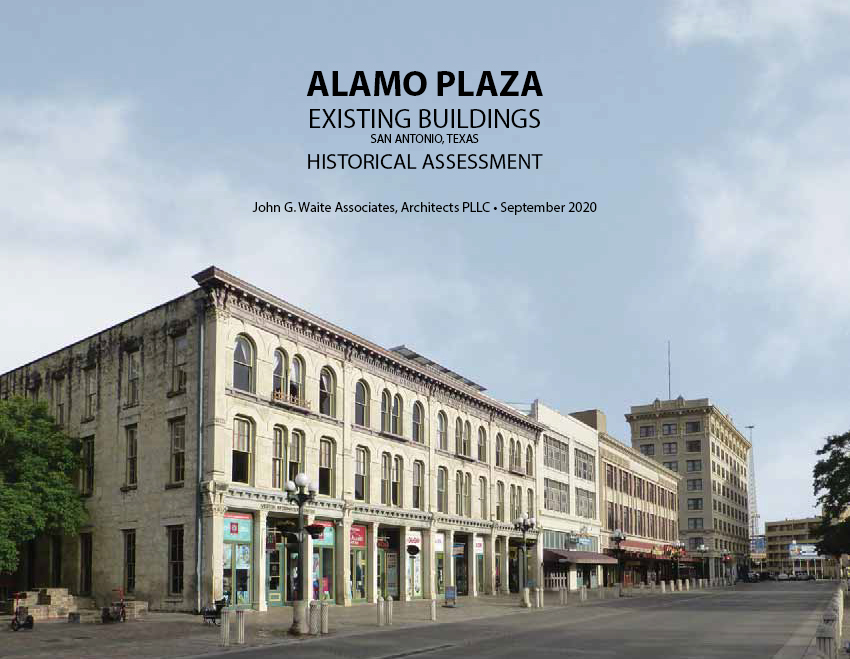
Toast the Historical Assessment of the experts or mistrust the Alamo Trust?

alamo plaza buildings historical assessment

Above from left to right: The Crockett Block (1882); the Palace Theater (1923); and the Woolworth Building (1921) on the west side of the plaza facing the Alamo

Been dreading the arrival of the Historical Assessment of a trio of historic buildings on the west side of Alamo Plaza conducted by John G. Waite Associates for the Alamo Trust. My trust eroded by a dearth of information emanating from the Alamo during the past several years, I assumed the instructions given the architectural firm might have been skewed to doom them to the wrecking ball. But I must have been wrong.

The conclusions reached by the study are a dream come true for preservationists and proponents of adaptive reuse. The landmarks are viewed as prime for transformation into a visitor center and museum for the Alamo.

Continue reading “Toast the Historical Assessment of the experts or mistrust the Alamo Trust?”