
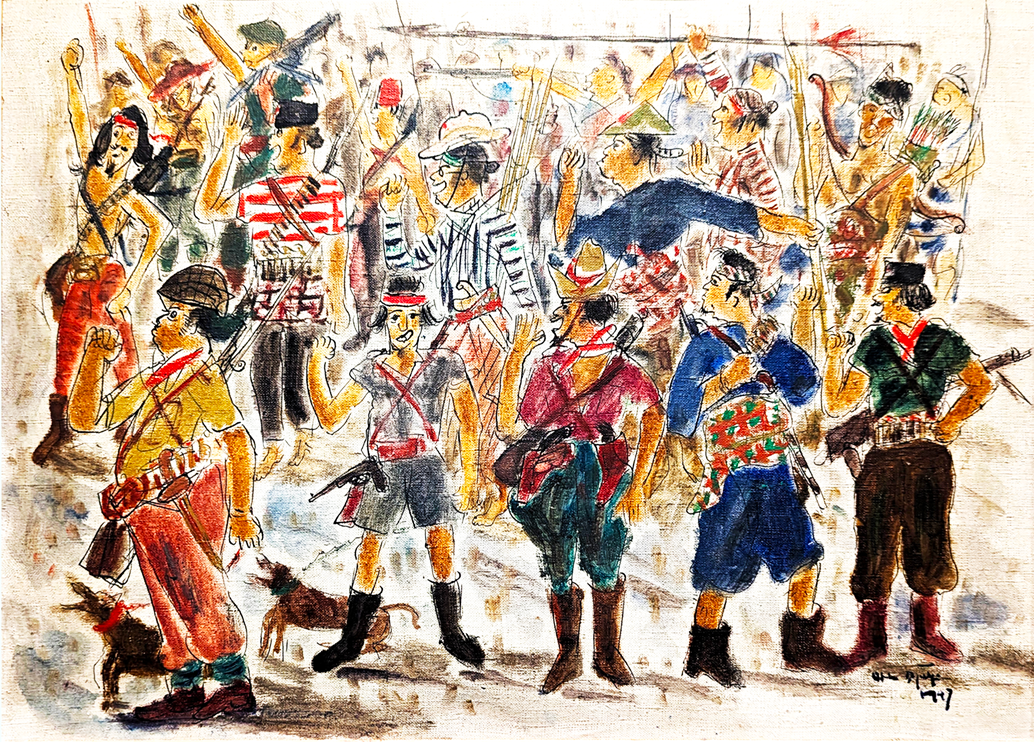

Above: “Revolution,” Otto Djaya (1916-2002), oil and ink on canvas, 1947
The fighters depicted in Otto Djaya’s painting ‘Revolution’ (1947) are all dressed and equipped for revolutionary action. The figures’ various styles of dress represent the great variety of local costumes worn in the different regions of the archipelago. Their makeshift equipment references the ragtag make-up of the Indonesian revolutionary army, which Otto depicted with a sense of humor…. Otto clearly aimed to break with the Dutch concept of ‘volkstypen,’ meaning ‘ethnic types:’ A koelie is always an indigenous Javanese or Chinese person, whereas an ambtenaar (official), a priester, and certainly a regent is always of Dutch descent.”
“Fighting Colonial Claims to Power,” Kerstin Winking, Stedelijk Museum website
Before the Japanese occupation during World War II, the archipelago now known as Indonesia had been a profitable colonial outpost for the Dutch for almost 350 years. Following the Allied defeat of Japan, revolutionary forces declared independence, taking advantage of the Netherlands’ weakened state after years of war and German occupation. The Netherlands balked at recognition, so a bloody four-year war ensued.
Yet, in 1947, in the midst of this revolt, the curator of the Stedelijk Museum of Modern and Contemporary Art and Design boldly mounted an exhibition focused on the work of two brothers, Agus and Otto Djaya, newly arrived in Amsterdam from their native land, the Dutch East Indies. Members of the revolutionary army, the pair harnessed the power of art as a weapon to persuade the Dutch to recognize Indonesian independence. Some of their works brazenly represented Dutch colonialism as a monster.
This, in a museum originally funded by private donors who had made their fortunes through colonial exploitation. I’ve tried, but it’s impossible for me to imagine the public outcry and political fallout caused by this exhibition. Think of Queen Wilhelmina (1880-1962), only just returned to The Hague following her wartime exile in England. Exhausted after ruling through two world wars and facing intense criticism for the potential loss of the oil-rich Dutch East Indies, the ailing Queen Wilhelmina abdicated in favor of her daughter Juliana (1909-2004) in 1948.
Vincent van Gogh was there for me even before I started painting…. It was the first dispute with my father who saw things so differently; for me it was the breakthrough to a new world…. The major Amsterdam exhibition of his work after the Liberation was even more of a Liberation for me than the actual one.”
Charley Toorop (1891-1955)
At first, I failed to realize “Charley” was a woman, so unexpected was the strong presence of a female artist from that period. But Charley, Annie Caroline Pontifex Fernhout-Toorop, was extremely influential in the development of avant-garde Dutch art in the first half of the 20th century. She worked closely with prominent artists in Amsterdam and particularly with members of the Bergen School.


Top left: “Three Figures,” Charley Toorop, 1926. Middle: “The Red Kimono,” George Hendrik Breitner (1857-1923), 1894. Right: “Augustine Roulin (Rocking a Cradle),” Vincent van Gogh (1853-1890), 1889.
Heinrich Campendonk’s art echoes the memory of his early experiences with the Blaue Reiter and Der Sturm groups in Germany, and he recalled the years of daily contact with Wassily Kandinsky and Franz Marc as the most wonderful of his life…. However, while Marc’s animal imagery expressed an apocalyptic world view and Kandinsky’s pure abstractions sought to express the spiritual unity of all the arts, Campendonk remained content to be a teller of dream-like tales.”
“German Expressionism: The Graphic Impulse,” Starr Figura, 2011
After being dismissed from his teaching position at Dusseldorf Academy in 1933 by Nazis, Campendonk was fortunate to have left Germany. The artist became a Dutch citizen in 1951.


Left: “Interior of a Farm,” Heinrich Campendonk (1889-1957), 1921. Middle and detail on right: “The Pregnant Woman/Maternity,” Marc Chagall (1887-1985), 1913.
Between 1915 and 1925, artists came together in the Dutch town Bergen near the North Sea, and developed the Bergen School. Dutch artist Piet van Wijngaerdt and French artist Henri le Fauconnier started this art movement, and were joined by many young artists who were eager to move away from Impressionism. The artists flocking to Bergen were attracted by the sea, the nature, and the fresh air and beautiful light in the area. The art of the Bergen School is characterized by figuration with cubist and expressionist influences. Famous Bergen School avant-garde artists include Charley Toorop, Leo Gestel, John Rädecker and Jan Sluijters.”
“Art Colonies – Where Artists and Movements Were Shaped,” Shira Wolfe, Artland Magazine
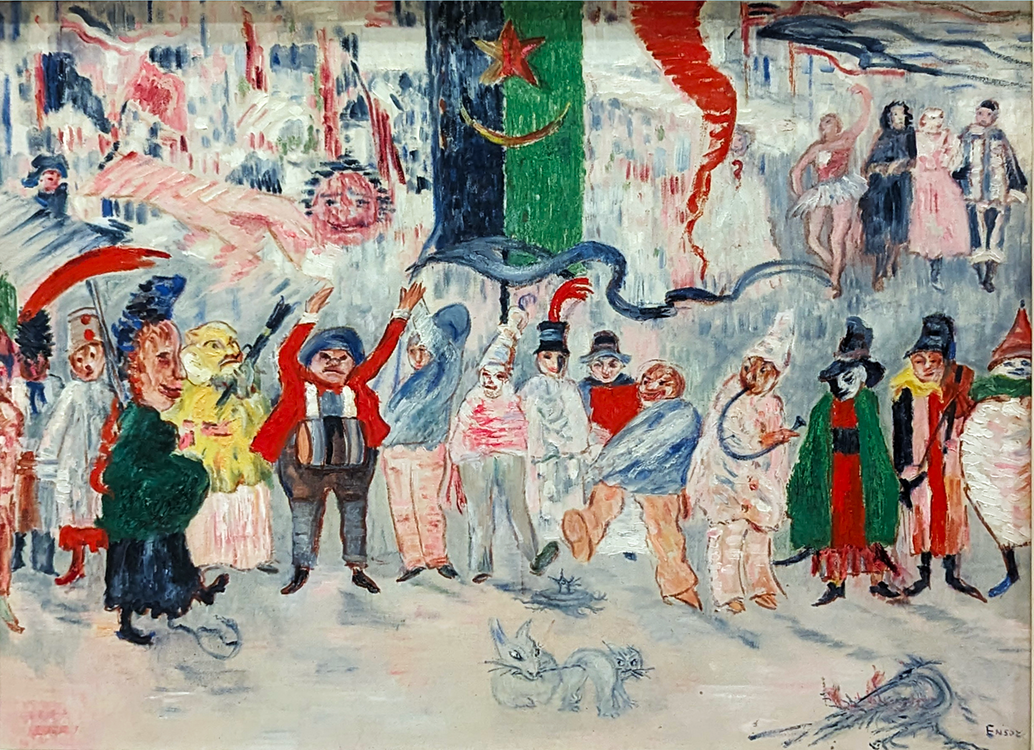


Top left: “Carnival in Flanders,” James Ensor (1860-1949), 1930. Bottom left: “Reading Woman,” Leo Gestel (1881-1941), oil on canvas, 1910. Right: “Model 31/42,” Alvar Aalto (1898–1976), armchair in laminated birch wood, 1931.
A photo only presents the moment itself, but in a well-painted portrait you can recognize somebody in all his expressions. Every day you have to be able to see something else in it.”
Charley Toorop (1891-1955)


Above left: “Residents of the Willem Arntsz House,” (artist’s original title, “The Imbeciles”), Charley Toorop, 1924. Bottom left: “The Rocking Car,” Hans Brockage (1925-2009), reversible chair/car for children, beech bentwood frame, plywood seat, 1950. Right: “Seated Woman,” Leo Gestel, oil on canvas, 1912.
Gustave de Smet (1877-1943) fled Belgium for the neutrality of the Netherlands during World War I. This exposed him to international modern art movements, influences affecting his paintings upon his return to rural Flanders:
We can recognize the simplification of forms of French Cubism and German Expressionism in the work of de Smet…. a vital impulse was the ‘popular’ theme of peasants and workers, who embodied purity and honesty…. translated everyday life into short stories: painted worlds that mix reality with poetry and wonderful memories…. with humour and sometimes a little hauteur.”
“Flemish Expressionism,” Kunstmuseum den Haag


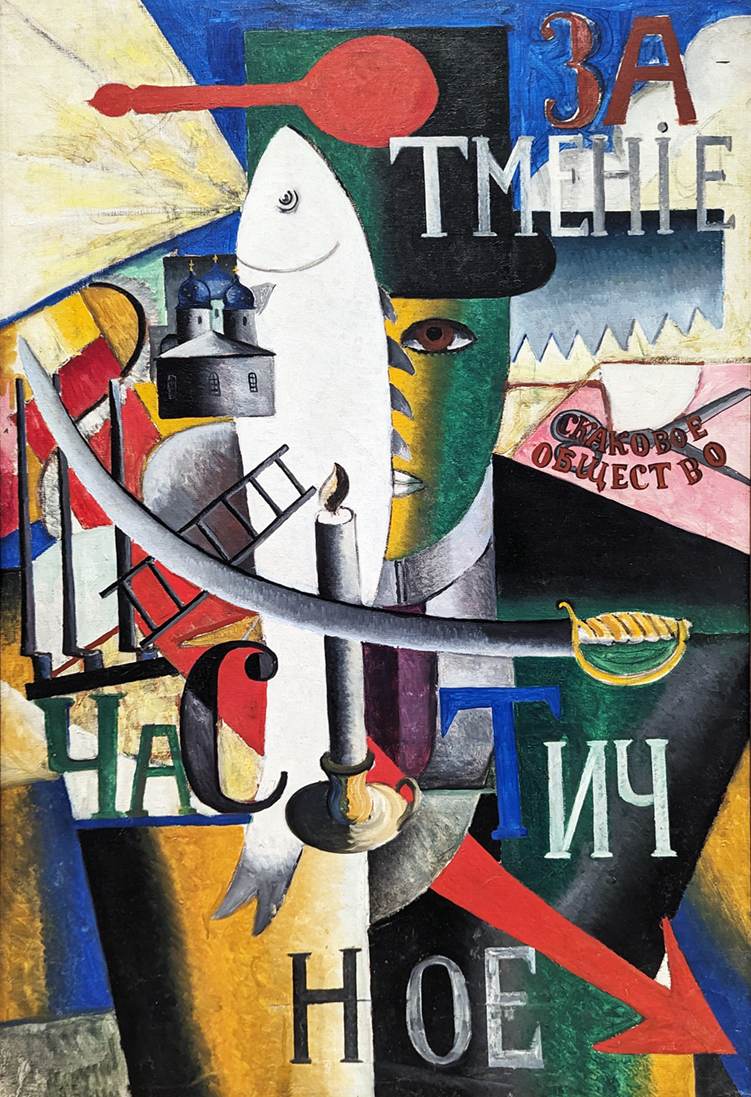
Above left: “The Three Comrades,” Fernand Leger (1881-1955), oil on canvas, 1920. Middle: “The Fertile Soil,” Gustave de Smet, oil on canvas, 1917. Right: “An Englishman in Moscow,” Kazimir Malevich (1879-1935), 1914.
My drawings and paintings were done as an act of protest; I was trying by means of my work to convince the world that it is ugly, sick and hypocritical.”
George Grosz (1893-1959)

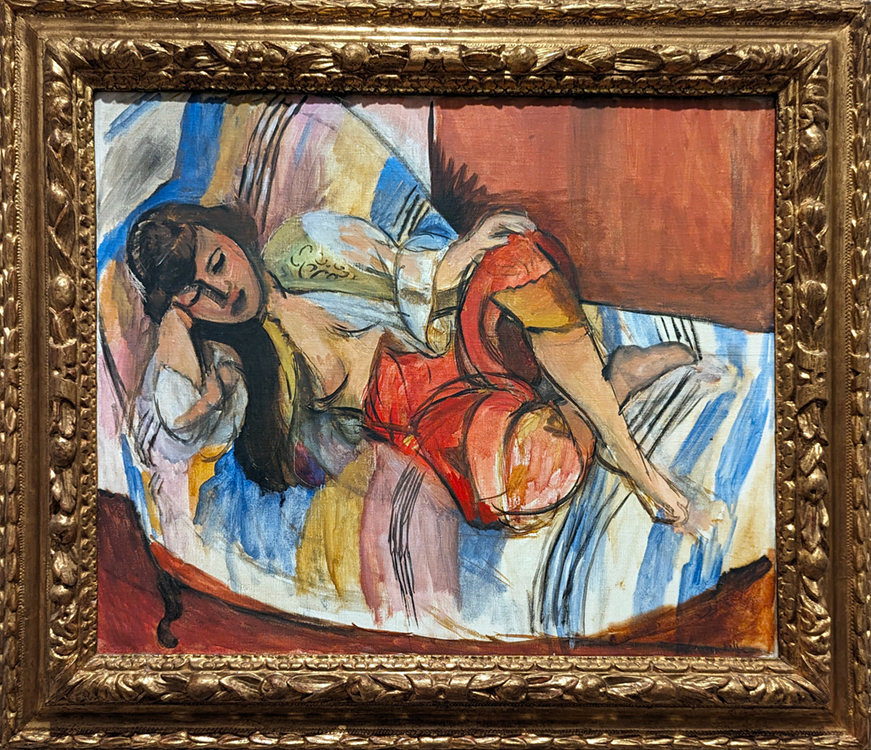

Above left: “The Rabble Rouser,” George Grosz, oil on canvas, 1928. Above right: “Odalisque,” Henri Matisse (1869-1954), paint on canvas, 1921. Bottom right: “Still Life with Wooden Figure,” Erich Heckel (1883-1970), paint on burlap, 1910.
Armand Baag did not complete his training at the Rijksakademie because he disagreed with the Western standards that were taught as ‘universal art.’ He came from the Black working class and in his work he was also looking for ‘ownness,’ among other things to counteract the mental legacy of colonialism: ‘I want to give my people back their ideal of beauty. They have been ruined over the centuries.’”
“In Search of ‘Ownness,'” Mitchell Esajas, Surinamese School: Painting from Paramaribo to Amsterdam


Above left: “Raysse High Voltage Painting,” Elain Sturtevant (1924-2014), acrylic, collage and neon light on canvas, 1969. Middle: “Family Portrait Baag,” Armand Baag (1941-2001), oil on canvas, 1989. Right: “Interior,” Frieda Hunziker (1908-1966), oil on canvas, 1945.
Pictured here is Henriette von Motesiczky, the artist’s mother, with Lissy Gray, the wife of composer Allan Gray (a pseudonym of Josef Zmigrod), who, like the Motesiczkys, fled from Austria to Great Britain. The work, in which Gray refers to the old, lost world with her harp, is an allegory of exile. Marie-Louise Von Motesiczky: ‘She had always told mother how terrible her husband was! He is the ugly bird in the picture – he spoils the sound.'”
Curator’s Notes


Above left: “The Old Song,” Marie-Louise Von Motesiczky (1906-1996), oil on canvas, 1959. Above right: “Angel,” Simone Forti (1935-), holographic print, incandescent light bulb, plastic and wood, 1977. Bottom right: “The Song of the Great Falls,” Ed Hart (1936-), oil and pencil on plywood, 1971.
A colorful suit hanging on a wall caught my eye. Artist Sel Kofiga uses fashion design to call attention to a tremendous environmental catastrophe overwhelming his hometown, Accra, Ghana.
Those used clothes we over-consumers discard and donate to charities? Well, only about ten percent are high enough quality to find new homes; the rest of them are shipped out and sold and resold and resold until they reach markets in places like Accra. Their final resting places. Only an extremely small percentage of the 15-million garments arriving weekly in Accra have any value remaining, according to Jenny Marc, reporting for CNN World. The majority overwhelm dumpsites or are discarded along the shore, only to return with the next tide to smother the beaches.
Best known for his wearable art—hand-painted garments made of upcycled fabric—, his projects deal with the circulation, the socio-political underpinnings, and the creative potential of waste material. “I’m interested in what it is and how it ends up in my space, how it moves in my space; how it clothes my space, and how it affects the social landscape of my space….”
“The Slum Studio’s founder Sel Kofiga on Why Sustainable Fashion Goes beyond Clothing,” Amelie Varzi, Friends of Friends
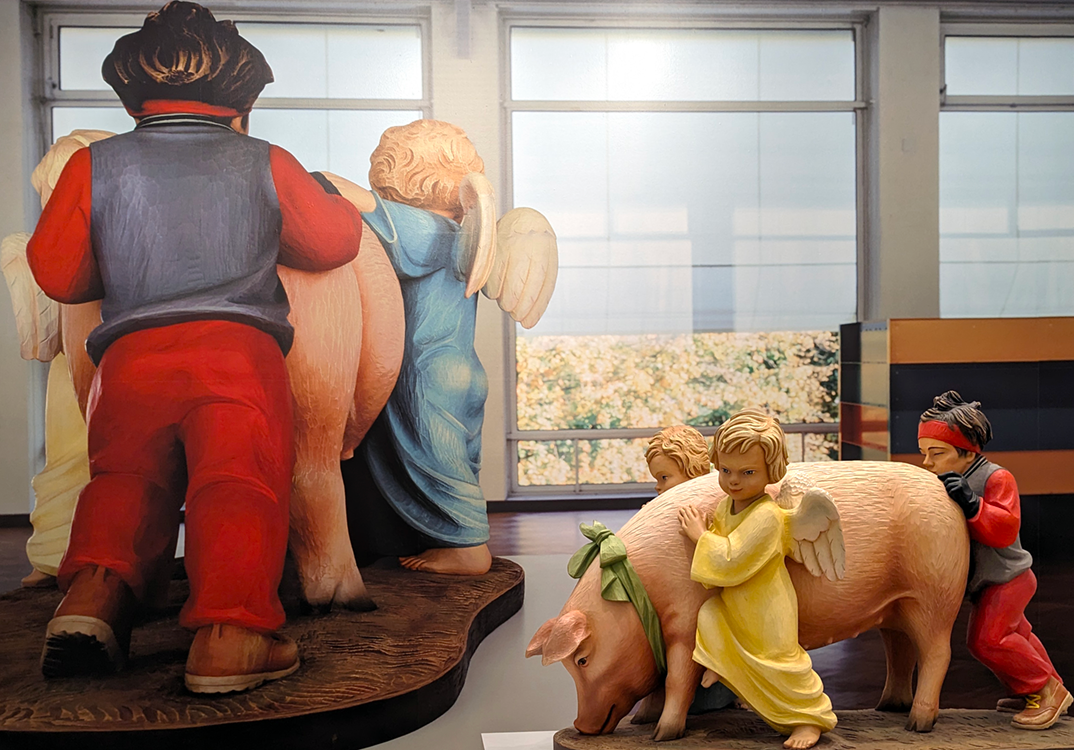


Above left: “Ushering in Banality,” Jeff Koons (1955-), 1988. Second from left: Suit, Sel Kofiga, The Slum Studio, hand-painted on upcycled material. Third from left: “Igloo: From Honey to Ashes,” Mario Merz (1925-2003). Right: “White Head,” Niki de Saint Phalle (1930-2002), polyester, paint, 1970.


Above left: “Eveningdawn (Reverse Pareidoliac Figure),” Anthony Cudahy (1989-), oil on canvas, 2022. Middle: “Dentata,” Miriam Cahn (1949-), oil on canvas, 2020. Right: “Cut by Grass,” Co Westerik (1924-2018), oil and tempera on hardboard, 1966.
The Stedelijk Museum’s 1895 red-brick building was designed by Adriaan Willem Weissman (1858-1923), the city’s municipal architect in its Public Works Department. Located on what is known as Museum Square, it complements the architecture of the 1885 Rijksmuseum nearby.
Naturally, the Stedelijk collection has grown. An addition designed by Benthem Crouwel Architects was completed in 2012.
By lifting part of the new volume above ground and sinking the rest underground, the existing building is left almost entirely intact and in full view. The entrance was moved to the spacious and transparent extension on the side of Museumplein, contributing to the new public quality of the square. The glossy, smooth white volume above the entrance, also known as ‘the Bathtub’ because of its shape, has a seamless construction of reinforced fiber and a large canopy hovering over the square, creating a roofed plaza that belongs as much to the building as to Museumplein.”
Benthem Crouwel Architects website


Museums are not mere receptacles for hanging paintings too large for the walls of most people’s houses. Artworks are not chosen like a swimsuit competition on a boardwalk, nor as art for art’s sake. Collections are curated thoughtfully.
Art can reveal much about a place’s culture and history, and it sometimes serves as an artist’s megaphone, alerting viewers to critical political, social or environmental issues. It awakens curiosity and makes you think. And, yes, sometimes it is beautiful.
As usual, a museum visit reminds me how much more there is to learn and how enjoyable a journey that process can be.
 Postcards from Barton Springs