


Above: Angels surround an image of the Virgin Mary and Child in a 14th-century Byzantine fresco in the dome crowning a side chapel of the former Church of the Holy Saviour in Chora, recently reopened as the Kariye Mosque.
I have no religion, and at times I wish all religions at the bottom of the sea. He is a weak ruler who needs religion to uphold his government; it is as if he would catch his people in a trap.”
Mustafa Kemal Ataturk (1881-1938)
For many in Turkey, Mustafa Kemal Ataturk remains the most respected figure in the republic’s history. Banners bearing Ataturk’s image still flutter across streets and on buildings throughout Istanbul.
Following the defeat of the Ottoman Empire during World War I, Ataturk led a successful revolution against the Allied Forces to prevent them from dividing up Turkey as spoils of war. He abolished the Sultanate and then proclaimed Turkey an independent republic in 1923.
As the country’s first president, Ataturk launched a host of aggressively progressive reforms: free and compulsory elementary level education for all; equal rights for women; and secularization of the state. Later, both Hagia Sofia and Chora Church were converted into museums, demonstrating Turkey’s tolerance of different religions.
In 2020 to cement his support on the conservative right, President Recep Tayyip Erdogan succeeded in convincing the court to overturn Ataturk’s original decree and announced the conversion of both into mosques. The conversions were accompanied by a promise to keep the mosques accessible to those of all faiths.
We maintained these lands and made them our homeland with our blood, our flag, and the sound of prayer from the mosques. This is why the re-opening of the Hagia Sophia as a mosque is important, as it is a legacy of conquest…. I believe that every mosque we build is a cultural lighthouse to safeguard the future of our people and our homeland.”
President Recep Tayyip Erdogan of Turkey, Ekathimerini News, April 6, 2021
In Greek, chora means outside, in the case of Chora Church outside the city walls of what was then known as Constantinople, and the first chapel to stand on the hilltop site was built in the fourth century. A new chapel was erected there for important religious ceremonies by the Eastern Roman Emperor Justinian I (482-545).
Hundreds of years later in 1203, this church was destroyed at the end of the Fourth Crusade by western crusaders ransacking the city. Their bloodthirsty destruction and consequent division of much of the Byzantine Empire created a wound between Eastern Orthodox church leaders and Rome that never has healed completely.
During the reign of Emperor Andronikos II (1259-1332), the church was rebuilt and adorned with fine Byzantine-style frescoes and golden mosaics. Those exquisite works of art were covered up by the Grand Vizear of the Ottoman Empire, Hadim Ali Pasa (1450?-1511), with a thin layer of plaster or whitewashed to hide the representations of human figures forbidden in mosques. He replaced the belfrey with the requisite minaret.
Fast forward a few more centuries to the time of Ataturk. During the conversion of Chora into a museum by the Byzantine Institute of America, the ancient works of art began to surface. Those that could be resurrected were restored, a decade-long effort.


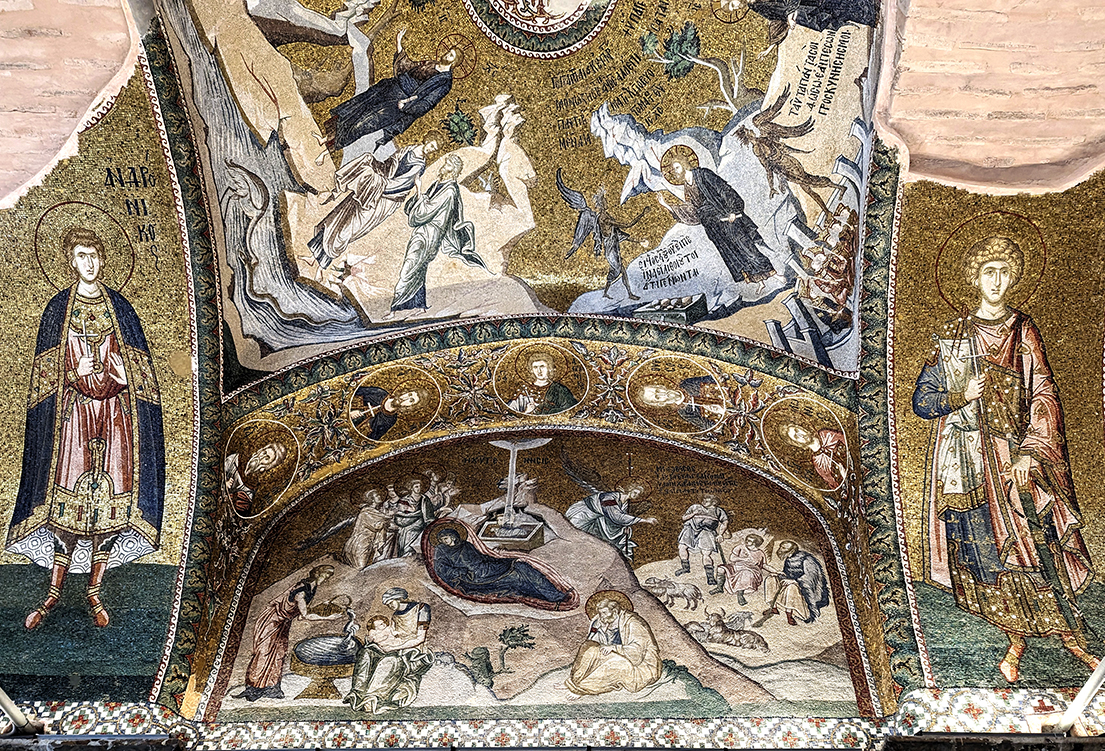
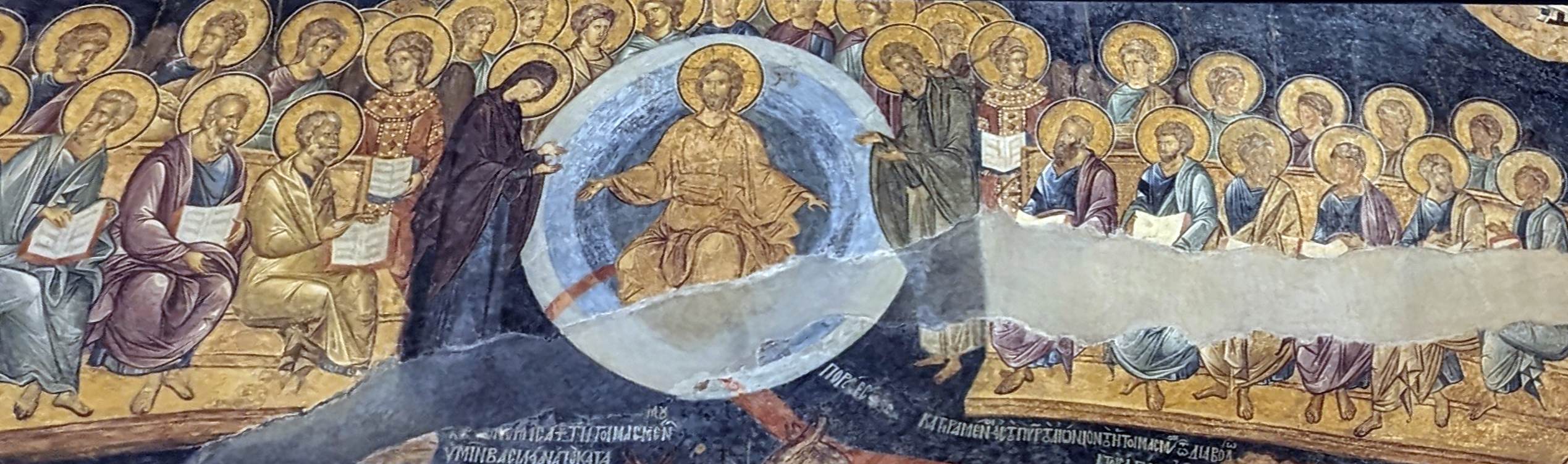
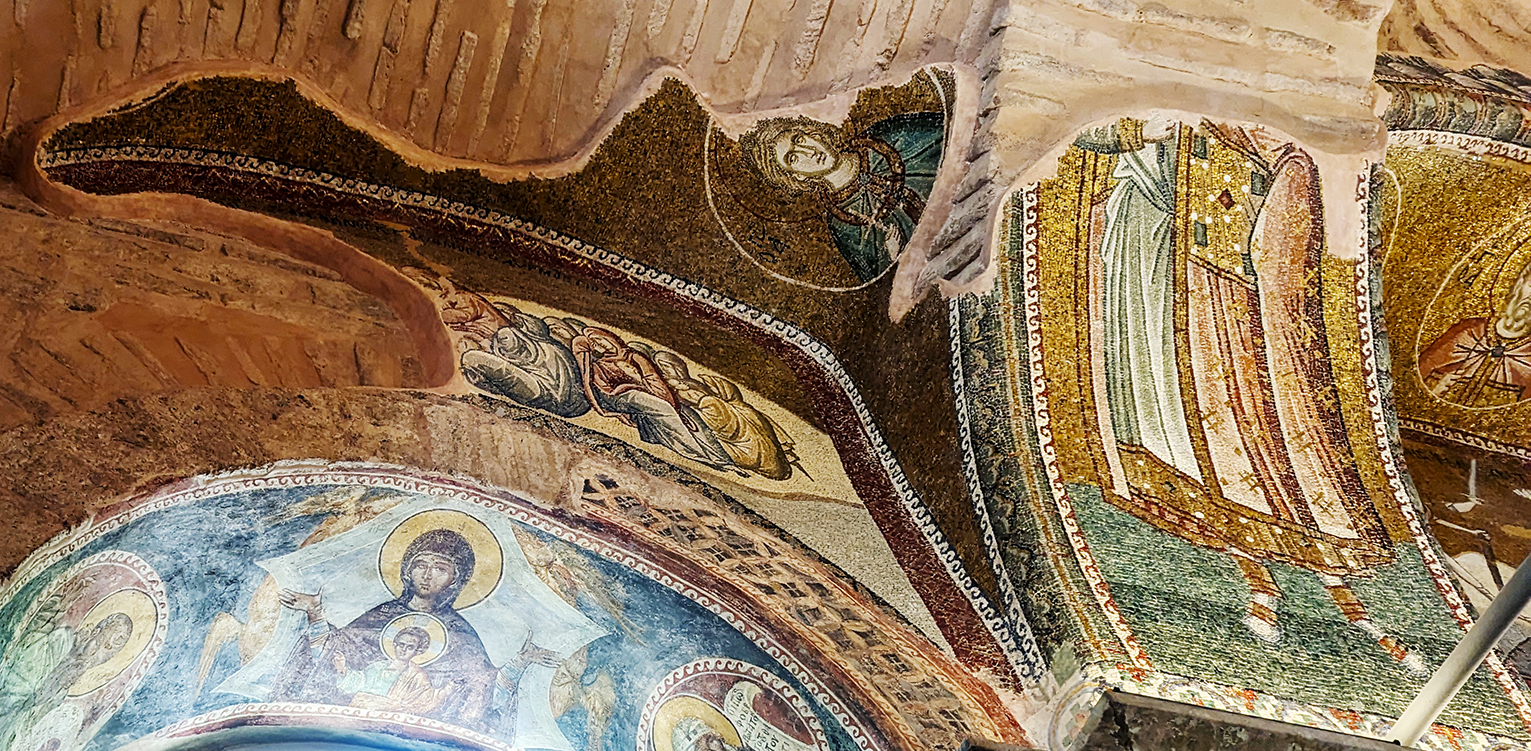
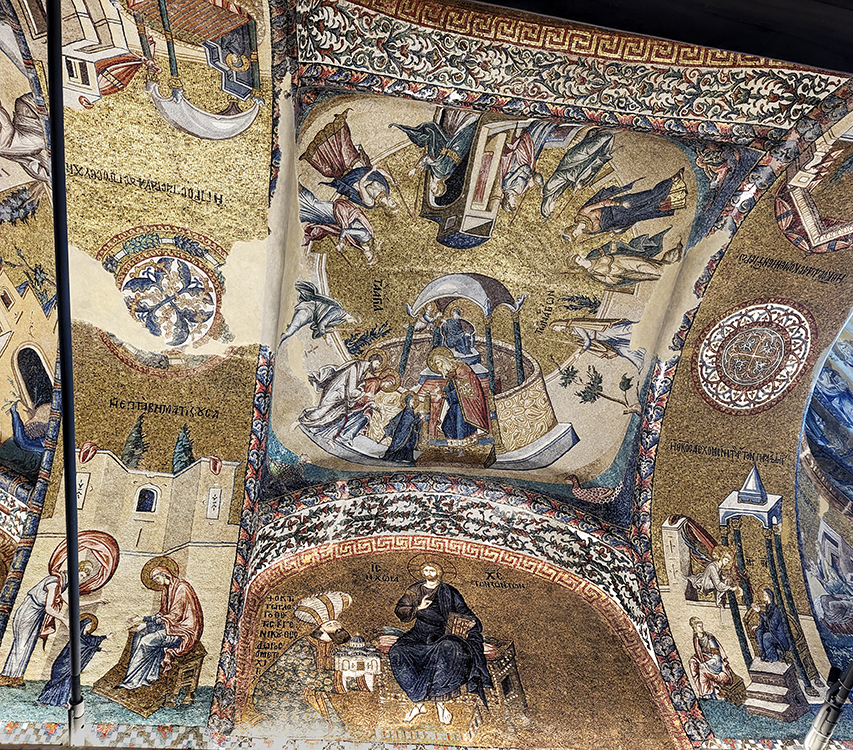
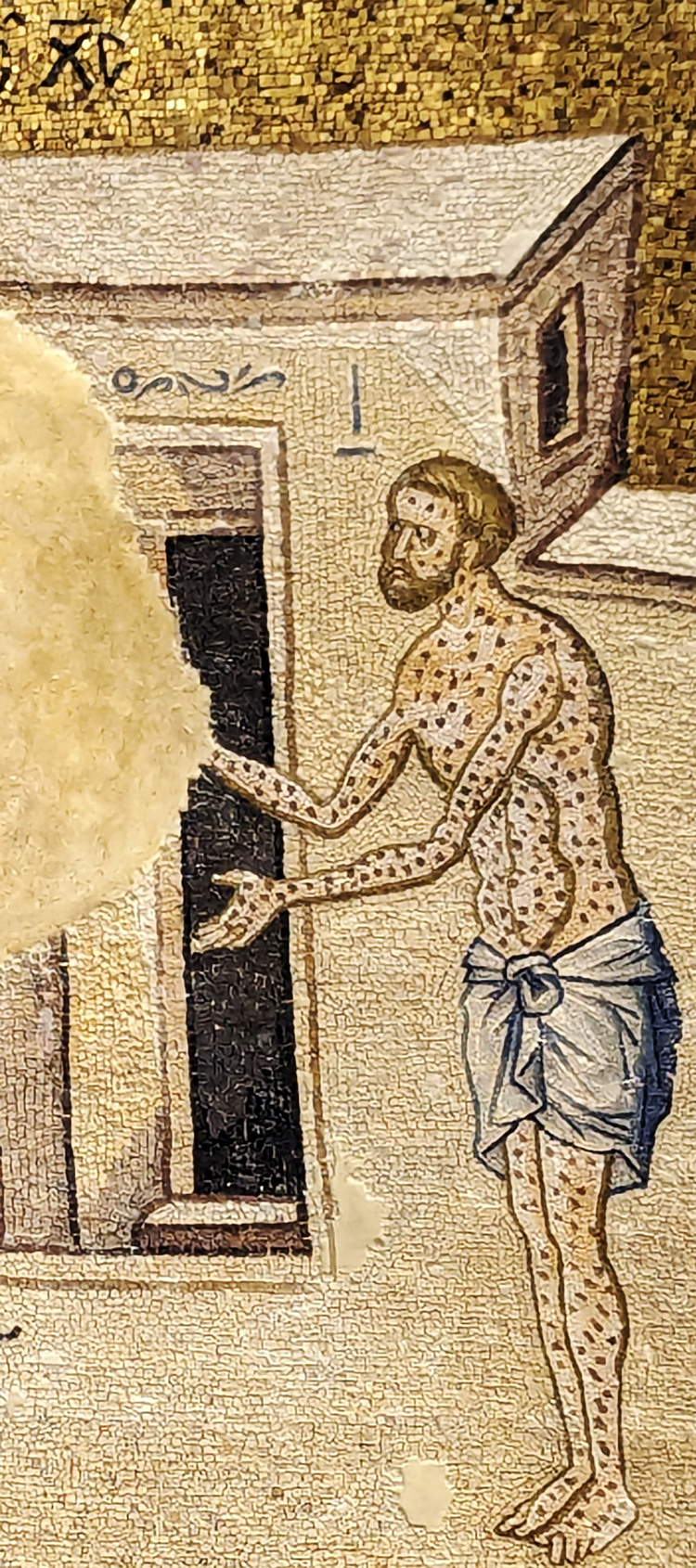


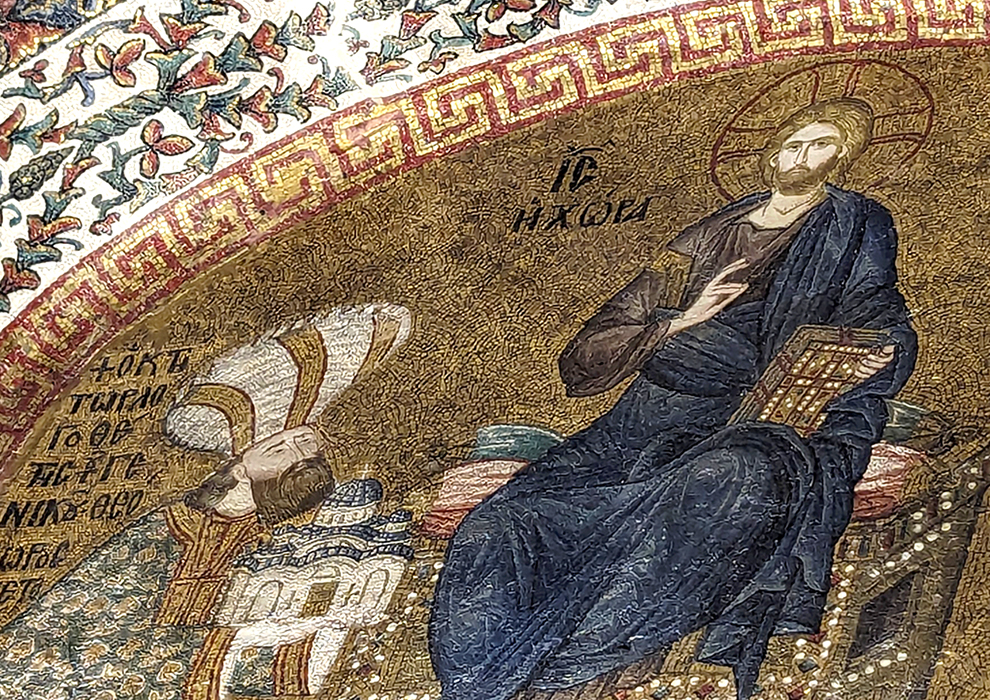

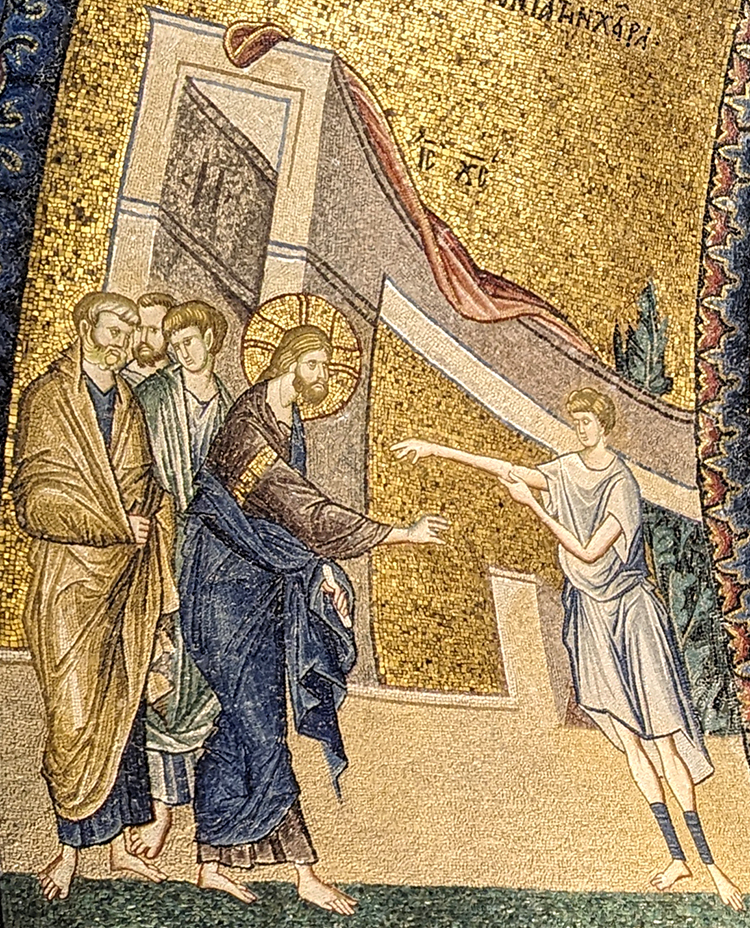


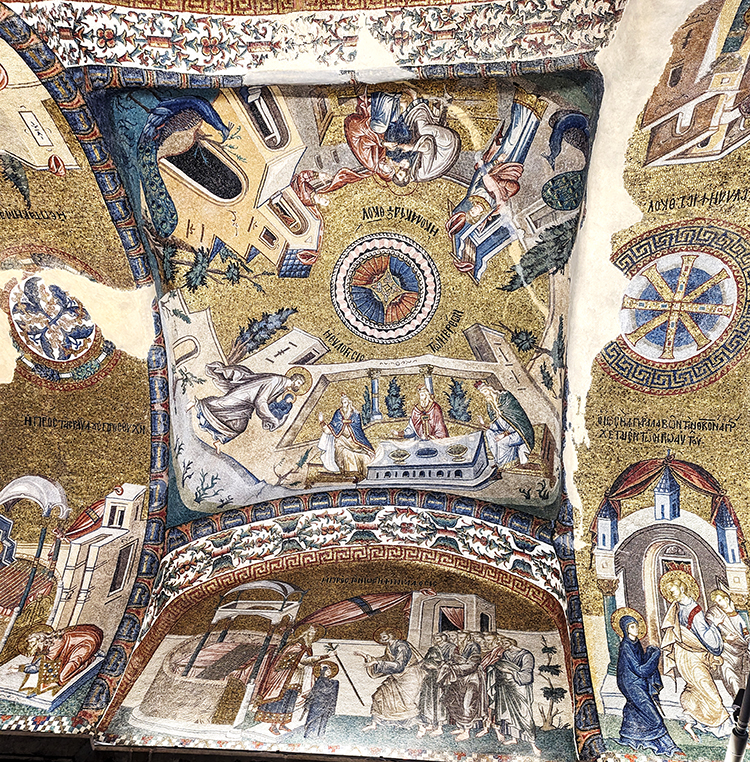
Above: Images taken outside the Musalla, or Main Prayer Hall, of Kariye Mosque in May of 2024.
I’m unsure what this recent reversion to a mosque required doing to the Musalla, or Main Prayer Hall, to make it acceptable. We visited the first week it reopened this year, and the center certainly appears stripped down. Screened off from the Musalla though, the precious art in the former side chapels has been retained. President Erdogan appeared living up to his promise to keep it “accessible for the benefit of our nation and all humanity,” reported in the May 14, 2024, edition of La Croix International.
Arriving for a meeting with President Erdogan only two days after the May re-opening, Greek Prime Minister Kyriakos Mitsotakis did not hesitate to express his disapproval:
‘There are no shortages of mosques in the city. This is no way to treat cultural heritage,’ he said, recalling that Istanbul “was the capital of Byzantium and Orthodoxy for over a thousand years.'”
Greek Prime Minister Kyriakos Mitsotakis, La Croix International, May 14, 2024
While the move is popular with conservative religious supporters of President Erdogan, Turkey’s most famous author, Orhan Pamuk, said the decision would take away the ‘pride’ some Turks had in being a secular Muslim nation.
‘There are millions of secular Turks like me who are crying against this but their voices are not heard.'”
“Hagia Sophia,” BBC News, July 10, 2020
President Erdogan’s definition of “accessible” changed in mid-August of this year. Foreigners must now pay 20 euros to enter Kariye Mosque.
 Postcards from Barton Springs