While orange trees abound along the streets of Valencia, mulberry trees were more important as a cash crop in the 1400s. Not for the fruit, but because their leaves provided food for the very hungry caterpillars striving to build cocoons and emerge as moths. The moths only live about five days, but lay hundreds of eggs before their passing.
For Valencian farmers, the cocoons were the most important result of the short life cycle. After a dip in boiling water killing the pupa who so industriously wove it, a silkworm’s cocoon can be unraveled to produce a strand of silk ranging from about 1,000 up to almost 3,000 feet long.
So unravel the Valencians did. They unraveled so much, that by 1482 the fortunes amassed and riches anticipated from future trade enabled the silk merchants to begin construction of a major Gothic edifice worthy of housing their transactions.
Now a UNESCO World Heritage Site, La Lonja de la Seda has a hall with soaring palm-tree-like columns for conducting transactions, a tribunal hall for adjudicating commercial disputes and even a prison for those found at fault.
Ah, but there are devils in the details. Although the Virgin Mary crowns the entryway and there is a nod to the crown on the side, many of the embellishments throughout the secular compound feature up-to-no-good-looking creatures. Was the ornamentation designed to warn dishonest merchants to stay away or to represent merchants thumbing their noses at the power of the church?
Less expensive fabric from Japan and China began dominating the silk market in the 1800s, but the streets of Valencia still house numerous shops continuing to vend fine silk brocade, with windows displaying their use in women’s fashions of centuries ago.
Oh, and the model wearing one such dress? She simply popped into camera view on a walk the same day we visited the silk exchange.
This blogger has blogged so prolifically she has used up all the free space WordPress has to offer. This is good news for you because ads will no longer pop up at the bottom of posts, but it was bad news for me because I actually have to pay a small amount to engage in this form of therapy. I’m not complaining though, because I have never understood how WordPress can afford to offer this service at no charge. I’m grateful for enjoying a free ride for several years.
This list represents the most-read posts during the past 12 months, and interest in the Alamo and its plaza rose to the top once again. But thanks for continuing to give me the freedom to wander around the globe and send postcards back to San Antonio as well.
The numbers in parentheses represent the rankings from six months ago:
Like a lump of coal in your Christmas stockings, I’m writing this for the next generation: Cecil, Bill, Lawrence, Tarrall and Kate.
I don’t mean to be a bah-humbug type, but it’s a lot worse for your mothers and me. We grew up told we were Indian princesses, the 13th-great-grandchildren of Pocahontas (Pocahontas “Rebecca” Powhatan Matoaka Rolfe, 1595-1618). I don’t think we promised you that you are the 14th with the same degree of certainty.
But we were told this by your Great-Great Aunt Mary (Mary Virginia Williams, 1894-1967), a rather intimidating Victorian-type woman whom we did our best not to cross and who, thank goodness, has no idea that we produced offspring who might pronounce her title as “Ant” Mary.
As long as she was alive, no one challenged her story to her face. And would she lie? Well, maybe, if it were something she viewed as extremely important, such as qualifying for the Daughters of the American Revolution.
Diluted through generations, Pocahontas never could provide enough Native American blood to qualify for scholarships, but she added something exotic to our ho-hum English-Irish combative combination.
But it’s time to strip that false heritage away once and for all.
Your Great-Great Aunt Mary fudged, or her “professional” genealogist did. The shortcut to Pocahontas they took was through Elizabeth Bernard in the 1700s. While we have an Elizabeth Bernard, the one they claimed was married to John Lambeth, Jr. (1726-1813, your 6th-great-grandfather) actually was married to Philip Gooch.
The line of our Elizabeth Bernard (1750-1796) definitely takes us back to daughters and sons qualifications, which I don’t think any of us have considered tapping into, but not to Pocahontas. If you are related to Pocahontas, it’s not direct. At most, Pocahontas might be something more like the 4th-great-grandmother of your 1st-cousin 6-times removed.
You are losing Pocahontas, but, hey, there are a ton of people (many fudging like Aunt Mary) who claim to be her descendants. Instead, it’s time to put away your moccasins and embrace your Spanish blood.
Yes, it’s true, or possibly true, you have Fernandez blood lurking in your veins. And that was a pretty rare infusion in Virginia in the 1800s.
A remote cousin who I have never met and I both have come to this conclusion. Her leap might be based more on fact than mine, and, if it’s wrong, I’ll blame her.
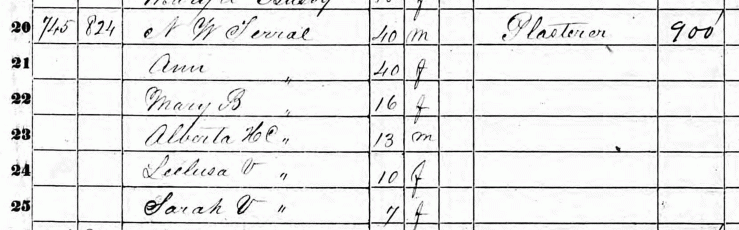
But we think your 4th-Great-Grandfather, Nicholas Marshall Tarrall (1809-1852), married Ann Biddle Fernandis (1815-1884). Ann and her brother Joseph P. Fernandez (1817-1876), a shipmaster before the Civil War demoted to a watchman afterwards, lived in Norfolk, Virginia, but were born in Maryland. Ann Fernandis was christened in Saint Paul Protestant Episcopal Church in Baltimore. Alas, poor Joseph drowned in the Norfolk Harbor.
1850 Norfolk, Virginia, Census: Nicholas Marshall Tarrall 1809-1852: Ann Biddle Fernandis Tarrall 1815-1884; Mary B. Tarrall Nottingham 1835-1886; Henry Alberti Tarrall 1836-1907, your 3rd-great-grandfather; Secluseval V. Tarrall Bryan 1840-1893; and Sarah Virginia Tarrall 1842-1850.
Now these Spanish roots might be part of Aunt Mary’s disapproval of Grana’s background, your great-grandmother (Thelma Virginia Tarrall Williams, 1899-1999), but the joke might be on Aunt Mary. We’re not positive when our Fernandis ancestors first set foot on American soil, but there were not many around and only a handful living in Maryland.
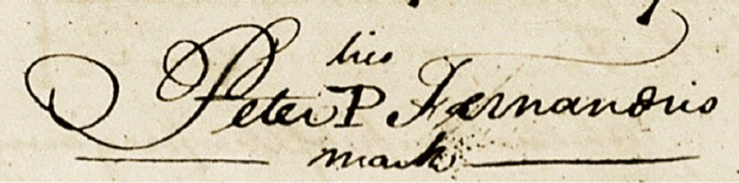
Pedro, or Peter, Fernandise (1652-1736) was born in Valenciana, Spain, and died in Marbury in Charles County, Maryland; although his body has gone missing. Two of his sons served in the American Revolution. I’m hoping they represent our Fernandez roots. If so, Pedro might be your 7th-great-grandfather.
Sorry about Pocahontas, but paella is part of your past. So put on some flamenco music for the holidays, stamp your feet and douse your pasta with extra olive oil. Olé!


 Postcards from Barton Springs