Postcard from Mexico City: A mountainous amount of history reflected in Chapultepec Palace

In 1725, the commanding Chapultepec hilltop rising steeply 200 feet above Mexico City was the site chosen by Viceroy Bernardo de Galvez (1746-1786) for his manor house. During the Mexican War of Independence, the site was abandoned. The Mexican government then remodeled it for use as a military academy.

Two hundred cadets, some as young as 13, were among the 1,000 Mexican soldiers guarding the citadel when General Winfield Scott (1786-1866) set his eyes on the target as a strategic asset facilitating the capture Mexico City during the Mexican-American War (1846-1848.) Following intensive shelling, American troops were able to scale the fortress and engage in bloody hand-to-hand combat with the defenders.

The costly victory for participating Marines is engrained deeply in the corps’ tradition, “From the halls of Montezuma….” For Mexicans, the battle heroes remembered are six brave cadets who refused to surrender. Fighting until the bitter end, one wrapped himself in the Mexican flag before leaping off the precipice so the flag would not be captured. Virtually every city in Mexico has an avenida memorializing the valor of the cadets, los ninos heroes.

Captured flags arouse countries, and the aging silk banner of the New Orleans Greys seized by General Antonio Lopez de Santa Anna (1794-1876) during the 1836 Battle of the Alamo is displayed in Chapultepec Castle today despite continual efforts to negotiate its return to San Antonio. History always is subject to the interpretation of the teller, and it is not surprising that the slant given the Mexican-American War in the United States differs slightly from the version presented in the museum housed in Chapultepec Castle.

For the United States, the war represented the fulfillment of its Manifest Destiny. As explained on the San Jacinto Monument, the Texians’ victory at the Battle of San Jacinto laid the foundation for the next violent chapter of relations between the neighbors:

Measured by its results, San Jacinto was one of the decisive battles of the world. The freedom of Texas from Mexico won here led to annexation and to the Mexican War, resulting in the acquisition by the United States of the states of Texas, New Mexico, Arizona, Nevada, California, Utah and parts of Colorado, Wyoming, Kansas and Oklahoma. Almost one-third of the present area of the American nation, nearly a million square miles of territory, changed sovereignty.

With the signing of the Treaty of Guadalupe Hidalgo in 1848, the United States paid the Mexican government $15 million, or about $15 per square mile, for the land it now claimed.

The treaty meant Mexico lost half its territory for the same amount of money paid the French for the Louisiana Purchase. The interpretation at Chapultepec records the war as a land grab by its greedy neighbor, a war that cost many their lives. At the very bottom of the signage is a quotation from President Ulysses S. Grant, expressing shame for the “wicked” war.

Grant’s words, however, were not taken out of context. Here is a longer portion from an 1879 interview given by Grant:

I do not think there was ever a more wicked war than that waged by the United States on Mexico. I thought so at the time, when I was a youngster, only I had not moral courage enough to resign…. I considered my supreme duty was to my flag. I had a horror of the Mexican War, and I have always believed that it was on our part most unjust. The wickedness was not in the way our soldiers conducted it, but in the conduct of our government in declaring war…. We had no claim on Mexico. Texas had no claim beyond the Nueces River, and yet we pushed on to the Rio Grande and crossed it. I am always ashamed of my country when I think of that invasion.

Another intrusion into Mexico’s sovereignty occurred soon after. The $15 million received from the United States did little to alleviate the debt Mexico incurred during the expensive war. President Benito Juarez defaulted on Mexico’s loans from France. A conspiracy between out-of-power Mexican conservatives and Napoleon III resulted in an 1862 invasion by France. The French were defeated in the Battle of Puebla on May 5, the reason for the annual Cinco de Mayo celebrations.

But that was one battle, not the entire war. While the United States was occupied fighting the Confederacy, France succeeded in installing Maximilian I, a Hapsburg prince, as Emperor of Mexico. Emperor Maximilian transformed the castle into his residential palace with a grand boulevard, now known as Paseo de la Reforma, leading into the heart of the city.

Not surprisingly, many in Mexico were not fond of having a foreign monarch with no command even of the Spanish language, and forces loyal to Benito Juarez executed him in 1867.

During the extended off-and-on terms of President Porfirio Diaz from 1876 to 1911, the castle served as his palatial headquarters as well. Amazingly, during the following tumultuous years of the Mexican Revolution that followed, much of the opulent décor contributed by Maximilian and Diaz remained unscathed.

Chapultepec was declared a national museum in 1939.

Masterful murals depicting the revolutionary period were commissioned in the late 1950s to 1970s. Juan O’Gorman’s (1904-1982) murals commemorating Mexican independence were begun in 1960. Work by David Alfaro Siqueiros (1896-1974) was interrupted when he was imprisoned followed anti-government protests in 1960, and he completed his 175-foot mural after his release in 1964.


Postcard from Mexico City: Long-buried Aztec deities continue to surface downtown

A life-size figure with skin flayed and liver hanging out sounds alarming, but there is a disarming charm to Mictlantecuhtli. So cute, let’s call him Mickey.

The sculpture represents the Aztec god of death who periodically was bathed in the blood of human sacrifices. But his well manicured hands appear to be politely gesturing “pardon me,” and his smile possesses almost a Mona Lisa-like serenity. And, what a survivor. He was buried in downtown Mexico City for more than 400 years.

Maybe it was the recent exposure to all of the Day of the Dead skulls and skeletons accompanied by traditions designed to encourage the departed to return to earth to their loved ones that made the god of death less terrifying. Plus, I imagine he would be more menacing if I were a perspective blood donor of his bath water.

The destruction of Aztec temples under the order of Hernan Cortes in 1524 was no secret, and, in fact, the reuse of some of their stones for the construction of the Cathedral dedicated to the Assumption of the Virgin Mary was a major public relations maneuver demonstrating the might of the Spanish conquistadors. But for centuries, the remains of the city of Tenochtitlan and its Templo Mayor were kept buried below the development of the cosmopolitan city above. Archaeologists poking about and stumbling across remnants of the Aztec civilization were discouraged from their pursuits.

In 1978, electrical company workers digging a little deeper stumbled upon a circular monolith more than 10 feet across. The intact relief of Coyolxauhqui, the daughter of a maternal earth goddess and Mixcoatl, a god of the hunt, war and the Milky Way. Coyolxauhqui plotted against her mother, so a younger sibling, Huitzilopochtli, chopped off her head and limbs. Her depiction in stone shows her severed limbs all akimbo around her torso.

Her brother’s revenge extended to his brothers, all 400 of them. Eliminating much of the competition, Huitzilopochtli emerged to assume a role as a deity of war and the sun. He was the patron of the city of Tenochtitlan, and appeasing him required frequent refueling from human sacrifices, accounting for many of the human skulls found on site.

The twin sanctuaries of the Templo Mayor were dedicated to his worship and that of Tlaloc, the rain god, “he who makes things sprout.” While rain god sounds peaceful, a provoked Tlaloc could cause drought, floods, hurricanes and illnesses. Although he kindly bestowed life in paradise to those who drown or were struck by lightning, Tlaloc, too, needed sacrifices to encourage him to provide the right amount of rain needed for crops.

Back to 1978, weighing in at about eight tons the monolithic Coyolxauhqui proved hard to ignore. Excavation around her revealed a rich minefield of artifacts in amazingly good condition. Numerous buildings near the Cathedral were demolished to provide accessibility, and archaeologists soon discovered the Templo Mayor consisted of pyramids built upon pyramids by successive Aztec rulers over a period of about 150 years.

Designed by architect Pedro Ramirez Vazquez, the Museum of the Templo Mayor opened adjacent to the site in 1987 to display some of the more than 7,000 objects unearthed during the archaeological explorations.

The main ruins of Tenochtitlan cover close to seven city blocks, much of which has not been excavated. Often emerging from adversity, opportunities for additional digs still arise. In the 1990s, work to halt the sinking of the Cathedral as the city’s water table dropped led to numerous finds beneath its floor. More than 20 years after the deadly 1985 earthquake, a damaged building was demolished to reveal the ruins of the Calmecac, the elite school of the Aztec nobility.

Near the museum foyer lies a 12-ton monolith representing Tlaltecuhtli, the earth goddess. This massive 12 x 13-foot relief was not discovered until 2006 on the grounds of an estate on the corner of Guatemala and Argentina Streets. As with many of the Aztec deities, she possessed a split personality. Her name means “the one who gives and devours life.” She demanded many human hearts and much blood to keep her in a positive life-giving mood.

The excavation of Tenochtitlan and the adjacent museum provide an incredible opportunity to view relics from the Aztec civilization from one site all grouped together. Its location downtown by the Zocalo offers an understanding of the development of Mexico City from the 1300s, to the conquest and the construction of the Cathedral, to the growth of the surrounding aristocratic neighborhood during the Diaz years and finally into a bustling contemporary city, home to more than 20 million inhabitants.

Pardon us, Mickey and crew. Please look kindly upon us mortals pausing to stare. Surely you appreciate your liberation after centuries underground. And the contemporary temple of a museum reverently sheltering you now is quite palatial.

Kicking off the year with biannual list of your favorite posts

The topics of posts you have been reading most over the last six months are wide-ranging. Concerns about the Alamo and Alamo Plaza tend to be remain your high priority, and the primary battle between Jerry Patterson and George P. Bush for Land Commissioner will keep these issues on the front page. I love it that you continue to help me promote Helen Madarasz as a ghost actively haunting Brackenridge Park.

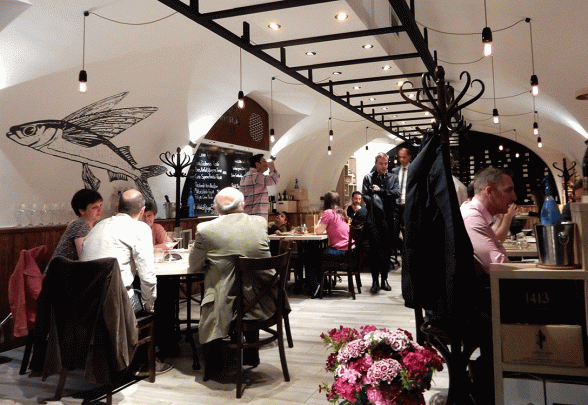
The interest in our favorite restaurant in Budapest might arise not as much from regular followers as from Fricska’s loyal fans on facebook. San Antonio’s current Tricentennial Celebration seemed to send more people in search of “The San Antonio Song” written in 1907 by Williams and Alstyne. Thanks for your interest in my quest for a mini-Kate, and it makes me happy some of you heading to Guanajuato were aided by our restaurant suggestions.

So here’s your top 12, with the numbers in parentheses representing the rankings from six months ago:

  1. Dear Mayor and City Council: Please don’t surrender Alamo Plaza, 2017 (1)
  2. The Madarasz Murder Mystery: Might Helen Haunt Brackenridge Park?, 2012 (2)
  3. Postcard from Budapest, Hungary: Currently suffering from case of miss-you-Fricska blues, 2017

    Fricska Gastropub in Budapest
  4. Please put this song on Tony’s pony and make it ride away, 2010 (11)

    Chorus of “The San Antonio Song” written by the Tin Pan Alley pioneer team of Harry Williams and Egbert Van Alstyne in 1907: “San An-to ni An-to-ni-o. She hopped up on a pony and ran away with Tony.”
  5. Brackenridge Park: ‘Is it still a postcard place?,’ 2017 (4)
  6. What’s up top counts, 2017 (3)
  7. Thanks to the Mister on his day for persistence in obtaining my Mother’s Day present, 2017 (8)

    3-D representations of Kate
  8. Postcard from Guanajuato, Mexico: Wishing these dining spots were not 600 miles away, 2016 (6)
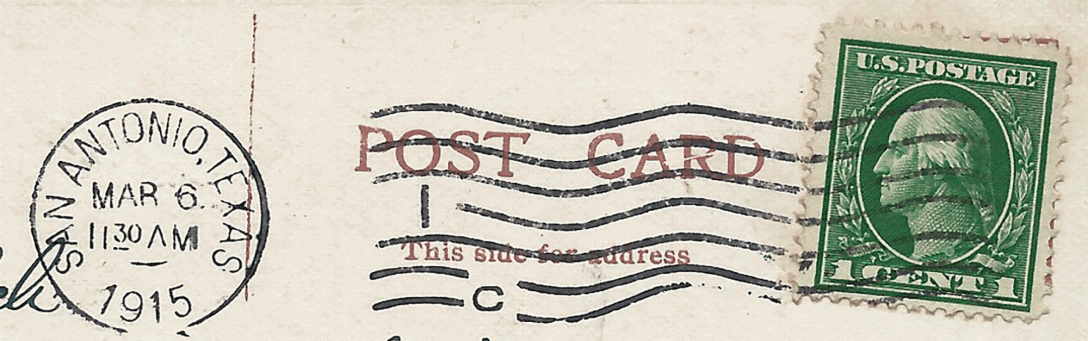
  9. Postcards from San Antonio a Century Ago, 2016 (5)

    San Antonio’s love affair with fresh corn tortillas is nothing new.
  10. How would you feel about the Alamo with a crewcut?, 2011 (7)
  11. Postcard from Campeche, Mexico: Sittin’ on Campeche Bay, 2017 (12)
  12. Postcard from Bergamo, Italy: Bidding Italy ciao, for now, 2017

    Bergamo, Italy

And the best part of number 12 on your list is that our bidding ciao to Italy “for now” appears accurate. Will be taking you there through pictures later in 2018. For now, though, delivery of postcards from the fall trip to Mexico City was delayed by the holidays. They will be dribbled out over the next month.

Thanks for dropping by periodically. Always welcome your feedback.