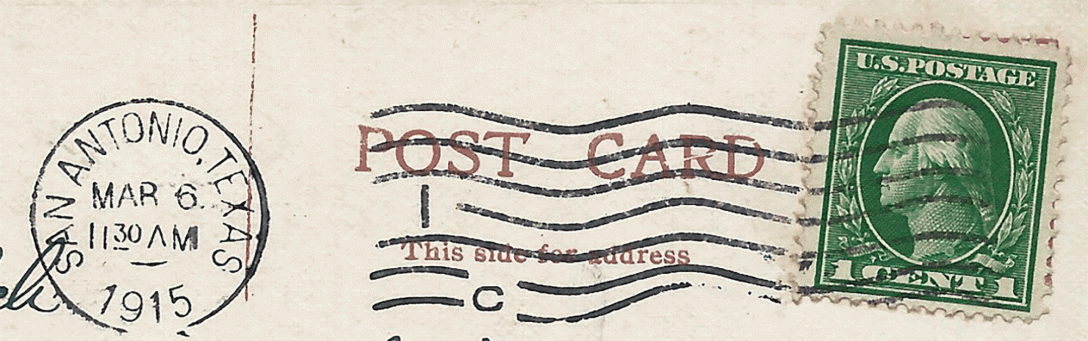
Kicking off the year with biannual list of your favorite posts

The topics of posts you have been reading most over the last six months are wide-ranging. Concerns about the Alamo and Alamo Plaza tend to be remain your high priority, and the primary battle between Jerry Patterson and George P. Bush for Land Commissioner will keep these issues on the front page. I love it that you continue to help me promote Helen Madarasz as a ghost actively haunting Brackenridge Park.

The interest in our favorite restaurant in Budapest might arise not as much from regular followers as from Fricska’s loyal fans on facebook. San Antonio’s current Tricentennial Celebration seemed to send more people in search of “The San Antonio Song” written in 1907 by Williams and Alstyne. Thanks for your interest in my quest for a mini-Kate, and it makes me happy some of you heading to Guanajuato were aided by our restaurant suggestions.

So here’s your top 12, with the numbers in parentheses representing the rankings from six months ago:

  1. Dear Mayor and City Council: Please don’t surrender Alamo Plaza, 2017 (1)
  2. The Madarasz Murder Mystery: Might Helen Haunt Brackenridge Park?, 2012 (2)
  3. Postcard from Budapest, Hungary: Currently suffering from case of miss-you-Fricska blues, 2017
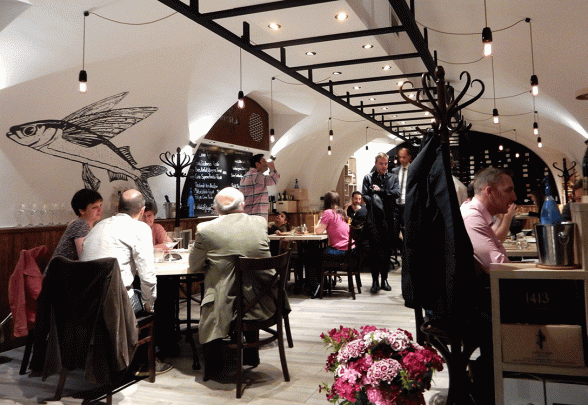
    Fricska Gastropub in Budapest
  4. Please put this song on Tony’s pony and make it ride away, 2010 (11)

    Chorus of “The San Antonio Song” written by the Tin Pan Alley pioneer team of Harry Williams and Egbert Van Alstyne in 1907: “San An-to ni An-to-ni-o. She hopped up on a pony and ran away with Tony.”
  5. Brackenridge Park: ‘Is it still a postcard place?,’ 2017 (4)
  6. What’s up top counts, 2017 (3)
  7. Thanks to the Mister on his day for persistence in obtaining my Mother’s Day present, 2017 (8)

    3-D representations of Kate
  8. Postcard from Guanajuato, Mexico: Wishing these dining spots were not 600 miles away, 2016 (6)
  9. Postcards from San Antonio a Century Ago, 2016 (5)

    San Antonio’s love affair with fresh corn tortillas is nothing new.
  10. How would you feel about the Alamo with a crewcut?, 2011 (7)
  11. Postcard from Campeche, Mexico: Sittin’ on Campeche Bay, 2017 (12)
  12. Postcard from Bergamo, Italy: Bidding Italy ciao, for now, 2017

    Bergamo, Italy

And the best part of number 12 on your list is that our bidding ciao to Italy “for now” appears accurate. Will be taking you there through pictures later in 2018. For now, though, delivery of postcards from the fall trip to Mexico City was delayed by the holidays. They will be dribbled out over the next month.

Thanks for dropping by periodically. Always welcome your feedback.

As eagerly anticipated as the Academy Awards. Not.

Thanks so much, John Branch, http://comicskingdom.com/john-branch

Okay, the biannual roundup of what posts you read most during the past year is not exciting, but it always interests me.

As usual, he Alamo floats up near the top. While lots of you read my “Dear Mayor” post, it seemed to have little impact at City Hall despite its direct delivery to the inboxes of the 11. I actually was writing about the Alamo some yesterday, slipping Alamo politics into the historic fiction manuscript on which I am focusing. The passionate stands and debates about the Alamo and its plaza a century ago differ little from those of today.

You hold the King William neighborhood and Brackenridge Park dear as well. And am hoping some of our recent travels help serve as inspiration or guides for yours.

The numbers in parentheses represent the rankings from six months ago:

  1. Dear Mayor and City Council: Please don’t surrender Alamo Plaza, 2017
  2. The Madarasz Murder Mystery: Might Helen Haunt Brackenridge Park?, 2012 (2)
  3. What’s up top counts, 2017
  4. Brackenridge Park: ‘Is it still a postcard place?,’ 2017
  5. Postcards from San Antonio a Century Ago, 2016 (3)
  6. Postcard from Guanajuato, Mexico: Wishing these dining spots were not 600 miles away, 2016 (12)
  7. How would you feel about the Alamo with a crewcut?, 2011 (6)
  8. Thanks to the Mister on his day for persistence in obtaining my Mother’s Day present, 2017
  9. Introducing Otto Koehler through a Prohibition politics caper of yesteryear, 2016 (11)
  10. Postcard from Bologna, Italy: Volunteering to eat at E’Cucina Leopardi everyday, 2016
  11. Please put this song on Tony’s pony and make it ride away, 2010 (4)
  12. Postcard from Campeche, Mexico: Sittin’ on Campeche Bay, 2017

Thanks for dropping by periodically. Love hearing your feedback.

Footnoting historic fiction too cumbersome for me to handle

The historical novel requires an extra set of choices – what sources to consult, what shape to cut from the big picture – what to do when the evidence is missing or contradictory. Most of these choices are invisible to the reader. You must be able to justify your decisions to the well-informed. But you will not satisfy everyone. The historian will always wonder why you left certain things out, while the literary critic will wonder why you put them in. “Because I could” is not a good reason.

“Can These Bones Live?,”  Dame Hilary Mantel, Reith Lecture, BBC Radio, June 24, 2017, The Spectator

How to handle historic fiction. I’ve received all kinds of advice and foolishly continue to reject most of it as too cumbersome.

Recently, a published author told me I needed to classify my novel about Hedda Burgemeister, the woman who shot Otto Koehler more than a century ago in San Antonio, as creative nonfiction. Her approach to citing references, accepted for print as mine might not be, is that, as the lead characters once lived, everything in the book must be footnoted. Meticulously. She also added that everyone’s names must be changed – both to protect the innocent and to protect oneself from lawsuits.

Well, the names in An Ostrich Plume Hat need to stay put because of the very fact they belonged to real people. But I admit, this is just one of Gayle’s new rules.

As for footnotes? I recently completed a manuscript about the Coker Settlement – nonfiction – with hundreds upon hundreds of numbered, well-documented endnotes. It almost killed me. And I’m quite far into writing this unfootnoted novel upon which I have been working for more than a decade as time allowed.

Last week, my solution hit me. Will Cuppy. A few years ago, blogger Bluebird Blvd introduced me to his The Decline and Fall of Practically Everybody. Cuppy wrote about real people. With great artistic license taken. He footnoted his text, but certainly not according to the Chicago Manual for Style. In fact, Cuppy’s footnotes are a pleasure to read and contain some of his most amusing lines.

So I have decided to tread water instead of drowning in footnotes. I’m electing to float somewhere between Cuppy and the Chicago Manual.

I’m creating Gayle’s own rules for documenting historic fiction with unnumbered endnotes. This requires me to honestly identify what is true, what is unknown and what is invented for the sake of the story. This is particularly important in cases where I violate Dame Mantel’s “Because I could” mantra from above.

As of now, Gayle’s rules for endnotes are somewhat fluid, evolving as I strive for consistency. I want to establish credibility with the reader.

Chapter Three’s endnotes include this:

Please pay attention to spare me from typing portions of the following over and over: Resemblance to actual persons, no longer living, locales and events is far from coincidental. For the majority of characters, almost everything included about them was reported in print during their lifetimes. If some of these so-called facts are gleaned from fake news, please direct libelous claims to the appropriate publishers of more than a century ago.

I hope you will go review and evaluate my approach to documenting the first three chapters.

Let me know if you think Gayle’s rules will fly. I need advice and value yours, but please don’t be offended if I am too damn hardheaded to listen to it.