Caste discrimination woven into Spanish Colonial art of the Americas

Above: “Virgin of the Tailors,” Cusco, Peru, circa 1750, on loan from Museo Pedro de Osma, Lima

Late-colonial New Spain was awash with conflicting energies: American-born Spaniards (Creoles), like their North American counterparts, felt a growing desire for independence, yet needed their identification with Europe to cement their sense of superiority over the racialized indigenous, African, and mixed-race lower classes….”

“Casta Painting and the Rhetorical Body,” Christa Olson, Rhetoric Society Quarterly, Fall 2009

And 18th-century fashion statements as recorded in paintings and sculpture became a tool to exhibit the claimed superiority of those with pure, or at least high, percentages of Spanish blood flowing through their veins. On display at the Blanton Museum of Art through January 8, Painted Cloth: Fashion and Ritual in Colonial Latin America focuses on the societal role of textiles in conveying class distinctions.

Continue reading “Caste discrimination woven into Spanish Colonial art of the Americas”

Postcard from Zaragoza, Spain: Seductive scallops and marisquerias

Above: Zamburinas at Marisqueria Tony

Faithful making the long Camino de Santiago pilgrimage crossing from France through Spain, perhaps a 500-mile hike, wanted to return with a souvenir as proof of the arduous journey afoot. A shell found commonly on the Galician coast just beyond the route’s destination of Santiago de Compostela became that evidence, a variegated or calico sea scallop, zamburina.

Continue reading “Postcard from Zaragoza, Spain: Seductive scallops and marisquerias”

Postcard from Zaragoza, Spain: Alma Mater and the Countless Martyrs

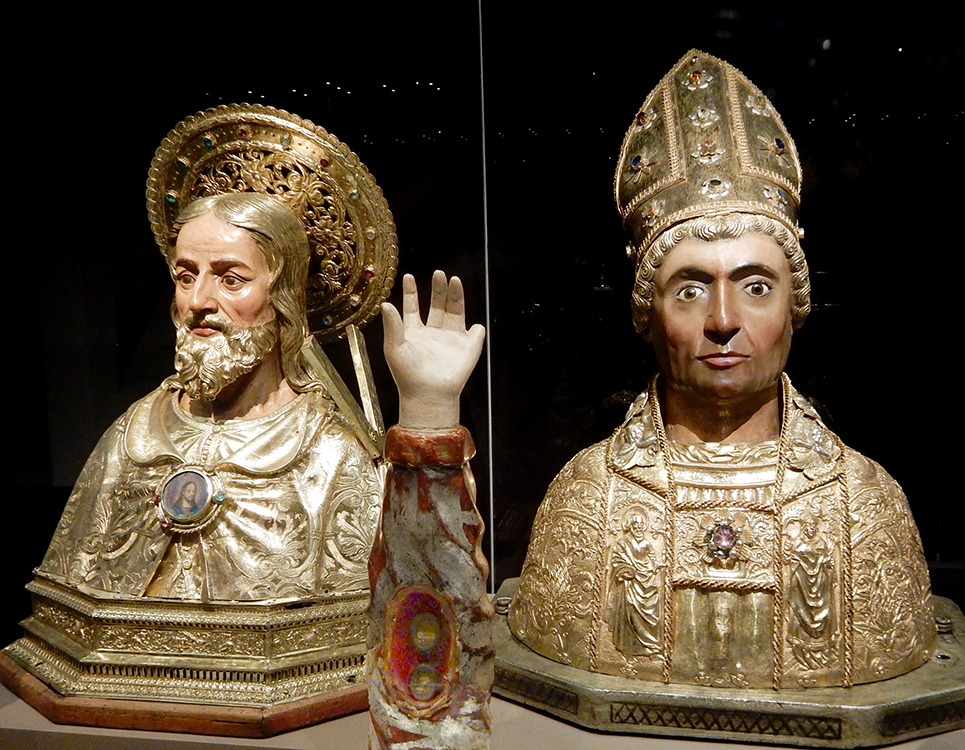
Above: Reliquaries in the Alma Mater Museum

After Aragon King Alfonso I (1073-1134), the Battler, conquered the Moors (prior post), construction began immediately on a cathedral atop a former Mosque. The king gifted the archbishop with adjacent land for his headquarters.

When Aragon King Alfonso II (1157-1196) ascended to the throne, he had other plans. The Aljaferia Palace was not grand or comfortable enough for him, so he began major remodeling and additions to this prominent location. Upper floors in the Mudejar and later Renaissance traditions reflect the styles favored by subsequent royals of Aragon and Spain.

Continue reading “Postcard from Zaragoza, Spain: Alma Mater and the Countless Martyrs”