Postcard from Bologna, Italy: Volunteering to eat at E’Cucina Leopardi everyday

At home or traveling, we tend to latch onto certain places and return to them over and over again. E’ Cucina Leopardi was our go-to place in Bologna. Our lunches there were so good, when we dined elsewhere we often wondered what the chef had dreamed up for lunch at Leopardi. And, whenever we got our checks after lunch elsewhere, we wondered why we had not eaten at Leopardi yet again.

A little off the touristy beaten path, Leopardi had a waiting line most days. Not because there are only a few tables; it is a large, cheerful, funky place with an open kitchen. Locals love it.

Okay, part of its appeal is the 10-Euro three-course lunch, with three courses meaning appetizer, first course, dessert, wine, espresso, no tax and no tip expected. Yes, there are several more expensive options and dinner is more, but we never ventured past the all-inclusive one-price-fits-us.

We’re not sure how Chef Cesare Marretti makes his magic work at this price point, but the dishes are amazingly good. A major part of it must be the limited lunch menu allowing bulk purchases of fresh seasonal ingredients. But, when it comes to flavors, there are no shortcuts taken.

While waitstaff is friendly, bear in mind there are only a few servers handling many more tables than a waiter in the United States could imagine. They have no time to linger with extensive translations and lists of ingredients. For a tourist not speaking Italian, this can make ordering challenging. There are no written menus. No choices are needed for the appetizer, but the main course requires selecting something vegetarian, maybe a meat-sauced pasta or something from the sea. We rarely understood completely what we were ordering, but we were never disappointed when the mystery was revealed on a plate in front of us.

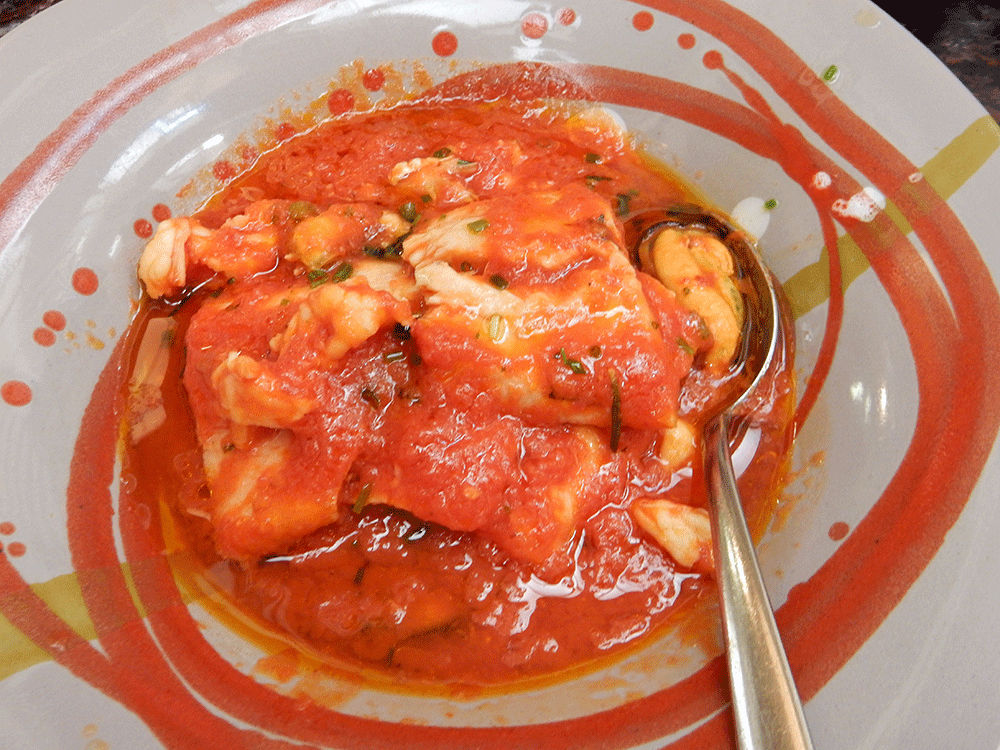
My favorite appetizer was a light carrot flan. One day, the kitchen was cracking open major wheels of aged parmesan and placing massive chunks of it on the first-course salad. Pastas were always perfect, but the kitchen truly shines in producing intensely flavored fish stews. Liberal use of wine and olive oil obviously plays a role, as seen in the video below. Regulars clearly favored the recurring offering of a small molten chocolate cake (somehow ending up camera-shy), but, as strawberries were in season, they also figured prominently in dessert offerings.

Surprisingly, given the crowds, customers are not rushed. Often they sit and chat long after their desserts and coffee are finished.

We almost felt as though we had stumbled upon some haute-cuisine government-subsidized food program. Not only were we contentedly wining and dining for under $11, we often emerged so stuffed we did not want even a salad for dinner at home that night. We found ourselves wondering, how can we afford not to live in Bologna?

Can’t imagine if Leopardi had not been part of our month in Bologna and am very happy we did not pick the month of August to stay there: Leopardi is closed for vacation until September 4.

Biannual roundup of an ad-free blog

alamoplaza2

This blogger has blogged so prolifically she has used up all the free space WordPress has to offer. This is good news for you because ads will no longer pop up at the bottom of posts, but it was bad news for me because I actually have to pay a small amount to engage in this form of therapy. I’m not complaining though, because I have never understood how WordPress can afford to offer this service at no charge. I’m grateful for enjoying a free ride for several years.

This list represents the most-read posts during the past 12 months, and interest in the Alamo and its plaza rose to the top once again. But thanks for continuing to give me the freedom to wander around the globe and send postcards back to San Antonio as well.

The numbers in parentheses represent the rankings from six months ago:

  1. Don’t Let Battle Zealots Overrun the Crockett Block, 2016
  2. The Madarasz Murder Mystery: Might Helen Haunt Brackenridge Park?, 2012 (1)
  3. Take pleasure in little unauthorized treasures along the River Walk before they vanish, 2015 (7)
  4. How would you feel about the Alamo with a crewcut?, 2011 (3)
  5. Please put this song on Tony’s pony and make it ride away, 2010 (5)
  6. Postcards from San Antonio a Century Ago, 2016
  7. Playspace of Yanaguana Garden bursts into bloom October 2, 2015 (8)
  8. Postcard from Madrid, Spain: Flavorful food memories, 2015
  9. Postcard from Puebla, Mexico: An unlikely trio of favorite restaurants, 2015
  10. Reviving Dia de los Muertos, 2015
  11. Postcard from Sintra, Portugal: Masonic mysteries surface at Quinta da Regaleira, 2014
  12. Postcard from Oaxaca, Mexico: Settling into La Biznaga, 2016

Thanks for dropping by every once in a while. Love hearing your feedback.

mandarezpark


Postcard from Ravenna, Italy: A sleeping beauty awakened

Honorius (384-423) was only ten years old when his father died. Sad fact on its own, but his father was Theodosius the Great (347-395), Emperor of the Roman Empire. With big shoes to fill, he needed to grow up quickly. The rule of the empire was divided, with his older brother reigning over the eastern half and Honorius presiding over the western half.

Pesky barbarians kept trying to wrest control of his empire, and Honorius decided to move his capital to Ravenna in 402. The new capital was viewed as easy to defend, surrounded by fortifications built by earlier emperors and marshland. While the capital could be defended, its location left much of the rest of Italy vulnerable.

In 408, the Roman Senate bought their way out of danger by paying the Visigoths 4,000 pounds of gold to leave Italy alone. But having run through that the Goths returned to sack Rome itself in 410. Britain and much of the rest of the Roman Empire were left without Roman protection. And, although Rome was regained in 414, Honorius is remembered for the defeats suffered and the unraveling of the empire during his reign.

Perhaps tired of being cold, the Goths returned with a vengeance under the leadership of the King of the Ostrogoths, Theodoric the Great (454-526). Theodoric made Ravenna the base for his new Arian kingdom, welcoming more than 200,000 of his followers to settle in Italy. While this was bad for much of Italy, Ravenna flourished under the attention.

Two decades after Theodoric’s death, Justinian I (483-565), the Byzantine Emperor, was able to wrest control of Ravenna and much of Italy from the Ostrogoths. Ravenna continued to benefit from royal attention.

After the 8th century, Ravenna was no longer a star. This lack of attention and imperialistic investment turned her into somewhat of a sleeping beauty, extremely beneficial for preserving the city’s early Christian monuments. Eight of its 5th and 6th century buildings are recognized on UNESCO’s World Heritage List as demonstrating “great artistic skill, including a wonderful blend of Graeco-Roman tradition, Christian iconography and oriental and Western styles.”

The mosaics inside these monuments are Ravenna’s main attractions, but we are going to ease into those. This first postcard from Ravenna is simply a random combination of photos of the city to whet your appetite.

Threw in a little bit of food from lunch to make you hungrier for Ravenna. We stumbled across a nice restaurant with street-side seating, La Gardela. As ridiculous as this sounds, the zucchini fries alone were worth the train ride from Bologna.

Okay, it’s not fair to totally hold out on the mosaics. Peek if you must at this UNESCO preview.