There is Eugene Delacroix’ “The Massacre at Chios,” with its 1824 showing in the Salon de Paris igniting European concern about tragedies occurring during the Greek War of Independence.
There are Francisco Goya’s “Fatal Consequences of Spain’s Bloody War with Bonaparte, and Other Emphatic Caprices,” prints so controversial they were not published as “The Disasters of War” until 1863, 35 years after his death.
There is Pablo Picasso’s “Guernica,” his 1937 painting of the German bombing of a Basque town that attracted the world’s attention to the atrocities occurring during the Spanish Civil War.
And now there is Vincent Valdez’ haunting 2016 black-and-white monumental depiction of Ku Klux Klansmen in “The City I,” owned and currently on exhibit at the Blanton Museum of Art.
This could be any city in America. These individuals could be any Americans. There is a false sense that these threats were, or are, contained at the peripheries of society and in small rural communities. . . . It is possible that they are city politicians, police chiefs, parents, neighbors, community leaders, academics, church members, business owners, etcetera. This is the most frightening aspect of it all.
Vincent Valdez was born and raised in San Antonio; an artist about whom we boast. Yet you want this enormous painting stretching across the gallery wall to please be a scene from any other city in America. Please not here. Not my neighbors.
The KKK and other racist groups exist throughout the country; denial does not help; you cannot simply wish them away. They might indeed be your neighbors.
The menacing eyes peering out from the holes in the white hoods glare at you, following you around the room. There is no place to hide.
We have interrupted their gathering. The group looks warily at us as we look at them; no one appears to be welcome here.
Alamo CEO Doug McDonald said the City Council must approve the lease with the Land Office before the state will hire a museum designer.
“A major turning point for the Alamo Plaza redesign comes Thursday night,” Scott Huddleston, Express-News, August 29, 2018
So now, Alamo management is trying to blackmail the San Antonio City Council into turning over its public park. The disposition of Alamo Plaza should have little to do with the awarding of the museum design contract. There has been no talk of its construction within that “sacred” space.
What does affect the architectural design project is whether it is build-from-scratch or adaptive-reuse. The Alamo did not release the request for qualifications for an architectural historian to assess the significance of the three buildings on the west side of the plaza until a week ago. The RFQ claims earlier assessments are out of date. No mention is made of their potential candidacy for adaptive-reuse. It is a thinly veiled request for a study slanted toward finding excuses to demolish the historic landmarks.
Rather than letting the Texas General Land Office hold the museum hostage in exchange for San Antonio’s public park, the City of San Antonio should withhold any lease on the land without agreement from the State of Texas to respect our designated landmarks.
And then there is the issue of fencing in Alamo Plaza, funneling everyone through one non-historical access point conveniently located by the museum entrance to encourage the purchase of admission tickets and rental of audio guides for the Alamo and its plaza. To try to soften this closure, the barriers restricting public access are now called a “combination of architectural elements” by District 1 Council Representative Roberto Trevino.
Trevino’s justification for restricting access to one point during “special events,” according to a report by Paula Schuler on San Antonio Heron, is “having three access points open at all times could be costly.” We are unsure why unlocking a gate to the public is so costly, but we do know erecting no fences, aka “architectural elements,” is free.
And, while Trevino earlier signed his name to an op-ed saying barriers would only be used during “special events,” he has redefined that phrase. He is quoted on San Antonio Heron:
What we wrote was that the site needed to be maintained as a civic space aside from special or schedule events. And so that, I think, is addressed by what we’re telling you: The museum hours are special scheduled and special events. Non-museum hours, it’s open.
Wait, the Alamo is open seven days a week. So, in the Mr. Rogers’ spirit, Trevino is proclaiming everyday is “special.” How special.
The time for public input is limited. The Alamo Citizens Advisory Committee (advice often ignored) is expected to vote on the plan tonight, with no opinions from the peanut gallery permitted.
According to Huddleston, the procedure that will follow is:
If approved then, the plan will next be considered by a six-member Alamo Management Committee and a two-member Alamo Executive Committee composed of Mayor Ron Nirenberg and Texas Land Commissioner George P. Bush.
It will be reviewed at open meetings of the city’s Historic and Design Review Commission, Planning Commission and the City Council. Review by the council could happen in mid-October.
Some elements of the plan, including relocation of the 1930s Alamo Cenotaph and demolition or significant alterations to three historic state-owned commercial buildings on the west side of Alamo Plaza, also would require approval of an antiquities permit by a 10-member Antiquities Board of the Texas Historical Commission and the full 15-member commission.
The monument and buildings are in the national Alamo Plaza Historic District created in 1977. Meetings of the board and full commission are open and include citizen input.
For the plan to be carried out, the state Land Office will become the manager of Alamo Plaza.
Alamo CEO Doug McDonald said the City Council must approve the lease with the Land Office before the state will hire a museum designer. The nonprofit Alamo Endowment can then begin active fund-raising for the plan. But McDonald said the project is on a challenging timeline for completion by 2024.
We trust the City Council will refuse to be bullied into ceding public parkland without adequate protections and reversionary clauses.
Just in case, though, please take every opportunity to protest the closing of Alamo Plaza and be on standby to place your bodies between the wrecking ball and the Crockett Block.
No time to pause for even the slightest genuflection in this lightening-fast tour of more than a dozen churches in Rome.
You might think this blog has dragged you through every single church in Rome, but, no. One could spend a year visiting a church a day without exhausting that supply. Rome is divided into 339 parishes, and there are close to 70 basilicas within the city. Probably all are worth ducking into for a visit.
But, mercifully, our tour stops here.
On this whiplash final lap, am going to point out two major relics of the type upon which most American Catholics never lay their eyes. The reliquary above is said to contain “the first foot to be entered in the tomb of Christ,” that of Mary Magdalene enshrined in the Basilica di San Giovanni dei Fiorentini. And the other is a portion of the head of Saint John the Baptist housed in a chapel in the Basilica di San Silvestro in Capite.
Basilica di San Giovanni Battista dei Fiorentini, San Antonio de Padua
Basilica di San Lorenzo in Damasco
Basilica di San Vitale
Basilica di Santi Ambrogio e Carlo al Corso
Chiesa Nazionale Argentina
Basilica di San Silvestro in Capite, reliquary containing part of the head of Saint John the Baptist
Basilica di Santi Ambrogio e Carlo al Corso
reliquaries
Basilica di Santa Pudenziana
Basilica di Sant’Agostino
Basilica di San Silvestro in Capite, bell tower
Basilica di San Lorenzo in Lucina
Basilica di Sant’Agostino
Basilica del Sacro Curore di Gesu
Basilica di San Lorenzo in Lucina
Basilica di San Silvestro in Capite
Basilica di Santi Ambrogio e Carlo al Corso
Basilica di Santi Ambrogio e Carlo al Corso
Basilica di Santi Ambrogio e Carlo al Corso
Basilica di San Giovanni Battista dei Fiorentini, Mary Magdalene’s foot
Chiesa del Gesu
Basilica di Santi Ambrogio e Carlo al Corso
Chiesa Nazionale Argentina
Basilica di Santi Ambrogio e Carlo al Corso
Basilica di Sant’Agostino
Basilica di Santa Pudenziana wedding
Basilica di San Vitale
Chiesa del Gesu
Eglise Saint Louis des Francais
Chiesa dei Jesus Sant’Agatha
Chiesa del Gesu
Basilica di Sant’Agostino
Basilica di San Lorenzo in Lucina
I wonder whether anyone ever has developed a scavenger hunt for spying saintly parts tucked away in nooks and crannies in churches in Rome.
A shortcut to encountering a massive number of bones, if one is so inclined, is to seek out the Capuchin Museum and Crypt tucked under Santa Maria della Concezione. The church was commissioned in 1626 by Pope Urban VIII (to whom you were introduced during my “wild things” museum meltdown) in recognition of a relative who was a Capuchin friar, Cardinal Antonio Barberini. Cardinal Barberini had the remains of thousands of his Capuchin brethren transferred to the crypt, which provided monks with a creative side unusual materials for their assemblages.
The museum offers a rather dry history of the Capuchin order, somewhat interesting if not for the macabre magnetic pull of the crypt you know lies on the far side. I doubt much has changed there since Mark Twain’s visit long ago, so I will let him describe the interior:
There were six divisions in the apartment, and each division was ornamented with a style of decoration peculiar to itself – and these decorations were in every instance formed of human bones! There were shapely arches, built wholly of thigh bones; there were startling pyramids, built wholly of grinning skulls; there were quaint architectural structures of various kinds, built of shin bones and the bones of the arm; on the wall were elaborate frescoes, whose curving vines were made of knotted human vertebrae; whose delicate tendrils were made of sinews and tendons; whose flowers were formed of knee-caps and toe-nails. Every lasting portion of the human frame was represented in these intricate designs (they were by Michael Angelo, I think,) and there was a careful finish about the work, and an attention to details that betrayed the artist’s love of his labors as well as his schooled ability. I asked the good-natured monk who accompanied us, who did this? And he said, “We did it” – meaning himself and his brethren upstairs. I could see that the old friar took a high pride in his curious show. We made him talkative by exhibiting an interest we never betrayed to guides.
“Who were these people?”
“We – upstairs – Monks of the Capuchin order – my brethren.”
“How many departed monks were required to upholster these six parlors?”
“These are the bones of four thousand.”
“It took a long time to get enough?”
“Many, many centuries.”
“Their different parts are well separated – skulls in one room, legs in another, ribs in another – there would be stirring times here for a while if the last trump should blow. Some of the brethren might get hold of the wrong leg, in the confusion, and the wrong skull, and find themselves limping, and looking through eyes that were wider apart or closer together than they were used to. You can not tell any of these parties apart, I suppose?”
“Oh, yes, I know many of them.”
He put his finger on a skull. “This was Brother Anselmo – dead three hundred years – a good man.”
The Innocents Abroad, Mark Twain, 1869
And, as this is a whiplash tour of churches, our friend Chris’ seconds-long forbidden video recording of the interior seems appropriate.
I asked the monk if all the brethren upstairs expected to be put in this place when they died. He answered quietly:
“We must all lie here at last.”
The Innocents Abroad, Mark Twain, 1869
Catholicism remains a religion of many mysteries, even for someone who was raised as one, particularly during the years when mass still was said in Latin. Like, when near the end of the service, the priest would talk about Nabisco crackers: “Dominus vobiscum.” “The Lord be with you,” lost in translation between the priest’s lips and my ears.




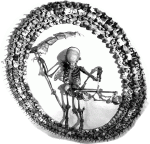 A shortcut to encountering a massive number of bones, if one is so inclined, is to seek out the Capuchin Museum and Crypt tucked under Santa Maria della Concezione. The church was commissioned in 1626 by Pope Urban VIII (to whom you were introduced during my
 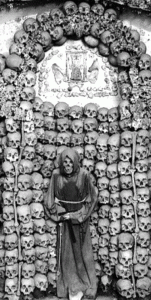 There were six divisions in the apartment, and each division was ornamented with a style of decoration peculiar to itself – and these decorations were in every instance formed of human bones! There were shapely arches, built wholly of thigh bones; there were startling pyramids, built wholly of grinning skulls; there were quaint architectural structures of various kinds, built of shin bones and the bones of the arm; on the wall were elaborate frescoes, whose curving vines were made of knotted human vertebrae; whose delicate tendrils were made of sinews and tendons; whose flowers were formed of knee-caps and toe-nails. Every lasting portion of the human frame was represented in these intricate designs (they were by Michael Angelo, I think,) and there was a careful finish about the work, and an attention to details that betrayed the artist’s love of his labors as well as his schooled ability. I asked the good-natured monk who accompanied us, who did this? And he said, “We did it” – meaning himself and his brethren upstairs. I could see that the old friar took a high pride in his curious show. We made him talkative by exhibiting an interest we never betrayed to guides.
 Postcards from Barton Springs