Weather Forecast: 11 Days of Confetti Showers Ahead

more-pics
Royalty from Fiesta San Jacinto, 1915

Thousands of eggshells from February’s Cowboy Breakfast are recycled annually by volunteers from the San Antonio Conservation Society who stuff them full of colored confetti, transforming them into cascarones to crack over the head of revelers at A Night in Old San Antonio. During NIOSA alone, 200,000 cascarones are cracked. Can’t imagine what the overall total is for the entire 11-day run of Fiesta San Antonio, April 16 through 26.

Although San Antonians continue to exuberantly embrace the more than 100 events packing the calendar, few pause to remember the origins of Fiesta. The festival was founded as a salute to the Texian victory at the Battle of San Jacinto on April 21, 1836.

Perhaps a reporter, though, writing a century ago in the San Antonio Light best summarized what the annual event means for natives: it transports San Antonians “from the prosaic, work-a-day world to a wonderful fairyland” – a ten-day escape from reality.

King Antonio I, 1915, San Antonio Light

The year 1915 was the first year the king assumed the name of King Antonio. Following his ceremonious arrival aboard a whistle-blowing Southern Pacific train, Dr. T.T. Jackson’s chariot drawn by six milk-white horses transported him to Alamo Plaza to kick off Fiesta San Jacinto.
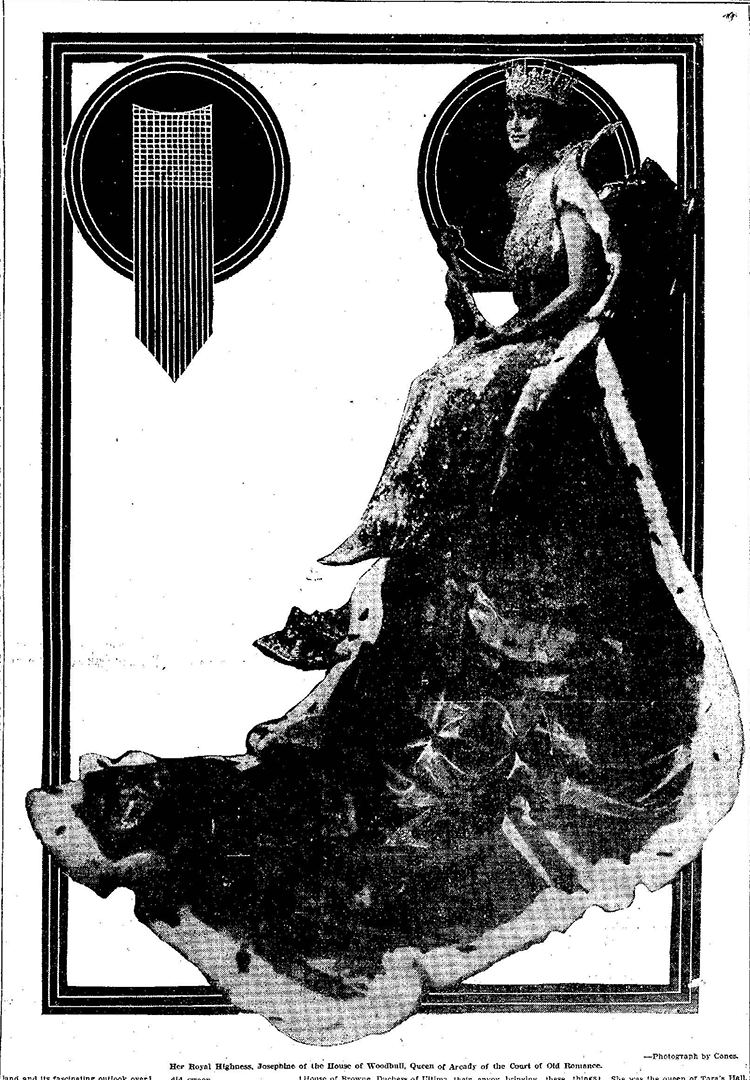
Queen of Arcady, 1915, San Antonio Light

Later in the week, Josephine Woodhull was crowned as “Her Majesty, the Queen of Arcady” at the Majestic Theater. She wielded her scepter over the “Court of Old Romance.” Edged in ermine, her peacock blue velvet train was embroidered heavily with gems, shimmering as a peacock’s feathers.

Numerous parades filled the week, including the “Pageant of Caliph,” a burlesque night parade staged by the Fiesta Association. The first float in 1915 bore the “Duchess of Frijoles,” satirizing the high society coronation of the prior evening. Politicians, local to international, received “a goodly share of ‘guying,’” including a “Floating Vote” float with politicians portrayed aboard as “pulling the strings.”

A century ago, the Battle of Flowers Parade represented the high point of the week, with floats and carriages laden with thousands of fresh flowers. During the mock battle circling Alamo Plaza, even visiting Governor “Pa” Ferguson was pelted with flowers.

battle-of-flowers-11

Somehow, the flower-pelting tradition was allowed to continue, despite its tumultuous first year. The following is pulled from a post from several years ago. Sarah Reveley transcribed the description of the 1891 melee from an April 25, 1891, edition of the San Antonio Daily Light:

…The procession contained over 100 carriages and other vehicles, all gaily decorated and many containing decorations of real artistic merit. Mr. Madarasz’s carriage, decked in pure white lilies and variegated grasses, with honeysuckle was plain, pretty and neat. Col. H. B. Andrews’ pony phaeton, with four Shetlands drawing it, was exquisite, and J. J. Stevens’ children in a four-in-hand Shetland surrey, representing a yacht, was also very pretty….

On arriving at the plaza the police divided the procession into two lines, each half going in opposite directions and passing around the park were brought, face to face with each other. The crowd on foot pressed the carriages closely and the fight began and waged furiously for nearly an hour. The occupants of the carriages had all the ammunition while those on foot had none. They began picking the fallen roses from the pavement, and even tore off the trimmings of the carriages, and soon had the best of the fight.  Heavy bunches of laurel thrown soon had their effect, and many ladies lost their temper and used their carriage whips indiscriminately on the crowd. One lady struck Mr. Doc Fitzgerald, a passive spectator, a severe blow on the face with her whip, but did not see fit to apologize for her mistake. Mr. H. P. Drought made an ugly cut with his whip into the crowd…. One young angel with white wings appealed to the crowd for protection from the missiles saying, “I wish you men would make them quit….”

The police were powerless to keep the people off the park beds, and prevent them from tearing off the flowers. One outright fight occurred. Mr. Phil Shook, one of the horseback party, lost his temper, and cutting a man in the face with his riding whip, was assaulted, and a fist fight on the pavement resulted. Both combatants were arrested by the police. Mr. Charley Baker used his umbrella for defense. While the crowd was very dense on the plaza, waiting for the procession to come along, Mr. Cristoph Pfeuffer’s splendid team and carriage took fright on South Alamo street, at an electric car. The carriage was decorated and contained several ladies, a child and the driver. Dashing into Alamo street, past and into the crowd of people and vehicles, it overturned a buggy and horse at the corner, and its driver jumped out and was dragged under the carriage by the lines. The lady on the front seat caught one of the lines and held it, but the horses made straight for the crowd of women and children in the park and struck a very deep mass of them, it being impossible for them to move out of the way. The ladies were thrown out and their clothing was badly torn. One little boy was knocked senseless, another was bruised, and one little girl had her apron torn off.  Other children were trampled by the frightened people. The plunging horses were secured and the carriage was taken to a side street….

Some irrepressible small boys arranged a dog fight in the midst of an interested crowd of spectators, during the battle, and a regular stampede ensued. Some of the combatants whose supply of ammunition had exhausted, resorted to buggy robes and quirts for aggressive warfare, and umbrellas and parasols for the defensive….

The battle was a success, but if it is given next year, more police will be needed, carriages must not be allowed on the plaza at all, and the participants must not lose their temper.

Let the chaotic merriment begin. Viva Fiesta!

The Curse of Madarasz Park: Another Ghost Wandering in Brackenridge Park?

Sometimes in the middle of the night, lions and wildcats can be heard crying out from the San Antonio Zoo by people living in neighborhoods more than a mile away from Brackenridge Park. Or so they say. I’m not convinced that some of those cries might not be a woman’s screams….

Shortly before coming to San Antonio to star in a silent film shooting in San Antonio in 1923, Martha Mansfield predicted what fashions stylish women would be wearing that fall:

The straightline frock, slim and narrow, is back for another season…. in lustrous satin of white or pastel shades.

The Hamilton News, July 2, 1923

After breakfasting in the company of friends at the St. Anthony Hotel on the morning of November 29, she unfortunately traded a narrow, fashionable frock for one of yards of fabric billowing over layers of crinolines. She donned the gown for her role as a daughter of the Confederacy falling in love with a Union soldier in The Warrens of Virginia, written by William Churchill de Mille, Cecil’s older brother. Brackenridge Park was selected for the day’s shooting because it:

contained a picturesque group of rag pickers’ shacks that would do very well for the servants’ quarters of the Southern plantation….

The Ogden Examiner, December 30, 1923

Her chauffeur parked the car near the set, and, during a break in filming, Martha retreated inside to relax. Shortly thereafter she emerged “screaming from her limousine, a flaming torch.” Leading man Wilfred Lytell threw his jacket over her head and face to protect her from the flames as the chauffeur frantically flailed to extinguish them. Although she was rushed to the hospital, she died from the severe burns on November 30.

How the fire started and enveloped Martha so quickly remained a mystery; police termed her death accidental. Some say the cause was a match tossed away carelessly by a fellow cast member; others speculated she herself dropped a match while lighting a cigarette. The Ogden Examiner hinted at foul play, perhaps the actress had not been alone:

What was it that turned the picturesque gown into a fiery funeral shroud?…. What started the flames that swept over her crinoline costume and wrapped her in a deadly embrace….

This slideshow requires JavaScript.

Born in New York as the new century dawned, Martha Erlich quickly progressed from the Ziegfeld Follies to star in silent films under her stage name of Martha Mansfield. The young starlet quickly was cast in numerous films, with a role opposite John Barrymore in Dr. Jekyll and Mr. Hyde in 1920 her most famous.

After her life was extinguished in San Antonio, her body was shipped to New York. Papers reported 1,000 people crowded into the funeral chapel, with another 5,000 held at bay by police outside. Among the films released after her death was The Silent Command, a story of “temptation and disgrace of a naval officer” by a ring of spies led by Bela Lugosi. The Washington Post reported the film was “heartily endorsed by Theodore Roosevelt, assistant secretary of the Navy and by General Pershing.”

So perhaps there is another ghost haunting Brackenridge Park, joining poor Helen Madarasz whose body went up in flames the year Martha Mansfield was born.

I promise I am not actively seeking spirits to populate the park. Helen is the only one I stumbled across on my own. Pursuers of the paranormal based in Austin recently led me to Martha after reading my earlier post about Helen. Just in time for Halloween. And Sarah found an additional four men who all perished in 1906 and 1907 in the portion of the park that bore Helen’s name – Ernest Richter, Otto Petrus Goetz, Sam Wigodsky and William Berger.

Let me know if you see or sense any of them. Or perhaps hear their screams.

Postcard from Portugal: Lessons for San Antonio?

Whenever you travel, you always come across things you’d love to see at home. These are listed randomly, not ranked. Click on the photos to see larger images or the highlighted links if you would like to see additional related photos.

  1. tables under giant rubber trees at Esplanada Cafe
    sandwiches served under giant rubber trees at Esplanada Cafe

    Huge multi-grain sandwiches oozing with melted cheese served under towering rubber trees in a park. This was the easiest of things to adapt from Portugal. Panini(tost)-maker purchased. How did I live without one? It grills veggie burgers, Greek cheese, eggplant, zucchini, naan bread, pineapple, French toast. Anything and everything.

  2. DSCN0748Robert H. H. Hugman designed the River Walk  in San Antonio with varying designs of sidewalks underfoot, but Portugal takes such artistry a giant step farther, and the results are striking. Every step you take should be memorable. Maybe we need a non-slick surface, though. But, it all goes back to something we haven’t quite embraced in Texas. Park the car. A city should be walked to be appreciated.
  3. DSCN0692Statues should be statuesque, or not at all. Poor Henry B. by the Convention Center, wherever he ends up relocated, is rendered too petite. He seems less than life-size. Statues should be awe-inspiring (The exception: Keep oyster-shelly Gompers small and hidden under overgrown trees.).
  4. DSCN1349DSCN1350Festival beer booths do not have to be hideous. Lisbon utilizes these little self-contained booths with several different designs for their special events. Some have homey images, such as a cat in a window or a friendly dog at the door.
  5. DSCN1163Tiles. We have the tradition here. Wonderful tiles from Ethel Harris’ San Jose Pottery. Or those colorful tiles Marion Koogler McNay installed on the risers of her patio stairs. Susan Toomey Frost donated a San Jose tile mural for the Museum Reach of the river to add to the original ones along the downtown river bend, and there are the incredible ones at Alamo Stadium. But we need more. They are such an enduring form of art.
  6. DSCN1200Promotional banners and advertising for festivals do not all have to be identical. Maintaining integrity of logos is one thing, but succumbing to boring repetition renders the message meaningless. Love the way Lisbon engages several artists each year to interpret their marketing materials for its month-long festival in honor of Saint Anthony.
  7. Sardines are a good thing. When they are fresh. Grilled street-side. Just before we left for Portugal, Central Market had a few laid out for the media preview of their Ciao Italia. Then we left, and dove into the land where they were in abundance. We’d like them here, please.
  8. DSCN1214DSCN1216Love our San Antonio Book Festival. But how in the world does Lisbon keep Feira Livro up and running for two weeks? Self-contained booths that can be locked up securely each night help. The sheer number of booths and books made me feel downright illiterate, particularly since the books were in Portuguese.
  9. DSCN0582Inner-city parks are filled with activities on a rotating basis. Farmers’ markets. Regional gourmet food festivals with vendors and tastings. Mini-book fairs. A once-a-month antique fair that would be great some place like Travis Park.
  10. DSCN1316The San Antonio Missions are crying out for intimate, customized tuk-tuk tours crisscrossing the Mission Reach of the San Antonio River. The tuk tuks of Lisbon had different designs on the outside. My favorite one, not pictured, was covered with a skin of images of some of Portugal’s distinctive blue tiles.
  11. DSCN1229We now have food trucks, but what about little portable craft beer carts, perfect for sampling new beers on tap in park-like settings. This cart was parked outside the botanical garden. We also encountered wine trucks for sampling Portuguese wine, complete with bar stools for sipping at the wine truck counter. Oh how I would love it if Texas wines were as inexpensive as Portuguese.
  12. DSCN1160Portugal seems to have more than its fair share of parts of saints enshrined in reliquaries. I always thought American Catholics were too squeamish to even want to know how far one saint could be spread, but I was wrong. We just don’t have many saints and parts to fight over. Archbishop Fulton Sheen has not even been beatified yet, and New York and Peoria are fighting over his body and whether he should be exhumed for obtaining some first-class relics to disseminate. I wonder if Portugal would share some modest little second-class relic of Saint Anthony with this city bearing his name….
  13. DSCN1248And about Saint Anthony. He is ever-present everywhere in Portugal. This city named after him needs to pay more attention to him, particularly on his feast day in June. He is a really useful saint.
  14. And, finally, although this blogger might prove the exception….DSCN1257

Note Added: The featured photo strangely popped up on my facebook page immediately after I posted this. Thanks to Mark Twain for providing it.