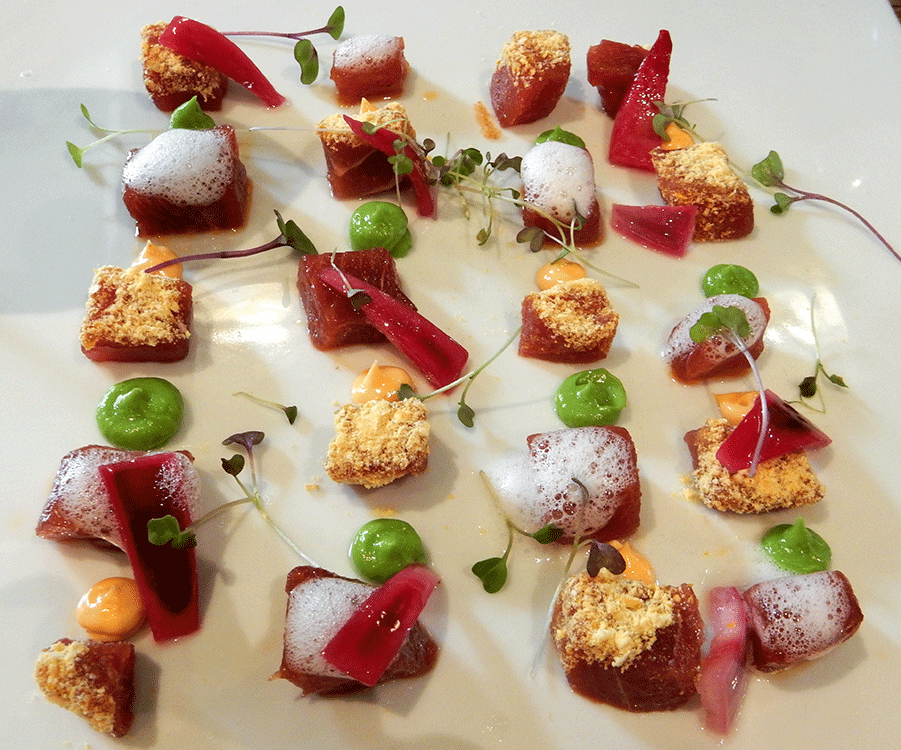
Postcard from Sevilla, Spain: Sorry, you must be starving by now

Seems too long since this blog made a food stop.

Fresh red tuna was running while we were in Spain this spring and summer, and the above photo represents an upscale presentation of it from the kitchen of chef Gonazlo Jurado of Tradevo Centro. The name represents a fusion of the words tradition and evolution. An avocado roll, or canelon, filled with shrimp is particularly luscious.

Like Tradevo, ConTendor Slow Food Restaurant is a little more upscale than we tend to frequent, but neither results in particularly high tabs at lunchtime. The long and varied daily menu is written on a large chalk board, and the server reads through the entire thing with you to see if you have any questions. It can be parked on your table briefly for consideration, but on a two-top it is awkward to read and we quickly found ourselves forgetting what some of the dishes were. Everything is presented artfully, such as an unusual deconstructed dessert of eucalyptus ice cream with creamy meringue and basil hazelnut paste on the side.

The winner for our favorite people-watching patio is Quilombo. The casual spot is on an intimate plaza on a mainly pedestrian narrow street frequented by locals. The mussels and salmon burgers are good, but it was the patio that really drew us back.

While one Arte y Sabor Tapas is located on Plaza Hercules, there is an overflow one about half a block away that attracts more locals. The prosciutto-wrapped asparagus and the falafel are welcome changes. Artefacto Grill & Beers is just off the plaza as well, and, as a result, snagging a table at lunch is much easier. Love their cheesy rice-filled zucchini and croquetas filled with spinach and pine nuts. Burgers, from veggie to retinto beer, are their specialties.

We did not realize when we stumbled across Vida Loca that it had only been open a week. The neighborhood evidently was keenly aware, so it was packed. The traditional garbanzo stew and boquerones are spot on, and the plate piled high with fresh vegetables and slices of jamon is uncommonly varied. Tucked away on a side street and seemingly undiscovered by many tourists, tables in Estraperlo are wedged between shelves holding fresh vegetables and other “ecological market” items for sale. We shared a lunch of artichokes with jamon and a stir-fry with shrimp.

We tried more than one Morroccan/Arab restaurant but were shocked to find our most successful meal in that vein right smack in the middle of one of the areas most congested by tourists – a Halal restaurant, Al Wadi. The chilled squash with a pomegranate, honey and lemon sauce is a pleasant starter, and lamb arrives atop the most flavorful savory rice ever entering my mouth. And then, right under the landmark visitor magnet Las Setas, was Malavida Tapas. I almost left it off the list, but the photos rescued it at the last minute. We went on a rare rainy day, so it was empty instead of overrun. The vegetables, the seedy avocado salad and the beef panes are all much better than one would expect to find in the location.

The final stop offered for your meal consideration in Sevilla almost reminded me of the old Europe on $5 a day (pretty nigh on impossible even in the olden days) guidebooks; it was that much a bargain. A simple neighborhood hole-in-the-wall, El Enano Verde offers ridiculously low-priced freshly prepared vegetarian fare. Both our wok-style vegetables and black rice with snow peas resulted in clean plates. I am including this because it is an ideal conscious-clearing spot to balance your budget and your calories after indulging in too many splurge meals.

But, you might ask, where is the pizza? Anyone who knows us is aware we don’t travel for long without pizza. We tried several in Seville but failed to find one we would recommend. But our Spanish options were so abundant we survived easily.

Postcard from Xativa, Spain: Socarrat good for paella but not for a town

In Valencia, the crispy caramelized socarrat around the edges of the paella pan is a cook’s goal, but scorched is far from ideal when applied to your town.

Spaniards have referred to residents of Xativa as socarrats since the early 1700s. Flush with victory at the Battle of Almansa securing Spain for the Bourbons, the vengeful Phillip V (1683-1746) ordered the town taken and set ablaze. Felipe has not been forgiven, his portrait condemned to hang upside down in the city’s Almodi Museum.

The twin peaks of Monte Vernissa above Xativa have been fortified since Roman times. Himilice, the wife of Hannibal, gave birth to a son there in 218 B.C. Although the fortress appears difficult to conquer, sometimes alliances place one on the conquered side because of battles lost elsewhere.

While under Moorish control, Xativa became the 12th-century European center for production of paper. Most of the walls stretching across the two hilltops today are preserved from the Islamic and Gothic periods. Portions of the castles and fortifications were rebuilt more frequently, including the upper Santa Fe Tower – destroyed by a gunpowder explosion in 1563, an earthquake in 1748 and the French in 1813.

Xativa was home to the powerful Borgia family, known for their Machiavellian political maneuvers. Two of the Xativa-born Borgias became popes, Calixtus III (1378-1458) and Alexander VI (1431-1508). The city also takes great pride as the birthplace of the painter Jose de Ribera (1591-1652).

Out of respect for possible remaining scorched sensibilities, the Mister opted for rabo del toro instead of socarrat-crusted paella. Translated literally, this means bull’s tail, making one think this was one way Spain took care of the remnants of bullfights. But it is oxtail, slowly cooked to an extremely tender stage and served with the resulting rich broth.

Postcard from Valencia, Spain: More saffron and less of everything else needed in my paella pan

Ask a purely traditional cook from Valencia, Spain, about paella, and you are told there is only one. It contains rabbit, chicken and maybe sausage or snails.

But I realized after a month consuming rice dishes there, we never tried the classic version. Seafood lovers have corrupted many a restaurant kitchen, and experimental contemporary chefs led us into playful flavorful territory.

Two things I learned I have always done incorrectly: I am too stingy with saffron, and I put too much of everything else in the pan. Proper Valencian paella is shallow in depth to allow the rice to caramelize in the bottom and particularly around the edges of the pan. This crispy crust – socarrat – is key, and Valencians are not timid about vigorously scraping the dish, even when served in a communal pan. Of course, I’m not even sure we can buy the real Valencian rice at home – the rice grown specifically for its capabilities of absorbing the broth quickly without turning into mush.

Also, paella should be made only upon ordering. The broad pans are only set on the stove for at least two; you just are out of luck if no one at the table is willing to share. If your paella arrives on a plate dished out of a large deep pre-prepared pan in the kitchen, we’re talking by pure Valencian standards, it’s just wrong.

As the photos demonstrate, we violated tradition by ordering seafood paella, such as the one at Namua, and, horrors, even a verde, all-vegetable one at Viva Mascaraque. We weren’t disappointed at all.

Another rice preparation prevalent in the region adds more rich stock to the pan than the rice can absorb – arroz merloso. Mythos Tapas y Mas featured a different one daily on its comida specials, and we enjoyed a wild mushroom and bean one at Refugio. Foam-topped mussel-plump arroz at Seu Xerea fell into this category as well.

And then, there were the totally unexpected, on our part, arrivals in paella pans – fideo noodles, caramelized the same way as the rice. Don’t tell any of the traditionalists, but my favorite dish delivered in a paella pan was the black fideo filled with tender pulpo served at Viva Mascaraque. We greedily scraped up very bit of socarrat we could. Just wanted to save the kitchen staff some elbow grease.