Postcard from Mexico City: A mountainous amount of history reflected in Chapultepec Palace

In 1725, the commanding Chapultepec hilltop rising steeply 200 feet above Mexico City was the site chosen by Viceroy Bernardo de Galvez (1746-1786) for his manor house. During the Mexican War of Independence, the site was abandoned. The Mexican government then remodeled it for use as a military academy.

Two hundred cadets, some as young as 13, were among the 1,000 Mexican soldiers guarding the citadel when General Winfield Scott (1786-1866) set his eyes on the target as a strategic asset facilitating the capture Mexico City during the Mexican-American War (1846-1848.) Following intensive shelling, American troops were able to scale the fortress and engage in bloody hand-to-hand combat with the defenders.

The costly victory for participating Marines is engrained deeply in the corps’ tradition, “From the halls of Montezuma….” For Mexicans, the battle heroes remembered are six brave cadets who refused to surrender. Fighting until the bitter end, one wrapped himself in the Mexican flag before leaping off the precipice so the flag would not be captured. Virtually every city in Mexico has an avenida memorializing the valor of the cadets, los ninos heroes.

Captured flags arouse countries, and the aging silk banner of the New Orleans Greys seized by General Antonio Lopez de Santa Anna (1794-1876) during the 1836 Battle of the Alamo is displayed in Chapultepec Castle today despite continual efforts to negotiate its return to San Antonio. History always is subject to the interpretation of the teller, and it is not surprising that the slant given the Mexican-American War in the United States differs slightly from the version presented in the museum housed in Chapultepec Castle.

For the United States, the war represented the fulfillment of its Manifest Destiny. As explained on the San Jacinto Monument, the Texians’ victory at the Battle of San Jacinto laid the foundation for the next violent chapter of relations between the neighbors:

Measured by its results, San Jacinto was one of the decisive battles of the world. The freedom of Texas from Mexico won here led to annexation and to the Mexican War, resulting in the acquisition by the United States of the states of Texas, New Mexico, Arizona, Nevada, California, Utah and parts of Colorado, Wyoming, Kansas and Oklahoma. Almost one-third of the present area of the American nation, nearly a million square miles of territory, changed sovereignty.

With the signing of the Treaty of Guadalupe Hidalgo in 1848, the United States paid the Mexican government $15 million, or about $15 per square mile, for the land it now claimed.

The treaty meant Mexico lost half its territory for the same amount of money paid the French for the Louisiana Purchase. The interpretation at Chapultepec records the war as a land grab by its greedy neighbor, a war that cost many their lives. At the very bottom of the signage is a quotation from President Ulysses S. Grant, expressing shame for the “wicked” war.

Grant’s words, however, were not taken out of context. Here is a longer portion from an 1879 interview given by Grant:

I do not think there was ever a more wicked war than that waged by the United States on Mexico. I thought so at the time, when I was a youngster, only I had not moral courage enough to resign…. I considered my supreme duty was to my flag. I had a horror of the Mexican War, and I have always believed that it was on our part most unjust. The wickedness was not in the way our soldiers conducted it, but in the conduct of our government in declaring war…. We had no claim on Mexico. Texas had no claim beyond the Nueces River, and yet we pushed on to the Rio Grande and crossed it. I am always ashamed of my country when I think of that invasion.

Another intrusion into Mexico’s sovereignty occurred soon after. The $15 million received from the United States did little to alleviate the debt Mexico incurred during the expensive war. President Benito Juarez defaulted on Mexico’s loans from France. A conspiracy between out-of-power Mexican conservatives and Napoleon III resulted in an 1862 invasion by France. The French were defeated in the Battle of Puebla on May 5, the reason for the annual Cinco de Mayo celebrations.

But that was one battle, not the entire war. While the United States was occupied fighting the Confederacy, France succeeded in installing Maximilian I, a Hapsburg prince, as Emperor of Mexico. Emperor Maximilian transformed the castle into his residential palace with a grand boulevard, now known as Paseo de la Reforma, leading into the heart of the city.

Not surprisingly, many in Mexico were not fond of having a foreign monarch with no command even of the Spanish language, and forces loyal to Benito Juarez executed him in 1867.

During the extended off-and-on terms of President Porfirio Diaz from 1876 to 1911, the castle served as his palatial headquarters as well. Amazingly, during the following tumultuous years of the Mexican Revolution that followed, much of the opulent décor contributed by Maximilian and Diaz remained unscathed.

Chapultepec was declared a national museum in 1939.

Masterful murals depicting the revolutionary period were commissioned in the late 1950s to 1970s. Juan O’Gorman’s (1904-1982) murals commemorating Mexican independence were begun in 1960. Work by David Alfaro Siqueiros (1896-1974) was interrupted when he was imprisoned followed anti-government protests in 1960, and he completed his 175-foot mural after his release in 1964.



Dear Mayor and City Council: Please don’t surrender Alamo Plaza

It’s hard to send a letter to you, because I don’t yet know who will be occupying those offices at City Hall. But, whoever you are, your first week in office, you will be pressured to approve a plan to wall off a major public plaza, the historical heart of so many of San Antonio’s cherished celebrations.

Please do not vote unconditionally to support the Reimagining the Alamo Master Plan in a rush to meet the budgetary cycle of the State Legislature.

There is much merit to parts of the proposal. The Alamo building itself is crumbling, and the plan targets its restoration and preservation. That is urgent.

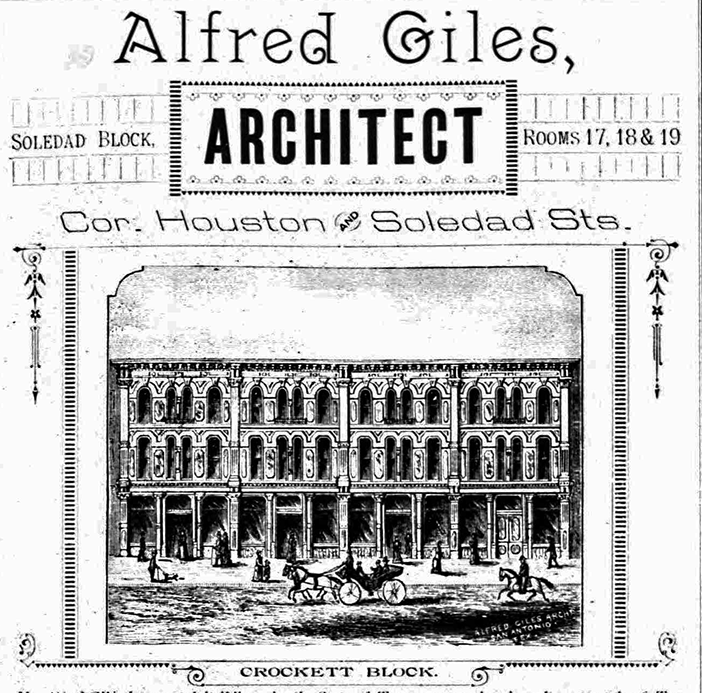
The Phil Collins Collection is waiting for a home in San Antonio, and the State has acquired several historic structures on the westside of Alamo Plaza to display the valuable artifacts. (Adaptive reuse is wonderful, but please urge the State to reconsider gutting the entire interior of the landmark Crockett Block, designed by Alfred Giles.)

So the east and west parts of the plan on the state’s existing turf seem on somewhat sound ground. But then we get to the plaza.

As we approach San Antonio’s Tricentennial, we should be particularly attuned to the city’s early history. But, at least in the Executive Summary,* the Master Plan ignores the history of Mission San Antonio de Valero – a site not dubbed the Alamo until years later.

In the aftermath of the Battle, General Santa Anna ordered his troops to destroy as much of the site as possible. This was the beginning of the decline of the historic Alamo compound. Restoring the reverence and dignity of the Alamo is the obligation of our generation and the mission of our efforts.

The decline of the compound that originally was Mission San Antonio de Valero began earlier, before the mission was secularized. Where is that layer of history of the mission days? Not on page 1. Mission San Antonio de Valero is not even recognized by name in the summary until page 24. In the appendices.

Reimagining apparently calls for walling in the plaza and locking it up every night. The planners evidently believe members of the public incapable of envisioning the original walls of the compound. To do so, they must be restricted from entering the plaza aside from as a herd entering through a southern portal.

If returning the Alamo compound to its appearance at the time of the battle truly was a principal adhered to by the Master Plan, the “bold” plan would call for the removal of the iconic parapet added later by the United States Army.

Vehicular movement north and south through downtown currently is impaired. Removing another street from the existing clogged pattern is impractical. Yet, even so, it is difficult to argue that closure would not enhance the experience for pedestrians on the plaza.

But ceding the rights of pedestrians to cross through the plaza makes absolutely no sense. Public parks should be porous, easily accessible from all sides. Yet access to this civic space will be reserved to one entryway on its southern side.

Behind glass, this current pedestrian crossroad will become a dead-end. An Alamo cul-de-sac.

Thanks so much, John Branch, http://comicskingdom.com/john-branch

The city of San Antonio has struggled for years to revive Houston Street, and it finally provides a healthier retail environment. Houston Street merchants will again disappear if they lose the pedestrian traffic they need. Pedestrians will all be funneled in and out by way of Rivercenter.

Trees will be removed from the center of the plaza between the Alamo and the Crockett Block to create an open space, a space too hot under the Texas sun for anyone to linger.

A sizzling comal for tourists. A playground for reenactors. A place locals will avoid.

Paraphrasing W.S. Merwin, there is no recipe for “unchopping a tree.” Walk the Mission Reach of the San Antonio River Improvements Project and envision how many years, or generations, of growth it will take for the new saplings to recreate the groves of trees Spanish missionaries originally found along the river’s banks.

In exchange for placing much of the city’s space in a fishbowl with restricted access, the plan offers San Antonio “a new civic space – Plaza de Valero,” a tiny sliver of the plaza in front of the Menger Hotel. This is billed as: “an opportunity for visitors to have a quiet moment, in the shade of mature trees, enjoying food and refreshments, as they experience the reimagined Alamo.” This “new” space already exists.

The very definition of civic is “relating of or to a city or town or the people who live there.” We have a great civic space, the entire plaza, now. A place for exuberant celebrations and the exercise of first-amendment rights, rights championed by those who died at the Alamo. A spot for gathering in the shade of trees.

There is no reason City Council cannot approve the Alamo restoration on the east and the Museum concept on the west side of the plaza as envisioned in the Master Plan on May 11.

Obviously, improvements can be made to enhance historical interpretation in the plaza, but eliminating Alamo Plaza as a pedestrian passageway or civic gathering place for your citizens need not be a requisite to forward a portion of the plan. Judgment on the disposition of the roadway and plaza should be withheld pending refinement and public release of the full plan.

The many volunteers and professionals tackling this project should be commended for their efforts. But that does not mean this initial plan merits a rubber stamp. The streets and plaza belong to the City of San Antonio.

Please request a reexamination and rethinking of this portion of the plan. Don’t consent to turning a beautiful urban park into a walled-off wasteland of a plaza. A place completely isolated from the fabric of San Antonio.

Thank you for your consideration of this request from a concerned citizen.

P.S.  If one haunts the place of one’s death, would it not seem a Sisyphean hell if the only thing you got to witness was men reenacting your painful death over and over? Would you want the site of your bloody end preserved in the desolate state it was in in the aftermath of your death?

Or would you want to witness people actively enjoying the freedom for which you fought on a daily basis?

One resembles a horror film, the other a fulfillment of your dreams.

*As of this time, the only portion of the plan available to the public online is the sketchy Executive Summary. The public comments you receive prior to voting are based solely upon that and what can be pried out of presenters during hearings. The publicly funded Master Plan appears a closely guarded secret.

Don’t let battle zealots overrun the Crockett Block

Alfred Giles (1853-1920) left England for Texas in 1873 for health reasons, according to historian Mary Carolyn Hollers George, author of The Architectural Legacy of Alfred Giles.

A page 1 article in the March 26, 1883, edition of the San Antonio Evening Light related that the young architect found few opportunities in Austin and was “in very reduced circumstances.” So, the Light continued, Giles and a newly found friend:

…determined to come to San Antonio. Their wealth did not admit of the ordinary expense of travel, which in those days was large, so they elected to walk from Austin to this city. When they arrived here, the prospects were little better, but they got employment cotton picking.

Things began looking up. Giles was commissioned to design houses by some of San Antonio’s most prominent families, numerous commercial structures, an addition to the Bexar County Courthouse and a new courthouse in Wilson County. According to a biographical sketch of Giles provided by the University of Texas Libraries of the U.T. Austin:

…Giles’ work reflected a great variety of styles derived from architectural forms of the past, usually in more or less new combinations. Giles’ own means of expression, however, always took precedence over novelty of fashion. The sobriety and simplicity with which he adapted and combined these stylistic elements suggests that he exercised strong control over his work and that he preferred restraint. A reserved use of ornament and a strong feeling for symmetry, even in asymmetrical compositions, characterize his approach.

Giles produced unpretentious domestic residences and showy mansions, as well as commercial and institutional structures for clients who were the makers of San Antonio, especially the Mavericks, the altruistic developers of Alamo Plaza and Houston Street for whom Giles designed twenty major structures, and the Terrell family for whom he designed at least seven. Indeed, San Antonio was a Giles town with forty structures to his credit in the central city alone by 1900. Families in other Texas towns were also loyal clients, especially Captain Charles Schreiner of Kerrville and the Faltin and Ingenhuett families of Comfort.

This introduction to Alfred Giles is meant to establish his credentials in preparation for a battle to save one his landmarks on Alamo Plaza, the Crockett Block.

Samuel Augustus Maverick (1803-1870) was among the signers of the Declaration of Independence at Washington-on-the-Brazos in 1836. As soon as Texas was established as a republic, his name appeared constantly in deed transactions filed in Bexar County. The freedom he found in the new republic allowed him to quickly purchase land grants awarded by Texas to those who had fought for independence and a multitude of lots along both banks of the San Antonio River and the “Alamo Ditch.”

Although he personally knew men who perished at the Alamo, his acquisitions and building projects demonstrate no attachment to preserving the spots where they died. Only five years after the fall of the Alamo, in fact, he purchased property immediately beside the church itself from Mariano Romano. And he built his home on what is the northwest corner of Alamo Plaza.

Perhaps those closest to war long to move on to more peaceful times. Perhaps this explains why Maverick is thought to have a cannon from the Alamo forged into a bell for St. Mark’s Episcopal Church.

Unfortunately, Sam’s son, William Maverick (1847-1923), made a major mistake. He sold part of the Romano property to Augustine Honore Grenet (1823-1882) in 1878, adding to land Grenet purchased from the church. Grenet commissioned what William Corner’s 1890 guide termed an “inartistic erection” and an “atrocious lumber building” atop the foundation of the convent and used the Alamo chapel for storage. The Grenet building was later sold to Hugo & Schmeltzer.

Directly across the plaza from the Alamo, however, William and his brother Albert Maverick (1854-1947) did better. In 1882, they hired San Antonio’s most in-demand architect, Alfred Giles, to design a modern structure to supplement the Maverick Building on the northwest corner of Alamo Plaza.

At three stories, the handsome Italianate limestone Crockett Block was low-slung compared to its original neighbors. Both its height and coloring were complementary to the building directly across the plaza from it, the Alamo Chapel. The first-floor commercial bays and windows are flanked by Corinthian columns; the tops of the windows on the second floor appear to take their shape from portions of octagons; while the third-floor windows are arched with keystones.

Among the first Crockett Block tenants was Rafael Diaz, according to undated notes from the Historic Preservation Office of San Antonio in files of the San Antonio Conservation Society Library. Exiled from Cuba for political reasons in 1868, Diaz manufactured what was once the most popular cigar in San Antonio, La Flor de Diaz. He “returned his profits to Cuba to finance the revolutions of his homeland for 32 years.” Another early tenant was Heuermann & Brothers Grocers.

The Crockett Block was a prestigious address for businesses for many years. The vintage postcards of Alamo Plaza demonstrate her subtle presence, as well as the city’s changing treatment of the plaza itself.

But the old girl’s façade suffered some abuse during a period of urban decline. The century-old landmark needed a facelift by the 1980s. George considers the monumental restoration of the Crockett Block undertaken in 1982 to be a Cinderella story, a preservationist’s dream come true. Investors led by developer Bill Schlansker hired architect Humberto Saldana to reclaim the classical details of Giles’ original design.

Now well over a century old, the Crockett Block stands as an important landmark on the plaza. The only flaws in its appearance are the City of San Antonio’s lax enforcement of its signage regulations. Every first-floor tenant has more signage than allowed. Alamo Trolley and Del Sol have plastered some of the handsome windows with self-promotional posters, and even the City of San Antonio’s Visitors Center violates the city’s own rules. “Visitors Center” easily conveys what it is, yet additional messages advertising “Gifts and Souvenirs” have been plastered onto storefront windows.

But the Crockett Block has a new steward. At the end of 2015, it was purchased by the General Land Office of Texas. Perhaps Land Commissioner George P. Bush can rein in his tenants to meet more tasteful standards appropriate for the historic district.

There is only one reason I am telling you all of these things now. It seems as though there is a huge target painted on the façade of the Crockett Block. And it also seems as though the San Antonio Express-News has a giant slingshot loaded with a wrecking ball tautly pulled and aimed that way.

On January 9, the Express-News Editorial Board set forth “Our Agenda 2016 issues and goals.” The Alamo is one of three things the Editorial Board plans to focus on repeatedly this year. The timing of this is to influence the outcome of the master planning process for Alamo Plaza undertaken jointly by the city and the state. The paper is pushing its vision:

We envision a restoration of the site to its 1836 footprint as much as possible, a world-class Alamo museum and visitors center, and surrounding businesses that don’t disrespect the history attached to the Cradle of Texas Independence.

Our Agenda 2016 editorials will be urging bold action.

All that sounds well and good until you follow the track of the original western wall of the Alamo compound at the time of the 1836 battle. Yes, it cuts right through the front portion of the handsome Crockett Block.

1981 excavations on the south side of the Crockett Block opened up Paseo del Alamo linking Alamo Plaza and the San Antonio River through the new Hyatt Regency Hotel. Archaeologists were able to expose foundations of walls of the original Mission San Antonio del Valero, better known as the Alamo. But during the original construction of the Crockett Block, according to George, “surviving wall fragments would have disappeared with excavation of the structure’s basement.”

The Crockett Block could serve a multitude of purposes on a reconfigured plaza. Certainly nothing could make the job of a development officer for the Alamo Endowment easier than positioning potential donors in a third-floor office squarely facing the Alamo itself.

The Crockett Block also stands as a major shield, not just sheltering the plaza from the stark 1980s’ design of the Hyatt Regency, but also its parking garage. A photo of the parking garage is difficult to take because, fortunately, it is screened from view by the Crockett Block.

The Crockett Block is too valuable a part of San Antonio’s history of urban development to lose, and moving it would be absurdly expensive.

And, if a return to appearances before the 1836 Battle of the Alamo is truly a goal, the distinctive parapet would have to go. The unfinished chapel had a flat top at the time. The now-iconic roofline was added 14 years after the fall of the Alamo by the United States Army.

Obviously, the small readership of this blog is no match for the voice of a major newspaper. I feel armed with a peashooter against the onslaught about to be launched by the editorial board.

But maybe someone influential, someone who understands layers of history are as important as any one event, will stumble across this post and take up the charge to spare the Crockett Block.

January 26, 2016, Update: Letter to the Editor from the Express-News

To demolish the historic buildings facing it would be an act of urban design — vandalism in favor of a Disneyland approach to history.

June 27, 2016, Update: The San Antonio Conservation Society has posted a two-part statement, Defending Alamo Plaza:

Alamo Plaza’s importance as a cultural hub… is what we should strive to reclaim and restore, not with re-created structures that function as props, but with compatible adaptive use of existing historic buildings, innovative interpretation, and strategic revitalization that enhances the overall experience for locals and tourists, alike.