Whoopee, biannual roundup: Favorite postcards from this blog

Above: Remnants of the South Austin Museum of Popular Culture are found at its former home on South Lamar Boulevard.

Yes, I know. This blog is suffering a bit of an identity crisis. First, 2020 abruptly cut short my boulevardier ways, and then in early 2021 we pulled up stakes and moved up the road to Austin.

This blogger entertained herself throughout much of the pandemic by posting her entire novel – An Ostrich-Plumed Hat, and, Yes She Shot Him Dead – online, slowly unfolding it chapter by chapter. A few of my readers actually followed Hedda Burgemeister all the way through her 19teens trial for murder; although, I had been hoping for a little more feedback and filming rights have yet to be sold. Others have embraced posts about our new neighborhood as we started boulevardier-ing north and south off Lamar Bouldevard.

Continue reading “Whoopee, biannual roundup: Favorite postcards from this blog”
Oakwood Cemetery: Gleaning snippets of history from headstones

At the urging of President Mirabeau B. Lamar*, the Congress of the Republic of Texas selected a site on the Colorado River to serve as the country’s capital. In October of 1839, the government was loaded into oxcarts and moved to a site bounded by Shoal Creek and Waller Creek and newly named in honor of Stephen F. Austin.

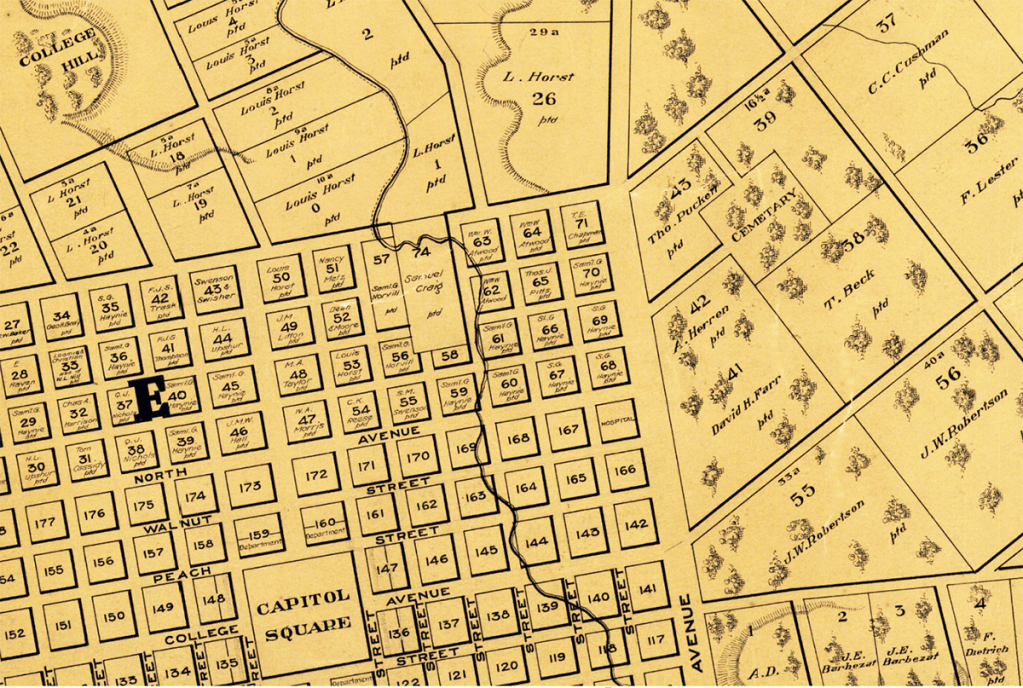
William H. Sandusky’s 1840 map of the new capital, Austin, indicates a square plot of land dedicated for use as a cemetery. Texas General Land Office collection.

By January 1840, the population swelled to 839, and the need for a cemetery was obvious. The original core of what would later become known as Oakwood Cemetery is marked on the right of the map above.

Continue reading “Oakwood Cemetery: Gleaning snippets of history from headstones”

Most precious part of Zilker Botanical Garden reflects the spirit of one man

The drawing-rooms of one of the most magnificent private residences in Austin are a blaze of lights. Carriages line the streets in front, and from gate to doorway is spread a velvet carpet, on which the delicate feet of the guests may tread. The occasion is the entrance into society of one of the fairest buds in the City of the Violet Crown.

“Tictoca,” William Sydney Porter (O. Henry), The Rolling Stone, October 27, 1894

Clara Driscoll Sevier, who loved flowers to the point of promoting a rose garden next to the Alamo as more desirable than saving its historic convent walls, found Austin lacking a garden club for women. To remedy this, she invited a group of ladies to Laguna Gloria, her home that is now The Contemporary Austin, to establish one in 1924. O. Henry’s reference to the violet-crowned hills of Austin inspired the name for the new group, the Violet Crown Garden Club.

Annual flower shows were the primary focus of the club until 1946 when members set aside modest seed money of $50 to initiate efforts to seek space in the city’s Zilker Park for a botanical garden. The Violet Crown Garden Club recruited six other garden clubs to join its quest and their persistence finally resulted in the 1964 completion of the Austin Area Garden Center building in what became the Zilker Botanical Garden.

Continue reading “Most precious part of Zilker Botanical Garden reflects the spirit of one man”