The Alamo will indeed be saved.
Although verbal and sometimes litigious warfare over how best to treat the surrounding grounds has been ongoing almost continually since the Battle of the Alamo itself, there seems to be little, if any, disagreement about the need move forward to conserve the Alamo Chapel. There also is much enthusiasm about a new museum to house existing Alamo collections and the incredible donation of Alamo-related items from Phil Collins.
Last week, the design team for an Alamo re-do presented an updated Comprehensive Interpretive Plan to the San Antonio’s Citizens Advisory Committee. The consultants from Reed Hilderbrand of Cambridge, Massachusetts; PGAV Destinations of St. Louis, Missouri; and Cultural Innovations of London, England, did seem to have listened to some of the passionate cries that arose following the unveiling of an earlier version.
That’s right; they are not from here. And, for many Texans, that automatically is a strike against them. They might as well have put a jar of salsa made in New York City in the middle of the table. Plus, even greater, is that San Antonio thing. While the Battle of the Alamo is the most important component of this project to outsiders, many San Antonians have an equal attachment to the plaza itself. The consultants must sense this underlying mistrust the moment they walk into the room.
Designers now acknowledge San Antonio is hot and that removal of trees would leave a sizzling comal of a plaza. “Shade” seems their favorite word when referencing the plan.
To view a pdf file of the entire plan on the General Land Office site, click here (Be patient; the pdf file is large so slow to download.). The renderings below are all from that plan. To watch/listen to the entire June 7 presentation via NowCastSA, click here.
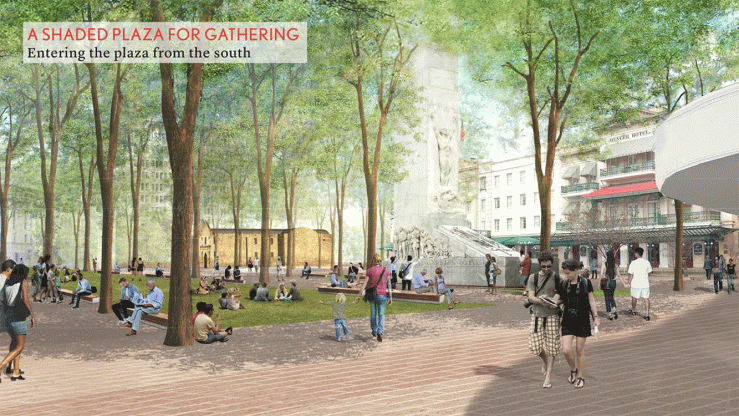
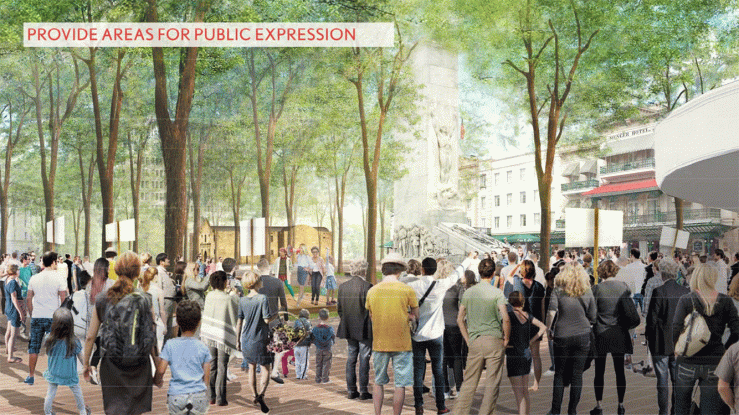
The team offered a compromise concerning the restoration and relocation of the Cenotaph, removing it from the footprint of the mission walls while keeping it in the neighborhood. The consultants suggested transferring the massive memorial monument to the adjacent Plaza de Valero in front of the Menger Hotel (rendering above), about where the soon-to-be-banished bandstand currently is located. Just the mere mention of a potential move brought a chorus of boos from some descendants of defenders in the audience, but, as no feedback from the general public was allowed at this meeting, future hearings will reveal whether this new proposal lessens their objections.
Several major skirmishes loom on the horizon. The unpopular concept of a glass wall blocking access to Alamo Plaza, a dedicated public park owned by San Antonio, has been removed. But that has not eliminated erecting barriers “to enable flexible management options” of much of the area within the original footprint.
An “almost-not-seen” four-foot fence would be “hidden” in planting beds on the south side and would take the form of 42-inch high glass rails (no longer termed walls) on the museum side on the west. These would be penetrated by four gateways (certainly appearing taller than four-feet high in the rendering below).


According to the presentation, access inside the controlled enclosure would remain free but would be restricted during the hours the Alamo is open, mainly via the southside gate. During those hours all non-Alamo-destination pedestrians would be funneled north/south along a promenade on the west side, behind the glass rails. The current proposal would open all four gates for unlimited pedestrian access in the plaza after hours.
The strangest unanswered part of this new “solution” is that, during the prior phase, the argument was made that the space needed to be glassed in and locked to protect the Alamo after hours. Now, the need is expressed to control access during the day for programming purposes, and it is evidently fine to leave it all open throughout the night.
If San Antonians are to be persuaded to cede control of their public park, someone needs to develop more persuasive rationale. This unexplained flip-flopping makes fencing in what is now an open public plaza appear completely unnecessary, even capricious. It flies in the face of one of the plan’s guiding principles, “to enhance connectivity.”
Here is the existing site plan of the proposed “open-air museum:”

Included in the “Vision” of the plan is to “tell the in-depth history of the Alamo area to the present day….” One presenter said the plan proposes to “peel off layers of the 21st century.” Their desire appears to peel deeper, though, back through layers of the 20th century and even 19th century. There is the matter of several pesky buildings termed “non-contributing structures.”

The designers are aware that some consider these structures as valuable parts of the area’s history, particularly Alfred Giles’ Crockett Block and the former Woolworth’s, its lunch counter playing a key role in San Antonio’s relatively peaceful path toward integration. Proposed options include complete demolition of all of these structures over a portion of what would have been the western wall of the Alamo; facadomy, leaving their front walls standing; or reuse.
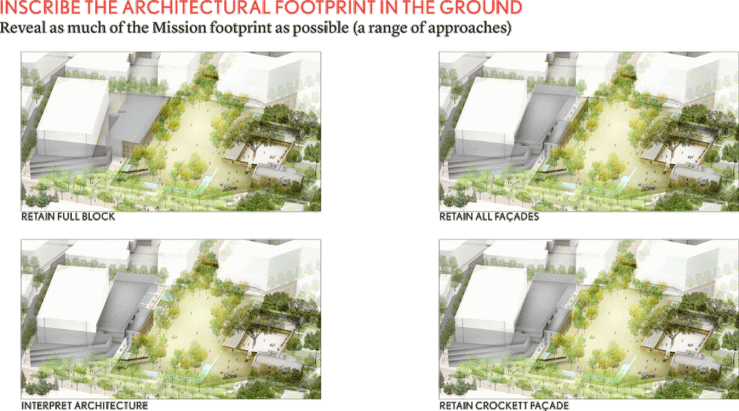
Most of the renderings presented in the plan show retention of the facade, at a minimum, of the historic Crockett Block; although designers seemed reluctant to endorse retention of any of the buildings recently purchased by the state. Clearly, their preference is for what they view as the creation of a “unified and coherent place.”

Committee member Frank Ruttenberg expressed the desire to “try to not take down history to focus on a certain aspect of history.” While it is easier for architects to have an empty piece of land on which to design a new Alamo history museum, repurposing the historic structures there would support the plan’s stated vision. The structures are handsome, and creative architects could repurpose them. With the San Antonio Conservation Society looming as a force opposing demolition, committee member Dave Phillips cautioned, “Demolishing historic buildings is a fight we don’t need to take on.”
And he probably is correct because reconfiguring traffic to create the coherent space above has major repercussions well beyond the plan’s boundaries. The plan’s desired level of “pedestrianization” requires closure of numerous streets to automobile traffic. Perhaps the most controversial part of the plan is the concept of moving traffic from Alamo Street to already-congested Losoya, making it two-way. With businesses on the west side of Losoya hemmed in by the river and those on the east side backing up to Alamo, how in the world would they receive deliveries? Phillips labeled the Losoya concept downright “scary.”
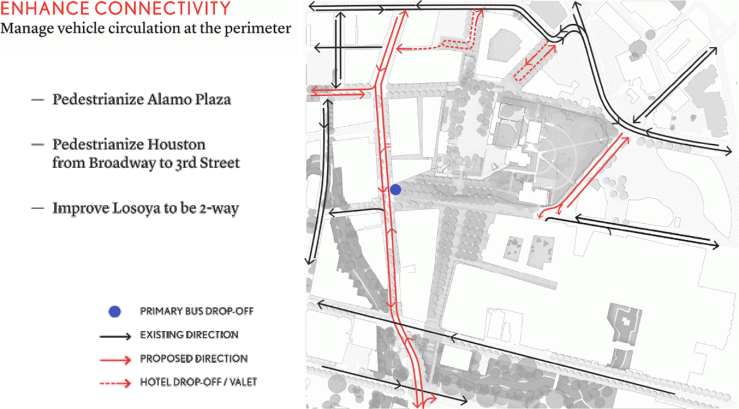
Untangling the web of ramifications from the closures into a workable rerouting of traffic certainly will require a team of immensely talented and creative engineers. Then they have to convince San Antonians the “improvements” will work.
The time of the year that more locals visit Alamo Plaza than any other is without a doubt during the 11 days of Fiesta San Antonio for wreath-layings, coronations and parades. While the women in the audience who traditionally don their yellow hats to stage the Battle of Flowers Parade in the location it has taken place for more than a century were too polite to boo, they are unlikely to be timid in pushing to keep the parade routes open.

The plaza is far from a blank slate; there are meaningful layers of San Antonio’s history there. Several landmines still must be defused in formulating and implementing the plan.
Overall though, there seemed a sense of optimism in the room among the committee members. A can-do attitude and a determination to find workable solutions and compromises.
The presenters emphasize that the plan would “change the understanding of the Alamo as a building to the Alamo as a place.” For San Antonians, however, Alamo Plaza has always been a “place.” Our place. The plaza is not just the Alamo’s front yard, it is our front yard. And you are going to have a hell of a hard time convincing us to let you fence us out.
If the City of San Antonio decides to cede control of the plaza to the state, I am pulling for an agreement with deed restrictions ensuring ongoing free public access backed by a powerful reversionary clause.
June 19, 2018: The San Antonio Conservation Society has launched a petition drive concerning the fate of Alamo Plaza via change.org. Please consider signing this appeal to San Antonio City Council. The petition can be found here.
https://www.change.org/p/san-antonio-city-council-save-alamo-plaza


 The first “fact” claimed by the Express: “There will not be a fence around Alamo Plaza downtown.” These are the Editorial Board’s words. This sentence does not appear in the plan itself.
 On the left is a rendering representing a tall gate, in a fence line “hidden” in landscaping, that presumably would be open after museum hours.
 On the north and west sides are 42-inch so-called “rails.” As the plan proposes to lower the floor of the entire plaza 16 to 18 inches, tourists will feel protected from San Antonio’s foot traffic by a barrier more than five feet in height.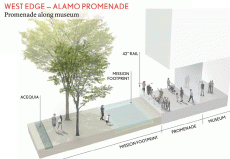

 Fact Number Three: “Closing Alamo Street does not mean there won’t be a north-south connection for vehicles across downtown. The plan proposes a nearby alternative for traffic.”

 Both my opinion and that of the Editorial Board of the Express-News are biased. I urge you to read the plan to make an informed decision about the “facts.”
 Postcards from Barton Springs