Postcard from Zaragoza, Spain: Competing patron saints and cathedrals, plus some miracles

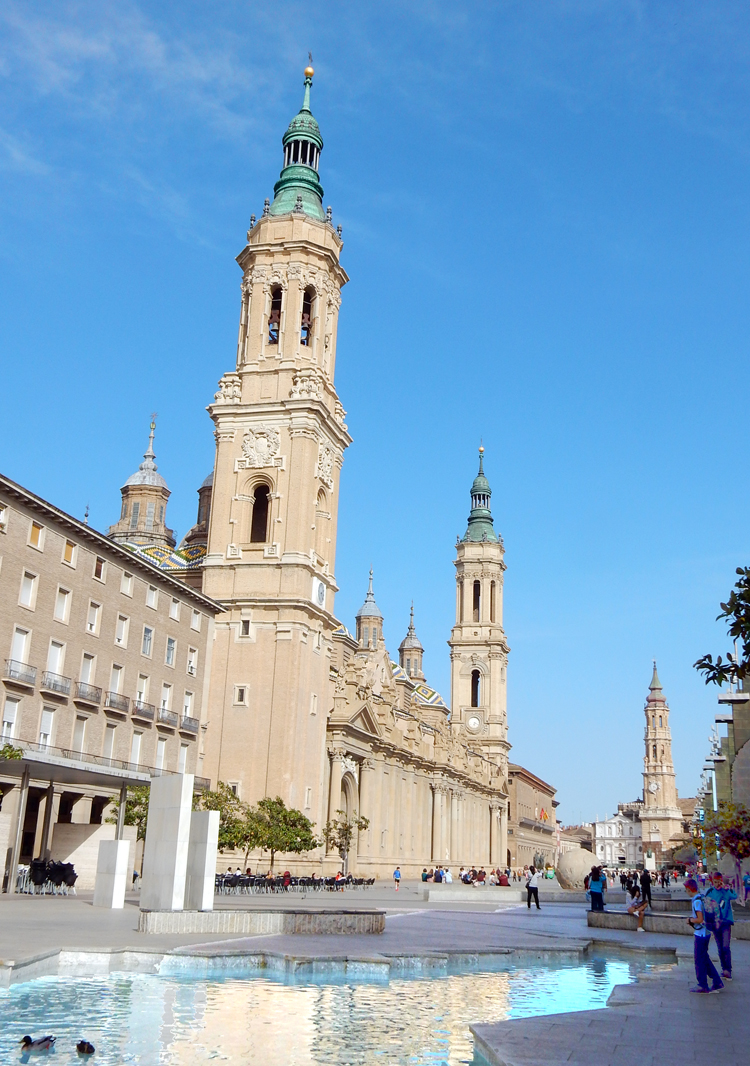
Above: La Basilica de Nuestra Senora del Pilar is on the left while La Seo de Zaragoza anchors the far end of the plaza.

Although conquered by The Battler, Alfonso I (1073-1134), the Moorish rulers of Zaragoza left rich architectural contributions in their wake. The main mosque was an impressive one, so The Battler opted for adaptive reuse, making alterations for Christian purposes and consecrating the new church in the name of San Salvador in 1121.

The Battler’s predilection for war unfortunately extended to his life with his wife, with no heirs produced from the contentious marriage. Leapfrogging over the resulting confusion following Alfonso I’s death, Ramon Berenguer (1114-1162), the Count of Barcelona, was betrothed to one-year-old Petronilla of Aragon (1136-1173) in 1137. The toddler’s father, known as Ramiro II (1086-1157), transferred the rule of the kingdom of Aragon to his new son-in-law so he could retire to a normally peaceful monastic life. As this post is not really about Ramiro the Monk, we will not dwell on his priestly qualifications that include the legend of his beheading of a dozen nobles who opposed him and using the head of their leader as the clapper for the bell of Huesca.

Demonstrating his dedication to the marriage-acquired territory of Aragon, Ramon had much of Zaragoza’s mosque/Catholic church razed to begin construction of a Romanesque replacement in 1140. This church became the home for coronations of Aragonese kings, and, with the papal appointment of an archbishop of Zaragoza in 1318, a cathedral.

Continue reading “Postcard from Zaragoza, Spain: Competing patron saints and cathedrals, plus some miracles”

A season when cemeteries reunite the living and the dead

Above: No rearranging of the surroundings would be needed to film a horror movie in the dark and cavernous Cimitero delle Fontanelle in Naples, Italy.

It’s not surprising that a writer who would include Haunting the Graveyard as part of a book title is drawn to cemeteries. A few random headstones can reveal stories about individuals and entire communities.

Someone in the family demonstrates great patience with sating my taphophilia wherever we travel. Naturally, All Saints Day and All Souls Day are among my favorite times to do so. Posts in this blog are filled with the resulting photos, and the links below will take you to a few from our past travels. So many graveyards from which to choose….

Continue reading “A season when cemeteries reunite the living and the dead”

Caste discrimination woven into Spanish Colonial art of the Americas

Above: “Virgin of the Tailors,” Cusco, Peru, circa 1750, on loan from Museo Pedro de Osma, Lima

Late-colonial New Spain was awash with conflicting energies: American-born Spaniards (Creoles), like their North American counterparts, felt a growing desire for independence, yet needed their identification with Europe to cement their sense of superiority over the racialized indigenous, African, and mixed-race lower classes….”

“Casta Painting and the Rhetorical Body,” Christa Olson, Rhetoric Society Quarterly, Fall 2009

And 18th-century fashion statements as recorded in paintings and sculpture became a tool to exhibit the claimed superiority of those with pure, or at least high, percentages of Spanish blood flowing through their veins. On display at the Blanton Museum of Art through January 8, Painted Cloth: Fashion and Ritual in Colonial Latin America focuses on the societal role of textiles in conveying class distinctions.

Continue reading “Caste discrimination woven into Spanish Colonial art of the Americas”