A 1911 postcard shows the beauty of the land in Brackenridge Park formerly owned by Helen Madarasz.
Time for the semiannual big-brother spy report on what posts you have been reading most during the past 12 months. As usual, you are all over the map, seemingly encouraging me to continue randomly sending postcards from San Antonio and back home no matter where we wander.
The mysterious murder of Helen Madarasz in Brackenridge Park rose to the top, which makes me wonder why ghost-hunters have not latched onto the story of Martha Mansfield. There are still some who pine to hear the San Antonio Song, a post from five years ago, but a few new posts squeezed into the top dozen. Hope some of you have found your way to dine in our favorite restaurants in Oaxaca, but my personal favorite entry about food in Oaxaca is on grasshoppers.
The number in parentheses represents the rankings from six months ago:
Thence up he flew, and on the Tree of Life,
The middle Tree and highest there that grew,
Sat like a Cormorant; yet not true Life
Thereby regaind, but sat devising Death
To them who liv’d….
Paradise Lost, John Milton
Satan disguised as a cormorant to spy on Adam and Eve in the Garden of Eden seems apt to me.
USDA photo
The gloomy-looking double-crested cormorants always spook me. They love to pose on the chains by the dam by the marina, stretching their pterodactyl-type wings as though offering to lift the chains for the barges to cruise right under, dramatically plunging to the level below.
I feel a little bit better about this display now that I know they have no oil glands to repel water; they have to spread their wings to dry out their water-logged feathers. They can’t help it.
But cormorants pop up suddenly from underwater, seemingly out of nowhere, as you walk along the river’s banks. Like Lola Fandango swimming in the tank in Where the Boys Are, these expert fishermen can hold their breath as they swim underwater for a long time. More than a minute.
Even one of river’s cormorants can give me the willies. That’s why this Hitchcock-like gathering of the birds on the Mission Reach seemed particularly ominous the other morning. For birds added to the list of those protected under the Migratory Bird Treaty Act in the 1970s, this had to represent some kind of major powwow. Fortunately, their eyes focused toward downtown, the water buzzards let us pass by them unharmed.
What could the convention of cormorants portend? The Irish part of me heaved a sigh of relief – at least the sea crows were not perched atop a church steeple.
Some cultures consider cormorants noble, but, while I’m trying to regard the glass as half-full, I can’t sell myself on that one.
Fishermen regard their sighting as good luck; the fish they seek should be found nearby. One plus for the cormorant.
According to the USDA, greedy cormorants keep fish from overpopulating the river. They actually are an environmental indicator species, meaning the environment of the Mission Reach is healthy. So our cormorants are bearers of good news. Chalk up one more for the cormorant, plus one for the work of the San Antonio River Authority.
In old Norwegian legends, a trio of cormorants bear messages or warnings from the dead.*
But we encountered a whole army of them ready to invade downtown. There were maybe 100 of them. Maybe even more than 200 (Okay, I’m not sure how many. But we definitely were outnumbered.).
But good ol’ Cliff helped me figure this out. Norwegians also believed the dead used the cormorant guise another way as well – so they could fly home for a visit.
the noble spirits of defenders of the Alamo?
So, based on my extensive research, my interpretation of the meaning of the gathered army follows.
Obviously, those cormorants were the defenders of the Alamo, rising up to celebrate the anniversary of the defeat of the Mexican Army at San Jacinto in 1836.
What do you think of that brilliant idea, my friend, Phil Collins?
Fiesta San Antonio must be their favorite holiday for rising from the grave. Betcha they come back next year.
*I have to stop right here and make a confession to the spirit of Mrs. Masterson. Some of these concepts came from CliffsNotes.com. But I promise. I never opened one of those guides once in your class in high school. Not for Milton. Not even when Moby Dick threatened to swallow all time for social life. Plus, I knew you could smell a CliffsNotes’ idea in the answer to a discussion question before the ink dried. Toward the end of the book, though, I did start reading only every fifth chapter…. That was still a whale of a lot of pages.
Thousands of eggshells from February’s Cowboy Breakfast are recycled annually by volunteers from the San Antonio Conservation Society who stuff them full of colored confetti, transforming them into cascarones to crack over the head of revelers at A Night in Old San Antonio. During NIOSA alone, 200,000 cascarones are cracked. Can’t imagine what the overall total is for the entire 11-day run of Fiesta San Antonio, April 16 through 26.
Although San Antonians continue to exuberantly embrace the more than 100 events packing the calendar, few pause to remember the origins of Fiesta. The festival was founded as a salute to the Texian victory at the Battle of San Jacinto on April 21, 1836.
Perhaps a reporter, though, writing a century ago in the San Antonio Light best summarized what the annual event means for natives: it transports San Antonians “from the prosaic, work-a-day world to a wonderful fairyland” – a ten-day escape from reality.
King Antonio I, 1915, San Antonio Light
The year 1915 was the first year the king assumed the name of King Antonio. Following his ceremonious arrival aboard a whistle-blowing Southern Pacific train, Dr. T.T. Jackson’s chariot drawn by six milk-white horses transported him to Alamo Plaza to kick off Fiesta San Jacinto.
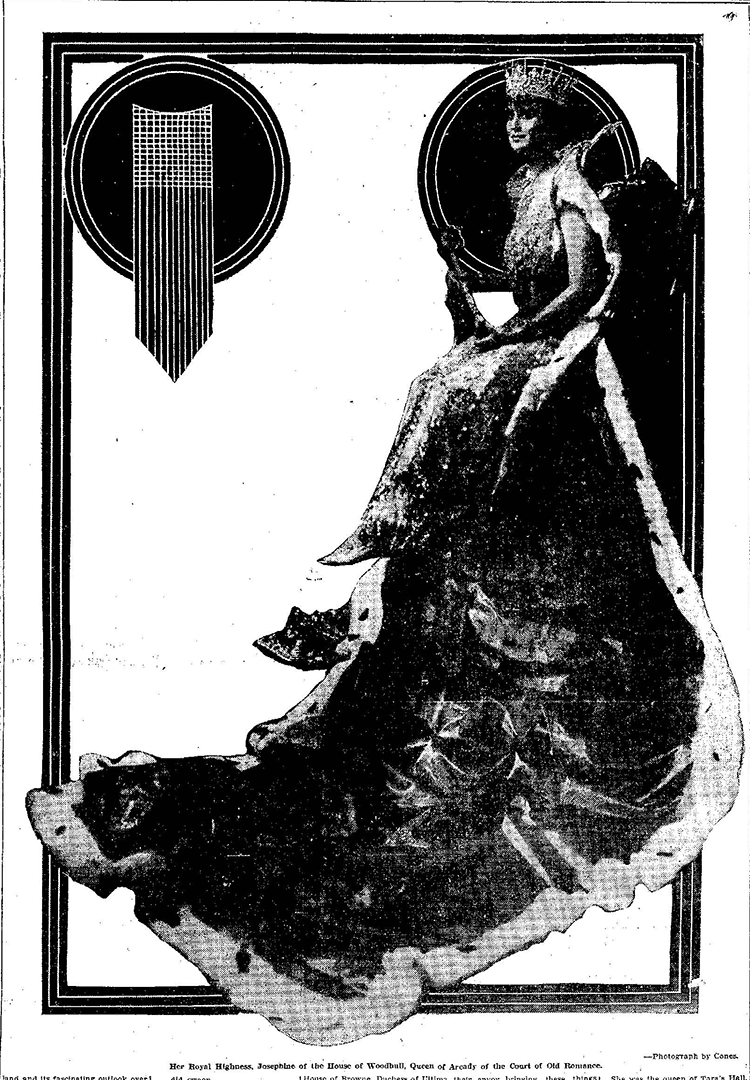
Queen of Arcady, 1915, San Antonio Light
Later in the week, Josephine Woodhull was crowned as “Her Majesty, the Queen of Arcady” at the Majestic Theater. She wielded her scepter over the “Court of Old Romance.” Edged in ermine, her peacock blue velvet train was embroidered heavily with gems, shimmering as a peacock’s feathers.
Numerous parades filled the week, including the “Pageant of Caliph,” a burlesque night parade staged by the Fiesta Association. The first float in 1915 bore the “Duchess of Frijoles,” satirizing the high society coronation of the prior evening. Politicians, local to international, received “a goodly share of ‘guying,’” including a “Floating Vote” float with politicians portrayed aboard as “pulling the strings.”
A century ago, the Battle of Flowers Parade represented the high point of the week, with floats and carriages laden with thousands of fresh flowers. During the mock battle circling Alamo Plaza, even visiting Governor “Pa” Ferguson was pelted with flowers.
Somehow, the flower-pelting tradition was allowed to continue, despite its tumultuous first year. The following is pulled from a post from several years ago. Sarah Reveley transcribed the description of the 1891 melee from an April 25, 1891, edition of the San Antonio Daily Light:
…The procession contained over 100 carriages and other vehicles, all gaily decorated and many containing decorations of real artistic merit. Mr. Madarasz’s carriage, decked in pure white lilies and variegated grasses, with honeysuckle was plain, pretty and neat. Col. H. B. Andrews’ pony phaeton, with four Shetlands drawing it, was exquisite, and J. J. Stevens’ children in a four-in-hand Shetland surrey, representing a yacht, was also very pretty….
On arriving at the plaza the police divided the procession into two lines, each half going in opposite directions and passing around the park were brought, face to face with each other. The crowd on foot pressed the carriages closely and the fight began and waged furiously for nearly an hour. The occupants of the carriages had all the ammunition while those on foot had none. They began picking the fallen roses from the pavement, and even tore off the trimmings of the carriages, and soon had the best of the fight. Heavy bunches of laurel thrown soon had their effect, and many ladies lost their temper and used their carriage whips indiscriminately on the crowd. One lady struck Mr. Doc Fitzgerald, a passive spectator, a severe blow on the face with her whip, but did not see fit to apologize for her mistake. Mr. H. P. Drought made an ugly cut with his whip into the crowd…. One young angel with white wings appealed to the crowd for protection from the missiles saying, “I wish you men would make them quit….”
The police were powerless to keep the people off the park beds, and prevent them from tearing off the flowers. One outright fight occurred. Mr. Phil Shook, one of the horseback party, lost his temper, and cutting a man in the face with his riding whip, was assaulted, and a fist fight on the pavement resulted. Both combatants were arrested by the police. Mr. Charley Baker used his umbrella for defense. While the crowd was very dense on the plaza, waiting for the procession to come along, Mr. Cristoph Pfeuffer’s splendid team and carriage took fright on South Alamo street, at an electric car. The carriage was decorated and contained several ladies, a child and the driver. Dashing into Alamo street, past and into the crowd of people and vehicles, it overturned a buggy and horse at the corner, and its driver jumped out and was dragged under the carriage by the lines. The lady on the front seat caught one of the lines and held it, but the horses made straight for the crowd of women and children in the park and struck a very deep mass of them, it being impossible for them to move out of the way. The ladies were thrown out and their clothing was badly torn. One little boy was knocked senseless, another was bruised, and one little girl had her apron torn off. Other children were trampled by the frightened people. The plunging horses were secured and the carriage was taken to a side street….
Some irrepressible small boys arranged a dog fight in the midst of an interested crowd of spectators, during the battle, and a regular stampede ensued. Some of the combatants whose supply of ammunition had exhausted, resorted to buggy robes and quirts for aggressive warfare, and umbrellas and parasols for the defensive….
The battle was a success, but if it is given next year, more police will be needed, carriages must not be allowed on the plaza at all, and the participants must not lose their temper.





 Postcards from Barton Springs