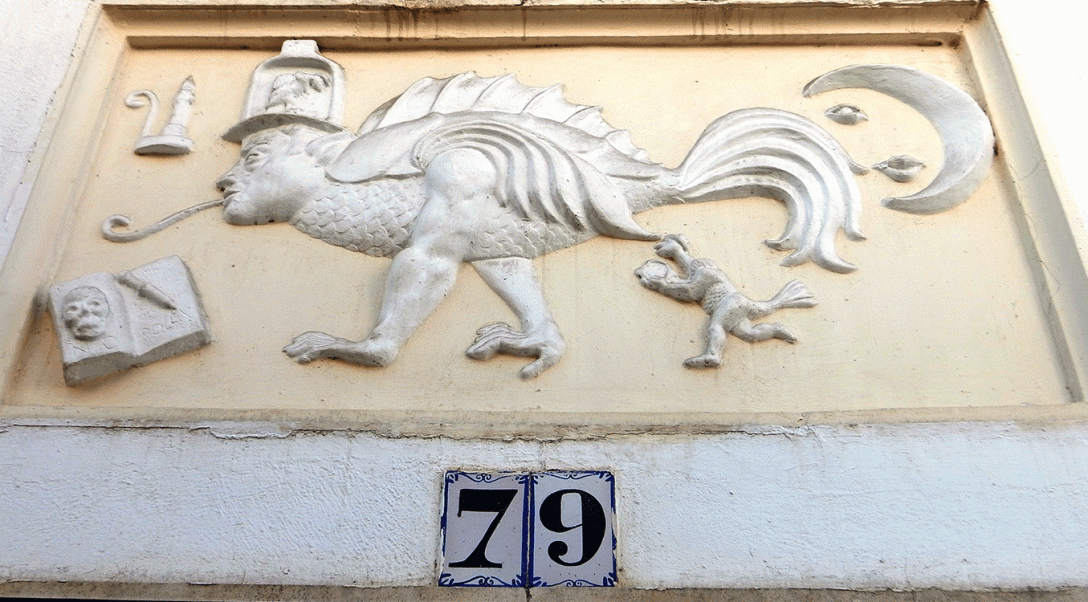
Postcard from Siracusa, Sicily: Protector of eyes and the quill

Above: Santa Lucia holy card superimposed over silver milagros displayed in Cattedrale della Nativita di Maria Santissima
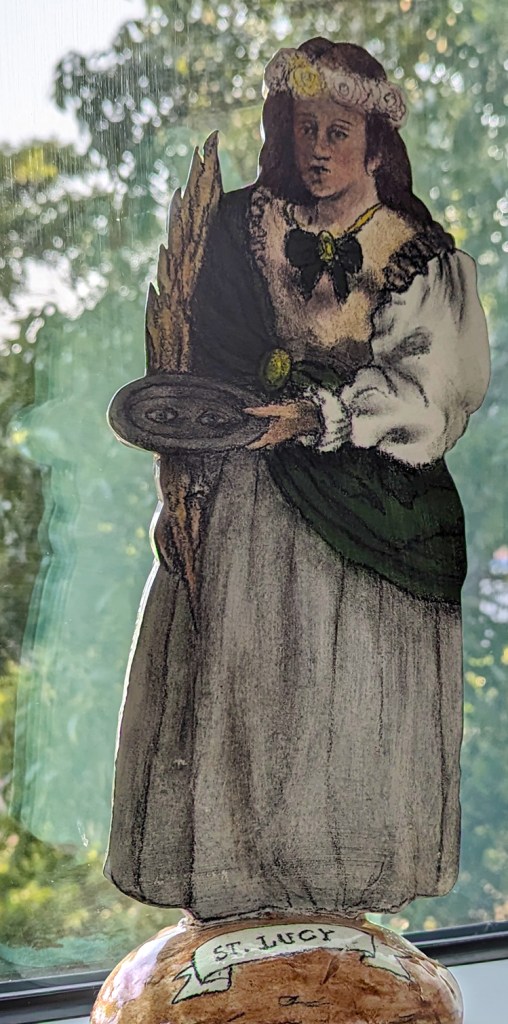
She stands guard on the windowsill by my desk as I write. As the patron of eyesight and authors, Saint Lucy (283-384) has long been a favorite of mine. Both near-sighted and far-sighted, I’ve worn glasses since the second grade. And certainly my writing needs all the help it can get.

Having lost sight in my right eye a year ago, it seemed serendipitous that one of the spots the Mister planned on staying, Siracusa, turned out to be her hometown. A church dedicated to the saint, Chiesa di Santa Lucia alla Badia, was a block away from our rental – a proximity presenting an opportunity to soak up some of Santa Lucia’s goodwill to protect the left.

Continue reading “Postcard from Siracusa, Sicily: Protector of eyes and the quill”

Postcard from Antequera, Spain: Where women are not depicted as the weaker sex

Romans. Visigoths. Moors. Then Christians. As in Ronda, evidence of the waves of occupiers choosing to fortify a natural citadel in Andalucia remains in Antequera. Real Colegiata de Santa María la Mayor, an early (early 1500s) Renaissance church, dominates the hilltop with its Alacazaba fortress.

A replica of a 1760 float from the Corpus Christi processions parked near the front of the church is what stands out. Tarasca depicts a powerful woman, representing faith, conquering the seven deadly sins, symbolized by a snarling seven-headed dragon.

Then there are the faded murals on the church’s walls. Look closely. The Virgin Mary is not the only role model for young women here. The featured saints are all women. Women at war, leading Christian forces to victory.

And in the church of San Sebastian, there is a statue of a young woman gazing toward heaven. In her right hand, she bears a sword pointing downward to the head of a slain Moor at her feet.

Growing up with these images, are the women of Antequera particularly strident?

We lunched in a small restaurant patronized by locals that balanced things out by presenting the male side of the equation – the walls were covered with photos of matadors.

Postcard from Sevilla, Spain: This makes no sense

Alice: Would you tell me, please, which way I ought to go from here?
The Cheshire Cat: That depends a good deal on where you want to get to.
Alice: I don’t much care where.
The Cheshire Cat: Then it doesn’t much matter which way you go.
Alice: …So long as I get somewhere.
The Cheshire Cat: Oh, you’re sure to do that, if only you walk long enough.

Alice in Wonderland, Lewis Carroll

The most recent post having left you well fed, it is time to work those calories off with a long rambling walk through the streets of Seville.

These remaining orphan photos that failed to find a home in earlier posts make no sense as a group.

Except… this randomness is part of the joy of slow travel. Taking time to stroll and explore areas you might otherwise overlook always leaves one “curiouser and curiouser.”

Seemingly unrelated snapshots can convey the diversified textures that are woven together to create a sense of place.

That makes sense, right?