You have done it again. No wonder I wander around flitting arbitrarily from subject to subject. My readers flit, too.
During the past year, you have remained as Alamobsessive as I, particularly focusing on the guns Land Commissioner Jerry Patterson let be drawn in front of the Alamo. You joined me in remembering my father-in-law, George Spencer, and photographer Rick Hunter. You have demonstrated your interest in photography by two artists, Richard Nitschke and Sarah Brooke Lyons. You have let me take you traveling to San Miguel de Allende, and shown interest in the reign of Maximilian and Carlota in Mexico.
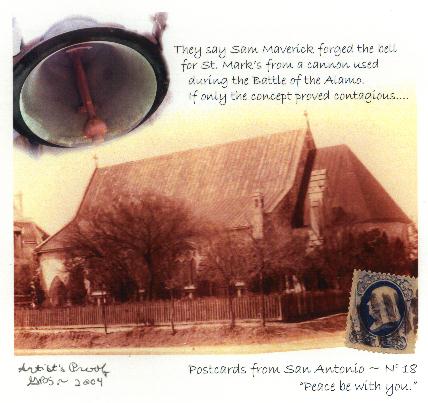
“They say Sam Maverick forged the bell for St. Mark’s from a cannon used during the Battle of the Alamo. If only the concept proved contagious….” Postcards from San Antonio – No. 12, “Peace be with you.” http://postcardssanantonio.com/other-themes.html
The 1928 headline was a bit premature for the neighborhood, but we did live in their shadow briefly. Or at least the shadow of the freeway. Right there on their street. Ostrom. As close to 281 as possible. Yet in the midst of a neighborhood of fairytale cottages.
You’ve probably driven by it often, yet not through it. The freeway, the golf course, Mulberry and the river cut it off from any through traffic.
The River Road neighborhood. Filled with eccentric little cottages inhabited by some of San Antonio’s most wonderfully eccentric characters.
Some of these modern-day opinionated residents quickly would have taken sides in the “Goat Case” as covered by the San Antonio Daily Light on June 8, 1889:
Mrs. V.C. Ostrom, a well known lady of San Antonio, who has made herself quite famous in San Antonio by her untiring efforts in the cause of temperance and prohibition, was in court yesterday afternoon and all hands concerned had a lively time of it. This lady sued Jose Rodriguez, a neighbor living near San Pedro springs for damages for allowing his flock of goats to devastate her garden. Rodriguez’s goats have long been a nuisance to dwellers of the new fourth ward, even down to Marshall street, and time and again the city, through its recorder, has imposed light fines upon him for violating the ordinance in allowing said goats to run at large. Alone and unaided the lady attempted to defend herself against the evil and, what with the lawyers of the defendant and the crowd of spectators whose sympathies, on account of her prohibition sentiments, were decidedly against her, she had a hard time of it, and it may as well be mentioned, Rodriguez’s lawyer also had a pretty hard time of it.
But Sarah Hummer Ostrom and her daughter Frances were firm in their beliefs. They were willing to put their money on the table to spread the Good Word. They helped build and run a place of worship in their yard on Jones Avenue to minister to those who lived in the quarry area in “houses of tin strips, flattened-out tin cans and waste lumber.” According to a November 23, 1913, article in the San Antonio Light, they:
…set up a little mission among the jacals of Mexican squatters in the rock quarry district and spread the Christian Gospel among the lowly sons and daughters of the Moctezumas.
…she (Mrs. Ostrom) “works at her religion.” She does not save it merely for Sunday use.
This slideshow requires JavaScript.
But growing crops and saving souls on their farm soon yielded to the surrounding pressures to grow houses instead. Bess Carroll’s copy in an April 1928 edition of the San Antonio Light is so dramatic, I decline to edit her descriptions of a booming city stretching northward:
Over many a road blazed by adventurers, long ago, the huge stride of progress has marched into San Antonio, leaving great monuments in its footprints. And now this Titan whose breath is the stream of power, whose blood is an electric flow, has followed an old wagon road to the door of an ancient farmhouse.
Though phantom wolves may still howl their hymns to the moon there, San Antonio’s last prairie is being linked to the heart of her business being.
Beside the banks of the San Antonio river, where a tented city once stood buried in the mist of prehistoric oblivion, steam rollers snort and machinery does its superhuman work as the geographical end of St. Mary’s street is gradually dragged along by iron horses – the street-building equipment of the city of San Antonio – to meet Jones Avenue….
For the gigantic march of development is taking its parade of houses and money down an old Indian trail, across the path of the ragged Texas army of 1836, and along the course of what was, until recently, a shady country lane….
Along Jones avenue wide acres of oats and grain stretched out “once upon a time,” and only a short while ago the last remnant of the sole surviving farm gave way at last to development. That was when Miss Frances Ostrom, 1910 Jones avenue, converted the old Ostrom farm into a residence district known as “The French Village.”
When V.C. and Sarah Ostrom bought their nine-acre farm in ’69 they acquired water rights issued by the crown of Spain to this land when San Fernando cathedral was still young. But because it occupied a rise in the flat prairie surrounding it, the Ostrom farm very seldom “took the water” from the Upper Labor Ditch, a canal dug in early times for irrigation purposes….
(Miss Ostrom recalled) “The nearest store was Costanola’s, occupying the site of the present Robert E. Lee hotel; it was in the brush. Brackenridge park was largely a pasture. Later Rubiola’s ‘country store’ opened; soon after came a rural saloon. It was not until about 1885 that any houses were built on the North Side this far out. The mule car street ‘railway’ caused some development.”
The last stone of the Ostrom farmhouse was torn down in 1926. It had been a typical old stone house – four rooms and an eight-foot hall….
Land that had been green and virgin once was paved for the first time, in April, 1926. The last of the old prairie, plowed by oxen when at last its fertile acres were claimed by civilization, had its face covered over with a black veil of asphalt. It had been widowed, verily.
Now an avenue of trade will link the lost furrows of the Ostrom farm with San Antonio’s downtown district. In 1927 alone eight million dollars, according to real estate estimates, were spent in new building alone on St. Mary’s. Included in the principal buildings are: The Plaza hotel, Public Service building, Aztec theater, Smith Brothers-Young building – which is to be the tallest office structure in Texas – and the San Antonio Drug company, St. Mary’s Catholic church, The Gunter building, the Real estate building, Builder’s Exchange, Travis building, Lanier hotel, Commercial Loan and Trust company and the Brady building.
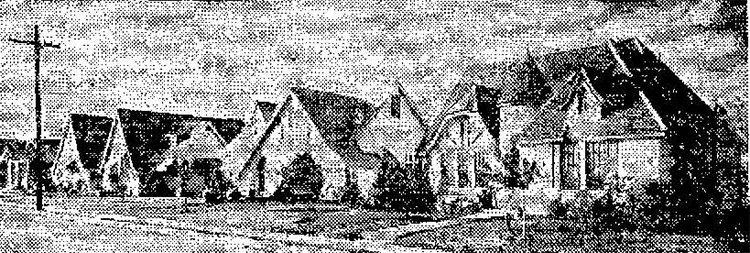
The picturesque houses of the “French village,” with roof lines mimicking those of major chateaus, albeit miniature in scale, still line several of the narrow streets, scarcely wide enough to accommodate two-way traffic, in the River Road neighborhood. Park in Brackenridge Park one day and follow trails across Mulberry to walk among the cottages and along the tree-lined banks of this natural portion of the San Antonio River. You will understand why the neighbors feistily defend this magical spot against any additional modern-day incursions.
Warning: Copy from newspaper accounts describing violence or demonstrating racial prejudice of the day appears as written.
Cruising through Brackenridge Park at night, park police tell tales of the woman in the long flowing dress holding a basket of roses as she gracefully stoops, tending flower beds near the river. They turn their patrol cars around to shine headlights on the mysterious figure to find her vanished, the only trace of her presence a small pile of freshly plucked weeds.
Some nights, they see another woman silhouetted in the moonlight walking on the river wall by the upper pumphouse or precariously along the highest lip circling the Japanese Tea Garden. Her long dress is ripped off one shoulder, her hair springs wildly from its bun and she wields garden shears in such a threatening fashion they find themselves involuntarily crossing their legs.
These visions are the same, Helen Ujhazy Madarasz. Her ghost has roamed the area for more than a century in search of justice for the men who robbed, raped and killed her, setting her afire to destroy evidence of their crime.
First time you have heard of this ghost?
Okay. I confess. The ghost is a figment of my imagination, percolated in the bubbles of my bath.
But Helen was real. And, if a ghost needs an excuse to lurk in the dark, she certainly has reason to haunt Brackenridge Park.
Born in 1838, Helen Ujhazy was still a child when her idealistic Hungarian father found himself on the side of the underdog as the last fortress fell to the Austrians in 1849. While her father was greeted as a hero upon arrival in New York, according to James Patrick McGuire in The Hungarian Texans, the family’s journey to settle with fellow Hungarian exiles on farmland in New Buda, Iowa, was hard. And, for the first time in their lives, the Ujhazy girls had no servants.
McGuire wrote that Helen adapted quickly:
She was an excellent horsewoman, and, riding sidesaddle, she was responsible for herding the family’s newly purchased livestock…. In a letter written in February of 1851, Helen said that she was healthy despite the harsh winter and was making an overcoat from stag hide, which she had obtained from visiting Indians for eight scarves bought in Hamburg.
Helen’s mother died that fall, and, in mourning, her father left the family behind while traveling to look at the prospect of building a new life for them in San Antonio. During his absence, according to McGuire, the 15-year-old set her mind on marriage to Vilmos Madarasz, the teen-aged son of a fellow Hungarian immigrant. Despite, her father’s disapproval, the couple married in June of 1853. The newlyweds remained in New Buda with Vilmos’ family when Lazlo Ujhazy moved the rest of the family on to San Antonio.
In this case, father evidently knew best. Helen found herself two children later in Hungary with a straying husband, supposedly off settling business connected to his inheritance from his grandmother. While she once again had a maid, McGuire wrote she felt:
… abandoned by her husband, who was wasting his inheritance in rich living and flirting with women in another part of Hungary. This situation created a scandal in both their families. Described as uncontrollable as well as childish, lonely and weak, Madarasz let it be known that he considered his American civil marriage invalid in Hungary….
Reuniting with her father during his visit to Switzerland, a pregnant Helen and her two sons sailed with him to Texas in 1858. While aboard ship crossing between New Orleans and Galveston, she lost her youngest son to a raging fever.
In San Antonio, Helen moved into the Ujhazy house, Sirmezo, on Olmos Creek near the headwaters of the river (now Olmos Basin and Olmos Park). Texas did not impress Helen immediately, and she was not getting along with her older sister, Klara, in the cramped homestead. McGuire wrote, Helen complained in a letter she penned to another sister:
There is scarcely a day that I don’t ask God to liberate me from here.
Helen borrowed from her family against an expected inheritance arriving from Hungary to purchase a farm on the Cibolo. Farming alone was difficult – drought, scorpions and marauding Indians – and working the fields added years to her appearance. In 1864, she finally filed for divorce, granted by default.
Following the death of her father in 1870, her brother, Farkas, made a series of unfortunate business decisions affecting the estate. His main creditors, Dr. Ferdinand Herff and Judge Albert Dittmar, foreclosed on Sirmezo. Fortunately, prior to the sale, wrote McGuire, Farkas had at least transferred ownership of all moveable property and livestock to Helen.
While her siblings returned to Hungary, Helen had become a Texan. McGuire described her as having emerged as a capable, independent businesswoman, making money through real estate transactions and by loaning out profits.
In 1883, she purchased land on the river from George Brackenridge, who lived on the adjacent property, Fernridge. Brackenridge retained the water rights, wrote McGuire, for San Antonio Waterworks.
A 1911 postcard shows the beauty of the land in Brackenridge Park formerly owned by Helen Madarasz.
A May 1, 1899, edition of the San Antonio Daily Express described Helen’s home:
Her house was located in a beautiful Eden-like grove near the head of the San Antonio River; on it and its shrubs, flowers and foliage, as well as the grounds, she expended considerable of her means, and their beauty was famous. The old Madarasz home is in one of the most beautiful natural parks in Texas. It is a grove of tall, thick-boughed trees, under which rise several of the large springs that form the San Antonio River…. In the midst of this grove, with beds of former lagoons and spring feeders to the river, and the head arm of the river itself flowing close by, stood the neat little old-style cottage of Mrs. Madarasz.
The river waters and those of the ancient labor ditch provided the water needed for Ilka Nurseries, which her son Ladislaus operated until he began working in his new neighbor’s bank, First National Bank. This left Helen to run the nurseries and greenhouses.
Helen socialized with her neighbors, both suffragette Eleanor Brackenridge and her brother George, a friendship that attracted attention of others. McGuire wrote:
Colonel Brackenridge, also Helen’s close friend and a lifelong bachelor, possibly provided wise financial advice for her investments, and their names were linked in local gossip.
The divorcée and son managed to move amongst San Antonio’s high society. Helen was among the participants in the first, rather wild, Battle of Flowers Parade in 1891. She also presided at one end of the table at an elegant birthday celebration Ladislaus hosted for himself at the Lakeside Hotel, West End. An October 10, 1892, edition on the San Antonio Daily Light described the event in great detail, listing the Herffs, Kalteyers and Duerlers among the guests. The party stretched until “11 o’clock:”
… the conclusion of which the guests formed a circle around their host, touched glasses and silently drank to his future peace, pleasure and prosperity….”
Ah, but if only the power of the toast had proved more potent. Fortunes changed.
While on April 23, 1895, the San Antonio Daily Light reported Mrs. H. Madarasz received the first ribbon award for the best general collection in the Rose Show, the headlines on May 2 brought bad news about Ladislaus’ role in the disappearance of large sums of cash at First National Bank:
The bank officials are reticent, but enough has been learned to say that he was infatuated with the great American game of poker, and was a heavy player at club tables, often losing or winning as high as $500 on a night’s play….
It is understood the poker rooms frequented by Mr. Madarasz were those of Thurmond, on Dolorosa Street. Very high, or unlimited play is said to be allowed there….
Among the “goody-goody” folks, Mr. Madarasz was thought to be such a “nice” man.
Ladislaus fled the country, and the embarrassed Helen, according to McGuire, became reclusive, focusing on her greenhouses.
Then the final tragedy befell her. At first, the San Antonio Daily Express of April 30, 1899, reported that Helen accidentally had burned to death in a fire in a home that took fire fighters downtown too long to reach. But on May 1, the San Antonio Daily Light started unfolding a more grisly story and the incendiarism ignited to conceal it:
Aged Lady* Killed Robbed and Burned….
In the ruins were found the remains of Mrs. Madarasz on some blood-soaked bedding in the bedroom. The trunk of the body and the back of the head was all that remained of this venerable and well-known lady. She had either been burned alive after being wounded near death or had been smothered by the smoke.
The Light speculated about the motives:
Deceased was supposed to have always a sum of money in her home. She had been in quite opulent circumstances in former years, and by the sale of flowers recently from the nursery for Flower Battle decorations and for the State Medical Convention it was known she had at least $200 in the house….
It is said Mrs. Madarasz possessed a large quantity of old jewelry, old family heirlooms as well as valuable bric-a-brac and silver, none of which have been accounted for.
And pointing of fingers began quickly:
The theory generally accepted about the city that some Mexicans who are strangers and have recently arrived at the rock quarry settlement, near Mrs. Madarasz’ place, from Mexico, on their way to East Texas, are responsible for the crime.
A $1,000 reward was posted for information in the case. But rather than Mexicans surfacing as suspects, Captain James Van Riper traveled to Alice, Texas, to fetch two suspects in another case and exacted a confession from William Cary, also known as John Sands, a confession also implicating J.W. Hart.
These two suspects were African American, and indignation raged in the city as the news of the arrest spread. Talk turned to hanging, so precautions were taken. According to the June 21 edition of the Daily Light:
Sheriff Campbell had carefully made plans to avoid any disorder and notified Van Riper to have the train stopped before the depot.
The suspects were slipped off the train and driven in a hack to the county jail.
But once again, suspects were cleared. The headline of the June 28, 1899, edition of the Daily Express read “Negro Suspect’s Story Straight,” and “Hart and Cary said to have been in Tampico when the crime was committed.”
On June 29, the Daily Light reported District Attorney Carlos Bee had produced a letter from the American consul in Tampico verifying the alibi. Bee asked Sands:
… if he had made a confession of the murder of Mrs. Madarasz and he replied that if he had he knows nothing of it. He stated that sometimes he loses his mind and that he does not know what he talks about in such cases. He said he fell out a tree while a boy and has been affected ever since. He said he loses his mind, when he becomes frightened. He is a very ignorant negro. Both men denied they had ever been in San Antonio before.
Hart is an intelligent negro. He stated he was a British subject in the Bahama Islands and that he had gone to school fourteen years and was a monitor and had taught school. He was also a tailor in his country and regretted ever having left his shop….
Their stories must have been convincing to the point it moved some in the room to contribute to their transportation back out of San Antonio:
After the men had been discharged District Attorney Carlos Bee, Country Treasurer John Tobin and others who were in the courtroom contributed a little change toward them until each man had a dollar.
While that seems small compensation for their inconvenience, at least they were not hung by an angry mob.
But, that leaves the murder of Helen Madarasz a mystery.
That’s why I think her spirit still wanders the park at night, tending the flowers and seeking the guilty.
Let me know if you see her.
*I object to calling a 61 year-old “aged,” but that certainly pales in comparison to the quick accusations in the press against Mexicans and African Americans at the time.
Update on August 5, 2012: The ghosts who might be haunting Madarasz Park appear to be multiplying, and I promise they are not figments resulting from over-percolating in bath bubbles. Sarah sent me a clipping from the March 29, 1907, issue of the San Antonio Gazette that indicates this could be titled “The Curse of Madarasz Park.”
The parkland claimed the lives of four men during a one-year period. On May 14, 1906, Ernest Richter, “an aged man from Fredericksburg,” drowned. The proprietor who took over the management of the park in June of that year, Otto Petrus Goetz, committed suicide there on December 3. The fate of the following proprietor, Sam Wigodsky, was hardly better. He and his employee, William Berger, drowned on March 28, 1907, when their boat capsized as they tried to retrieve an empty beer keg midstream. While the drowning of the two men, both in their mid-30s, was ruled accidental, reports the following day claimed Wigodsky had been in possession of $1,000 in cash, mysteriously missing. Makes one almost afraid to ask the fate of the next proprietor….



 Postcards from Barton Springs