How’s the GLO managing Alamo Plaza? Welcome to the faux Alamo.

Oft-criticized for its failure to curb commercialism on Alamo Plaza, the City of San Antonio turned management of the historic city park over to the Texas General Land Office.

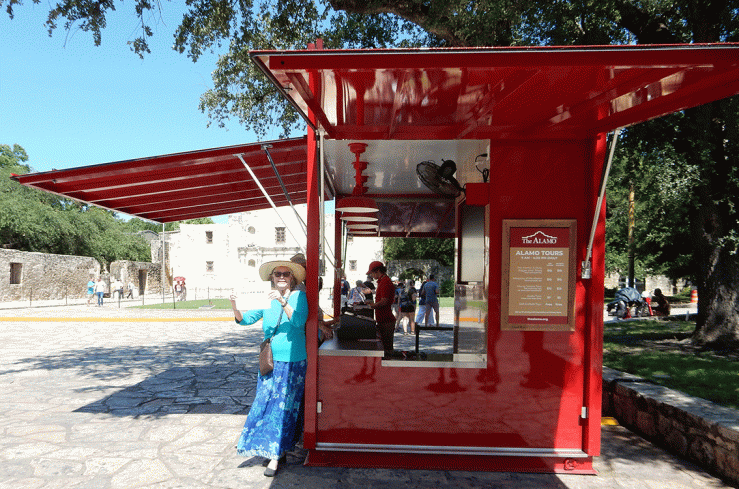
Millions of people presumably have passed through there since then, and the first thing most see is a caboose-red, shiny metal, faux Alamo Welcome Center. There in the middle of the plaza where there used to be a small table stand with an umbrella shading a vendor of icy cold raspas. It was 99 degrees when I was there, and I definitely would have found a snow cone more welcoming.

Anyway, visitors first glimpse of the distinctive Alamo-shaped parapet is on this booth. Why? Well, that’s obvious. It’s shiny red, and the Alamo with its ancient limestone walls pales by comparison. The Alamo might be free, but the Alamo prefers you to pay for headsets or tours. It requires the bold red to make sure you do not miss the opportunity.
protester with pitifully inadequate #NoFauxAlamo sign
Oh, there’s the real Alamo, along with protester with pitifully inadequate #NoFauxAlamo sign.

While the General Land Office deems the stately Cenotaph nearby as inappropriate for the battlefield site, the powers that be evidently consider this carnivalesque booth a perfect fit.

In case you somehow manage to miss the warm welcome this booth extends to you, there are other signs strategically placed around the plaza.

And there is the opportunity to purchase a photo taken right up close by the Alamo door.

But the appropriateness of the tenant mix and their appearance on the west side of Alamo Plaza was top among the complaints aired by many, and supposedly the state solved that with the General Land Office’s purchase of a row of historical buildings there. A new Alamo Museum is envisioned for the area.

In the meantime, millions of visitors pass by. Strangely, among the most flagrant violators of the sign ordinance governing the Alamo Plaza Historic District (view signage codes here) is the Official San Antonio Visitor Center, with flamboyant advertisements completely covering one its windows. And the Del Sol Color Change shop located next door to the Official The Alamo Store. The GLO evidently is not able to request its tenants abide by tasteful signage regulations.

But, hey, one can never have too many signs addressing Alamo Plaza. So both the San Antonio Visitor Information Center and the Official The Alamo Store plop illegal signage boards right in the middle of the sidewalk.

As a final pictorial update to how the Texas General Land Office is managing one of San Antonio’s most treasured plazas, there is this mysterious Christo-like treatment between the Alamo Chapel and the Menger. I peeked in and could determine no function, but it does arouse one’s curiosity.
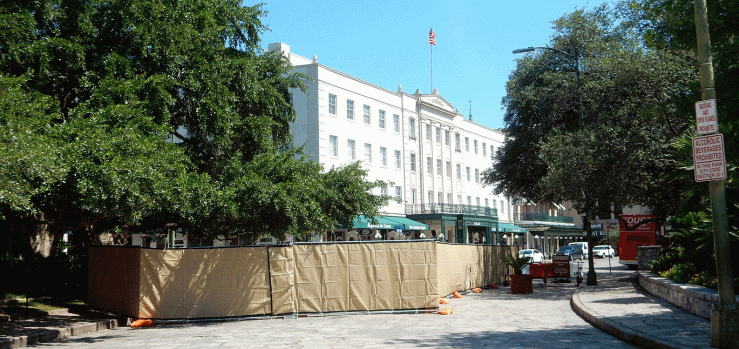
Welcome to the improved (?) version of Alamo Plaza.

June 27, 2019, Update: A portion of this post was published in The Rivard Report.

Postcard from Sevilla, Spain: Tiles turn advertisements into enduring street art

Members of the Sanchis family opened El Cronometro watch shop on Calle Sierpes in 1901. Their investment in this monumental wood and tile advertisement must have been substantial, although surely the Swiss watchmaker Longines underwrote some of the expense. Even if the store closed its doors, it is doubtful Sevillanos would permit the sign to be removed. The commercial advertisement has become a cherished part of the streetscape.

On the same street, Zacarias Zulategui commissioned Ceramica Santa Ana to add two tile advertisements for Armeria Z and Deportes Z. His gun shop and sports store have disappeared, but the ads remain. Women no longer roll cigars inside the Fabrica Real de Tabacos, but the tile sign still is embedded in the wall. The last Studebaker rolled off the assembly line in 1966, but the Studebaker mural in Seville endures.

In Seville, the art form has never gone out of fashion. Azulejos are so durable, they are used for street signs. The vintage look is a favorite of producers of alcoholic beverages, who find their installation is embraced as part of the streetscape. Restaurants, bars and shops continue to turn to Seville’s ceramicists to announce their presence to passers-by.

And you have to admire the cleverness of the tavern-owner whose frugal three-tile B-A-R sign takes full advantage of the azulejos above it depicting a graceful Virgin Mary protecting the Spanish fleet. The juxtaposition makes the establishment appear particularly blessed.

Postcard from Sevilla, Spain: The celebrated potters of Triana

“Saints Justa and Rufina” (detail above) by Francisco de Goya hangs in the Cathedral of Seville.

The most revered potters of Seville made their living in the area known as Triana in the third century – Santa Justa and Santa Rufina. During a festival, the sisters purportedly refused to sell any of their wares for use in pagan celebrations. In anger, those who had been refused service broke all of the pair’s ceramics. And, in the spirit of an eye for an eye, the sisters retaliated by smashing a statue of Venus.

The city’s prefect imprisoned the sisters and demanded they renounce their Christian beliefs. They refused, so their deprivation of food and water and various stages of torture began. Barefoot marches, the rack, hooks. Their faith remained steadfast.

Justa finally starved to death, and still Rufina refused to surrender to the prefect’s demands. Rufina was cast into the public amphitheater with a lion, but the fierce lion supposedly demurred attacking and purred at her instead. The frustrated prefect finally resorted to beheading, a method that proved effective at ending Rufina’s life.

With clay from nearby Isla de Cartuja, the Triana neighborhood on the left bank of the river remained Seville’s center for ceramics and azulejos for centuries. In 2014, the former Ceramica Santa Ana factory reopened as the Centro Ceramica Triana. The museum traces the regional history of tiles from the earliest known examples through the 20th-century.