It seems every time I type a few sentences for the book I’m writing about the Coker community, I come across something that makes me want to dig deeper. Most of the time, the research is like doggedly following a trail of bread crumbs through dense underbrush for hours only to look up and realize a flock of crows just swept down and gobbled up the path ahead.
Sometimes though, as in two days ago, I am rewarded. When I wrote Last Farm Standing on Buttermilk Hill, I was not comfortable in the identity of the man Joseph Coker shot by water hole. Seeking someone named John Jones in a community full of Joneses can be tricky. But at last, I found him, and it was not the one I had assumed.
My point is, that discovery now serves to justify my endless, stubborn wanderings after trivia to round out the story. Cutting off research is the hardest thing about writing nonfiction.
The following update from the Coker Cemetery Association Newsletter, illustrates the stumbling-lost-in-the-woods style of research distracting me daily:
In the 1860 Census, Ella and J.K.P. Campbell were listed between the Robert Smith family and Joseph Coker. A 35-year-old stock raiser from Tennessee with a 21-year-old wife from Vermont made an interesting pairing, particularly on the eve of the Civil War.
James Knox Polk Campbell with daughter Mattie from the family files of Chuck and Honor
With no intermarrying ties in the community, the couple slipped out of my mind until I was working on the Civil War chapter for the book you have commissioned about the Coker Settlement. Unlike many men in the community who enlisted as privates, James Knox Polk Campbell immediately was appointed assistant commissary for the Sixth Regiment of Texas Infantry at Camp Holmes, Arkansas.
So many families stayed for so long on the land around the Coker Settlement, the families moving away always mystify me. Why would anyone abandon a home in this rattlesnake-infested, drought-prone land where one had to constantly watch out for marauding Indians poised to snatch up your children while you were hoeing or bent over laundry?
Digging to find out more about Campbell, I stumbled across an online post dating from the 1990s. Charles _____ had letters, letters referencing Campbell’s “ranching venture” outside of San Antonio and his Civil War imprisonment. All I had to do was find Charles _____.
I prefer looking for dead people; surely they are happy to know someone cares enough to want to know their stories after they have left the earth. Nosing around the internet for the living makes you feel you are prying, spying, trying to identify someone by prowling on LinkedIn, Facebook, Google, white page look-ups.
And then making that phone call, to perhaps the totally wrong stranger, and not sound crazy? I lucked out and got an answering machine. And lucked out even more. I hit the right person in the right state the first time and got a return call.
And from someone sympathetic to such a call emerging from nowhere about some post made more than a decade earlier. Chuck, himself, had stumbled across the letters on the internet years earlier.
Billee W. Hoombeek brought them to the surface. Chuck retained her email from years ago and forwarded it to me. She was an archaeologist working on the Green Mountain National Forest project in Vermont between 1979 and 1988. As part of her project, she concentrated on “interpreting the deserted farmsteads that dotted the woods.” Hmm, a kindred spirit perhaps?
One of her resources in the Brandon, Vermont, library was a collection of materials assembled by a “Mr. Chamberlin” for a novel he had intended to write comparing life in two small towns – Brandon, Vermont, and Brandon, Virginia. Here, Hoombeek encountered the letters from Campbell to his father-in-law, Colonel Frank Farrington, of Vermont. Finding them fascinating, she went out of her way to share them through a Campbell descendant organization and online.
When Chuck found her, she responded: “I would be in seventh heaven if an ancestor of mine had left such a rich treasure. He does indeed have feet of clay, but she (Chuck’s wife Honor, who is the actual descendant) will know him very well when she finishes.”
And Chuck and Honor are again sharing with us….
A blog post by the Special Collections of the UTSA Libraries reminded me how I long to get back to the comfort and flow of writing historic fiction – based on thorough research but woven together by my imagination instead of hundreds of footnotes.
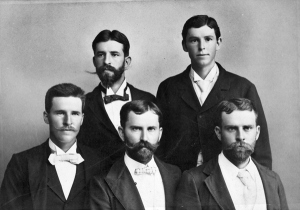
The facial hair photo on the UTSA blog happened to be of some real people featured in a chapter of An Ostrich Plume Hat, the completion of which is now interrupted by the writing of two other books. At any rate the photo is of the Goeth brothers – my favorite two going by the confusing initials, C.A. and A.C.
Edward Wilhelm Goeth, a rancher; Conrad A. Goeth, a lawyer; Adolph Carl Goeth, a merchant; Max A. Goeth, a rancher; and Richard A. Goeth, a doctor, from the UTSA Libraries Special Collections
Read about the Goeths’ involvement with Texas politics – part fact, part invention – here.
When immersed in fiction, I can close my eyes in the tub and hear my characters talking to one another. While writing nonfiction, bath time means my mind is submerged in thoughts of those innumerable trails of crumbs beckoning me to follow in wildly divergent directions.
Several chapters somehow have managed to emerge from my keyboard, so perhaps an end is in sight.
For now, I know I need to just keep awkwardly dog-paddling, trying not to drown in the details. This book is not supposed to be like digging my own grave.
One of the nicest features of the Mission Reach of the San Antonio River Improvements Project is that it invites you to visit the missions strung along the banks of the San Antonio River.
And not just the first two you normally take visitors from out of town to see before you get missioned-out and head for margaritas.
But the oft-overlooked San Juan Capistrano and San Francisco de la Espada, which, true confession, the Mister and I had not seen for at least two decades (but, true confession, not as long as it’s been since my last confession). Their histories easily can be found online, so I will not attempt to rewrite. This post is simply meant to entice you through pictures to rediscover what we tend to forget on the south side of town.
This slideshow requires JavaScript.
Mission San Juan Capistrano was founded in 1716, with much of the mission compound not completed until 1756. San Juan himself must of have been incredibly pious because he was governor of Perugia, the chocolate capital of Italy, before becoming a Franciscan. However, since chocolate came from the New World, maybe lording over Perugia around the year 1400 was not as flavorful as it would be today.
When the Mister and I made a mid-morning stop at the mission, the information center was staffed by a volunteer from the parish. What was wonderful was that he peopled the mission for us with his own ancestors, photographs of ancestors he did not realize had lived within the protective mission walls until seven years ago. Plus, he told us how a window at each of the missions is positioned to let illuminating rays of light shine on the statues of each one’s patron saint on the appropriate feast day. Clever calculations by the priests; miracles to the Native Americans they were converting.
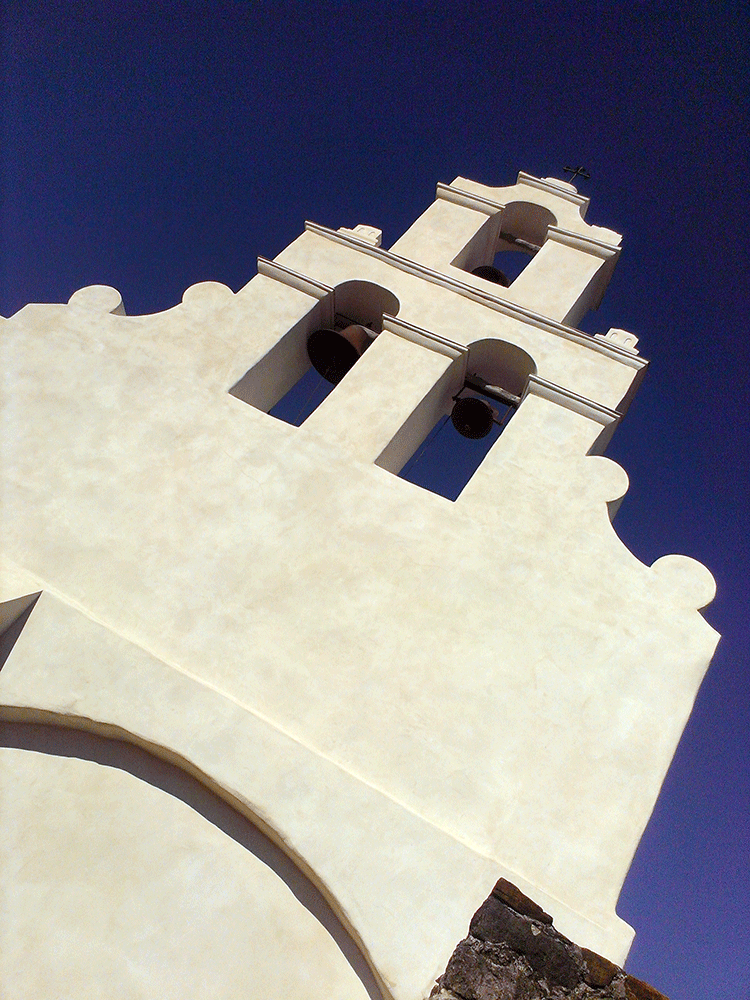
The National Park Service seems proving a good steward of the grounds, and Father David has been applying the funds he has raised successfully through the nonprofit Old Spanish Missions to re-stucco the church for the first time in about 250 years. The church now gleams against the blue Texas sky. Unfortunately, the priest does not keep the same hours as the park, so we did not view the interior. Probably the most reliable time to view the interior is during a scheduled Mass, but I’ll probably stick with more random attempts.
Visiting Mission San Francisco de la Espada should become a more fashionable pilgrimage now with the popular Pope Francis in charge at the Vatican. More attention undoubtedly will be focused on Saint Francis, about whom I have written before in this blog. It would help if San Antonians, including myself, would incorporate the Francisco instead of shortening the name to Mission Espada.
Of course, if the National Park Service really wanted to market Espada to Texans, maybe the thrust of the story should change away from the agrarian and vocational skills the friars taught the inhabitants.
I mean, look at the Alamo. If you make it about guns, they will come, as Land Commissioner Patterson recently showed us.
If more people were aware of the battle fought there in October 1835, Espada would soon be mobbed.
The following is from a report submitted to General Austin by James Bowie and James Fannin following the battle, according to Wallace McKeehan on the Sons of Dewitt Colony Texas website:
Mission of Espadas, Saturday morning 7. oclk AM 24th octr 1835 Genl S F Austin Half an hour since we were attacked by the enmy, who were repulsed, after a few fires being exchanged Only a few men were seen-say about fifty-tho, from the dust etc. it is believed 200 or more, were in the company-Dr Archer says that Col. Ugartichea was the commandant, as he plainly saw him, and recognised him-The place is in a good condition, or can be made so in an hour, for defence, and until we know, of the advance of some aid, or what was intended by this feint, we will continue to occupy this station, where we have provisions enough for the army provided means are supplied to purchase….
If the Alamo attracts millions of visitors to a site where virtually all the Texians were slaughtered, wouldn’t people love to visit the spot where Bowie and Fannin were victorious?
Espada is the spot.
Visit it now. Before the word gets out. While it is still a peaceful place at the end of the Mission Reach.
A place to celebrate the Feast Day of St. Francis on October 4, perhaps even witnessing the rays of light illuminating his statue.
And well before reenactors decide they need to start shooting off noisy guns at 6:30 a.m. every October 24.
Update Added on August 12, 2014: As August 15th brings a solar illumination to Mission Conception in time for the Feast of the Assumption of Mary, an article in Today’s Catholic by Carol Baass Sowa sheds light on the phenomenon that would amaze Native Americans:
It was the Franciscan missionaries’ knowledge of astronomy, he related, that was responsible for the incorporation of solar illuminations in a number of their churches. They served to symbolically communicate the friars’ Catholic faith to the Native Americans, much as medieval churches used stained glass windows to tell the story of Christ and Gothic arches pointed upwards towards highly decorated ceilings to symbolize the heaven men should strive to attain.
Arriving in what was a wilderness, the Franciscan founders of Concepcion had little to work with, Father (David) Garcia explained, so they built into the church the symbols and signs that would tell the indigenous people about God and Christ. “They had a ray of sunshine come in and illuminate the sanctuary,” he said. It was a way to tell the native people “God is moving among us…..”
The friars were highly educated men, (George) Dawson explained, and the Catholic Church used churches as solar observatories since the 15th century as a means to figure out such things as when Easter fell. Also leading credence to the case for the Franciscans is research on the California missions, which has shown one or two Franciscan priests were in charge of construction for several of the missions there which feature the majority of the solar illuminations….
Mission Espada also has an illumination, he related. On the morning of Oct. 4, the Feast of St. Francis of Assisi, (the Franciscans’ founder), light from the rectangular window on the eastern wall bathes the statue of St. Francis on the altar in a golden glow. Again, there is a duplicate display on March 9, which happens to be the feast day of St. Frances, a woman mystic who died in the 1400s.
In light of current discussions focusing on the fate of Alamo Plaza (read Express-News article), thought this Alamobsessive blogger would take a shortcut to an earlier “crewcut” post. Based on the article, sure am a fan of President Sue Ann’s stand on behalf of the San Antonio Conservation Society.
“How would you feel about the Alamo with a crewcut?’ was posted in August of 2011:
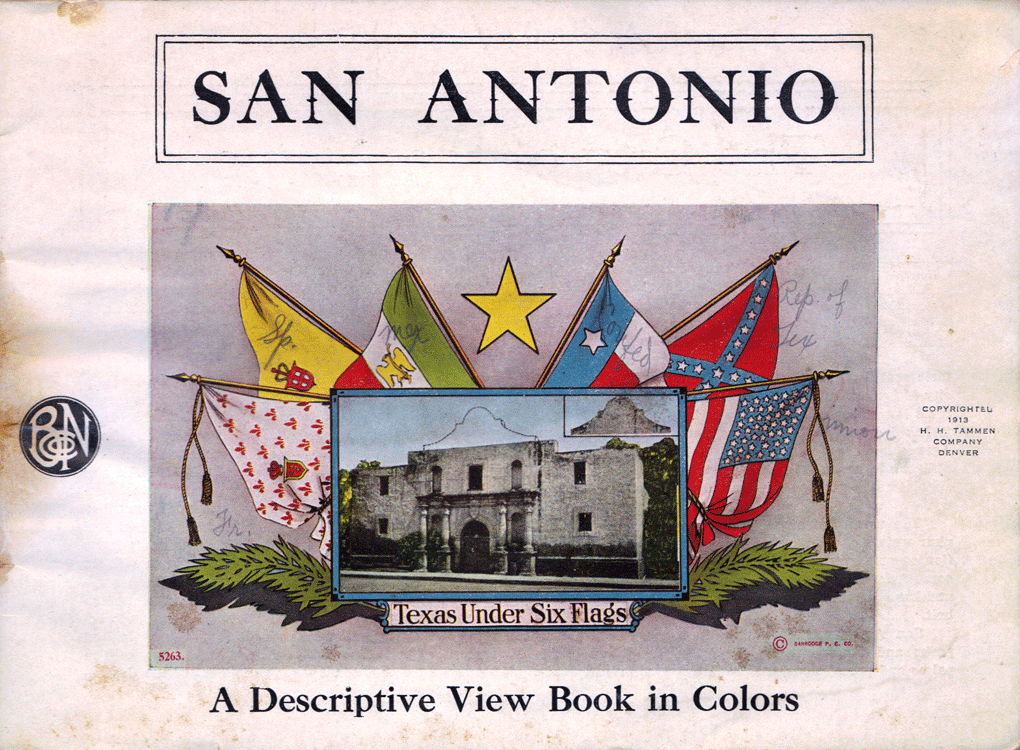
The treatment of the Alamo on the frontispiece of San Antonio, a 1913 “Descriptive View Book in Colors” – a birthday present from a friend – caught my eye with its unusually frank acknowledgement of the major alteration of the facade of the former Mission San Antonio de Valero.
The frontispiece of this booklet showed the Alamo with the added architectural frontispiece removed.
The distinguished curving outline of the facade has become a symbol not only of the battle that took place there in 1836, but of the city itself. The widely replicated outline, commercialized into many a business logo, is recognized worldwide.
But the distinctive parapet was not part of the original church built nearly 300 years ago; nor was it there during the famous battle in 1836.
According to the Handbook of Texas Online, the curvilinear addition is thought to have been the brainchild of an architect and builder by the name of John M. Friese, who designed the Menger Hotel next door to the Alamo a few years later. Friese’s client was the United States Army, which was renting the former mission from the Catholic Church. The project fell under the supervision of Major Edwin Burr Babbitt, assistant quartermaster for the post. According to the Handbook, Major Babbitt actually wanted to tear the Alamo down and erect a completely new building. General Thomas S. Jesup vetoed that idea, fortunately for today’s tourism industry, and the parapet was added in 1850 as part of the adaptation of the building for the Army’s needs.
Through the years, many changes have taken place on the plaza in front of the Alamo, the plaza that was enclosed by crumbling mission walls at the time of the battle.
A group has emerged with plans to recapture those grounds from the city that has encroached upon them. The Texas History Center at Alamo Plaza, Inc., has developed elaborate presentations for what it calls the Alamo Restoration Project.
The stated goal of this proposed project is:
to enhance the visitor’s pilgrimage to the “Cradle of Texas Liberty” by providing a historic atmosphere for personal reflection, inspiration, and learning. We encourage people to seek out their heritage, explore the rich and diverse history of the region, and immerse themselves with the texture of the past.
While this sounds noble on the surface, there are some who think the part of this site’s “heritage” and “diverse history” that is more important than a lost battle might be its much earlier role as a mission outpost.
Another major issue is the problem of a historic landmark built atop of the original western wall of the mission compound. The handsome Crockett Block, designed by architect Alfred Giles, was built only 30 years after the Army added the parapet to the Alamo. The project’s plan is to simplymove the massive building, as The Fairmount was relocated in 1985.
What would be left would be a huge open footprint of the grounds at the time of the 1836 battle, but what I see is hot. There are just not many days of the year where people are going to want to stand in the middle of a treeless, shadeless plaza contemplating the battle. Five minutes in the middle of the plaza on a day like today would be more than enough to make one pray for the return of the raspa vendors.
To accomplish this restoration project would mean major battles with not just the Daughters of the Republic of Texas but also with the yellow-hatted ladies of the Battle of Flowers Association, whose parade has a strong historical connection to Alamo Plaza.
While there are pictures on the group’s website showing the Alamo without the added parapet, there is nothing written online that I see calling for its removal. But, to be true to the group’s goals, it obviously should be.
Calling attention to the need for better treatment and interpretation of our most famous tourist site is worthwhile, but stripping the area back to the battle era seems extreme.
And, would San Antonians ever be willing to let go of that distinctive frontispiece for an Alamo with a crewcut? If nothing else above were, those seem like fighting words to me.



 Postcards from Barton Springs