One of the nicest features of the Mission Reach of the San Antonio River Improvements Project is that it invites you to visit the missions strung along the banks of the San Antonio River.
And not just the first two you normally take visitors from out of town to see before you get missioned-out and head for margaritas.
But the oft-overlooked San Juan Capistrano and San Francisco de la Espada, which, true confession, the Mister and I had not seen for at least two decades (but, true confession, not as long as it’s been since my last confession). Their histories easily can be found online, so I will not attempt to rewrite. This post is simply meant to entice you through pictures to rediscover what we tend to forget on the south side of town.
This slideshow requires JavaScript.
Mission San Juan Capistrano was founded in 1716, with much of the mission compound not completed until 1756. San Juan himself must of have been incredibly pious because he was governor of Perugia, the chocolate capital of Italy, before becoming a Franciscan. However, since chocolate came from the New World, maybe lording over Perugia around the year 1400 was not as flavorful as it would be today.
When the Mister and I made a mid-morning stop at the mission, the information center was staffed by a volunteer from the parish. What was wonderful was that he peopled the mission for us with his own ancestors, photographs of ancestors he did not realize had lived within the protective mission walls until seven years ago. Plus, he told us how a window at each of the missions is positioned to let illuminating rays of light shine on the statues of each one’s patron saint on the appropriate feast day. Clever calculations by the priests; miracles to the Native Americans they were converting.
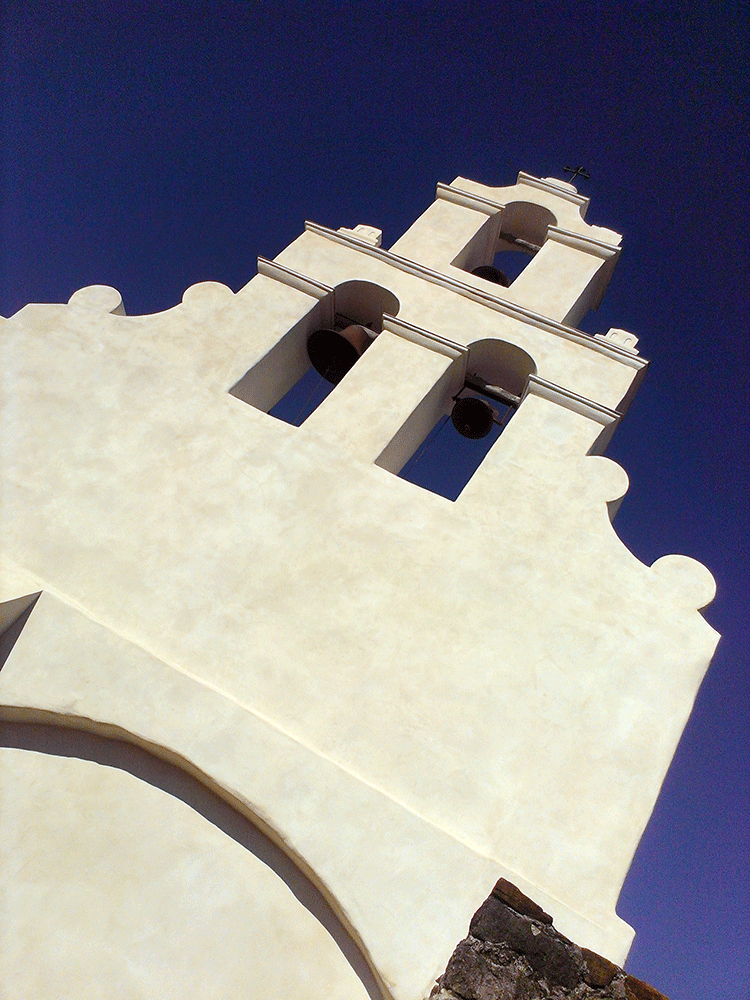
The National Park Service seems proving a good steward of the grounds, and Father David has been applying the funds he has raised successfully through the nonprofit Old Spanish Missions to re-stucco the church for the first time in about 250 years. The church now gleams against the blue Texas sky. Unfortunately, the priest does not keep the same hours as the park, so we did not view the interior. Probably the most reliable time to view the interior is during a scheduled Mass, but I’ll probably stick with more random attempts.
Visiting Mission San Francisco de la Espada should become a more fashionable pilgrimage now with the popular Pope Francis in charge at the Vatican. More attention undoubtedly will be focused on Saint Francis, about whom I have written before in this blog. It would help if San Antonians, including myself, would incorporate the Francisco instead of shortening the name to Mission Espada.
Of course, if the National Park Service really wanted to market Espada to Texans, maybe the thrust of the story should change away from the agrarian and vocational skills the friars taught the inhabitants.
I mean, look at the Alamo. If you make it about guns, they will come, as Land Commissioner Patterson recently showed us.
If more people were aware of the battle fought there in October 1835, Espada would soon be mobbed.
The following is from a report submitted to General Austin by James Bowie and James Fannin following the battle, according to Wallace McKeehan on the Sons of Dewitt Colony Texas website:
Mission of Espadas, Saturday morning 7. oclk AM 24th octr 1835 Genl S F Austin Half an hour since we were attacked by the enmy, who were repulsed, after a few fires being exchanged Only a few men were seen-say about fifty-tho, from the dust etc. it is believed 200 or more, were in the company-Dr Archer says that Col. Ugartichea was the commandant, as he plainly saw him, and recognised him-The place is in a good condition, or can be made so in an hour, for defence, and until we know, of the advance of some aid, or what was intended by this feint, we will continue to occupy this station, where we have provisions enough for the army provided means are supplied to purchase….
If the Alamo attracts millions of visitors to a site where virtually all the Texians were slaughtered, wouldn’t people love to visit the spot where Bowie and Fannin were victorious?
Espada is the spot.
Visit it now. Before the word gets out. While it is still a peaceful place at the end of the Mission Reach.
A place to celebrate the Feast Day of St. Francis on October 4, perhaps even witnessing the rays of light illuminating his statue.
And well before reenactors decide they need to start shooting off noisy guns at 6:30 a.m. every October 24.
Update Added on August 12, 2014: As August 15th brings a solar illumination to Mission Conception in time for the Feast of the Assumption of Mary, an article in Today’s Catholic by Carol Baass Sowa sheds light on the phenomenon that would amaze Native Americans:
It was the Franciscan missionaries’ knowledge of astronomy, he related, that was responsible for the incorporation of solar illuminations in a number of their churches. They served to symbolically communicate the friars’ Catholic faith to the Native Americans, much as medieval churches used stained glass windows to tell the story of Christ and Gothic arches pointed upwards towards highly decorated ceilings to symbolize the heaven men should strive to attain.
Arriving in what was a wilderness, the Franciscan founders of Concepcion had little to work with, Father (David) Garcia explained, so they built into the church the symbols and signs that would tell the indigenous people about God and Christ. “They had a ray of sunshine come in and illuminate the sanctuary,” he said. It was a way to tell the native people “God is moving among us…..”
The friars were highly educated men, (George) Dawson explained, and the Catholic Church used churches as solar observatories since the 15th century as a means to figure out such things as when Easter fell. Also leading credence to the case for the Franciscans is research on the California missions, which has shown one or two Franciscan priests were in charge of construction for several of the missions there which feature the majority of the solar illuminations….
Mission Espada also has an illumination, he related. On the morning of Oct. 4, the Feast of St. Francis of Assisi, (the Franciscans’ founder), light from the rectangular window on the eastern wall bathes the statue of St. Francis on the altar in a golden glow. Again, there is a duplicate display on March 9, which happens to be the feast day of St. Frances, a woman mystic who died in the 1400s.


 Postcards from Barton Springs