Most precious part of Zilker Botanical Garden reflects the spirit of one man

The drawing-rooms of one of the most magnificent private residences in Austin are a blaze of lights. Carriages line the streets in front, and from gate to doorway is spread a velvet carpet, on which the delicate feet of the guests may tread. The occasion is the entrance into society of one of the fairest buds in the City of the Violet Crown.

“Tictoca,” William Sydney Porter (O. Henry), The Rolling Stone, October 27, 1894

Clara Driscoll Sevier, who loved flowers to the point of promoting a rose garden next to the Alamo as more desirable than saving its historic convent walls, found Austin lacking a garden club for women. To remedy this, she invited a group of ladies to Laguna Gloria, her home that is now The Contemporary Austin, to establish one in 1924. O. Henry’s reference to the violet-crowned hills of Austin inspired the name for the new group, the Violet Crown Garden Club.

Annual flower shows were the primary focus of the club until 1946 when members set aside modest seed money of $50 to initiate efforts to seek space in the city’s Zilker Park for a botanical garden. The Violet Crown Garden Club recruited six other garden clubs to join its quest and their persistence finally resulted in the 1964 completion of the Austin Area Garden Center building in what became the Zilker Botanical Garden.

Continue reading “Most precious part of Zilker Botanical Garden reflects the spirit of one man”
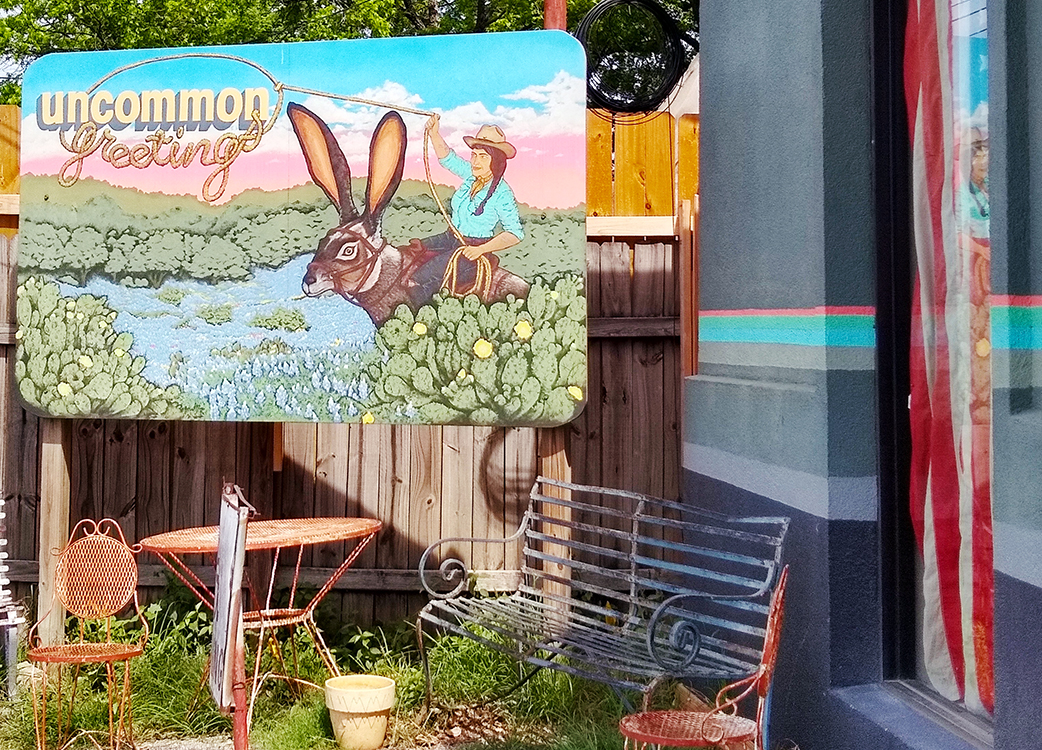
“Uncommon Greetings” postcard perfect

‘Curiouser and curiouser!’ cried Alice (she was so much surprised, that for the moment she quite forgot how to speak good English).

Alice’s Adventures in Wonderland, Lewis Carroll

Funky bud vases. I was supposed to be on a mission, but everything else was so distracting – the collective labels it “transcendent junk” – that I’m not sure I would have noticed a bud vase unless I knocked it over accidentally and it shattered it on the floor.

Continue reading ““Uncommon Greetings” postcard perfect”

Walking among the dead seeking hints about our past

Let us endeavor to live our lives that when we come to die even the undertaker will be sorry.

Words of Mark Twain engraved on the memorial for Bertie Lee Hall (1926-1999), member of the Texas House of Representatives, storyteller and writer

Getting to the cemetery first is not a race you normally want to win, but, when General Edward Burleson (1798-1851) died, leaders of the Republic of Texas realized they were caught flat-footed as to where to honor their heroes. Burleson had served with Ben Milam in San Antonio; fought at San Jacinto; and served as Vice President of the young republic. House member Andrew Jackson Hamilton (1815-1875) offered his own property in East Austin, with the state assuming responsibility for the burial ground in 1854.

Other prominent figures from the early days of the Republic of Texas gradually were reinterred in places of honor in the Texas State Cemetery. The remains of Stephen F. Austin (1793-1836) were moved from Peach Point to a commanding spot by Governor Oscar Colquitt in 1910. The statue of him was made by San Antonio sculptor Pompeo Coppini (1870-1957), creator of the currently controversial Cenotaph in Alamo Plaza.

Continue reading “Walking among the dead seeking hints about our past”