The July 23 editorial, “Deep breath, just the facts about the Alamo,” in the San Antonio Express-News shocked me.
“Just the facts?”
Perhaps the editorial board of the paper received a totally different presentation than the one about the “Alamo Comprehensive Interpretive Plan” presented to San Antonio Citizen’s Advisory Committee? Perhaps the plan the members saw is different from the one on the Alamo website?
 The first “fact” claimed by the Express: “There will not be a fence around Alamo Plaza downtown.” These are the Editorial Board’s words. This sentence does not appear in the plan itself.
Planners, who initially wanted to lock up the plaza at night, now want to “organize people” when the museum is open. They refer to some of this “management” as “fences almost not seen.” The image below isolates a portion of the softly blurred rendering above depicting what the Express terms as simply “rails,” clear barriers topped off by a rail as opposed to an actual picket fence, that will prevent people approaching from Houston Street from walking straight into the plaza and disrupting the “managed” people inside.

 On the left is a rendering representing a tall gate, in a fence line “hidden” in landscaping, that presumably would be open after museum hours.
 On the north and west sides are 42-inch so-called “rails.” As the plan proposes to lower the floor of the entire plaza 16 to 18 inches, tourists will feel protected from San Antonio’s foot traffic by a barrier more than five feet in height.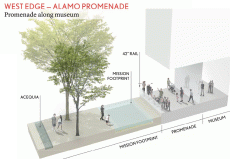
And on the southern edge, an actual “fence” is depicted camouflaged in the landscaping with, look closely as it is painted in a pale gray, an extremely narrow gate thrown open to allow public access… after “managed” hours.

The Editorial Board can call this anything they want, but it all looks like fencing off Alamo Plaza to me.
Presenters made it sound as though the goal during the hours the Alamo is open is to “choreograph approaches” so everyone enters the “railed-in” area through an entrance by a new museum on the west side of the plaza. This appears to be the exit as well. Presumably, this management is designed to promote museum attendance, perhaps a paid experience? This is also where the general public heading north or south will be funneled into the “Alamo Promenade.” So, with every visitor to the Alamo, including large tour and school groups, and all passersby converging, emerging and merging at this one sidewalk-width point on the “Alamo Promenade,” will we not have absurd pedestrian traffic jams? This is a serious question I would love answered.
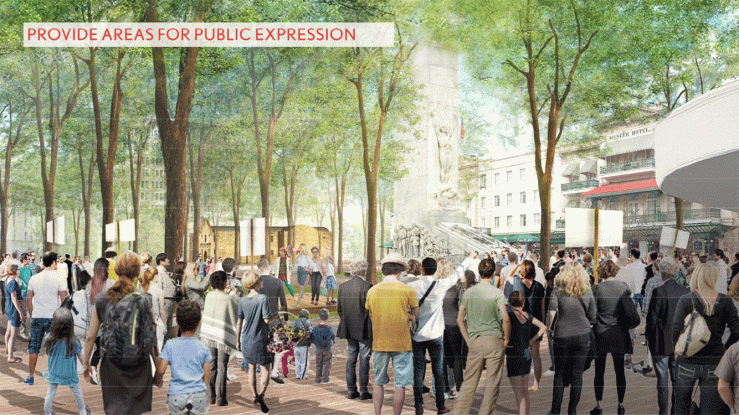
“Fact” Number Two: “People will not be shut out from this historic and public space. Protests and assemblies will continue at Alamo Plaza. It will remain open to the public.”
Essentially, all of the non-existent fencing sketchily depicted above will sever Alamo Plaza into two parcels – the Alamo fortress footprint on the north and the smaller Plaza de Valero fronting the Menger Hotel and RiverCenter Mall on the south. Planners make absolutely no secret of the goal of attempting to keep protesters out of the northern portion. Plaza de Valero is the designated area for “public expression,” traditionally referred to as the exercise of free speech.
 Fact Number Three: “Closing Alamo Street does not mean there won’t be a north-south connection for vehicles across downtown. The plan proposes a nearby alternative for traffic.”
I sure hope they engage an amazingly talented traffic engineer to work out the automobile traffic patterns. As someone who understands what it is like today to sit through multiple lights heading north on Navarro or south on Losoya or St. Mary’s or to crawl along behind horse carriages on Presa Street, I will let this rendering demonstrating “enhanced connectivity” speak for itself.

“Fact” Number Four: “A decision has not been made about razing five buildings across from Alamo Plaza.”
I am labeling this false because these buildings have always been in the crosshairs of those who are uncompromising in their desire “to restore the Alamo footprint as much as possible.” The way the plan is presented makes it obvious the consultants have made their decision. Certainly, the Editorial Board has made itself clear during the past several years about its desire for the mission footprint to be restored.
While offering token lip-service to “tell the in-depth history of the Alamo area to the present day….;” the redesign of Alamo Plaza is all about the 1836 battle. The plan blatantly labels the five referenced buildings as “non-contributing structures” that must be “addressed.” In the rendering below, they are addressed by erasure. Historic landmarks are reduced to flattened camel-colored rectangles with no mass.

And, voila! Instead of adaptive reuse of valued historic landmarks whose worthiness is well-documented, you now have a vacant lot for the “rail” representing the original western wall of the compound and a new museum facility.

While theoretically the decision has not been made on the buildings’ fate, the planners desire to demolish is obvious. The public presentations are called “conversations,” but are they mere shams?
According to an article in the Rivard Report by Iris Dimmick, City Councilman Roberto Trevino, who serves on the Alamo Management Committee and co-chairs the Citizens Advisory Committee, a study will be commissioned to determine the merit of preserving the structures. As though their history and condition is an unknown.
Dimmick reports Council RepresentativeTrevino:
…said it’s unlikely that other major components of the plan would change.
The design team “picked up where the master plan left off,” Trevino said. “Continuing the debate (about road closures and managed access), I don’t think that’s in line with the guiding principles.”
However, he said, pedestrian access, in general, is something on which the team is still working.
While the plan does indicate the buildings’ fates have not yet been sealed, the plan offers no alternative pedestrian routes than the ones illustrated. Fencing off the footprint is the only option presented for consideration.
The Editorial Board of the Express-News terms much of the opposition raised to the plan “hyperbole:”
Yes, the plan does include landscaping, rails and some hidden fencing to control pedestrian flow to the site. That’s far different from “restricting access” as the San Antonio Conservation Society has asserted. It’s about crowd control and guiding visitors during daytime hours when the Alamo itself is open to the public. Outside of those hours, people can still visit the plaza and admire the church.
I vehemently disagree. Call a fence a fence.
And the time to disagree is now. Because if San Antonians are quiet, the next version of the plan will pick up where this plan left off. Much like Trevino indicates road closures somehow already are a done-deal, the fencing closing off Alamo Plaza, a dedicated city park, will get cemented into the plan. And, if you value the historic landmarks lining the west side of the plaza, the time to express that is now.
 Both my opinion and that of the Editorial Board of the Express-News are biased. I urge you to read the plan to make an informed decision about the “facts.”
If you have concerns about the plan, please consider signing the online petition the San Antonio Conservation Society has made available: Save Alamo Plaza! at change.org.



 Postcards from Barton Springs