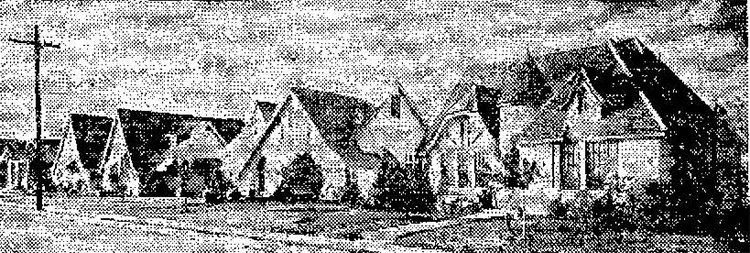
‘Skyscrapers Soon to Stand Where Wolves Once Howled’

The 1928 headline was a bit premature for the neighborhood, but we did live in their shadow briefly. Or at least the shadow of the freeway. Right there on their street. Ostrom. As close to 281 as possible. Yet in the midst of a neighborhood of fairytale cottages.

You’ve probably driven by it often, yet not through it. The freeway, the golf course, Mulberry and the river cut it off from any through traffic.

The River Road neighborhood. Filled with eccentric little cottages inhabited by some of San Antonio’s most wonderfully eccentric characters.

Some of these modern-day opinionated residents quickly would have taken sides in the “Goat Case” as covered by the San Antonio Daily Light on June 8, 1889:

Mrs. V.C. Ostrom, a well known lady of San Antonio, who has made herself quite famous in San Antonio by her untiring efforts in the cause of temperance and prohibition, was in court yesterday afternoon and all hands concerned had a lively time of it. This lady sued Jose Rodriguez, a neighbor living near San Pedro springs for damages for allowing his flock of goats to devastate her garden. Rodriguez’s goats have long been a nuisance to dwellers of the new fourth ward, even down to Marshall street, and time and again the city, through its recorder, has imposed light fines upon him for violating the ordinance in allowing said goats to run at large. Alone and unaided the lady attempted to defend herself against the evil and, what with the lawyers of the defendant and the crowd of spectators whose sympathies, on account of her prohibition sentiments, were decidedly against her, she had a hard time of it, and it may as well be mentioned, Rodriguez’s lawyer also had a pretty hard time of it.

But Sarah Hummer Ostrom and her daughter Frances were firm in their beliefs. They were willing to put their money on the table to spread the Good Word. They helped build and run a place of worship in their yard on Jones Avenue to minister to those who lived in the quarry area in “houses of tin strips, flattened-out tin cans and waste lumber.” According to a November 23, 1913, article in the San Antonio Light, they:

…set up a little mission among the jacals of Mexican squatters in the rock quarry district and spread the Christian Gospel among the lowly sons and daughters of the Moctezumas.

…she (Mrs. Ostrom) “works at her religion.” She does not save it merely for Sunday use.

This slideshow requires JavaScript.

But growing crops and saving souls on their farm soon yielded to the surrounding pressures to grow houses instead. Bess Carroll’s copy in an April 1928 edition of the San Antonio Light is so dramatic, I decline to edit her descriptions of a booming city stretching northward:

Over many a road blazed by adventurers, long ago, the huge stride of progress has marched into San Antonio, leaving great monuments in its footprints. And now this Titan whose breath is the stream of power, whose blood is an electric flow, has followed an old wagon road to the door of an ancient farmhouse.

Though phantom wolves may still howl their hymns to the moon there, San Antonio’s last prairie is being linked to the heart of her business being.

Beside the banks of the San Antonio river, where a tented city once stood buried in the mist of prehistoric oblivion, steam rollers snort and machinery does its superhuman work as the geographical end of St. Mary’s street is gradually dragged along by iron horses – the street-building equipment of the city of San Antonio – to meet Jones Avenue….

For the gigantic march of development is taking its parade of houses and money down an old Indian trail, across the path of the ragged Texas army of 1836, and along the course of what was, until recently, a shady country lane….

Along Jones avenue wide acres of oats and grain stretched out “once upon a time,” and only a short while ago the last remnant of the sole surviving farm gave way at last to development. That was when Miss Frances Ostrom, 1910 Jones avenue, converted the old Ostrom farm into a residence district known as “The French Village.”

When V.C. and Sarah Ostrom bought their nine-acre farm in ’69 they acquired water rights issued by the crown of Spain to this land when San Fernando cathedral was still young. But because it occupied a rise in the flat prairie surrounding it, the Ostrom farm very seldom “took the water” from the Upper Labor Ditch, a canal dug in early times for irrigation purposes….

(Miss Ostrom recalled) “The nearest store was Costanola’s, occupying the site of the present Robert E. Lee hotel; it was in the brush. Brackenridge park was largely a pasture. Later Rubiola’s ‘country store’ opened; soon after came a rural saloon. It was not until about 1885 that any houses were built on the North Side this far out. The mule car street ‘railway’ caused some development.”

The last stone of the Ostrom farmhouse was torn down in 1926. It had been a typical old stone house – four rooms and an eight-foot hall….

Land that had been green and virgin once was paved for the first time, in April, 1926. The last of the old prairie, plowed by oxen when at last its fertile acres were claimed by civilization, had its face covered over with a black veil of asphalt. It had been widowed, verily.

Now an avenue of trade will link the lost furrows of the Ostrom farm with San Antonio’s downtown district. In 1927 alone eight million dollars, according to real estate estimates, were spent in new building alone on St. Mary’s. Included in the principal buildings are: The Plaza hotel, Public Service building, Aztec theater, Smith Brothers-Young building – which is to be the tallest office structure in Texas – and the San Antonio Drug company, St. Mary’s Catholic church, The Gunter building, the Real estate building, Builder’s Exchange, Travis building, Lanier hotel, Commercial Loan and Trust company and the Brady building.

The picturesque houses of the “French village,” with roof lines mimicking those of major chateaus, albeit miniature in scale, still line several of the narrow streets, scarcely wide enough to accommodate two-way traffic, in the River Road neighborhood. Park in Brackenridge Park one day and follow trails across Mulberry to walk among the cottages and along the tree-lined banks of this natural portion of the San Antonio River. You will understand why the neighbors feistily defend this magical spot against any additional modern-day incursions.

Writing Nonfiction: Dig a little. Peck a little. Dig, dig, dig….

It seems every time I type a few sentences for the book I’m writing about the Coker community, I come across something that makes me want to dig deeper. Most of the time, the research is like doggedly following a trail of bread crumbs through dense underbrush for hours only to look up and realize a flock of crows just swept down and gobbled up the path ahead.

Sometimes though, as in two days ago, I am rewarded. When I wrote Last Farm Standing on Buttermilk Hill, I was not comfortable in the identity of the man Joseph Coker shot by water hole. Seeking someone named John Jones in a community full of Joneses can be tricky. But at last, I found him, and it was not the one I had assumed.

My point is, that discovery now serves to justify my endless, stubborn wanderings after trivia to round out the story. Cutting off research is the hardest thing about writing nonfiction.

The following update from the Coker Cemetery Association Newsletter, illustrates the stumbling-lost-in-the-woods style of research distracting me daily:

In the 1860 Census, Ella and J.K.P. Campbell were listed between the Robert Smith family and Joseph Coker. A 35-year-old stock raiser from Tennessee with a 21-year-old wife from Vermont made an interesting pairing, particularly on the eve of the Civil War.

James Knox Polk Campbell with daughter Mattie from the family files of Chuck and Honor

With no intermarrying ties in the community, the couple slipped out of my mind until I was working on the Civil War chapter for the book you have commissioned about the Coker Settlement. Unlike many men in the community who enlisted as privates, James Knox Polk Campbell immediately was appointed assistant commissary for the Sixth Regiment of Texas Infantry at Camp Holmes, Arkansas.

So many families stayed for so long on the land around the Coker Settlement, the families moving away always mystify me. Why would anyone abandon a home in this rattlesnake-infested, drought-prone land where one had to constantly watch out for marauding Indians poised to snatch up your children while you were hoeing or bent over laundry?

Digging to find out more about Campbell, I stumbled across an online post dating from the 1990s. Charles _____ had letters, letters referencing Campbell’s “ranching venture” outside of San Antonio and his Civil War imprisonment. All I had to do was find Charles _____.

I prefer looking for dead people; surely they are happy to know someone cares enough to want to know their stories after they have left the earth. Nosing around the internet for the living makes you feel you are prying, spying, trying to identify someone by prowling on LinkedIn, Facebook, Google, white page look-ups.

And then making that phone call, to perhaps the totally wrong stranger, and not sound crazy? I lucked out and got an answering machine. And lucked out even more. I hit the right person in the right state the first time and got a return call.

And from someone sympathetic to such a call emerging from nowhere about some post made more than a decade earlier. Chuck, himself, had stumbled across the letters on the internet years earlier.

Billee W. Hoombeek brought them to the surface. Chuck retained her email from years ago and forwarded it to me. She was an archaeologist working on the Green Mountain National Forest project in Vermont between 1979 and 1988. As part of her project, she concentrated on “interpreting the deserted farmsteads that dotted the woods.” Hmm, a kindred spirit perhaps?

One of her resources in the Brandon, Vermont, library was a collection of materials assembled by a “Mr. Chamberlin” for a novel he had intended to write comparing life in two small towns – Brandon, Vermont, and Brandon, Virginia. Here, Hoombeek encountered the letters from Campbell to his father-in-law, Colonel Frank Farrington, of Vermont. Finding them fascinating, she went out of her way to share them through a Campbell descendant organization and online.

When Chuck found her, she responded: “I would be in seventh heaven if an ancestor of mine had left such a rich treasure. He does indeed have feet of clay, but she (Chuck’s wife Honor, who is the actual descendant) will know him very well when she finishes.”

And Chuck and Honor are again sharing with us….

A blog post by the Special Collections of the UTSA Libraries reminded me how I long to get back to the comfort and flow of writing historic fiction – based on thorough research but woven together by my imagination instead of hundreds of footnotes.

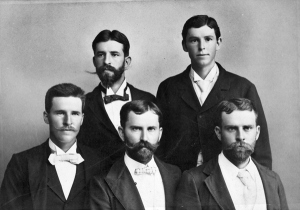
The facial hair photo on the UTSA blog happened to be of some real people featured in a chapter of An Ostrich Plume Hat, the completion of which is now interrupted by the writing of two other books. At any rate the photo is of the Goeth brothers – my favorite two going by the confusing initials, C.A. and A.C.

Edward Wilhelm Goeth, a rancher; Conrad A. Goeth, a lawyer; Adolph Carl Goeth, a merchant; Max A. Goeth, a rancher; and Richard A. Goeth, a doctor
Edward Wilhelm Goeth, a rancher; Conrad A. Goeth, a lawyer; Adolph Carl Goeth, a merchant; Max A. Goeth, a rancher; and Richard A. Goeth, a doctor, from the UTSA Libraries Special Collections

Read about the Goeths’ involvement with Texas politics – part fact, part invention – here.

When immersed in fiction, I can close my eyes in the tub and hear my characters talking to one another. While writing nonfiction, bath time means my mind is submerged in thoughts of those innumerable trails of crumbs beckoning me to follow in wildly divergent directions.

Several chapters somehow have managed to emerge from my keyboard, so perhaps an end is in sight.

For now, I know I need to just keep awkwardly dog-paddling, trying not to drown in the details. This book is not supposed to be like digging my own grave.

Please come and take them away from downtown San Antonio

You spent a year planning your wedding. Your ceremony will be Saturday in the church whose bell Sam Maverick had forged from cannon from the Alamo. Your attendants will line the sidewalk leading from St. Mark’s under the canopy of trees in Travis Park, showering guests with rose petals as they walk to the reception in the historic St. Anthony Hotel.

Whoops. Sorry you didn’t get the word.

Travis Park will be filled with approximately 1,000 armed men on Saturday afternoon.

But don’t worry. Your guests should feel really safe because these men with shotguns and rifles are really responsible. I mean, out of 1,000, what are the odds one would be a little mentally imbalanced or trigger-happy?

Of course, part of their plan is to try to antagonize the San Antonio Police Department by skirting or outright violating city ordinances and daring the police to arrest someone.

This is a goal because then they can howl all over the internet and sue the city. They want to show everyone San Antonio police are unreasonable in their attempts to make the rest of us unarmed people feel safe, those of us who might fear the one out of 1,000.

Alamo Plaza is such a small area of San Antonio in which to stage a protest – Come and Take It, the newest event added to San Antonio’s festival schedule. Yes, there will be great photo ops in front of the Alamo, but staying put in one place might not make the police nervous enough to arrest someone for carrying a weapon in a threatening manner.

Yes, the demonstrators will maintain an armed presence in Alamo Plaza from 10 a.m. to 2 p.m., but a large contingent of these law-abiding citizens will break away for Travis Park at 12:30 p.m., according to Murdoch Pizgatti of Don’t Comply.

There they will have stump speeches, revving up the crowd against the tyranny of police who would respond to a 911-call by some citizen who found it alarming when one of the Come-and-Take-It crowd walked into a Starbucks with a rifle or came and sat down with a trusty shotgun in a crowded movie theatre. Right there, in Travis Park, under what Murdoch calls “the statue.” You know the one. The Confederate monument.

If no one has been arrested yet, the group will then head for a little downtown “tour” out front of one of the police stations. And then back around through downtown to wind up the whole family friendly event in front of the Alamo.

Not content to be able to take their guns hunting, to keep them bedside to guard against intruders or in hand on a ranch in case of rattlesnakes, they want to brandish them downtown. They feel insecure unarmed, like Linus without his blanket. Because for these men “the front line is everywhere.”

In my mind, the Come and Take It guys have stolen downtown from me and thousands of others Saturday.

Use your guns to hunt and protect your own property; don’t bring them into our shared public spaces – you know, parks and such maintained by tax dollars many of you view as money stolen from you.

Personally, I want to thank all the members of the San Antonio Police Department who put their lives on the lines for us everyday, to make sure the rest of us can work and play downtown. You should not be harassed the way you will be tomorrow, and particularly not by the Land Commissioner of Texas. the self-proclaimed “#1 gun guy in Texas” who longs for a time when kids are free to take antique guns to school for show and tell.

“They say Sam Maverick forged the bell for St. Mark’s from a cannon used during the Battle of the Alamo. If only the concept proved contagious….” Postcards from San Antonio – No. 12, “Peace be with you.”