Not only is there a church on almost every corner in Puebla, but they are filled with saints to meet almost every need imaginable.
One often reads about the fall in the number of Catholics in Mexico, but maybe many simply don’t have time to devote attending a full Mass. Leave a church unlocked during the day, and there is always someone dropping by for a quick prayer for help with some difficulty encountered in life.
Catholicism in Mexico, or in all of South America and Europe, is a totally different animal from the religion of my childhood. I find myself mesmerized by the magical mysticism permeating their churches.
Sure we had incense wafting about at Midnight Mass on Christmas Eve at Star of the Sea, but, beyond that, things were pretty tame. There were Hail Mary’s and Our Father’s offered aplenty. But, when we were growing up, we pretty much missed out on the more than 10,000 saints hovering above waiting to answer our prayers.
If I’d only known. I mean, how many times would I have turned to St. Anthony with help locating that lost homework or to St. Jude when I totally missed the teacher telling us about a test? Gladly, I would have parted with every charm on my bracelet if I’d known leaving them as milagros might improve outcomes.
So many people in Puebla pin their hopes on saints, tuck photos of loved ones near their favorites, leave flowers as thanks and light candles to brighten the chance their prayers will be heard.
Miracles might not always arrive, but maybe comfort does. Time alone thinking calmly in a pew might be what’s needed to face life’s everyday challenges.
Certainly viewing a statue of a saint in flames or Jesus suffering from his wounds diminishes the size of one’s own troubles.
Lest you jump to conclusions prematurely, the red guitar balloon was not left by the Mister. Although perhaps that presents a far less dicey alternative to going down to the crossroads.
But, if one is going to place faith in a balloon, of course there’s a saint for that. Bluesmen would best be served by leaving their tributes floating near the harp-bearing hands of Santa Cecilia.
Densely clustered deep plum and royal blue embroidered flowers blanket the huipiles of women running errands in San Cristobal de las Casas from the nearby Tzotzil town of Zinacantan. They were my favorites spotted on the streets.
As with San Juan Chamula, male leaders operate the small town of Zinacantan somewhat autonomously, charging a toll to outside visitors. But here the women are not subjected to polygamous marriages.
The feathers young women spend months weaving into their bridal outfits do symbolically spell out their standing in the marriage. The feathers aren’t brilliant parrot or peacock feathers but are those of the humble hen. Unable to fly, hens don’t flee the coop. Chickens stay close to home, subject to the rooster’s whims.
This slideshow requires JavaScript.
Several churches abut plazas at the heart of Zinacantan. The church of San Lorenzo dates to 1546. We are not sure why Saint Lawrence was popular, but he is the patron saint of chefs.
As punishment for having distributed the church’s wealth to the poor instead of Roman authorities in the year 258, Lawrence was slowly grilled upon an iron grate. He is alleged to have quipped to his tormenters, “Turn me over; I’m done on that side.” Perhaps Nana (Katherine Ann Conway Brennan, 1887-1972) was prescient in naming my father Lawrence (Lawrence Conway Brennan, 1918-1988), for no one enjoyed grilling a thick sirloin steak, fork in one hand and Bourbon in the other, more than Dad.
San Sebastian has a more obvious connection to a second church built about 200 years later. Some believe the saint who was martyred about the same time as Saint Lawrence miraculously appeared to construct this church in Zinacantan with his own hands, a feat he accomplished in only three days.
Others claim he reappeared in Mexico only to be pierced by arrows shot by Spanish soldiers, as he originally had been in Rome. He died, once again, on the site of the church and was buried there. Saint Sebastian is a patron of athletes and soldiers and a protector against the plague, particularly beneficial when Spanish soldiers are spreading European diseases among the native population with no immunity to them.
Blessed be the eternal God; for the fishes of the sea honour him more than men without faith, and animals without reason listen to his word with greater attention than sinful heretics.
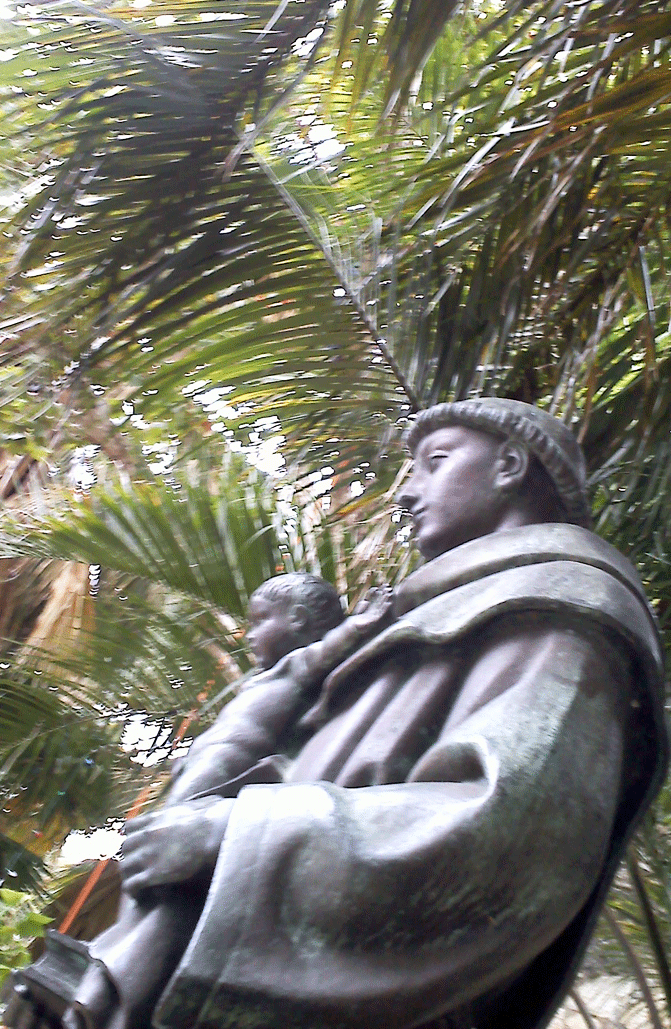
St. Anthony on the river
It is said that on that day, June 13, 2013, the fish gathered around him.
With great expectations, they gazed upward.
So many fish bobbed in the waters of the San Antonio River, barge traffic was halted.
The fish waited and waited to hear words of tribute. They waited for sounds of great celebration.
You probably think I am referring to the honkers, the ones who exuberantly circle the streets of downtown just above St. Anthony’s head whenever the Spurs are victorious.
Which they were not doing on June 13, the Feast Day of San Antonio de Padua, the patron saint of San Antonio.
Yes, the Spurs seemed lost. And, he, the patron saint of lost things, was all but ignored. Save by the fish.
St. Anthony, St. Anthony
Turn around.
I’ve lost something
That can’t be found.
This festival does not take place here. In this city. In front of his mission.
St. Anthony is not vengeful. Surely the Spurs’ loss was mere coincidence. If saints interceded in sports, would St. Anthony have looked down more kindly on the team of his namesake city or the Celtics?
After all, here, in the heart of his city, we are in danger of losing even his mission. Mission San Antonio de Valero. But it’s rarely called by its proper name. You probably know it as the Alamo.
For a while, there was a spark of hope for an emerging celebration of our patron saint. An artist, Rolando Briseno, sought attention for the overlooked day on the calendar.
Flippin’ San Antonio Fiesta 2011
He brought us a Flippin’ San Alamo Fiesta and a Flippin’ San Antonio Fiesta on June 13 a while back. An emerging grand Fiesta Patronal seemed on the horizon for future years.
But, alas, this year on the Feast Day of St. Anthony, the artist instead submitted a commentary to the San Antonio Express-News.
In this published piece, Briseno explains the rationale behind his earlier fiestas:
Tejanos, the first European/mestizo settlers of Texas and builders of the Alamo, and Latinos in general do not feel welcome at the Alamo today because the narrative has been spun into one of Anglo hegemony….
Little by little, over time, the Tejano role has been written out of the history books. Now that the Daughters of the Republic of Texas are no longer in control of the narrative at the Alamo, I’m among many who hope the Tejano contributions will be given just representation.
But Briseno has faith in the great state of Texas to rectify this, so there was no grand Fiesta Patronal:
I am not performing “Spinning San Antonio Fiesta” this year because Texas Land Commissioner Jerry Patterson, the new caretaker, has stated that he would like to change the Alamo’s narrative to be more inclusive.
This could make the Alamo a place where all people can go to leave behind discord and contemplate the convergence of cultures, and this, in turn, will make for a more harmonious future. That’s an ideal worth making a shrine for.
He’s right about the ideal. But I fear he is overly optimistic in his expectations of the commissioner.
There is much pressure building among the Alamobsessive to make Alamo Plaza a shrine to one day in history. And that day is not June 13.
Unlike Briseno, I fear that moment in 1836 will conquer the layers upon layers of history of great importance to our city that the plaza represents, both before and after the battle.
I’m not debating the historical importance of March 6, 1836, the Battle of the Alamo.
I’m not demeaning the sacrifices of those who perished in the battle, whether Mexicans or Texians. My dreams of Davy Crockett go way back.
And I do think millions who head to the plaza annually would benefit from better interpretation of that event on site.
But, I wonder whether the heroes of the day would want that moment in time frozen, the moment they were shot or impaled upon a bayonet.
If you were killed in a war, would you want those left behind to focus on the exact second the last drop of blood gushed from your body? Would you want them to visit that spot over and over and over, reliving your dramatic departure?
Or would you want them to remember what went on before, while you were alive?
And would you want to feel your sacrifice was worthwhile? Instead of being a static war memorial, would you want the plaza where you died returned to a place of life in the heart of a city filled with exuberant celebrations?
Briseno might be breathing easier, but I think it’s premature.
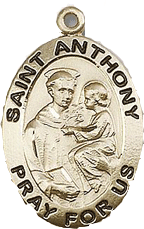
As there is yet a Fiesta Patronal, I think some of us better don a St. Anthony medal if we want the story of Mission San Antonio de Valero to be found.
And, maybe, just maybe, it’s a good idea to go buy one before the play-off game tonight.
That way, at least the fish will hear honkers celebrating above St. Anthony’s head.
Go Spurs, Go!
Post-Game Update on June 19, 2013:
Maybe medals alone are not potent enough.
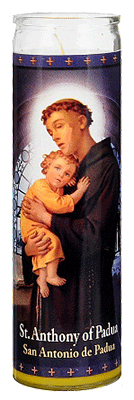
Time to ignite the power of a St. Anthony candle for Thursday night.
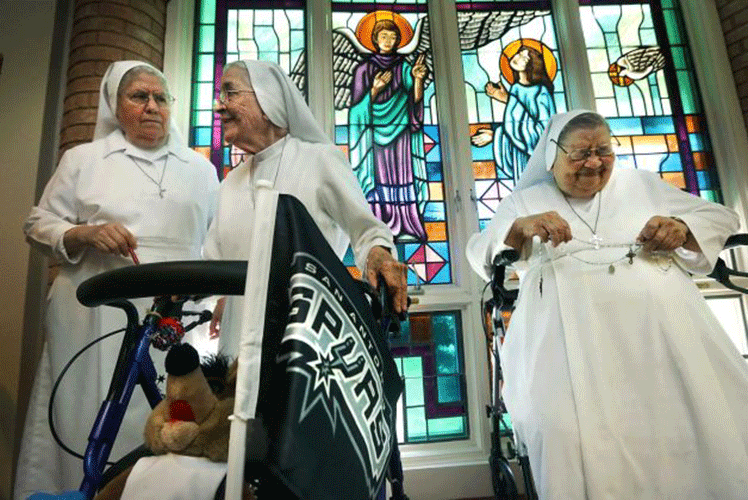
From “Nuns calling on the fan upstairs: For the naysayers who think Spurs don’t have a prayers” by Abe Levy in this morning’s San Antonio Express-News:
Would you deny the prayer of Sister Rosalba Garcia, 85?
A Spurs flag flutters from her walker next to a Spurs Coyote doll. On her closet door are team photos and a poster of her all-time favorite player, Manu Ginobili, next to a portrait of Sister Mary Mazzarello, the Salesians’ cofounder.




 Postcards from Barton Springs