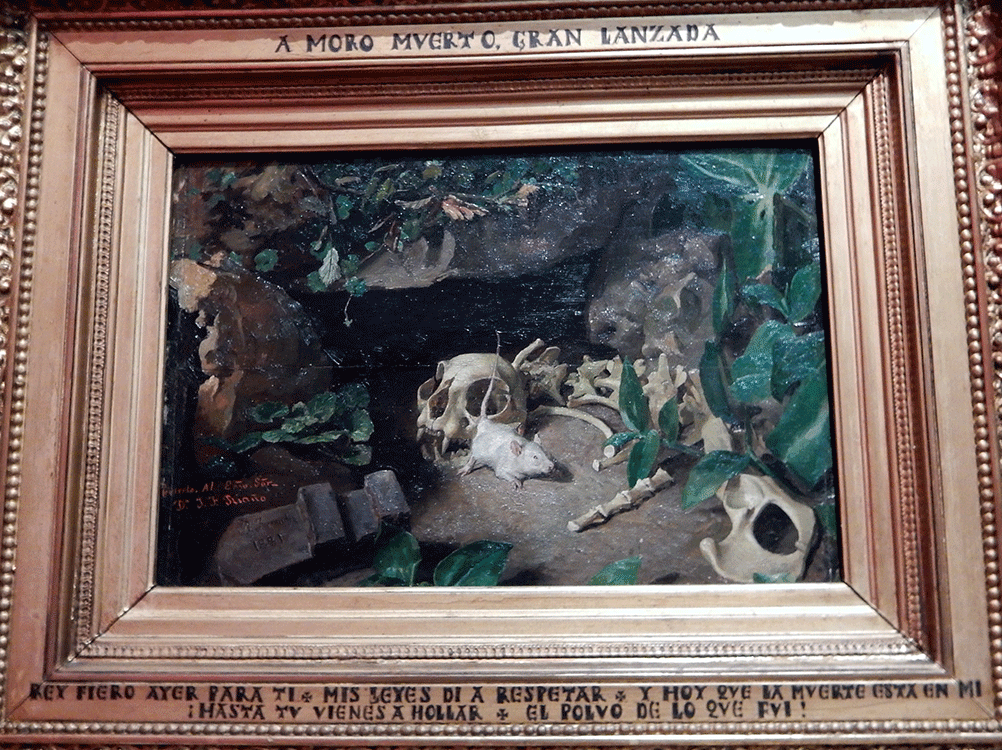
“Dying Moments: Kicking a Man When He’s Down,” Bernardo Ferrandiz y Badenes (1835-1885), 1881
From Museum of Malaga label: This allegorical composition alludes to an episode in the artist’s life. A man of choleric temperament, he had a run-in with a fellow Academy member… which resulted in Ferrandiz being tried and sent to prison. Deeply shaken by this event, which led to his removal from the post of director of the San Telmo Fine Art School and social and personal disgrace, the once-haughty artist depicted himself as the skeleton of a cat. Only then, when the feline is “down,” so to speak, does the weakest of its sworn enemies, the mouse, dare to scurry among its remains.
Pondered how to pick a piece of art to represent a museum’s enormous collection…. Not sure why this painting by the man regarded as a founder of the Malaga School of painting was nominated, except Day of the Dead has been on my mind.
The Mister spied the painting first, perhaps drawn by the unusual printing painted directly on the frame. Somewhat illiterate in Spanish (understatement), I am label dependent. But what a great personal story – a tale of the politics of art – lurks within that frame.
The Museum of Malaga occupies the Palacio de la Aduana. The former customs house was commissioned by King Charles III (1716-1788) in 1787 in recognition of Malaga’s major role as a maritime trading center.
Two collections, one of fine arts and one of archaeology, were merged to become the Malaga Museum of Art and moved into the almost 200,000 square-foot neoclassical building in 2016. A lot to wander through and absorb, but here’s an abbreviated armchair tour.

marble torso of emperor clad in a breastplate with victories and deities Oceanus and Tellus, Cordoba, 2nd centry

Pitcher, Pablo Ruiz Picasso, 1954

“Anatomy of the Heart: And She Had a Heart,” Enrique Simonet y Lombardo, 1890

detail of mosaic floor “Birth of Venus,” Cartama, 2nd century

“The Painter and His Model,” Jose Carlos Duran Jimenez, 1981

palms outside the Museum of Malaga

silver hoard of Cerro Colorado, 3rd-2nd century B.C.

detail of “The Saltimbanques/Acrobats,” Jose Suarez Peregrin, 1932

“Gravures de Pablo Picasso,” 1947

baptismal font produced by a Triana pottery in Sevilla, 15th century

“The Miracle of Santa Cecilda,” Jose Nogales Sevilla, 1892

Mudejar ceiling corbel from the Convent of La Merced, 16th century

detail of mosaic floor “Birth of Venus,” Cartama, 2nd century

colossal votive foot, Sevilla, 2nd century

detail of “Innoculation of the Children,” Enrique Borras y Abella, 1900

Three Faces: Mujer de Picasso, Eve and me

“A Child’s Dream,” Jose Moreno Villa, 1932

marble female head with diadem, Cordoba, 1st century

mosaic floor “Birth of Venus,” Cartama, 2nd century

pendant with intaglio of Egyptian goddess Sekhmet; gold, silver and carnelian; Malaga; 6th century B.C.

detail of “Anatomy of the Heart: And She Had a Heart,” Enrique Simonet y Lombardo, 1890

detail of mosaic floor “Birth of Venus,” Cartama, 2nd century

“The Saltimbanques/Acrobats,” Jose Suarez Peregrin, 1932

Mudejar ceiling corbel from the Convent of La Merced, 16th century
Loved the horse “volunteering” his serum to inoculate a child in the 1900 painting by Enrique Borras. But my particular favorite is Enrique Simonet’s 1890 painting of an autopsy – “Anatomy of the Heart: And She Had a Heart.” Alas, now she has none. Seems a screen-shot from a macabre film.




 Postcards from Barton Springs