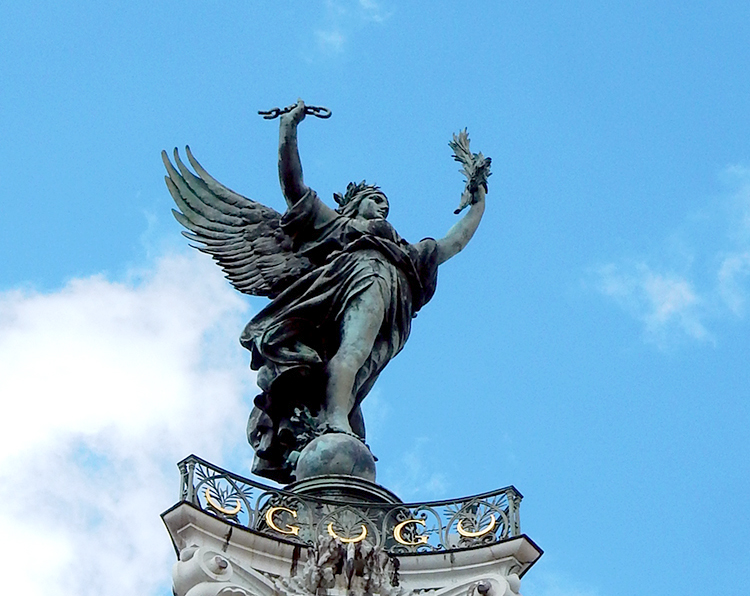
Postcard from Bordeaux, France: Lady Liberty breaks free of shackles on both sides of Atlantic

While the use of the guillotine symbolizes a reign of terror during the early days of the French Revolution, its usage was adapted in the late 1700s as a more humane way to carry out public executions. It was regarded as both efficient and fast, sparing the sentenced unnecessary pain. It is said that before it was sanctioned as the official executioner’s tool, King Louis XVI (1754-1793) suggested improving the design to utilize an angled straight blade instead of the original curved one. He himself, along with his queen, Marie Antoinette (1755-1793), benefitted from the enhanced efficiency when they were beheaded.

The tool became a hallmark of the political maneuverings carried out by one of the leaders of the revolution, Maximilien Robespierre (1758-1794). Robespierre definitely established himself as a kind of “if-you’re-not-with-me-you’re-against-me” kind of guy, placing those who found themselves in that category labeled as enemies of France. He was also adept at rallying the masses, the sans-culottes tradesmen in Paris, to protest against these enemies.

Continue reading “Postcard from Bordeaux, France: Lady Liberty breaks free of shackles on both sides of Atlantic”

Postcard from Bordeaux, France: Another place Romans trod

Above, detail of a mosaic floor from Roman times uncovered in a house in the historic center of Bordeaux, Musee d’Aquitaine

In an effort to boost his power within the Triumvirate ruling Rome, Gaius Julius Caesar (100 to 44 BC) tucked Gaul under his balteus amongst his growing collection of conquered lands in 56 BC. Burdigalia, later known as Bordeaux, soon emerged as a favored city in the territory called Gallia Aquitania. Grapes assisted immensely: To keep the Roman army in conquering mode, soldiers required copious amounts of wine to wash down their spelt and farro.

The city’s most prominent landmark from the days of Roman occupation is the remains of an amphitheater, Le Palais Gallien. It is thought the once-enormous venue was built to accommodate the multitudes, more than 17,000 spectators, summoned to celebrate a visit from Emperor Lucius Septimius Bassianus, self-ordained as Marcus Aurelius Antoninus (188-217) and better known as Caracalla.

Continue reading “Postcard from Bordeaux, France: Another place Romans trod”

Postcard from Guanajuato, Mexico: Makes no sense to start with a pair of French restaurants, except…

Above, a pistachio and berry chocolate tarte and a strawberry tarte from La Vie en Rose

I thought that love was just a word | They sang about in songs I heard | It took your kisses to reveal | That I was wrong, and love is real. | Hold me close and hold me fast | The magic spell you cast | This is la vie en rose.

English translation of Edith Piaf’s “La Vie en Rose”

Ah, finally rediscovering the boulevardier-type pleasure of entering a restaurant on a daily basis and ordering from a menu versus all that pent-up time of cooking at home during the past year or so. This blog will be taking you to numerous dining establishments in Guanajuato over the next week to help ignite your wanderlust. Two French ones come first because we are hoping to head to France in about ten days and don’t want you to tire of reading about French food.

Continue reading “Postcard from Guanajuato, Mexico: Makes no sense to start with a pair of French restaurants, except…”