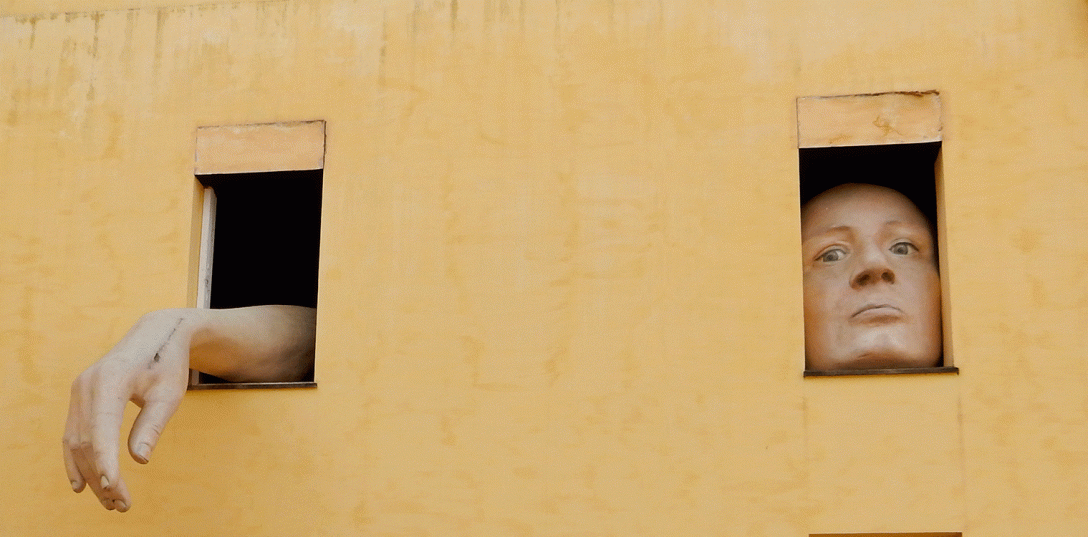
Postcards from Naples, Italy: Palazzo adapted to showcase contemporary art

Mimmo Paladino, 2006 rooftop installation at MADRE

The 19th-century Palazzo Donnaregina, referred to as “an example of historical stratification,” was purchased in 2005 by the Campania Regional Government for rehabilitation as a contemporary art museum. Much of the work was completed under the guidance of Alvaro Siza Veira, a Portuguese architect. By 2006, two floors of MADRE – Museo d’Arte Contemporanea Donnaregina – opened to the public. Daniel Buren’s brightly colored and illuminated installation in the entryway of MADRE sets the tone for the contemporary contents.

When we were there this past fall, there was an impressive exhibition of work, “Whisper Only To You,” by a South Korean artist, Yeesookyung. During her residency in Naples, she incorporated pieces of Capodimonte porcelain into the design of her large shapely vessels.

The master potter was trying to create the perfect piece each time, and he would discard even the ones with the slightest flaw. So I chose to create new forms from them, because perhaps, I don’t believe completely in that kind of perfection. To me, a piece of broken ceramic finds another piece, and they come to rely on one another. The cracks between them symbolise the wound.

Yeesookyung, interviewed in The Business Times, 2013

Postcard from Malaga, Spain: Centro de Arte Contemporaneo

Yet one more contribution to the explosion of art museums in Malaga, the Contemporary Art Museum opened in a spacious former wholesale market house in 2003.

Some of the works pictured are from the permanent collection; others are from a temporary exhibition open while we were there, “Make Something Different.” The show spotlights the resurfacing of Pop Art reinterpreted through the eyes of a new generation merging influences of “cartoons, animation, games, music, underground culture and advertising design.”

I had not realized the museum’s proximity to two enormous building-size murals pictured in the prior blog post on street art in Malaga was no mere coincidence. The poster above indicates that works by artists D’Face and Shepard Fairey – “managing quality dissent since 1989” – were featured in a two-person show in 2015. On his website, D’Face describes the luxury of large-scale:

Whoever said that size doesn’t matter? As an artist working in a world of image saturation through mass media, it’s always been important for me to make art that stands out from the crowd – nothing does that quite like a mural. From Los Angeles to Tokyo, every wall I’ve ever encountered presented a unique challenge, its own concrete personality. There’s nothing quite like stepping back from a wall you’ve had to do battle with for a week and seeing your vision come to life. They’re big, they’re bold and they’re downright badass….

Postcard from Sevilla, Spain: Contemporary art invigorates former Carthusian monastery

The giant “Alice” by Cristina Lucas is indeed stuck in a curiously odd place on the Isla de la Cartuja. Sevilla is bustling on one side of the Guadalquivir, but crossing the river on foot to this part of the island at first appears to be heading into somewhat of a remote no-man’s land.

For centuries, much of the clay for the city’s azulejos came from the island. In 1400, Archbishop Gonzalo de Mena chose the location for a Carthusian monastery. The founding of Monasterio de la Cartuja was in the nick of time to provide a suitable permanent home for the archbishop to rest, as he died in 1401. Christopher Columbus’ body was placed in the Capilla de Santa Ana from 1509 to 1536, but the archbishop’s tomb in the Capilla de la Magdalena Chapel is not the only one remaining within the ancient walls of the monastery.

Patrons of the monastic order, members of the Ribera family reside in sculpturally rich tombs dating from the 16th century and dominating the Sala Capitular. The 15th-century chapel with its colorful tiles serves a prime example of Mudejar architecture. Some of the bizarre images incorporated in the ornate motifs surrounding the tombs appear as though they emerged from the mind of someone who swilled some Wonderland “drink me” potion.

Government seizure of ecclesiastical property in 1836 left the monastery available. Englishman Charles Pickman rented and soon purchased the property to manufacture La Cartuja de Sevilla Pottery. Enormous brick chimneys erected there demonstrate both the size and modernity of the production facilities. In addition to tiles reflecting the city’s heritage, the facility produced mass-market earthenware dish patterns. A wall of rows of tiles serves as an outdoor “showroom” of sorts of the patterns available from La Cartuja.

The pottery factory still is in operation elsewhere in Seville, while the monastery and its grounds were refurbished when the city hosted the Universal Exhibition of 1992. Today the monastery is home to Centro Andaluz de Arte Contemporaneo.

Instead of turning left into “Argadedinam” or “Ebajodelaban” to explore the contemporary cultural center, it is wise to follow the right arrow on the whimsical directional sign. In addition to visual art, the café on the grounds is often a site for weekend jazz concerts.