I have tried to close the frontier between architecture and sculpture and to understand architecture as an art.
Santiago Calatrava
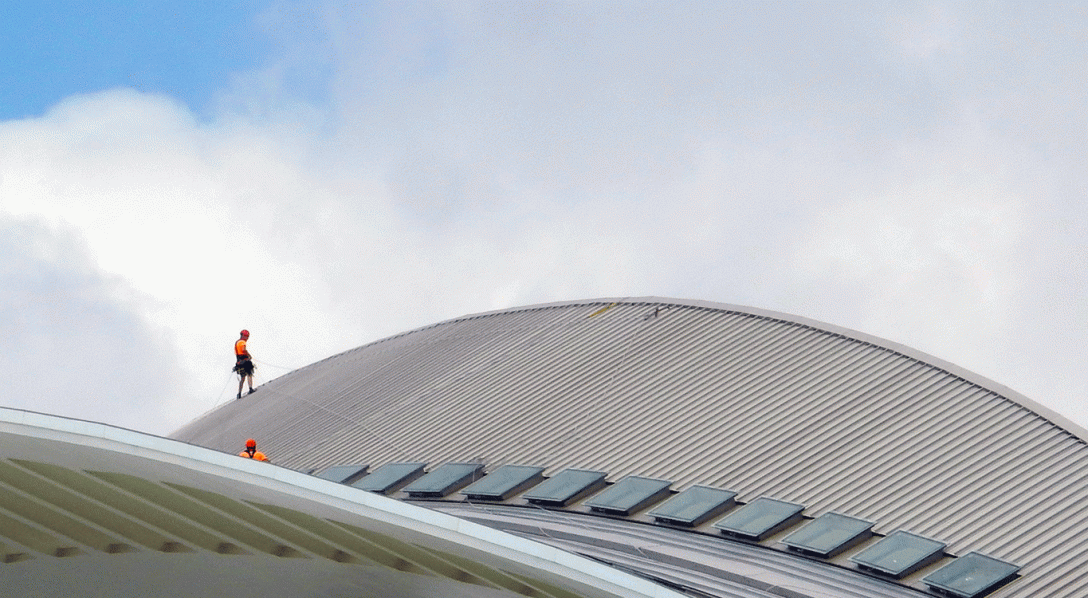
First we noticed window-washers dangling to clean midlevel glass on the enormous humpbacked Palau de les Arts Reina Sofia. Not a job meant for us. Then we spied another pair perched much higher, balancing on the peak of one of the topmost ridges of the opera house. Made the window-washer position appear a cakewalk.
We approached the opera house from below, walking along the pathways of a linear park stretching five miles through the heart of Valencia – Jardines del Turia. Wide enough to easily accommodate soccer fields and numerous tree-shaded bicycle and pedestrian trails, the park is sunken below street level in the former bed of the Turia River.
After more than 80 people lost their lives when the river sent floodwaters rushing through the city streets in 1957, engineers diverted the river Turin away from the center of town. What to do with the bed was debated for many years. Some wanted to pave it over to provide a quick route to the beach. Fortunately, those who wanted a park held the asphalt-lovers at bay (Does this sound familiar San Antonio?).
In the 1970s, the park was completed. Three decades later, the ample width of the riverbed provided a major opportunity for a massive economic development project on the east side of city. A Valencia-born architect and engineer, Santiago Calatrava, was selected by the city to design a string of contemporary public buildings on 90 acres of the river bed.

Príncipe Felipe Science Museum

Palau de les Arts Reina Sofia

Agora

L’Umbracle

Palau de les Arts Reina Sofia

Hemispheric Theater

Serreria Bridge

Serreria Bridge

maintenance workers atop Palau de les Arts Reina Sofia

L’Umbracle

Palau de les Arts Reina Sofia

Palau de les Arts Reina Sofia

Serreria Bridge

Príncipe Felipe Science Museum

Palau de les Arts Reina Sofia

Palau de les Arts Reina Sofia

Príncipe Felipe Science Museum

Hemispheric Theater

Ciudad de las Artes y de las Ciencias

Palau de les Arts Reina Sofia

Príncipe Felipe Science Museum

Serreria Bridge

Agora

Ciudad de las Artes y de las Ciencias

Hemispheric Theater
On an architect’s dream playground, Calatrava completed numerous monumental landmarks between 2005 and 2009, redefining the city of Valencia. These descriptions are from his website.
In recognition of the civic importance of the Opera House, Calatrava gave the building the iconographic character of a monumental sculpture. In form, the building is a series of apparently random volumes, which become unified through their enclosure within two symmetrical, cut-away concrete shells. These forms are crowned by a sweeping steel sheath, which projects axially from the entrance concourse out over the uppermost contours of the curvilinear envelope. The structure that results defines the identity of the Opera House, dramatically enhancing its symbolic and dynamic effect within the landscape, while offering protection to the terraces and facilities beneath.
http://calatrava.com/projects/palau-de-las-artes-valencia.html
The Opera House, Planetarium/IMAX Theater (Hemispheric Theater) and Príncipe Felipe Science Museum form a linear sequence from west to east. A fifth structure, known as L’Umbracle, is a promenade and parking garage, built within an open arcade that is a contemporary reinvention of the winter garden. A raised, axial walkway, offering views to the sea, serves as an ordering element, with gardens and reflecting pools on either side.
The Science Museum is a spatial tour de force, 104-meter wide and 241-meter long. Like the grand exhibition pavilions of the past, it is a longitudinal building, created from the modular development of transverse sections that repeat along the length of the site. Five concrete ‘trees,’ organized in a row, branch out to support the connection between roof and façade, on a scale that permits the integration of service cores and elevators….
The Planetarium/IMAX theater resembles a human eye, set within a 24,000 square meters pool. The ‘pupil’ is the hemispherical dome of the IMAX theater, which is transformed into a globe through its reflection in the pool. The concrete socket of the eye incorporates an ‘eyelid’ of vertical, articulated metal slats, which can be raised to permit views across the pool.
http://calatrava.com/projects/ciudad-de-las-artes-y-de-las-ciencias-valencia.html
Of course, those structures were not enough. Internationally known for his bridges, Calatrava added his second to the river – the Serreria Bridge. Almost 400 feet high, a curved pylon extends its harp-like “strings” across the former riverbed.
And wait, there’s more:
As Calatrava’s immense City of Arts and Sciences has taken shape, it became evident that the complex needs a multi-functional space, capable of accommodating large amount of audience and versatile enough to host various different types of events and activities. Calatrava therefore proposed the construction of a Agora on a site between the Sawmill Bridge and the City of Arts and Sciences’ Oceanographic building.
A diaphanous large hall, built of steel arches and a roof with glass will be crowned with a movable structure that controls the natural light and endows the otherwise horizontal building with a vertical component. This large hall will be raised slightly above the ground level. Underneath the large hall will be a lower level with seats of up to 6000 audiences as well as space for VIP rooms, dressing rooms, toilets, shops and in-house office facilities.
http://calatrava.com/projects/agora-ciudad-de-las-artes-y-las-ciencias-valencia.html
Sinful as this seems, we did not enter any of these structures. We were blocked from one or two undergoing repairs, and the higher-than-a-pyramid stairways mounting the sides of the science museum were closed (Darn?).
Instead, we skirted around and through the row of projects, soaking in their sculptural interactions with each other, the land, the cityscape and the sky.




 Postcards from Barton Springs