The Alamo: I’ve never been much of a fan of crewcuts

In light of current discussions focusing on the fate of Alamo Plaza (read Express-News article), thought this Alamobsessive blogger would take a shortcut to an earlier “crewcut” post. Based on the article, sure am a fan of President Sue Ann’s stand on behalf of the San Antonio Conservation Society.

“How would you feel about the Alamo with a crewcut?’ was posted in August of 2011:

The treatment of the Alamo on the frontispiece of San Antonio, a 1913 “Descriptive View Book in Colors” – a birthday present from a friend – caught my eye with its unusually frank acknowledgement of the major alteration of the facade of the former Mission San Antonio de Valero.
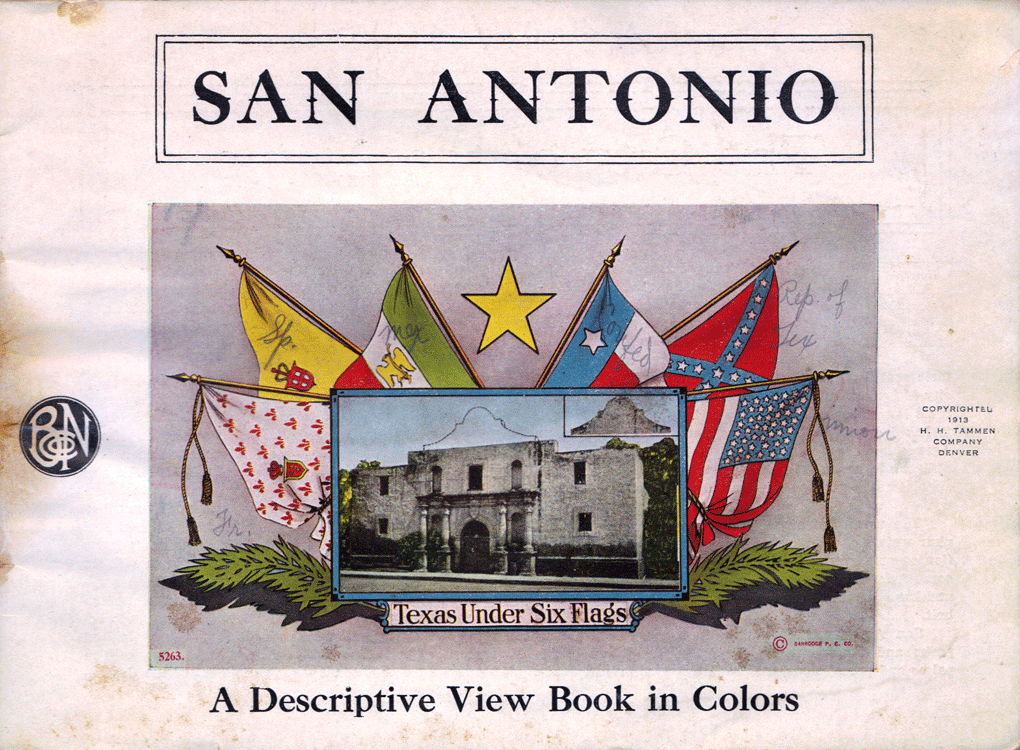
The frontispiece of this booklet showed the Alamo with the added architectural frontispiece removed.

The distinguished curving outline of the facade has become a symbol not only of the battle that took place there in 1836, but of the city itself. The widely replicated outline, commercialized into many a business logo, is recognized worldwide.

But the distinctive parapet was not part of the original church built nearly 300 years ago; nor was it there during the famous battle in 1836.

According to the Handbook of Texas Online, the curvilinear addition is thought to have been the brainchild of an architect and builder by the name of John M. Friese, who designed the Menger Hotel next door to the Alamo a few years later. Friese’s client was the United States Army, which was renting the former mission from the Catholic Church. The project fell under the supervision of Major Edwin Burr Babbitt, assistant quartermaster for the post. According to the Handbook, Major Babbitt actually wanted to tear the Alamo down and erect a completely new building. General Thomas S. Jesup vetoed that idea, fortunately for today’s tourism industry, and the parapet was added in 1850 as part of the adaptation of the building for the Army’s needs.

Through the years, many changes have taken place on the plaza in front of the Alamo, the plaza that was enclosed by crumbling mission walls at the time of the battle.

A group has emerged with plans to recapture those grounds from the city that has encroached upon them. The Texas History Center at Alamo Plaza, Inc., has developed elaborate presentations for what it calls the Alamo Restoration Project.

The stated goal of this proposed project is:

to enhance the visitor’s pilgrimage to the “Cradle of Texas Liberty” by providing a historic atmosphere for personal reflection, inspiration, and learning. We encourage people to seek out their heritage, explore the rich and diverse history of the region, and immerse themselves with the texture of the past.

While this sounds noble on the surface, there are some who think the part of this site’s “heritage” and “diverse history” that is more important than a lost battle might be its much earlier role as a mission outpost.

Another major issue is the problem of a historic landmark built atop of the original western wall of the mission compound. The handsome Crockett Block, designed by architect Alfred Giles, was built only 30 years after the Army added the parapet to the Alamo. The project’s plan is to simply move the massive building, as The Fairmount was relocated in 1985.

What would be left would be a huge open footprint of the grounds at the time of the 1836 battle, but what I see is hot. There are just not many days of the year where people are going to want to stand in the middle of a treeless, shadeless plaza contemplating the battle. Five minutes in the middle of the plaza on a day like today would be more than enough to make one pray for the return of the raspa vendors.

To accomplish this restoration project would mean major battles with not just the Daughters of the Republic of Texas but also with the yellow-hatted ladies of the Battle of Flowers Association, whose parade has a strong historical connection to Alamo Plaza.

While there are pictures on the group’s website showing the Alamo without the added parapet, there is nothing written online that I see calling for its removal. But, to be true to the group’s goals, it obviously should be.

Calling attention to the need for better treatment and interpretation of our most famous tourist site is worthwhile, but stripping the area back to the battle era seems extreme.

And, would San Antonians ever be willing to let go of that distinctive frontispiece for an Alamo with a crewcut? If nothing else above were, those seem like fighting words to me.
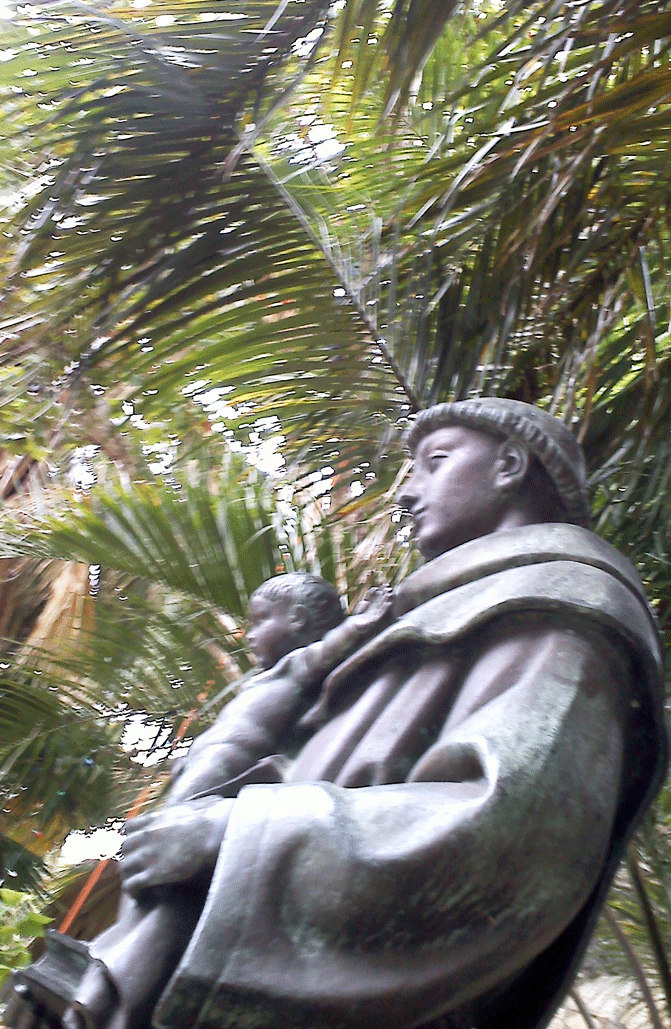
Sporting a San Anto medal just in case

Blessed be the eternal God; for the fishes of the sea honour him more than men without faith, and animals without reason listen to his word with greater attention than sinful heretics.

St. Anthony on the river

It is said that on that day, June 13, 2013, the fish gathered around him.

With great expectations, they gazed upward.

So many fish bobbed in the waters of the San Antonio River, barge traffic was halted.

The fish waited and waited to hear words of tribute. They waited for sounds of great celebration.

You probably think I am referring to the honkers, the ones who exuberantly circle the streets of downtown just above St. Anthony’s head whenever the Spurs are victorious.

Which they were not doing on June 13, the Feast Day of San Antonio de Padua, the patron saint of San Antonio.

Yes, the Spurs seemed lost. And, he, the patron saint of lost things, was all but ignored. Save by the fish.

St. Anthony, St. Anthony
Turn around.
I’ve lost something
That can’t be found.

Not everyone ignores St. Anthony.

What’s wrong with this video? It’s from Boston.

"Mission San Antonio de Valero Missing," digital collage by Gayle Brennan Spencer
“Mission San Antonio de Valero Missing,” digital collage by Gayle Brennan Spencer. Visit http://postscardssanantonio.com.

This festival does not take place here. In this city. In front of his mission.

St. Anthony is not vengeful. Surely the Spurs’ loss was mere coincidence. If saints interceded in sports, would St. Anthony have looked down more kindly on the team of his namesake city or the Celtics?

After all, here, in the heart of his city, we are in danger of losing even his mission. Mission San Antonio de Valero. But it’s rarely called by its proper name. You probably know it as the Alamo.

For a while, there was a spark of hope for an emerging celebration of our patron saint. An artist, Rolando Briseno, sought attention for the overlooked day on the calendar.

Flippin' San Antonio Fiesta 2011
Flippin’ San Antonio Fiesta 2011

He brought us a Flippin’ San Alamo Fiesta and a Flippin’ San Antonio Fiesta on June 13 a while back. An emerging grand Fiesta Patronal seemed on the horizon for future years.

But, alas, this year on the Feast Day of St. Anthony, the artist instead submitted a commentary to the San Antonio Express-News.

In this published piece, Briseno explains the rationale behind his earlier fiestas:

Tejanos, the first European/mestizo settlers of Texas and builders of the Alamo, and Latinos in general do not feel welcome at the Alamo today because the narrative has been spun into one of Anglo hegemony….

Little by little, over time, the Tejano role has been written out of the history books. Now that the Daughters of the Republic of Texas are no longer in control of the narrative at the Alamo, I’m among many who hope the Tejano contributions will be given just representation.

But Briseno has faith in the great state of Texas to rectify this, so there was no grand Fiesta Patronal:

I am not performing “Spinning San Antonio Fiesta” this year because Texas Land Commissioner Jerry Patterson, the new caretaker, has stated that he would like to change the Alamo’s narrative to be more inclusive.

This could make the Alamo a place where all people can go to leave behind discord and contemplate the convergence of cultures, and this, in turn, will make for a more harmonious future. That’s an ideal worth making a shrine for.

He’s right about the ideal. But I fear he is overly optimistic in his expectations of the commissioner.

There is much pressure building among the Alamobsessive to make Alamo Plaza a shrine to one day in history. And that day is not June 13.

Unlike Briseno, I fear that moment in 1836 will conquer the layers upon layers of history of great importance to our city that the plaza represents, both before and after the battle.

I’m not debating the historical importance of March 6, 1836, the Battle of the Alamo.

I’m not demeaning the sacrifices of those who perished in the battle, whether Mexicans or Texians. My dreams of Davy Crockett go way back.

And I do think millions who head to the plaza annually would benefit from better interpretation of that event on site.

But, I wonder whether the heroes of the day would want that moment in time frozen, the moment they were shot or impaled upon a bayonet.

If you were killed in a war, would you want those left behind to focus on the exact second the last drop of blood gushed from your body? Would you want them to visit that spot over and over and over, reliving your dramatic departure?

Or would you want them to remember what went on before, while you were alive?

And would you want to feel your sacrifice was worthwhile? Instead of being a static war memorial, would you want the plaza where you died returned to a place of life in the heart of a city filled with exuberant celebrations?

Briseno might be breathing easier, but I think it’s premature.

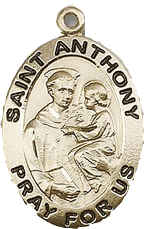
san-antoAs there is yet a Fiesta Patronal, I think some of us better don a St. Anthony medal if we want the story of Mission San Antonio de Valero to be found.

And, maybe, just maybe, it’s a good idea to go buy one before the play-off game tonight.

That way, at least the fish will hear honkers celebrating above St. Anthony’s head.

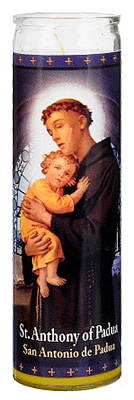
Go Spurs, Go!candle

Post-Game Update on June 19, 2013:

Maybe medals alone are not potent enough.

Time to ignite the power of a St. Anthony candle for Thursday night.

And, if we are not going to have a festival in his honor in San Antonio, I sure wish I could spend his feast day in his birthplace, Lisbon.

Pre-Game Update on June 20, 2013:

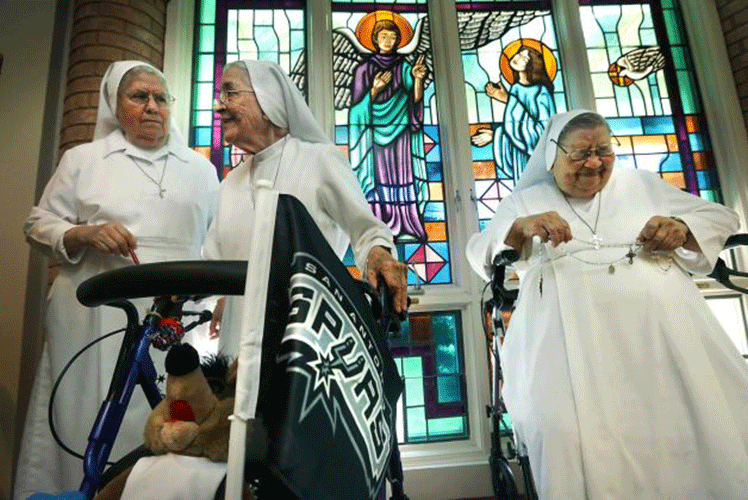
From “Nuns calling on the fan upstairs: For the naysayers who think Spurs don’t have a prayers” by Abe Levy in this morning’s San Antonio Express-News:

Would you deny the prayer of Sister Rosalba Garcia, 85?

A Spurs flag flutters from her walker next to a Spurs Coyote doll. On her closet door are team photos and a poster of her all-time favorite player, Manu Ginobili, next to a portrait of Sister Mary Mazzarello, the Salesians’ cofounder.

The photos accompanying this story are priceless.

Bob Owen photograph in San Antonio Express-News, June 20, 2013

Processing Art through Public Filters, Part Two

whitewashedOn the left side of the photo on the right is a wall.

The wall, prepped for painting, is not architecturally stunning.

In fact, one could say it is architecturally challenged.

Perhaps that is why the artist wanted to make a monkey out of it.

monkeyBut this building is located in the King William Historic District, and, according to the San Antonio Express-News, some of its residents evidently felt Robert Tatum’s Chi Chi Monkey made a mockery of the neighborhood.

tame-birdSo the artist came up with a rendering for a tame bird sporting a Tyrolean hat perched outside a gingerbready bird house, all nods to the characteristics of the neighborhood.

Some of the residents were happy.

But, upon further reflection, the artist was not.

He must have felt as though he had his wings clipped.

This tame bird is not representative of his art, and this bird house is on the outside wall of his office.

cuckoo-birdSo he transformed the bird into something more reflective of his style, more of a wild-eyed cuckoo bird too big-headed to fit into his house.

This bird looks much more like Tatum’s style, but some of the neighbors balked at the new one.

The frustrated artist told reporter Scott Huddleston it will be his prized bird or no bird at all.

The poor members of the Historic Design and Review Commission are left in the middle, stuck walking the tightrope between artistic integrity and the strict enforcement of guidelines of the historic district.

I’m rooting for the cuckoo.

Sometimes we take ourselves so seriously, we kill the spirit of things. “We” includes me. Sometimes.

I draw a rigid line in the sand when it comes to protecting sensitive areas, such as the Alamo Plaza Historic District. I’ve even gone so far as to label myself Alamobsessive about it.

But South Alamo in Southtown is not across from the Alamo. And this building is not nestled among stately residences.

It’s in more of the entertainment part of the neighborhood. People walking by the back side of this building are most likely on their way to art galleries or restaurants.

And this wall is not exactly in pedestrians’ faces. It is set way back from the sidewalk and street.

But what about its across-the-street neighbor? Well, that’s got to be about the most laid-back, relaxed place around – The Friendly Spot. The cartoonish cuckoo bird will fit right in and should delight the kids scampering over the Spot’s playscape while their parents gather with friends.

The photo below shows the current wall when viewed from the entrance of The Friendly Spot.

friendly-spot

You probably are thinking I posted the wrong photo. But no. That’s the proposed canvas, way back behind the red SUV, tucked unobtrusively between two buildings. If the bird’s features are not exaggerated, they won’t show up at all.

The tame version of the mural is like the Mission Drive-In, where the spirit of the original art was put in a straitjacket.

Art should reflect its creator. In this location, there seems no need to over-process it in the name of King William’s integrity.

Let that cuckoo bird fly free.

Update on March 7, 2013: Alas, Mr. Tatum, if you had only showed up at the HDRC meeting to plead your case and get a fair hearing, the cuckoo might be perched on your wall instead of caged in my blog.