Remembering everyday people: Our rural heritage merits attention

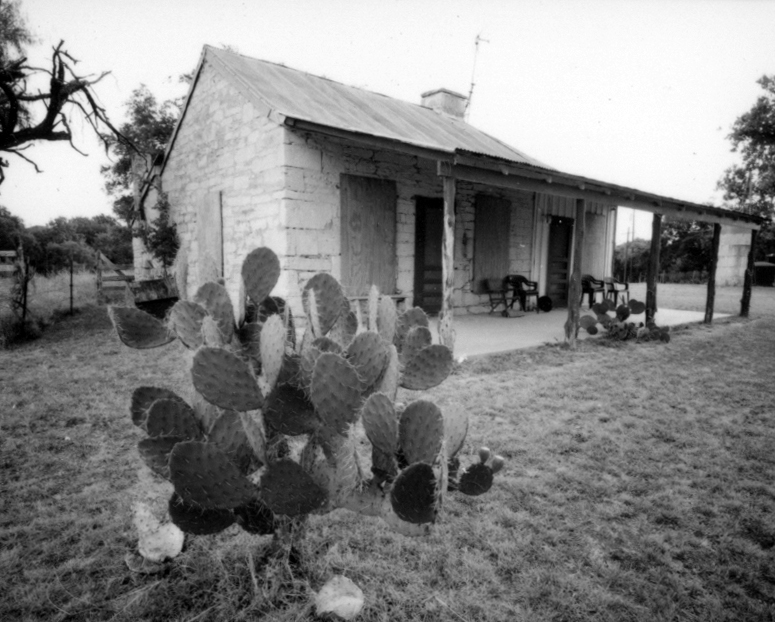
Photograph of the old rock house on the Voelcker Farm taken by Dudley Harris for "Last Farm Standing on Buttermilk Hill"
Photograph of the old rock house on the Voelcker Farm taken by Dudley Harris from “Last Farm Standing on Buttermilk Hill”

Max and Minnie Tomerlin Voelcker loved and fiercely protected their land from encroaching, encircling development swallowing up neighboring farms. The towering trees shading walkers in Phil Hardberger Park result from their stewardship.

Max and Minnie were not well-known in San Antonio, unless you were a frustrated real estate developer trying to court them. They were just plain, ordinary people. Like most of us.

Photograph by Dudley Harris of the Voelcker Dairy barn for "Last Farm Standing on Buttermilk Hill"
Photograph by Dudley Harris of the Voelcker Dairy barn from “Last Farm Standing on Buttermilk Hill”

What the retired dairy farmers never would have envisioned is that their old farm would end up safeguarded by the city that endangered it. The city’s Office of Historic Preservation has submitted a nomination to include the farmstead on the National Register of Historic Places, according to Preservation News:

The Max and Minnie Voelcker Dairy Farm, located in San Antonio’s Phil Hardberger Park, was nominated to the National Register of Historic Places this past spring. The farmstead exemplifies a turn-of-the-century agricultural landscape with preserved late nineteenth and early twentieth century buildings. The State Board of Review met on May 17, 2014, in Austin to review the application.  The Office of Historic Preservation (OHP) received a matching $10,000 Certified Local Government Grant to hire a consultant to prepare the nomination. The nomination assessment was prepared by Brandy Harris, M. Kelley Russell, Lila Knight, Ryan Fennell, Nesta Anderson, and Karissa Basse. The $10,000 grant was matched in-kind by the OHP through the execution of a survey in the West Sector Plan area of the city.  OHP staff members involved in the survey included Adriana Ziga, Kay Hindes, and OHP volunteer Brenda Laureano.  The nomination will now move forward to the National Park Service.

last-farm-coverI never met Max and Minnie but was offered the opportunity to delve into their lives deeply when retained by the Max and Minnie Tomerlin Voelcker Fund to tell their story. The resulting book, Last Farm Standing on Buttermilk Hill, in turn led me to even more concentrated involvement in the history of the dairy farms that surrounded the Voelcker Farm on San Antonio’s near north side.

As I struggle to uncover bits and pieces of the lives of their neighbors from the Coker Settlement resting beside them in the Coker Cemetery and weave them together into a new book for the Coker Cemetery Association, I am grateful for that introduction to Max and Minnie. Getting to know them and digging into the past of the Coker Settlement has given me incredible respect for the tough-skinned early residents farming on the outskirts of San Antonio.

Life was hard for those pioneering farmers, and it’s wonderful the Voelcker Farmstead has been spared as testimony of the city’s vanishing rural heritage.

deer
Coker Cemetery

Biannual roundup of what you are reading on this blog

You have done it again. No wonder I wander around flitting arbitrarily from subject to subject. My readers flit, too.

During the past year, you have remained as Alamobsessive as I, particularly focusing on the guns  Land Commissioner Jerry Patterson let be drawn in front of the Alamo. You joined me in remembering my father-in-law, George Spencer, and photographer Rick Hunter. You have demonstrated your interest in photography by two artists, Richard Nitschke and Sarah Brooke Lyons. You have let me take you traveling to San Miguel de Allende, and shown interest in the reign of Maximilian and Carlota in Mexico.

You refuse to let two old posts, one about David Sedaris’ “Nuit of the Living Dead” and one about Sandy Skoglund’s cheesy “Cocktail Party,” fade off of the top 12 list. It makes me particularly happy that you still show interest in the San Antonio Song and have given life to my true tale providing a ghost to inhabit Brackenridge Park.

The number in parentheses represents the rankings from six months ago:

  1. Please come and take them away from San Antonio, (1) 2013

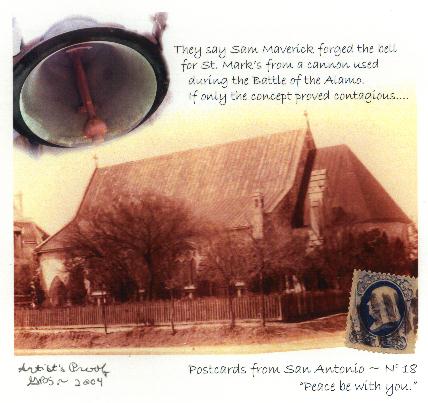
    “They say Sam Maverick forged the bell for St. Mark’s from a cannon used during the Battle of the Alamo. If only the concept proved contagious….” Postcards from San Antonio – No. 12, “Peace be with you.” http://postcardssanantonio.com/other-themes.html
  2. George Hutchings Spencer, 1923-2013 (3), 2013
  3. The State surrenders the Alamo; Run for Cover, (4) 2013
  4. Richard Nitschke: Seeing Agave in a Different Light, (8) 2013
  5. Please put this song on Tony’s pony, and make it ride away (10), 2010
  6. Sarah’s faces more than a thousand times better, (11) 2013
  7. The Madarasz Murder Mystery: Might Helen Haunt Brackenridge Park?, 2012
  8. “Nuit of the Living Dead” (9), 2010
  9. Postcard from San Miguel de Allende: Sun rises again at La Aurora, 2014
  10. The Tragic Rule of Maximilian and Carlota in Mexico, 2014
  11. Cheez Doodles as Art (12), 2011
  12. Rick Hunter lives here. And many other places., 2013

Thanks for hanging out here some and for giving me permission to keep on rambling on about whatever I’m currently pondering.

Visit those quiet little missions before the reenactors remember the Battle of Espada

One of the nicest features of the Mission Reach of the San Antonio River Improvements Project is that it invites you to visit the missions strung along the banks of the San Antonio River.

And not just the first two you normally take visitors from out of town to see before you get missioned-out and head for margaritas.

But the oft-overlooked San Juan Capistrano and San Francisco de la Espada, which, true confession, the Mister and I had not seen for at least two decades (but, true confession, not as long as it’s been since my last confession). Their histories easily can be found online, so I will not attempt to rewrite. This post is simply meant to entice you through pictures to rediscover what we tend to forget on the south side of town.

This slideshow requires JavaScript.

Mission San Juan Capistrano was founded in 1716, with much of the mission compound not completed until 1756. San Juan himself must of have been incredibly pious because he was governor of Perugia, the chocolate capital of Italy, before becoming a Franciscan. However, since chocolate came from the New World, maybe lording over Perugia around the year 1400 was not as flavorful as it would be today.

When the Mister and I made a mid-morning stop at the mission, the information center was staffed by a volunteer from the parish. What was wonderful was that he peopled the mission for us with his own ancestors, photographs of ancestors he did not realize had lived within the protective mission walls until seven years ago. Plus, he told us how a window at each of the missions is positioned to let illuminating rays of light shine on the statues of each one’s patron saint on the appropriate feast day. Clever calculations by the priests; miracles to the Native Americans they were converting.

The National Park Service seems proving a good steward of the grounds, and Father David has been applying the funds he has raised successfully through the nonprofit Old Spanish Missions to re-stucco the church for the first time in about 250 years. The church now gleams against the blue Texas sky. Unfortunately, the priest does not keep the same hours as the park, so we did not view the interior. Probably the most reliable time to view the interior is during a scheduled Mass, but I’ll probably stick with more random attempts.

Visiting Mission San Francisco de la Espada should become a more fashionable pilgrimage now with the popular Pope Francis in charge at the Vatican. More attention undoubtedly will be focused on Saint Francis, about whom I have written before in this blog. It would help if San Antonians, including myself, would incorporate the Francisco instead of shortening the name to Mission Espada.

Of course, if the National Park Service really wanted to market Espada to Texans, maybe the thrust of the story should change away from the agrarian and vocational skills the friars taught the inhabitants.

I mean, look at the Alamo. If you make it about guns, they will come, as Land Commissioner Patterson recently showed us.

If more people were aware of the battle fought there in October 1835, Espada would soon be mobbed.

The following is from a report submitted to General Austin by James Bowie and James Fannin following the battle, according to Wallace McKeehan on the Sons of Dewitt Colony Texas website:

Mission of Espadas, Saturday morning 7. oclk AM 24th octr 1835 Genl S F Austin Half an hour since we were attacked by the enmy, who were repulsed, after a few fires being exchanged Only a few men were seen-say about fifty-tho, from the dust etc. it is believed 200 or more, were in the company-Dr Archer says that Col. Ugartichea was the commandant, as he plainly saw him, and recognised him-The place is in a good condition, or can be made so in an hour, for defence, and until we know, of the advance of some aid, or what was intended by this feint, we will continue to occupy this station, where we have provisions enough for the army provided means are supplied to purchase….

If the Alamo attracts millions of visitors to a site where virtually all the Texians were slaughtered, wouldn’t people love to visit the spot where Bowie and Fannin were victorious?

Espada is the spot.

Visit it now. Before the word gets out. While it is still a peaceful place at the end of the Mission Reach.

A place to celebrate the Feast Day of St. Francis on October 4, perhaps even witnessing the rays of light illuminating his statue.

And well before reenactors decide they need to start shooting off noisy guns at 6:30 a.m. every October 24.

Update Added on August 12, 2014: As August 15th brings a solar illumination to Mission Conception in time for the Feast of the Assumption of Mary, an article in Today’s Catholic by Carol Baass Sowa sheds light on the phenomenon that would amaze Native Americans:

It was the Franciscan missionaries’ knowledge of astronomy, he related, that was responsible for the incorporation of solar illuminations in a number of their churches. They served to symbolically communicate the friars’ Catholic faith to the Native Americans, much as medieval churches used stained glass windows to tell the story of Christ and Gothic arches pointed upwards towards highly decorated ceilings to symbolize the heaven men should strive to attain.

Arriving in what was a wilderness, the Franciscan founders of Concepcion had little to work with, Father (David) Garcia explained, so they built into the church the symbols and signs that would tell the indigenous people about God and Christ. “They had a ray of sunshine come in and illuminate the sanctuary,” he said. It was a way to tell the native people “God is moving among us…..”

The friars were highly educated men, (George) Dawson explained, and the Catholic Church used churches as solar observatories since the 15th century as a means to figure out such things as when Easter fell. Also leading credence to the case for the Franciscans is research on the California missions, which has shown one or two Franciscan priests were in charge of construction for several of the missions there which feature the majority of the solar illuminations….

Mission Espada also has an illumination, he related. On the morning of Oct. 4, the Feast of St. Francis of Assisi, (the Franciscans’ founder), light from the rectangular window on the eastern wall bathes the statue of St. Francis on the altar in a golden glow. Again, there is a duplicate display on March 9, which happens to be the feast day of St. Frances, a woman mystic who died in the 1400s.