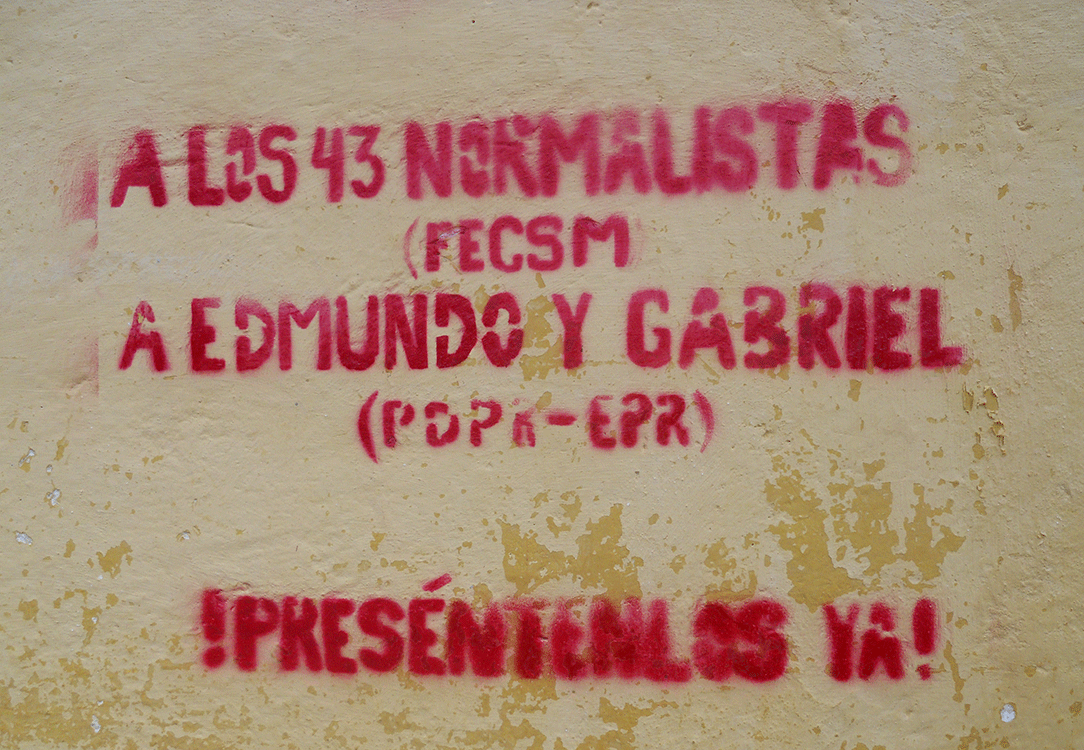
Postcard from San Cristobal de las Casas, Chiapas, Mexico: The Forty-Three

Forty-three. The number calls out from walls throughout downtown San Cristobal de las Casas.

And copies of their photographs leave their faces staring at you blankly as you wander near the zocolo at the heart of the city.

The desaparecidos, the missing students, may be from the State of Guerrero, but the sentiments of many of the young people studying to be teachers in this city appear to be with them.

City hall is heavily patrolled by well-armed soldiers during the day, but they check out for the night. On October 24, while the only guards were the janitors armed with mops, protesters took over city hall for the day. They also assumed control of the toll booths on the highway linking San Cristobal de las Casas and the state capital, Tuxtla Gutierrez.

This slideshow requires JavaScript.

Yesterday, the normalistas were back again, occupying city hall to call attention to the plight of their compadres.

The sit-in is peaceful. The protesters are unarmed. The blockade of the government offices is enforced by only a single string encircling the building.

Although the students could easily be overcome by force, the police and soldiers remain a distance away. There is no apparent desire to spark any confrontations. The students were allowed to express their concerns, with the everyday rhythms of the city expected to return today.
Biannual roundup of what you are reading on this blog

You have done it again. No wonder I wander around flitting arbitrarily from subject to subject. My readers flit, too.

During the past year, you have remained as Alamobsessive as I, particularly focusing on the guns  Land Commissioner Jerry Patterson let be drawn in front of the Alamo. You joined me in remembering my father-in-law, George Spencer, and photographer Rick Hunter. You have demonstrated your interest in photography by two artists, Richard Nitschke and Sarah Brooke Lyons. You have let me take you traveling to San Miguel de Allende, and shown interest in the reign of Maximilian and Carlota in Mexico.

You refuse to let two old posts, one about David Sedaris’ “Nuit of the Living Dead” and one about Sandy Skoglund’s cheesy “Cocktail Party,” fade off of the top 12 list. It makes me particularly happy that you still show interest in the San Antonio Song and have given life to my true tale providing a ghost to inhabit Brackenridge Park.

The number in parentheses represents the rankings from six months ago:

  1. Please come and take them away from San Antonio, (1) 2013

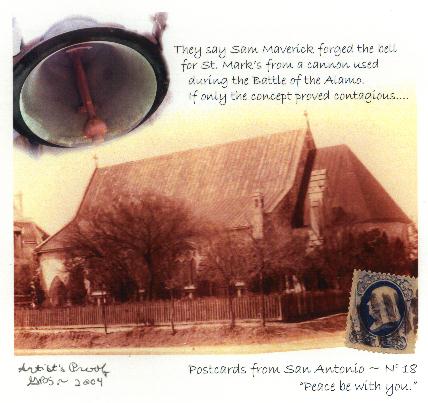
    “They say Sam Maverick forged the bell for St. Mark’s from a cannon used during the Battle of the Alamo. If only the concept proved contagious….” Postcards from San Antonio – No. 12, “Peace be with you.” http://postcardssanantonio.com/other-themes.html
  2. George Hutchings Spencer, 1923-2013 (3), 2013
  3. The State surrenders the Alamo; Run for Cover, (4) 2013
  4. Richard Nitschke: Seeing Agave in a Different Light, (8) 2013
  5. Please put this song on Tony’s pony, and make it ride away (10), 2010
  6. Sarah’s faces more than a thousand times better, (11) 2013
  7. The Madarasz Murder Mystery: Might Helen Haunt Brackenridge Park?, 2012
  8. “Nuit of the Living Dead” (9), 2010
  9. Postcard from San Miguel de Allende: Sun rises again at La Aurora, 2014
  10. The Tragic Rule of Maximilian and Carlota in Mexico, 2014
  11. Cheez Doodles as Art (12), 2011
  12. Rick Hunter lives here. And many other places., 2013

Thanks for hanging out here some and for giving me permission to keep on rambling on about whatever I’m currently pondering.

Postcards from San Miguel de Allende: Redirecting Grafitti Artists, Part Four

Part One, Part Two and Part Three

Some people see the arroyo of Obraje running through San Miguel de Allende as a squalid ditch, a place to dump household garbage when one fails to heed the bell of the municipal trucks collecting trash. It diverts floodwaters away from Colonia Guadalupe during the rainy season, but during the much longer dry season it serves as a shortcut for many, including children attending one of several schools bordering the arroyo. The area, well below street level, also is a magnet for those engaged in drug deals or other dangerous liaisons. And those armed with spray paint.

Former San Antonian Colleen Sorenson looks at the ditch and sees something different. She sees Paseo del Rio or pathways like those along the Mission Reach of the San Antonio River. The graffiti-covered walls of buildings backing up to the arroyo represent additional blank canvases for more constructive artistic expression. Muros en Blanco, ecologically concerned residents of San Miguel de Allende and city officials began meeting, and change is happening.

This slideshow requires JavaScript.

Bulldozers were clearing away debris in February, when these photos were taken.

According to an article by Antonio de Jesus Aguado in Attencion San Miguel, Edgar Bautista, head of the city’s Urban Development Department, said:

“The perspective is touristic…,” and it fulfills the development goals of the Millenium, the priorities of which are security, health and education. The idea is to turn the arroyo into a patio-garden within the city, a tourism corridor, “in other words, a park that would generate a new ecosystem as important as Parque Juarez.”

Colleen was working on another arts festival, but, in addition to the mural projects lining the arroyo, the event would involve the schools in Colonia Guadalupe and carry strong environmental messages to foster a spirit of community stewardship.

Looking forward to seeing the transformation next time we return….