San Antonio Book Festival: Lifting authors from book jackets into your Library

The quotes on the back of the book are from Dan Rather, Ken Burns, Jim Lehrer and Bob Schieffer. Pretty impressive for a story about a San Antonio family.

harnessmaker_cover_smThe lives of everyone are interesting, but most take their untold stories with them to their graves.

The Kallison family, however, was fortunate to count a Pulitzer Prize-winning journalist among its offspring – Nick Kotz. His book, The Harness Maker’s Dream: Nathan Kallison and the Rise of South Texas, was published by TCU Press in 2013.

The harness maker, who had emigrated to Chicago to escape persecution in the Ukraine in 1890, sensed the automobile would soon begin to dramatically impact his business. Nathan Kallison and his wife Anna were uncertain what direction to head until an older couple assured them that, in San Antonio, “the weather is mild, and there are more horses than people.” So, in 1899, the family moved to South Flores Street and opened a saddlery shop, increasingly expanding to cater to the diverse needs of South Texas farmers and ranchers.

As I struggle to encompass the families of the Coker Settlement into the confines of a book, I picked up Kotz’s book last week to see how someone who devoted years to honing his journalistic skills handles a regional story of one family while making it applicable to the experiences of others. Although I am not yet finished, the San Antonio Public Library Foundation is giving me the opportunity to hear from Kotz firsthand on Saturday.
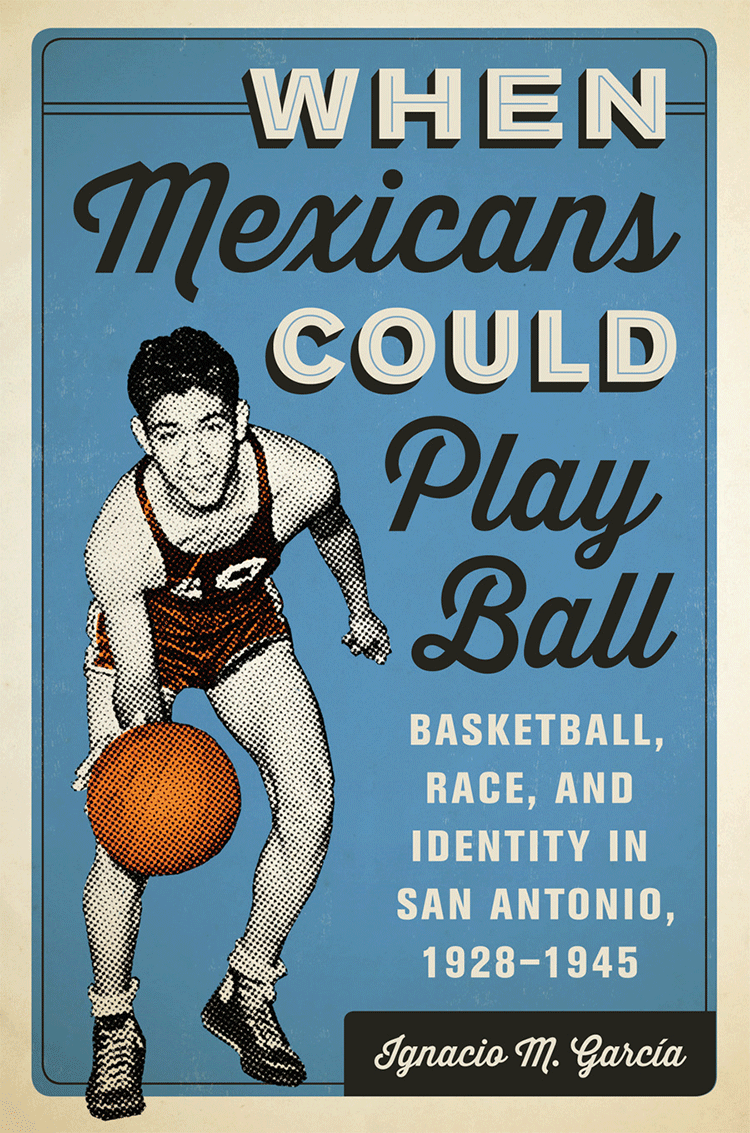
play-ballAs part of the San Antonio Book Festival, Kotz will appear on a panel with Ignacio Garcia, author of When Mexicans Could Play Ball: Basketball, Race and Identity in San Antonio, 1928-1945, with Gilbert Garcia of the San Antonio Express-News serving as their moderator. The topic they will discuss from noon to 1 p.m. in the Auditorium of the Central Library is Our Town: Stories that Shaped San Antonio.

More than 90 authors will be featured during the one-day Book Festival, and, amazingly, it’s admission-free. Decision-making about which sessions to attend is the dilemma. But this year, mapping out strategies is simplified by the user-friendly schedule on the Library Foundation’s website and a great free app. Go to Event Base in your app store; download it; then click on the “San Antonio Book Festival” tab.

Just happened to have written recently about two other authors appearing during the festival – Mary Margaret McAllen and Duncan Tonatiuh. And, from several years ago, a post about the wonderful tales Jake Silverstein spins in Nothing Happened and Then It Did.

And, although there is a small fee, the Literary Death Match sounds as though it should be a stimulating way to end the day. The Library Foundation website describes the event:

Literary Death Match marries the literary and performative aspects of Def Poetry Jam, rapier-witted quips of American Idol’s judging (without any meanness), and the ridiculousness and hilarity of Double Dare. Each episode of this competitive, humor-centric reading series features a thrilling mix of four famous and emerging authors (all representing a literary publication, press or concern — online, in print or live) who perform their most electric writing in seven minutes or less before a lively audience and a panel of three all-star judges.

After each pair of readings, the judges — focused on literary merit, performance and intangibles — take turns spouting hilarious, off-the-wall commentary about each story, then select their favorite to advance to the finals.The two finalists then compete in the Literary Death Match finale, which trades in the show’s literary sensibility for an absurd and comical climax to determine who takes home the Literary Death Match crown.

It may sound like a circus — and that’s half the point. Literary Death Match is passionate about inspecting new and innovative ways to present text off the page, and the most fascinating part about the LDM is how seriously attentive the audience is during each reading. We’ve called this the great literary ruse: an audacious and inviting title, a harebrained finale, but in-between the judging creates a relationship with the viewer as a judge themselves.
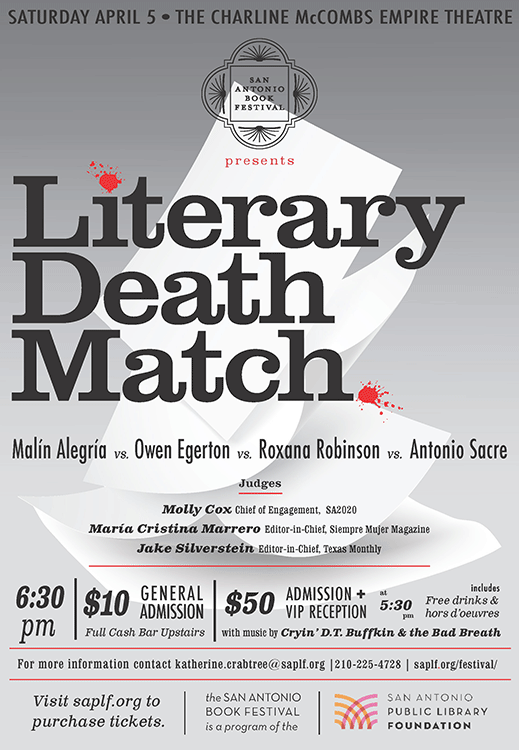
litarary-death-matchHey, when a musical group with a name like Cryin D.T. Buffkin and the Bad Breath performs, you know you don’t want to miss it.

Jimmie Draper: Rain, shine, sleet, heat

mariachi-festival

This post needs a soundtrack. Nothing would be more fitting than San Antonio high school students belting out mariachi music, so please play this while you read. For Jimmie.

1968. I think James Miller Draper, Jr., was there when the Paseo del Rio Association started, raising his hand to volunteer to do whatever it took to get attention for the River Walk.

It might be hard to imagine now, but the few businesses opening along the river were desperate. There were times when the only live things walking down the sidewalk in the heart of the river bend were pigeons. Things were so dull, there was even a night when some bored unnamed river operators shot fish. With guns.

Jimmie served as president of Paseo del Rio Association twice, in 1975 and 1984. But assumption of that responsibility is minor compared to his continual presence through thick and thin for more than four decades.

The coldest mornings in December always were the Fridays we placed luminarias along the river’s banks. Bob Buchanan made the coffee, and Jimmie brought the doughnuts. Without fail. For decades. Nancy Hunt, current executive director of Paseo del Rio Association, said that even last year Jimmie rode the bus downtown to deliver sweets to those delivering bags to the river’s banks.

No weather forecaster was more accurate than the first night of the annual Great Country River Festival the first weekend in February. Guaranteed sleet. Jimmie was always there.

The event closest to his heart always, though, was the Fiesta Mariachi Festival. It was his. I believe he was the first and only chair of the festival for more than 40 years. He threatened to retire one year. Paseo even threw him a party to recognize chairing the event 25 years or so. That just made him sentimental and mushy about the whole thing, so he kept coming back. Every year, he gave up four nights of Fiesta to meet the high school students boarding the barges. Without fail. Until this past year. Being 86 is a pretty good excuse for easing up a bit.

Generally Jimmie had the patience of Job. The time he really lost it, although not publicly, was at City Hall. The Paseo’s contract with the city in the late ’70s required we continually appear before Council to request approval for each event.

It should have been routine, but poor Mayor Lila Cockrell had a rather rowdy bunch to try to keep corralled. Those were colorful times.

I could almost see the hairs on the back of Jimmie’s neck bristle as a councilman went off on a rant about gringos being in charge of putting on a mariachi festival.

Then there was without a doubt the most incredible remark I ever heard at City Hall. Councilman Joe Webb interrupted the diatribe: “Mariachis. Cucarachas. What’s the difference? They’re all the same to me.”

Councilman Bernardo Eureste leapt to his feet and challenged Councilman Webb to duke it out. The scuffling councilmen went out in the hall to settle things, but were restrained before striking any serious blows.

Permission to stage the admission-free festival was granted, but, on the way out of City Hall, Jimmie said that was it. He would never go back there and be insulted like that again.

But he kept on volunteering again and again and again. Rain, shine, sleet, heat. No matter.

Gringo Jimmie might not have been known for shouting loud gritos in public, but, in those early years working with Belle San Miguel, his belief in bolstering the talents of young musicians gave fledgling programs in public schools a stage on which to shine. Before there were statewide competitions, the Mariachi Festival was the event inspiring students to strive for professionalism in their performances. Jimmie loved to see students board the barges, proudly wearing their festival medals from each year they had participated.

This spring will bring the 44th annual Fiesta Mariachi Festival. Jimmie was there for 42.

luminaria

Light a luminaria for Jimmie this holiday season. If it goes up in flame, it’s his unselfish and generous soul flying up to heaven.

Sporting a San Anto medal just in case

Blessed be the eternal God; for the fishes of the sea honour him more than men without faith, and animals without reason listen to his word with greater attention than sinful heretics.

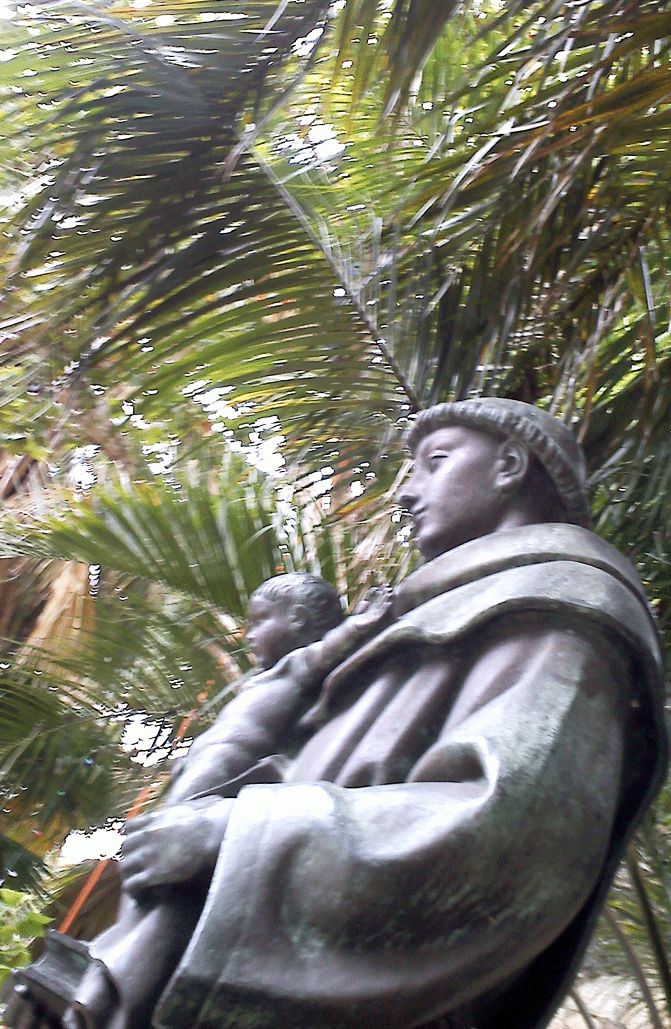
St. Anthony on the river

It is said that on that day, June 13, 2013, the fish gathered around him.

With great expectations, they gazed upward.

So many fish bobbed in the waters of the San Antonio River, barge traffic was halted.

The fish waited and waited to hear words of tribute. They waited for sounds of great celebration.

You probably think I am referring to the honkers, the ones who exuberantly circle the streets of downtown just above St. Anthony’s head whenever the Spurs are victorious.

Which they were not doing on June 13, the Feast Day of San Antonio de Padua, the patron saint of San Antonio.

Yes, the Spurs seemed lost. And, he, the patron saint of lost things, was all but ignored. Save by the fish.

St. Anthony, St. Anthony
Turn around.
I’ve lost something
That can’t be found.

Not everyone ignores St. Anthony.

What’s wrong with this video? It’s from Boston.

"Mission San Antonio de Valero Missing," digital collage by Gayle Brennan Spencer
“Mission San Antonio de Valero Missing,” digital collage by Gayle Brennan Spencer. Visit http://postscardssanantonio.com.

This festival does not take place here. In this city. In front of his mission.

St. Anthony is not vengeful. Surely the Spurs’ loss was mere coincidence. If saints interceded in sports, would St. Anthony have looked down more kindly on the team of his namesake city or the Celtics?

After all, here, in the heart of his city, we are in danger of losing even his mission. Mission San Antonio de Valero. But it’s rarely called by its proper name. You probably know it as the Alamo.

For a while, there was a spark of hope for an emerging celebration of our patron saint. An artist, Rolando Briseno, sought attention for the overlooked day on the calendar.

Flippin' San Antonio Fiesta 2011
Flippin’ San Antonio Fiesta 2011

He brought us a Flippin’ San Alamo Fiesta and a Flippin’ San Antonio Fiesta on June 13 a while back. An emerging grand Fiesta Patronal seemed on the horizon for future years.

But, alas, this year on the Feast Day of St. Anthony, the artist instead submitted a commentary to the San Antonio Express-News.

In this published piece, Briseno explains the rationale behind his earlier fiestas:

Tejanos, the first European/mestizo settlers of Texas and builders of the Alamo, and Latinos in general do not feel welcome at the Alamo today because the narrative has been spun into one of Anglo hegemony….

Little by little, over time, the Tejano role has been written out of the history books. Now that the Daughters of the Republic of Texas are no longer in control of the narrative at the Alamo, I’m among many who hope the Tejano contributions will be given just representation.

But Briseno has faith in the great state of Texas to rectify this, so there was no grand Fiesta Patronal:

I am not performing “Spinning San Antonio Fiesta” this year because Texas Land Commissioner Jerry Patterson, the new caretaker, has stated that he would like to change the Alamo’s narrative to be more inclusive.

This could make the Alamo a place where all people can go to leave behind discord and contemplate the convergence of cultures, and this, in turn, will make for a more harmonious future. That’s an ideal worth making a shrine for.

He’s right about the ideal. But I fear he is overly optimistic in his expectations of the commissioner.

There is much pressure building among the Alamobsessive to make Alamo Plaza a shrine to one day in history. And that day is not June 13.

Unlike Briseno, I fear that moment in 1836 will conquer the layers upon layers of history of great importance to our city that the plaza represents, both before and after the battle.

I’m not debating the historical importance of March 6, 1836, the Battle of the Alamo.

I’m not demeaning the sacrifices of those who perished in the battle, whether Mexicans or Texians. My dreams of Davy Crockett go way back.

And I do think millions who head to the plaza annually would benefit from better interpretation of that event on site.

But, I wonder whether the heroes of the day would want that moment in time frozen, the moment they were shot or impaled upon a bayonet.

If you were killed in a war, would you want those left behind to focus on the exact second the last drop of blood gushed from your body? Would you want them to visit that spot over and over and over, reliving your dramatic departure?

Or would you want them to remember what went on before, while you were alive?

And would you want to feel your sacrifice was worthwhile? Instead of being a static war memorial, would you want the plaza where you died returned to a place of life in the heart of a city filled with exuberant celebrations?

Briseno might be breathing easier, but I think it’s premature.

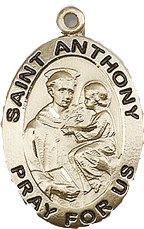
san-antoAs there is yet a Fiesta Patronal, I think some of us better don a St. Anthony medal if we want the story of Mission San Antonio de Valero to be found.

And, maybe, just maybe, it’s a good idea to go buy one before the play-off game tonight.

That way, at least the fish will hear honkers celebrating above St. Anthony’s head.

Go Spurs, Go!candle

Post-Game Update on June 19, 2013:

Maybe medals alone are not potent enough.

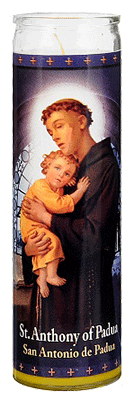
Time to ignite the power of a St. Anthony candle for Thursday night.

And, if we are not going to have a festival in his honor in San Antonio, I sure wish I could spend his feast day in his birthplace, Lisbon.

Pre-Game Update on June 20, 2013:

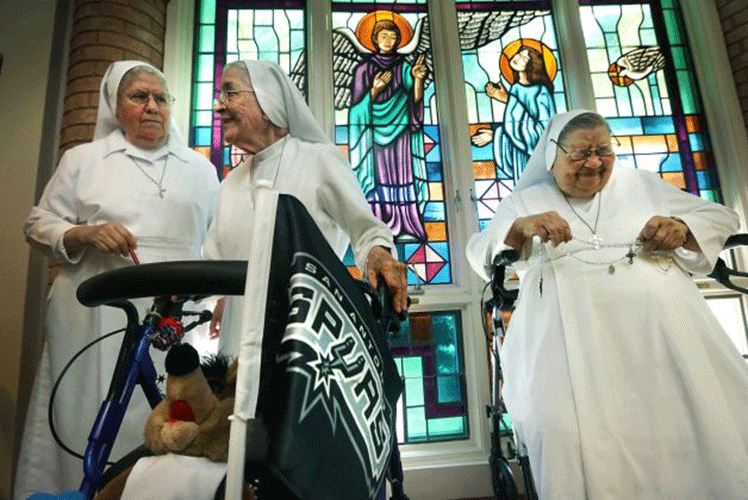
From “Nuns calling on the fan upstairs: For the naysayers who think Spurs don’t have a prayers” by Abe Levy in this morning’s San Antonio Express-News:

Would you deny the prayer of Sister Rosalba Garcia, 85?

A Spurs flag flutters from her walker next to a Spurs Coyote doll. On her closet door are team photos and a poster of her all-time favorite player, Manu Ginobili, next to a portrait of Sister Mary Mazzarello, the Salesians’ cofounder.

The photos accompanying this story are priceless.

Bob Owen photograph in San Antonio Express-News, June 20, 2013