Justin Boyd: Squeezing a year’s worth of river meanderings neatly into a box

Sergio Gonzales and Randy Allee of KLRN on location filming Justin Boyd
Sergio Gonzales and Randy Allee of KLRN on location filming Justin Boyd

The river is an amazing resource.

Justin Boyd

How do you take the essence of something as sweeping as the Mission Reach of the San Antonio River and compress it into a to-go size box?

Artist Justin Boyd does this in a multimedia format incorporating sound and video recordings and natural and manmade found objects in “Days and Days,” an exhibit on display through February 10 at the Southwest School of Art.

Although not as immense as trying to condense a broad landscape into a small box in a gallery, I struggled with adjusting my writing style to a television format in collaborating with the crew at KLRN-TV for this piece for ARTS. Whittling and weaving Justin’s dialogue into a story presented difficult and complicated choices for me, and, in turn, for David Bibbs at KLRN.

Here’s the result on ARTS | January 18, 2013 on PBS.

Although our paths never had crossed, Justin and I walk the same stretch of river often. But he has added new layers to my thoughts – the river representing time and its passage – as I meander southward along the river’s banks.

While celebrating the restoration of the Mission Reach as part of the San Antonio Improvements Project, Justin’s art is conscious of the litter man continually discards:

The impact we have as humans on the landscape…. This impact is so heavy…. Manmade objects are sitting right next to natural objects….

When you are down here everyday, you can’t help but reflect on how we are affecting our landscape.

January 28, 2013, Update:

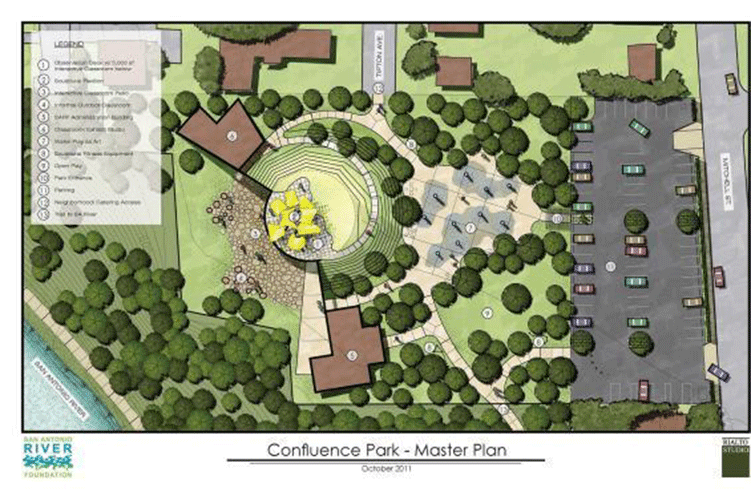
The photo above was shot at the point where the waters of San Pedro Creek (left) join the San Antonio River. The San Antonio River Foundation recently announced, according to the San Antonio Express-News, the commission of a pair of designers from the firm of Ball-Nogues Studio to design amenities for this point, to be known as Confluence Park:

With vague hopes of developing “some type of gathering place for the community,” the foundation spent about $300,000 on the park site several years ago and deeded it to SARA, said foundation executive director Estela Avery, wife of James Avery.

Plans gathered steam late last year, after Ball-Nogues Studio was invited to offer designs. The award-winning studio has created installations around the world that meld art and function, including works in California, New York, France, Italy and Hong Kong.

In recent months, designers Benjamin Ball and Gaston Nogues have collaborated with local water experts, botanists and others to create tentative concepts for the site at 310  W. Mitchell St.

“We’re working with an idea for a pavilion that will be enshrouded in vegetation, that’s also three windmills,” Ball said.

“We also have some features we’re calling ribbons, which are a man-made geology for the site. We’re trying to create some sense of discovery when you’re moving through the site so that you’re creating different vistas, different moments,” he said.

Added Nogues, “There’s going to be quite an extensive rainwater catchment system, which is going to mimic a cistern.”

Nogues appreciates the river restoration, noting that the Los Angeles River “suffered a similar fate” as the San Antonio River when its natural channel was lined with concrete decades ago. Most concrete has been removed here in the past few years during the river’s ecosystem restoration.

“It’s really an inspiration for what the Los Angeles River could become as  well,” Nogues said.

Foundation interim project manager Stuart Allen said design details are pending, but the park’s purpose is firm.

“We want this park to be a really unusual destination,” Allen said.

“It’s going to be a park geared toward teaching about ecosystems, sustainable living, water transport mechanisms and watersheds. The park will be designed around forms that collect water and direct them to an underground cistern. The water will be recirculated back into the park.”
confluence-parkl

Fundraising received a major boost from a gift of $1 million for an educational endowment fund from James and Estela Avery.

January 31, 2013, Update: Nancy Cook-Monroe writes about Confluence Park and the announcement of the Avery gift to the River Foundation:

This one, with a water catchment system, solar panels and windmills, will be all about teaching sustainability, stewardship and environmental science. Its centerpiece will be an artistically designed educational pavilion. Other elements will be laced with double meanings, such as a “foraging fence.”

“It doesn’t keep neighbors out but invites them to enjoy decorative and  edible plants,” said planning architect Gaston Nogues of Ball-Nogues Studio in Los Angeles.
 

Sam Maverick’s bell is still there. Melt more guns.

stmarkstemp

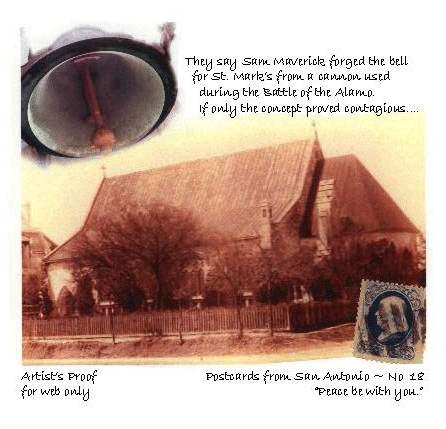
Don’t know why I have been so worried. But every time I pedaled by St. Mark’s Episcopal Church while it was undergoing renovation, I fretted the bell would disappear when the scaffolding was removed. The bell and an old image of the church inspired me to make “Peace be with you” in 2005.

Hanging in an arch on Jefferson Street, the bell’s past was not peaceful. Legend says it saw service during the Battle of the Alamo. According to the church’s website:

The church bell was cast from a bronze cannon found buried near the Alamo on the grounds of the home of founding members Samuel and Mary A. Maverick.

Abe Levy writes in the San Antonio Express-News the completion of work on the sanctuary will be celebrated on February 3:

St. Mark’s Episcopal Church has had a storied past with the likes of Robert E. Lee among its flock, and Lyndon Johnson marrying Lady Bird inside its native limestone walls.

Among the city’s oldest Protestant churches, it is a downtown landmark with a rich history, especially for generations of Episcopalians.

After 15 years of studying plans and raising money for a campus-wide  restoration, St. Mark’s is celebrating its $15 million overhaul. Its most recent phase is a $2.6 million facelift of its sanctuary, originally completed in 1875….

Established in 1858, St. Mark’s is considered the flagship congregation of the Episcopal Diocese of West Texas, producing many bishops through the years and lending the most financial support to diocesan operations among the diocese’s 90 congregations in South Central Texas….

Led by architecture firm Ford, Powell & Carson, renovation work included repositioning the altar to face the congregation. Care was taken to use original colors in plastering and paint, said Father Mike  Chalk, rector.

“We took our history very seriously,” he said. “We went back to early pictures of the building, and as we did the restoration, we noticed some colors associated with the original colors of the building…. We’re really trying to  reclaim the beauty of the building.”

The entire project was aimed to enhance the original architecture by the celebrated Richard Upjohn, who designed Trinity Church on Wall Street. St. Mark’s is a rare example of Upjohn’s work west of  the Mississippi River and is believed to be his only design in San Antonio.

From my print:

They say Sam Maverick forged the bell for St. Mark’s from a cannon used during the Battle of the Alamo.

If only the concept proved contagious….

That bell means a lot to me.

As I pedal by, often with the melody of some ancient hymn echoing in my mind from the carillon at St. John’s Lutheran Church, I wonder how all those semiautomatic assault rifles would sound ringing in church towers throughout the country.

Certainly a lot better than the sound of parents crying.

Note: Apologies for such a low-resolution image. Many of my print images temporarily are trapped in my old computer. My website is also in transition and in somewhat of a state of decomposition, but “peace” is there, albeit in equally low resolution.

Biannual survey of what you are reading on my blog

If blogging truly is my therapy, it’s amazing I have not been hospitalized this past year. My posts are few and far apart.

Yet some of my recent posts have crept up into the top dozen for 2012. Other favorites refuse to budge from the list, particularly Charles Elmer Doolin’s invention of Cheez Doodles turned into art. The number in parentheses represents the rankings from six months ago.

  1. Cheez Doodles as Art (1), posted on January 8, 2011
  2. Breaking news from the Alamo: The horse is already out of the barn, posted on August 18, 2012
  3. “Nuit of the Living Dead” (3), posted on October 30, 2010
  4. Return to the Alamo: Please don’t gag the Daughters (Whose side am I on anyway?), posted on July 29, 2012
  5. Haunting the graveyard to unearth the past (6), posted on April 4, 2012
  6. Please put this song on Tony’s pony, and make it ride away(8), posted on July 25, 2010
  7. Susan Toomey Frost stimulates a second revival of San Antonio’s traditional tilework (4), posted on June 24, 2011
  8. Concrete Artisans Leaving Lasting Imprint in San Antonio (9), posted on January 7, 2012
  9. The Madarasz murder mystery: Might Helen haunt Brackenridge Park?, posted on August 4, 2012
  10. Ban the Banner (11), posted on August 8, 2010
  11. Ribbons of Gaudi-inspired steel ripple above the river (5), posted on July 6, 2011
  12. Grandma’s rusks refuse to be rushed, posted on February 9, 2012

Thanks for following, and am hoping to be more faithful in my postings in the months ahead.

Although maybe my readers are happy not to hear from me quite so often…